 Add to Chrome
 Add to Firefox
 Add to Edge
SemiSAM-O1: How far can we push the boundary of annotation-efficient medical image segmentation?
Apr 27, 2026
Semi-supervised learning (SSL) has become a promising solution to alleviate the annotation burden of deep learning-based medical image segmentation models. While recent advances in foundation model-driven SSL have pushed the boundary to extremely limited annotation scenarios, they fail to maintain robust competitive performance in complex imaging modalities. In this paper, we propose SemiSAM-O1, an annotation-efficient framework using only one annotated template image for segmentation. SemiSAM-O1 extends the specialist-generalist collaborative learning framework to the extreme one-label setting by fully exploiting the foundation model's feature representation capability beyond its prompting interface. SemiSAM-O1 operates in two stages. In the first stage, the foundation model's encoder extracts dense features from all volumes, and class prototypes derived from the single annotated template are propagated to the unlabeled pool via feature similarity to produce coarse initial pseudo-labels. In the second stage, an iterative training-and-refinement loop progressively improves both the segmentation model and the pseudo-labels over multiple rounds, where each round trains the model from scratch on current pseudo-labels and generates updated predictions with voxel-wise uncertainty estimates. An uncertainty-guided refinement step further leverages the foundation model's global feature space to correct high-uncertainty regions by aggregating labels from their most similar confident neighbors, establishing a virtuous cycle of mutual improvement. Extensive experiments on a wide range of segmentation tasks across different modalities and anatomical targets demonstrate that SemiSAM-O1 significantly narrows the performance gap between one-label semi-supervised learning and full supervision, while significantly reducing the computational overhead of online foundation model inference.

Developing Foundation Models for Universal Segmentation from 3D Whole-Body Positron Emission Tomography
Mar 12, 2026Positron emission tomography (PET) is a key nuclear medicine imaging modality that visualizes radiotracer distributions to quantify in vivo physiological and metabolic processes, playing an irreplaceable role in disease management. Despite its clinical importance, the development of deep learning models for quantitative PET image analysis remains severely limited, driven by both the inherent segmentation challenge from PET's paucity of anatomical contrast and the high costs of data acquisition and annotation. To bridge this gap, we develop generalist foundational models for universal segmentation from 3D whole-body PET imaging. We first build the largest and most comprehensive PET dataset to date, comprising 11041 3D whole-body PET scans with 59831 segmentation masks for model development. Based on this dataset, we present SegAnyPET, an innovative foundational model with general-purpose applicability to diverse segmentation tasks. Built on a 3D architecture with a prompt engineering strategy for mask generation, SegAnyPET enables universal and scalable organ and lesion segmentation, supports efficient human correction with minimal effort, and enables a clinical human-in-the-loop workflow. Extensive evaluations on multi-center, multi-tracer, multi-disease datasets demonstrate that SegAnyPET achieves strong zero-shot performance across a wide range of segmentation tasks, highlighting its potential to advance the clinical applications of molecular imaging.
PET-F2I: A Comprehensive Benchmark and Parameter-Efficient Fine-Tuning of LLMs for PET/CT Report Impression Generation
Mar 11, 2026PET/CT imaging is pivotal in oncology and nuclear medicine, yet summarizing complex findings into precise diagnostic impressions is labor-intensive. While LLMs have shown promise in medical text generation, their capability in the highly specialized domain of PET/CT remains underexplored. We introduce PET-F2I-41K (PET Findings-to-Impression Benchmark), a large-scale benchmark for PET/CT impression generation using LLMs, constructed from over 41k real-world reports. Using PET-F2I-41K, we conduct a comprehensive evaluation of 27 models across proprietary frontier LLMs, open-source generalist models, and medical-domain LLMs, and we develop a domain-adapted 7B model (PET-F2I-7B) fine-tuned from Qwen2.5-7B-Instruct via LoRA. Beyond standard NLG metrics (e.g., BLEU-4, ROUGE-L, BERTScore), we propose three clinically grounded metrics - Entity Coverage Rate (ECR), Uncovered Entity Rate (UER), and Factual Consistency Rate (FCR) - to assess diagnostic completeness and factual reliability. Experiments reveal that neither frontier nor medical-domain LLMs perform adequately in zero-shot settings. In contrast, PET-F2I-7B achieves substantial gains (e.g., 0.708 BLEU-4) and a 3.0x improvement in entity coverage over the strongest baseline, while offering advantages in cost, latency, and privacy. Beyond this modeling contribution, PET-F2I-41K establishes a standardized evaluation framework to accelerate the development of reliable and clinically deployable reporting systems for PET/CT.
Uncovering Modality Discrepancy and Generalization Illusion for General-Purpose 3D Medical Segmentation
Feb 07, 2026While emerging 3D medical foundation models are envisioned as versatile tools with offer general-purpose capabilities, their validation remains largely confined to regional and structural imaging, leaving a significant modality discrepancy unexplored. To provide a rigorous and objective assessment, we curate the UMD dataset comprising 490 whole-body PET/CT and 464 whole-body PET/MRI scans ($\sim$675k 2D images, $\sim$12k 3D organ annotations) and conduct a thorough and comprehensive evaluation of representative 3D segmentation foundation models. Through intra-subject controlled comparisons of paired scans, we isolate imaging modality as the primary independent variable to evaluate model robustness in real-world applications. Our evaluation reveals a stark discrepancy between literature-reported benchmarks and real-world efficacy, particularly when transitioning from structural to functional domains. Such systemic failures underscore that current 3D foundation models are far from achieving truly general-purpose status, necessitating a paradigm shift toward multi-modal training and evaluation to bridge the gap between idealized benchmarking and comprehensive clinical utility. This dataset and analysis establish a foundational cornerstone for future research to develop truly modality-agnostic medical foundation models.
Future Optical Flow Prediction Improves Robot Control & Video Generation
Jan 15, 2026Future motion representations, such as optical flow, offer immense value for control and generative tasks. However, forecasting generalizable spatially dense motion representations remains a key challenge, and learning such forecasting from noisy, real-world data remains relatively unexplored. We introduce FOFPred, a novel language-conditioned optical flow forecasting model featuring a unified Vision-Language Model (VLM) and Diffusion architecture. This unique combination enables strong multimodal reasoning with pixel-level generative fidelity for future motion prediction. Our model is trained on web-scale human activity data-a highly scalable but unstructured source. To extract meaningful signals from this noisy video-caption data, we employ crucial data preprocessing techniques and our unified architecture with strong image pretraining. The resulting trained model is then extended to tackle two distinct downstream tasks in control and generation. Evaluations across robotic manipulation and video generation under language-driven settings establish the cross-domain versatility of FOFPred, confirming the value of a unified VLM-Diffusion architecture and scalable learning from diverse web data for future optical flow prediction.
Enabling Ultra-Fast Cardiovascular Imaging Across Heterogeneous Clinical Environments with a Generalist Foundation Model and Multimodal Database
Dec 25, 2025Multimodal cardiovascular magnetic resonance (CMR) imaging provides comprehensive and non-invasive insights into cardiovascular disease (CVD) diagnosis and underlying mechanisms. Despite decades of advancements, its widespread clinical adoption remains constrained by prolonged scan times and heterogeneity across medical environments. This underscores the urgent need for a generalist reconstruction foundation model for ultra-fast CMR imaging, one capable of adapting across diverse imaging scenarios and serving as the essential substrate for all downstream analyses. To enable this goal, we curate MMCMR-427K, the largest and most comprehensive multimodal CMR k-space database to date, comprising 427,465 multi-coil k-space data paired with structured metadata across 13 international centers, 12 CMR modalities, 15 scanners, and 17 CVD categories in populations across three continents. Building on this unprecedented resource, we introduce CardioMM, a generalist reconstruction foundation model capable of dynamically adapting to heterogeneous fast CMR imaging scenarios. CardioMM unifies semantic contextual understanding with physics-informed data consistency to deliver robust reconstructions across varied scanners, protocols, and patient presentations. Comprehensive evaluations demonstrate that CardioMM achieves state-of-the-art performance in the internal centers and exhibits strong zero-shot generalization to unseen external settings. Even at imaging acceleration up to 24x, CardioMM reliably preserves key cardiac phenotypes, quantitative myocardial biomarkers, and diagnostic image quality, enabling a substantial increase in CMR examination throughput without compromising clinical integrity. Together, our open-access MMCMR-427K database and CardioMM framework establish a scalable pathway toward high-throughput, high-quality, and clinically accessible cardiovascular imaging.
Robotic VLA Benefits from Joint Learning with Motion Image Diffusion
Dec 19, 2025Vision-Language-Action (VLA) models have achieved remarkable progress in robotic manipulation by mapping multimodal observations and instructions directly to actions. However, they typically mimic expert trajectories without predictive motion reasoning, which limits their ability to reason about what actions to take. To address this limitation, we propose joint learning with motion image diffusion, a novel strategy that enhances VLA models with motion reasoning capabilities. Our method extends the VLA architecture with a dual-head design: while the action head predicts action chunks as in vanilla VLAs, an additional motion head, implemented as a Diffusion Transformer (DiT), predicts optical-flow-based motion images that capture future dynamics. The two heads are trained jointly, enabling the shared VLM backbone to learn representations that couple robot control with motion knowledge. This joint learning builds temporally coherent and physically grounded representations without modifying the inference pathway of standard VLAs, thereby maintaining test-time latency. Experiments in both simulation and real-world environments demonstrate that joint learning with motion image diffusion improves the success rate of pi-series VLAs to 97.5% on the LIBERO benchmark and 58.0% on the RoboTwin benchmark, yielding a 23% improvement in real-world performance and validating its effectiveness in enhancing the motion reasoning capability of large-scale VLAs.
PET2Rep: Towards Vision-Language Model-Drived Automated Radiology Report Generation for Positron Emission Tomography
Aug 06, 2025Positron emission tomography (PET) is a cornerstone of modern oncologic and neurologic imaging, distinguished by its unique ability to illuminate dynamic metabolic processes that transcend the anatomical focus of traditional imaging technologies. Radiology reports are essential for clinical decision making, yet their manual creation is labor-intensive and time-consuming. Recent advancements of vision-language models (VLMs) have shown strong potential in medical applications, presenting a promising avenue for automating report generation. However, existing applications of VLMs in the medical domain have predominantly focused on structural imaging modalities, while the unique characteristics of molecular PET imaging have largely been overlooked. To bridge the gap, we introduce PET2Rep, a large-scale comprehensive benchmark for evaluation of general and medical VLMs for radiology report generation for PET images. PET2Rep stands out as the first dedicated dataset for PET report generation with metabolic information, uniquely capturing whole-body image-report pairs that cover dozens of organs to fill the critical gap in existing benchmarks and mirror real-world clinical comprehensiveness. In addition to widely recognized natural language generation metrics, we introduce a series of clinical efficiency metrics to evaluate the quality of radiotracer uptake pattern description in key organs in generated reports. We conduct a head-to-head comparison of 30 cutting-edge general-purpose and medical-specialized VLMs. The results show that the current state-of-the-art VLMs perform poorly on PET report generation task, falling considerably short of fulfilling practical needs. Moreover, we identify several key insufficiency that need to be addressed to advance the development in medical applications.
BLIP3-o: A Family of Fully Open Unified Multimodal Models-Architecture, Training and Dataset
May 14, 2025Unifying image understanding and generation has gained growing attention in recent research on multimodal models. Although design choices for image understanding have been extensively studied, the optimal model architecture and training recipe for a unified framework with image generation remain underexplored. Motivated by the strong potential of autoregressive and diffusion models for high-quality generation and scalability, we conduct a comprehensive study of their use in unified multimodal settings, with emphasis on image representations, modeling objectives, and training strategies. Grounded in these investigations, we introduce a novel approach that employs a diffusion transformer to generate semantically rich CLIP image features, in contrast to conventional VAE-based representations. This design yields both higher training efficiency and improved generative quality. Furthermore, we demonstrate that a sequential pretraining strategy for unified models-first training on image understanding and subsequently on image generation-offers practical advantages by preserving image understanding capability while developing strong image generation ability. Finally, we carefully curate a high-quality instruction-tuning dataset BLIP3o-60k for image generation by prompting GPT-4o with a diverse set of captions covering various scenes, objects, human gestures, and more. Building on our innovative model design, training recipe, and datasets, we develop BLIP3-o, a suite of state-of-the-art unified multimodal models. BLIP3-o achieves superior performance across most of the popular benchmarks spanning both image understanding and generation tasks. To facilitate future research, we fully open-source our models, including code, model weights, training scripts, and pretraining and instruction tuning datasets.
SemiSAM+: Rethinking Semi-Supervised Medical Image Segmentation in the Era of Foundation Models
Feb 28, 2025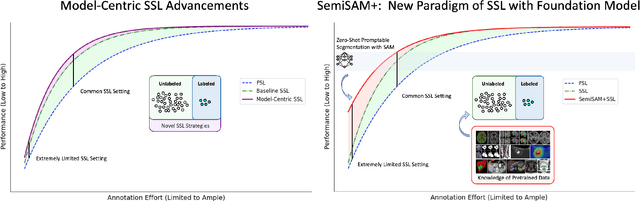
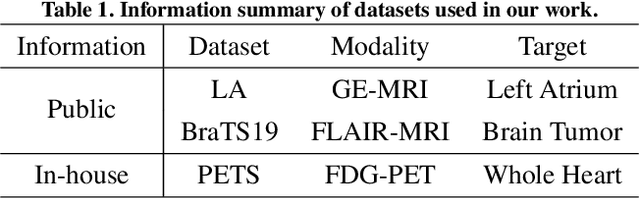
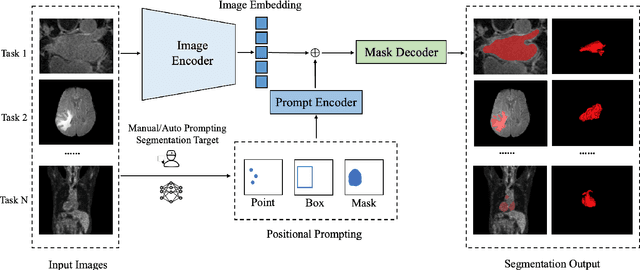
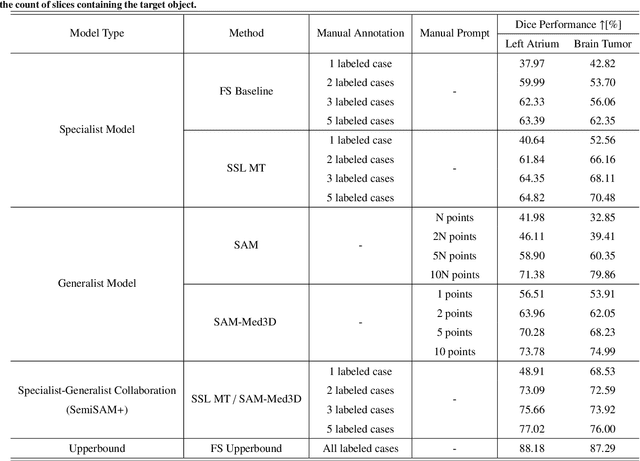
Deep learning-based medical image segmentation typically requires large amount of labeled data for training, making it less applicable in clinical settings due to high annotation cost. Semi-supervised learning (SSL) has emerged as an appealing strategy due to its less dependence on acquiring abundant annotations from experts compared to fully supervised methods. Beyond existing model-centric advancements of SSL by designing novel regularization strategies, we anticipate a paradigmatic shift due to the emergence of promptable segmentation foundation models with universal segmentation capabilities using positional prompts represented by Segment Anything Model (SAM). In this paper, we present SemiSAM+, a foundation model-driven SSL framework to efficiently learn from limited labeled data for medical image segmentation. SemiSAM+ consists of one or multiple promptable foundation models as generalist models, and a trainable task-specific segmentation model as specialist model. For a given new segmentation task, the training is based on the specialist-generalist collaborative learning procedure, where the trainable specialist model delivers positional prompts to interact with the frozen generalist models to acquire pseudo-labels, and then the generalist model output provides the specialist model with informative and efficient supervision which benefits the automatic segmentation and prompt generation in turn. Extensive experiments on two public datasets and one in-house clinical dataset demonstrate that SemiSAM+ achieves significant performance improvement, especially under extremely limited annotation scenarios, and shows strong efficiency as a plug-and-play strategy that can be easily adapted to different specialist and generalist models.