 Add to Chrome
 Add to Firefox
 Add to Edge
VentAgent: When LLMs Learn to Breathe -- Multi-Objective Arbitration for ARDS Ventilation
Jun 03, 2026
Mechanical ventilation for Acute Respiratory Distress Syndrome (ARDS) requires balancing competing physiological goals, including oxygenation, lung protection, and acid-base homeostasis. However, current data-driven methods, especially those imitating retrospective Electronic Health Records (EHR), often suffer from imitation bias. They may capture superficial correlations from inconsistent clinical demonstrations, such as associating passive ventilator settings with survival because such settings are common in stable patients, and thus fail to generalize to volatile or out-of-distribution phenotypes. Standard Reinforcement Learning (RL) methods also struggle with the adversarial trade-offs of critical care and often produce opaque policies with limited clinical interpretability. To address these limitations, we introduce VentAgent, a hierarchical framework in which Large Language Models (LLMs) act as transparent arbitrators for mechanical ventilation. We reformulate ventilation control as a dynamic Multi-Objective Arbitration process rather than single-objective optimization. VentAgent decomposes decision-making into three interpretable stages: Perception, Planning, and Orchestration. By leveraging the semantic reasoning capabilities of LLMs, it synthesizes strategies from heterogeneous experts and resolves conflicting clinical priorities through an explicit coordination mechanism. Evaluations on a high-fidelity physiological simulator show that VentAgent outperforms state-of-the-art RL and classical control baselines. Moreover, it converts control decisions into human-readable reasoning chains, offering a safer, more interpretable, and adaptable paradigm for critical care automation.

InterveneBench: Benchmarking LLMs for Intervention Reasoning and Causal Study Design in Real Social Systems
Mar 16, 2026Causal inference in social science relies on end-to-end, intervention-centered research-design reasoning grounded in real-world policy interventions, but current benchmarks fail to evaluate this capability of large language models (LLMs). We present InterveneBench, a benchmark designed to assess such reasoning in realistic social settings. Each instance in InterveneBench is derived from an empirical social science study and requires models to reason about policy interventions and identification assumptions without access to predefined causal graphs or structural equations. InterveneBench comprises 744 peer-reviewed studies across diverse policy domains. Experimental results show that state-of-the-art LLMs struggle under this setting. To address this limitation, we further propose a multi-agent framework, STRIDES. It achieves significant performance improvements over state-of-the-art reasoning models. Our code and data are available at https://github.com/Sii-yuning/STRIDES.
SemiSAM+: Rethinking Semi-Supervised Medical Image Segmentation in the Era of Foundation Models
Feb 28, 2025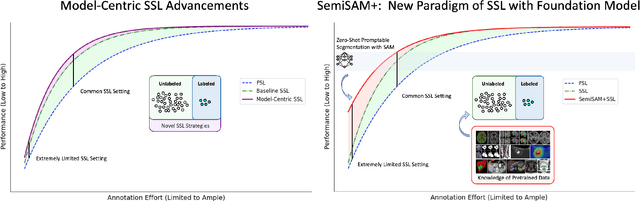
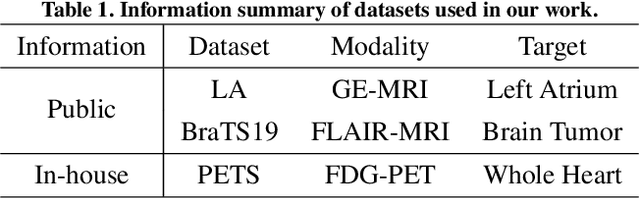
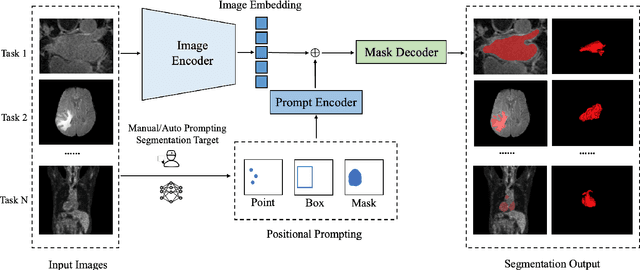
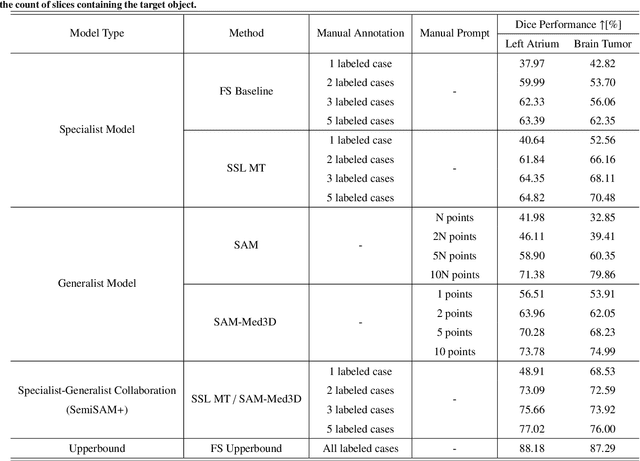
Deep learning-based medical image segmentation typically requires large amount of labeled data for training, making it less applicable in clinical settings due to high annotation cost. Semi-supervised learning (SSL) has emerged as an appealing strategy due to its less dependence on acquiring abundant annotations from experts compared to fully supervised methods. Beyond existing model-centric advancements of SSL by designing novel regularization strategies, we anticipate a paradigmatic shift due to the emergence of promptable segmentation foundation models with universal segmentation capabilities using positional prompts represented by Segment Anything Model (SAM). In this paper, we present SemiSAM+, a foundation model-driven SSL framework to efficiently learn from limited labeled data for medical image segmentation. SemiSAM+ consists of one or multiple promptable foundation models as generalist models, and a trainable task-specific segmentation model as specialist model. For a given new segmentation task, the training is based on the specialist-generalist collaborative learning procedure, where the trainable specialist model delivers positional prompts to interact with the frozen generalist models to acquire pseudo-labels, and then the generalist model output provides the specialist model with informative and efficient supervision which benefits the automatic segmentation and prompt generation in turn. Extensive experiments on two public datasets and one in-house clinical dataset demonstrate that SemiSAM+ achieves significant performance improvement, especially under extremely limited annotation scenarios, and shows strong efficiency as a plug-and-play strategy that can be easily adapted to different specialist and generalist models.