 Add to Chrome
 Add to Firefox
 Add to Edge
SCOPE: Evolving Symbolic World for Planning in Open-Ended Environments
Jun 21, 2026
Recent works have explored integrating Vision-Language Models (VLMs) with classical planners that rely on symbolic representations of planning problems to generate long-horizon plans for complex embodied tasks. However, in open-ended environments, these symbolic representations obtained from perception are often incomplete, leading to suboptimal performance. To address this, we introduce SCOPE, a self-adaptive symbolic planning framework that supports refining action plans and evolving the symbolic world, i.e., the symbolic representations of open-ended environments. SCOPE comprises two synergistic modules: a Symbolic Execution Simulator (SESim) that conducts symbolic validation and real execution of action plans, leveraging the feedback to refine the plans and evolve the symbolic world; and a Self-Adaptive Symbolic Memory (SASMem) that further distills feedback into evolving symbolic knowledge to enhance long-horizon planning and modeling of the symbolic world. Experiments in open-ended environments show that SCOPE significantly improves the completeness of the symbolic world, the success rate of plans under environment perturbations, and cross-task grounding and adaptability across diverse embodied scenarios.

CARE: Competence-Aware Reward Shaping for Adaptive Reasoning Length in Video-MLLMs
Jun 18, 2026In multimodal video reasoning, reinforcement learning-based methods typically rely on simplistic and inflexible reasoning-length control strategies that fail to adapt to the model's evolving competence. This mismatch may suppress necessary exploration at early stages, while encouraging redundant reasoning and inefficient decoding once the model becomes more competent. In this paper, we propose CARE, a competence-aware reward shaping framework for adaptive reasoning length optimization in multimodal reasoning. Specifically, CARE maintains a smoothed competence estimate via an exponential moving average of pass rates, and uses it to route training into progressive stages that shift the reward preference from exploration-oriented long-form reasoning to efficiency-oriented concise reasoning. To avoid conflating verbosity with intrinsic task complexity, CARE further normalizes reasoning effort with batch-level statistics, and introduces a posterior amplifier to strengthen reward signals for unexpectedly strong performance on historically difficult samples. The proposed mechanism is seamlessly integrated into the GRPO training pipeline and incurs no additional inference-time overhead. Extensive experiments on multiple video reasoning and general video understanding benchmarks demonstrate that CARE consistently improves reasoning accuracy, stabilizes reinforcement learning, and significantly enhances token efficiency. Moreover, CARE exhibits a characteristic inverted-U trajectory of reasoning length during training, and yields shorter yet more informative reasoning traces at convergence, indicating effective adaptive allocation of reasoning budget. We provide the source code for our proposed CARE framework and experiments at https://github.com/1Pansy/Video-CARE.
Reasoning as Intersection: Consensus-Frame Alignment for Visual Focus in Video-MLLMs
Jun 16, 2026Reinforcement learning has improved the reasoning ability of large language models, but applying outcome-only rewards to video multimodal large language models (Video-MLLMs) provides limited guidance on which visual evidence should support the answer. Inspired by multisensory integration, where consistent cues can enhance the salience and reliability of perceptual estimates, we introduce Consensus Frame GRPO (CF-GRPO), a temporal-annotation-free process-level reward framework for evidence-aware video reasoning. CF-GRPO constructs a consensus frame prior from intrinsic video cues, including temporal coverage, scene-transition cues, and query-conditioned visual relevance. It then computes a model-side frame-use score from visual and response representations and optimizes their agreement through the Consensus Frame Reward (CFR). With salience-aware sparse aggregation and distribution sharpening, CFR provides a high-contrast reward signal without requiring human temporal annotations. Experiments show that VideoCFR achieves competitive performance across complex video reasoning benchmarks and improves several metrics over representative Video-MLLM and RL baselines, while the consensus prior provides an interpretable view of the evidence frames emphasized during training. The implementation is available at https://github.com/1Pansy/VideoCFR.
A Robust Point Cloud Analysis Framework Inspired By Primary Visual Cortex
Jun 12, 2026Despite significant advancements in point cloud analysis, reducing energy consumption and improving robustness remain understudied, largely due to the inherent limitations of Convolutional Neural Networks (CNNs). To address this issue, we draw inspiration from the primary visual cortex and propose a Dendritic-Connected Continuous-Coupled Neural Network (DC-CCNN), a novel Brain-Inspired Neural Network (BINN) architecture for point cloud analysis. By combining discrete and continuous encoding, our design replaces traditional Multilayer Perceptrons (MLPs) with more efficient and robust BINNs. Building upon this framework, we further propose an extended model, DC-CCNN++, to improve robustness under complex corruption conditions. Specifically, we introduce a Neuro-Inspired Robust Modulation-and-Readout Module (NRMR) to enhance feature stability and decision robustness through global-context gain modulation and dual-code evidence integration. We also design a Cortically Inspired Progressive Variability Training (CPVT) strategy, which progressively exposes the model to structured environmental variability while preserving stable clean-sample anchors during training. Experimental results show that DC-CCNN++ improves the performance of brain-inspired networks on point cloud analysis while maintaining performance comparable to state-of-the-art methods. Compared with the original DC-CCNN, it achieves stronger results on both classification and part segmentation, and exhibits enhanced robustness against sparsity, occlusion, Gaussian noise, salt-and-pepper noise, and spatial transformations. With its efficiency, robustness, and biologically grounded design, DC-CCNN++ provides a promising alternative to traditional deep learning methods for point cloud analysis. Code is available at https://anonymous.4open.science/r/DC-CCNNpp-44E3.
MODF-SIR: A Multi-agent Omni-modal Distilled Framework for Social Intelligence Reasoning
Jun 10, 2026We propose a multi-agent collaborative framework built upon a lightweight Multimodal Large Language Model (MLLM), specifically designed for social intelligence reasoning. A key feature of our approach is that both the training and inference phases are augmented via knowledge distillation. Within this architecture, multi-modal data pertinent to social intelligence is precisely localized. Furthermore, relevant long-tail events are identified, extracted, and rendered as formatted, explicit text. This formatting strategy prevents critical long-tail information from being overshadowed by head events and environmental noise during the tokenization process. Specifically, we integrate Test-Time Adaptation (TTA) across the entire reasoning pipeline, encompassing the extraction and representation of long-tail events, Chain-of-Thought (CoT) prompting, and self-reflection. This TTA mechanism is also distillation-enhanced, utilizing Low-Rank Adaptation (LoRA) to fine-tune the foundation model exclusively for instance-level reasoning. Extensive evaluations against various open-source and proprietary AI models across multiple benchmarks demonstrate the effectiveness of the proposed framework. With around 30% of training data from IntentTrain, we achieve state-of-the-art results. Codes are available at https://github.com/eeee-sys/MODF-SIR, demo is available at https://huggingface.co/spaces/Harry-1234/MODF-SIR, LoRA is available at https://huggingface.co/Harry-1234/MODF-SIR and the dataset for training router is available at https://huggingface.co/datasets/Harry-1234/IntentRouterTrain.
On the Implicit Reward Overfitting and the Low-rank Dynamics in RLVR
May 07, 2026Recent extensive research has demonstrated that the enhanced reasoning capabilities acquired by models through Reinforcement Learning with Verifiable Rewards (RLVR) are primarily concentrated within the rank-1 components. Predicated on this observation, we employed Periodic Rank-1 Substitution and identified a counterintuitive phenomenon: RLVR may exhibit implicit reward overfitting to the training dataset. Specifically, the model can achieve satisfactory performance on the test set even when its rewards remain relatively low during the training process. Furthermore, we characterize three distinct properties of RL training: (1) The effective rank-1 component in RLVR don't maintain other model knowledge except mathematical reasoning capability. (2) RLVR fundamentally functions by optimizing a specific singular spectrum. The distribution of singular values of almost all linear layers in RLVR-trained model behaves like heavy-tailed distribution. (3) the left singular vectors associated with rank-1 components demonstrate a stronger alignment tendency during training, which echoes the discovery that RLVR is optimizing sampling efficiency in essence. Taken together, our findings and analysis further reveal how RLVR shapes model parameters and offer potential insights for improving existing RL paradigms or other training paradigms to implement continual learning.
Noise-Aware and Dynamically Adaptive Federated Defense Framework for SAR Image Target Recognition
Dec 31, 2025As a critical application of computational intelligence in remote sensing, deep learning-based synthetic aperture radar (SAR) image target recognition facilitates intelligent perception but typically relies on centralized training, where multi-source SAR data are uploaded to a single server, raising privacy and security concerns. Federated learning (FL) provides an emerging computational intelligence paradigm for SAR image target recognition, enabling cross-site collaboration while preserving local data privacy. However, FL confronts critical security risks, where malicious clients can exploit SAR's multiplicative speckle noise to conceal backdoor triggers, severely challenging the robustness of the computational intelligence model. To address this challenge, we propose NADAFD, a noise-aware and dynamically adaptive federated defense framework that integrates frequency-domain, spatial-domain, and client-behavior analyses to counter SAR-specific backdoor threats. Specifically, we introduce a frequency-domain collaborative inversion mechanism to expose cross-client spectral inconsistencies indicative of hidden backdoor triggers. We further design a noise-aware adversarial training strategy that embeds $Γ$-distributed speckle characteristics into mask-guided adversarial sample generation to enhance robustness against both backdoor attacks and SAR speckle noise. In addition, we present a dynamic health assessment module that tracks client update behaviors across training rounds and adaptively adjusts aggregation weights to mitigate evolving malicious contributions. Experiments on MSTAR and OpenSARShip datasets demonstrate that NADAFD achieves higher accuracy on clean test samples and a lower backdoor attack success rate on triggered inputs than existing federated backdoor defenses for SAR target recognition.
Reinforcing Video Reasoning with Focused Thinking
May 30, 2025Recent advancements in reinforcement learning, particularly through Group Relative Policy Optimization (GRPO), have significantly improved multimodal large language models for complex reasoning tasks. However, two critical limitations persist: 1) they often produce unfocused, verbose reasoning chains that obscure salient spatiotemporal cues and 2) binary rewarding fails to account for partially correct answers, resulting in high reward variance and inefficient learning. In this paper, we propose TW-GRPO, a novel framework that enhances visual reasoning with focused thinking and dense reward granularity. Specifically, we employs a token weighting mechanism that prioritizes tokens with high informational density (estimated by intra-group variance), suppressing redundant tokens like generic reasoning prefixes. Furthermore, we reformulate RL training by shifting from single-choice to multi-choice QA tasks, where soft rewards enable finer-grained gradient estimation by distinguishing partial correctness. Additionally, we propose question-answer inversion, a data augmentation strategy to generate diverse multi-choice samples from existing benchmarks. Experiments demonstrate state-of-the-art performance on several video reasoning and general understanding benchmarks. Notably, TW-GRPO achieves 50.4\% accuracy on CLEVRER (18.8\% improvement over Video-R1) and 65.8\% on MMVU. Our codes are available at \href{https://github.com/longmalongma/TW-GRPO}{https://github.com/longmalongma/TW-GRPO}.
Long-Term TalkingFace Generation via Motion-Prior Conditional Diffusion Model
Feb 13, 2025Recent advances in conditional diffusion models have shown promise for generating realistic TalkingFace videos, yet challenges persist in achieving consistent head movement, synchronized facial expressions, and accurate lip synchronization over extended generations. To address these, we introduce the \textbf{M}otion-priors \textbf{C}onditional \textbf{D}iffusion \textbf{M}odel (\textbf{MCDM}), which utilizes both archived and current clip motion priors to enhance motion prediction and ensure temporal consistency. The model consists of three key elements: (1) an archived-clip motion-prior that incorporates historical frames and a reference frame to preserve identity and context; (2) a present-clip motion-prior diffusion model that captures multimodal causality for accurate predictions of head movements, lip sync, and expressions; and (3) a memory-efficient temporal attention mechanism that mitigates error accumulation by dynamically storing and updating motion features. We also release the \textbf{TalkingFace-Wild} dataset, a multilingual collection of over 200 hours of footage across 10 languages. Experimental results demonstrate the effectiveness of MCDM in maintaining identity and motion continuity for long-term TalkingFace generation. Code, models, and datasets will be publicly available.
Fact :Teaching MLLMs with Faithful, Concise and Transferable Rationales
Apr 17, 2024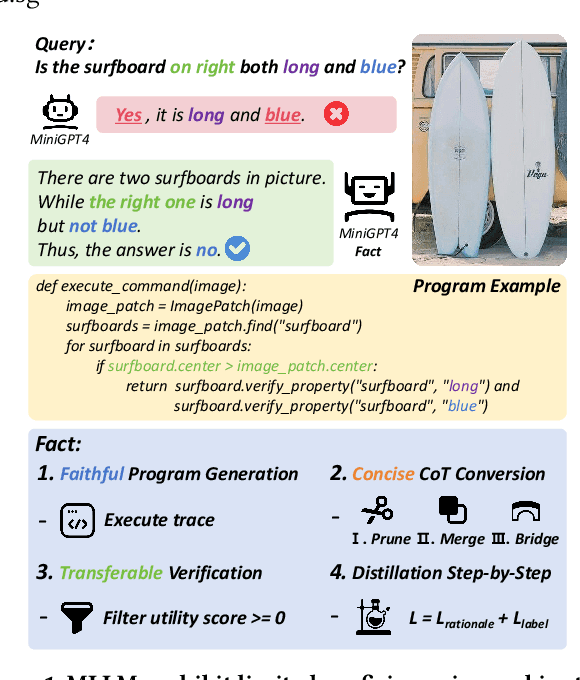

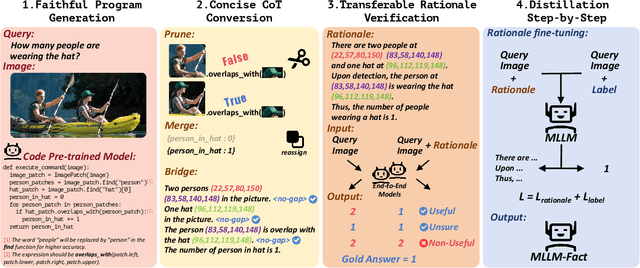

The remarkable performance of Multimodal Large Language Models (MLLMs) has unequivocally demonstrated their proficient understanding capabilities in handling a wide array of visual tasks. Nevertheless, the opaque nature of their black-box reasoning processes persists as an enigma, rendering them uninterpretable and struggling with hallucination. Their ability to execute intricate compositional reasoning tasks is also constrained, culminating in a stagnation of learning progression for these models. In this work, we introduce Fact, a novel paradigm designed to generate multimodal rationales that are faithful, concise, and transferable for teaching MLLMs. This paradigm utilizes verifiable visual programming to generate executable code guaranteeing faithfulness and precision. Subsequently, through a series of operations including pruning, merging, and bridging, the rationale enhances its conciseness. Furthermore, we filter rationales that can be transferred to end-to-end paradigms from programming paradigms to guarantee transferability. Empirical evidence from experiments demonstrates the superiority of our method across models of varying parameter sizes, significantly enhancing their compositional reasoning and generalization ability. Our approach also reduces hallucinations owing to its high correlation between images and text.