 Add to Chrome
 Add to Firefox
 Add to Edge
AWARe: Mitigating Catastrophic Forgetting via Activation-Weighted Adaptive REtention
Aug 12, 2026
Multimodal Large Language Models (MLLMs) exhibit strong generalization and reasoning abilities due to large-scale multimodal pre-training. However, fine-tuning these models on downstream tasks often leads to catastrophic forgetting, where newly learned task-specific knowledge degrades previously acquired capabilities. This issue arises because gradient updates for new tasks overwrite parameters critical to prior knowledge, limiting the practical deployment of MLLMs. To address this challenge, we propose Activation-Weighted Adaptive REtention (AWARe), a fine-tuning method that mitigates catastrophic forgetting by dynamically controlling parameter updates based on activation patterns. AWARe assigns activation-based importance scores to parameters, selectively freezing those essential for preserving prior capabilities while allowing less important parameters to adapt to new tasks. Importantly, AWARe operates without modifying model architectures, ensuring compatibility with existing inference engines. Extensive experiments demonstrate that AWARe effectively preserves upstream capabilities while achieving superior downstream performance compared to existing methods. Code is available at https://github.com/kaln27/AWARe.

SCOPE: Evolving Symbolic World for Planning in Open-Ended Environments
Jun 21, 2026Recent works have explored integrating Vision-Language Models (VLMs) with classical planners that rely on symbolic representations of planning problems to generate long-horizon plans for complex embodied tasks. However, in open-ended environments, these symbolic representations obtained from perception are often incomplete, leading to suboptimal performance. To address this, we introduce SCOPE, a self-adaptive symbolic planning framework that supports refining action plans and evolving the symbolic world, i.e., the symbolic representations of open-ended environments. SCOPE comprises two synergistic modules: a Symbolic Execution Simulator (SESim) that conducts symbolic validation and real execution of action plans, leveraging the feedback to refine the plans and evolve the symbolic world; and a Self-Adaptive Symbolic Memory (SASMem) that further distills feedback into evolving symbolic knowledge to enhance long-horizon planning and modeling of the symbolic world. Experiments in open-ended environments show that SCOPE significantly improves the completeness of the symbolic world, the success rate of plans under environment perturbations, and cross-task grounding and adaptability across diverse embodied scenarios.
Learning to Adapt: Self-Improving Web Agent via Cognitive-Aware Exploration
May 29, 2026Recent advances in Multimodal Large Language Models (MLLMs) have led to promising progress in web agents. However, existing web agents often rely on handcrafted execution pipelines or expensive expert trajectories, limiting their adaptability to complex, dynamic environments. To address these challenges, we propose SCALE (Self-Cognitive-Aware Learning and Exploration), which leverages three adversarial roles, Selector, Predictor, and Judger to autonomously discover the agent's limitations and expand its cognitive boundaries through environmental exploration. Moreover, we propose SCALE-Hop, a graph exploration strategy that facilitates global planning and helps agents avoid local exploration traps. To further support learning, we construct SCALE-20k, a large-scale dataset collected from 19 real-world websites, containing diverse task types and structured demonstrations generated from SCALE's exploration traces. Experimental results show that our approach significantly improves the performance and generalization of multiple MLLMs in various web environments. Our framework offers a scalable and generalizable solution for building truly autonomous and adaptive web agents.
WorldGPT: Empowering LLM as Multimodal World Model
Apr 28, 2024
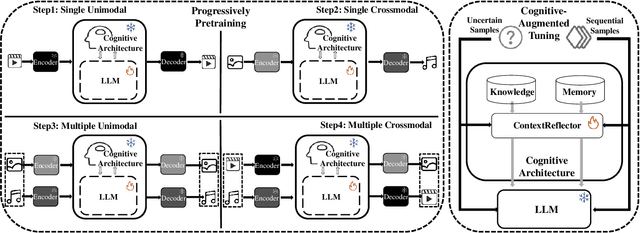
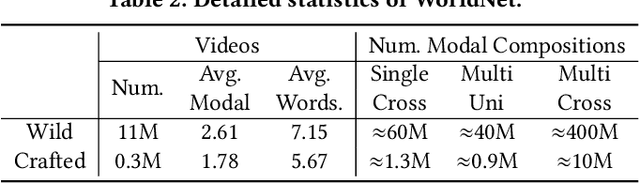
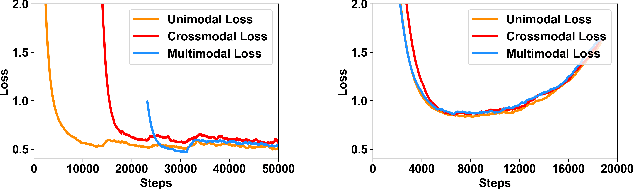
World models are progressively being employed across diverse fields, extending from basic environment simulation to complex scenario construction. However, existing models are mainly trained on domain-specific states and actions, and confined to single-modality state representations. In this paper, We introduce WorldGPT, a generalist world model built upon Multimodal Large Language Model (MLLM). WorldGPT acquires an understanding of world dynamics through analyzing millions of videos across various domains. To further enhance WorldGPT's capability in specialized scenarios and long-term tasks, we have integrated it with a novel cognitive architecture that combines memory offloading, knowledge retrieval, and context reflection. As for evaluation, we build WorldNet, a multimodal state transition prediction benchmark encompassing varied real-life scenarios. Conducting evaluations on WorldNet directly demonstrates WorldGPT's capability to accurately model state transition patterns, affirming its effectiveness in understanding and predicting the dynamics of complex scenarios. We further explore WorldGPT's emerging potential in serving as a world simulator, helping multimodal agents generalize to unfamiliar domains through efficiently synthesising multimodal instruction instances which are proved to be as reliable as authentic data for fine-tuning purposes. The project is available on \url{https://github.com/DCDmllm/WorldGPT}.
De-fine: Decomposing and Refining Visual Programs with Auto-Feedback
Nov 25, 2023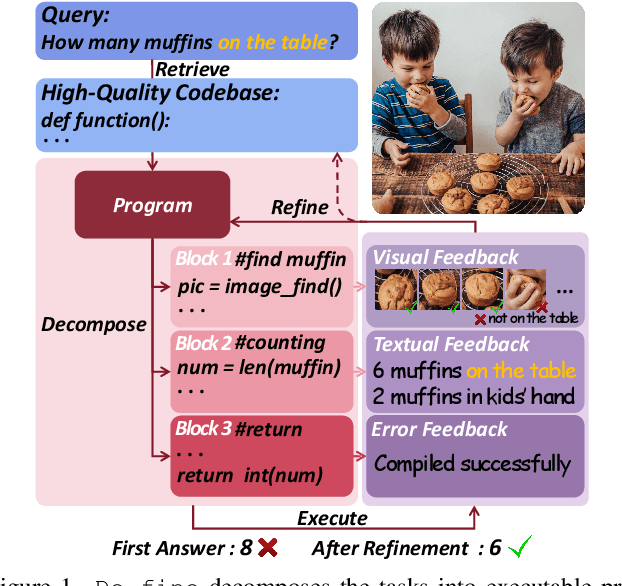
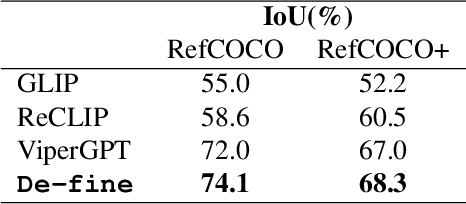
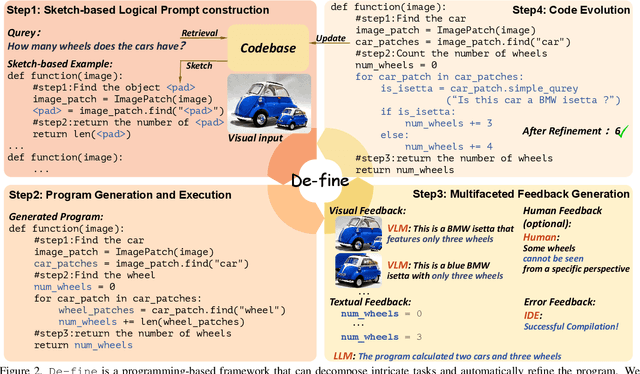
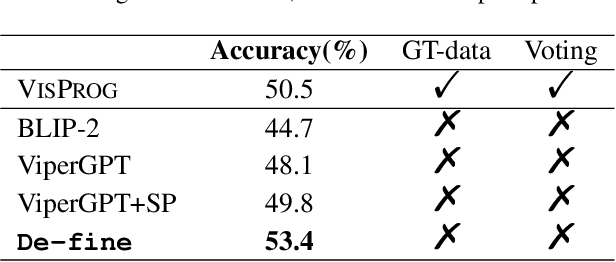
Visual programming, a modular and generalizable paradigm, integrates different modules and Python operators to solve various vision-language tasks. Unlike end-to-end models that need task-specific data, it advances in performing visual processing and reasoning in an unsupervised manner. Current visual programming methods generate programs in a single pass for each task where the ability to evaluate and optimize based on feedback, unfortunately, is lacking, which consequentially limits their effectiveness for complex, multi-step problems. Drawing inspiration from benders decomposition, we introduce De-fine, a general framework that automatically decomposes complex tasks into simpler subtasks and refines programs through auto-feedback. This model-agnostic approach can improve logical reasoning performance by integrating the strengths of multiple models. Our experiments across various visual tasks show that De-fine creates more accurate and robust programs, setting new benchmarks in the field.
Improving Vision Anomaly Detection with the Guidance of Language Modality
Oct 04, 2023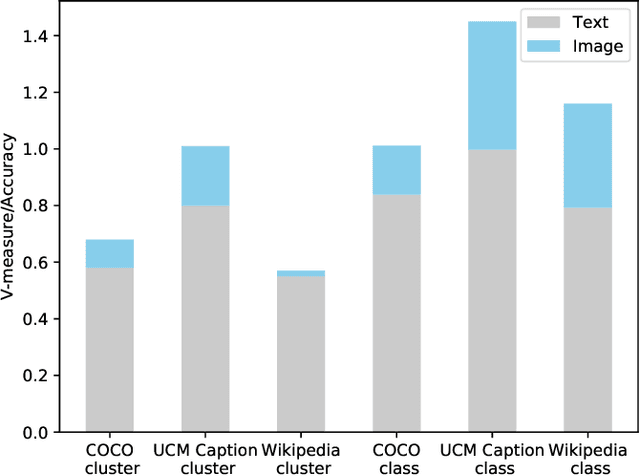
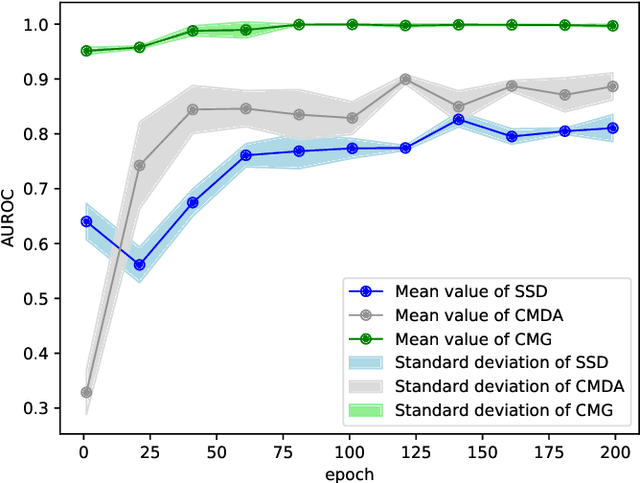
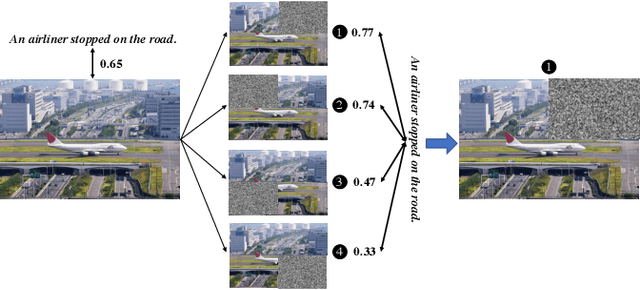
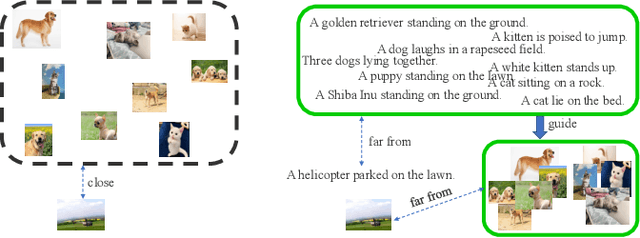
Recent years have seen a surge of interest in anomaly detection for tackling industrial defect detection, event detection, etc. However, existing unsupervised anomaly detectors, particularly those for the vision modality, face significant challenges due to redundant information and sparse latent space. Conversely, the language modality performs well due to its relatively single data. This paper tackles the aforementioned challenges for vision modality from a multimodal point of view. Specifically, we propose Cross-modal Guidance (CMG), which consists of Cross-modal Entropy Reduction (CMER) and Cross-modal Linear Embedding (CMLE), to tackle the redundant information issue and sparse space issue, respectively. CMER masks parts of the raw image and computes the matching score with the text. Then, CMER discards irrelevant pixels to make the detector focus on critical contents. To learn a more compact latent space for the vision anomaly detector, CMLE learns a correlation structure matrix from the language modality, and then the latent space of vision modality will be learned with the guidance of the matrix. Thereafter, the vision latent space will get semantically similar images closer. Extensive experiments demonstrate the effectiveness of the proposed methods. Particularly, CMG outperforms the baseline that only uses images by 16.81%. Ablation experiments further confirm the synergy among the proposed methods, as each component depends on the other to achieve optimal performance.