 Add to Chrome
 Add to Firefox
 Add to Edge
AlignFace: Human-Aligned Face Similarity Metric with Interpretable Concept Relations
Aug 14, 2026
Computer vision models for generated facial content, such as face editing and privacy protection, increasingly affect people, requiring similarity metrics that serve as faithful proxies for human perception. While perceptual evaluation has progressed from signal-based heuristics to representation-based metrics, current approaches are limited to behavioral modeling without cognitive alignment. They rely on implicit and spurious relations while assuming a universal observer, failing to account for inherent variations across diverse human populations. This leads to inaccurate evaluative models of stakeholders and misleading guidance for generative model debugging. Rather than treating perception as a black box, we leverage scientific findings from cognitive psychology of human face similarity perception: dependence on facial featural and configural attributes, nonlinear psychophysical response scaling, and own-group biases. We introduce the FACETS dataset and propose AlignFace, an interpretable, human-aligned, face similarity metric that encodes these cognitive principles through ante-hoc modeling. It employs visual-language modeling (VLM) to encode paired face images and text-based attributes, gated cross-attention (CA) to extract attribute-specific facial difference representations, concept bottleneck modeling (CBM) to constrain reasoning via interpretable face attributes, and neural generalized additive model (GAM) to model their nonlinear influence. Experiments found AlignFace significantly improves alignment with human subpopulation perceptions compared to baseline metrics, including recent domain-free learned perceptual metrics. By bridging learned representations and human cognitive processes, this work enables more transparent and aligned perceptual evaluation metrics for face images.

SketchXplain: Intuitive Visual Explanations of Image Classifiers with Sketches
Jun 16, 2026Saliency map visualizations explain image-based AI predictions by pointing to regions, but these are often unintuitive and semantically unclear, leaving an interpretability gap. We argue that AI explanations should be intuitive -- coherent to user knowledge, yet simple and selective to accelerate interpretation. Inspired by artistic drawings, we propose SketchXplain to generate sketch-based visual explanations for intuitive image-based explainable AI (XAI). Combining techniques in saliency maps, concept-bottleneck models, and sketch optimization, SketchXplain integrates saliency to select coherent observation artifacts, concepts for knowledge coherence, cues to represent them, and abstraction for simplicity. Evaluating on face expression recognition, modeling and user studies showed that SketchXplain supported quicker interpretation with more aligned visualizations than saliency maps or simple drawings. Further evaluation on skin lesion diagnosis found that SketchXplain more coherently visualized disease symptoms, better supporting lay diagnosis. Thus, this work illustrates the value of sketches for intuitive, simple, coherent, and quick image-based XAI visualizations.
MODF-SIR: A Multi-agent Omni-modal Distilled Framework for Social Intelligence Reasoning
Jun 10, 2026We propose a multi-agent collaborative framework built upon a lightweight Multimodal Large Language Model (MLLM), specifically designed for social intelligence reasoning. A key feature of our approach is that both the training and inference phases are augmented via knowledge distillation. Within this architecture, multi-modal data pertinent to social intelligence is precisely localized. Furthermore, relevant long-tail events are identified, extracted, and rendered as formatted, explicit text. This formatting strategy prevents critical long-tail information from being overshadowed by head events and environmental noise during the tokenization process. Specifically, we integrate Test-Time Adaptation (TTA) across the entire reasoning pipeline, encompassing the extraction and representation of long-tail events, Chain-of-Thought (CoT) prompting, and self-reflection. This TTA mechanism is also distillation-enhanced, utilizing Low-Rank Adaptation (LoRA) to fine-tune the foundation model exclusively for instance-level reasoning. Extensive evaluations against various open-source and proprietary AI models across multiple benchmarks demonstrate the effectiveness of the proposed framework. With around 30% of training data from IntentTrain, we achieve state-of-the-art results. Codes are available at https://github.com/eeee-sys/MODF-SIR, demo is available at https://huggingface.co/spaces/Harry-1234/MODF-SIR, LoRA is available at https://huggingface.co/Harry-1234/MODF-SIR and the dataset for training router is available at https://huggingface.co/datasets/Harry-1234/IntentRouterTrain.
On the Implicit Reward Overfitting and the Low-rank Dynamics in RLVR
May 07, 2026Recent extensive research has demonstrated that the enhanced reasoning capabilities acquired by models through Reinforcement Learning with Verifiable Rewards (RLVR) are primarily concentrated within the rank-1 components. Predicated on this observation, we employed Periodic Rank-1 Substitution and identified a counterintuitive phenomenon: RLVR may exhibit implicit reward overfitting to the training dataset. Specifically, the model can achieve satisfactory performance on the test set even when its rewards remain relatively low during the training process. Furthermore, we characterize three distinct properties of RL training: (1) The effective rank-1 component in RLVR don't maintain other model knowledge except mathematical reasoning capability. (2) RLVR fundamentally functions by optimizing a specific singular spectrum. The distribution of singular values of almost all linear layers in RLVR-trained model behaves like heavy-tailed distribution. (3) the left singular vectors associated with rank-1 components demonstrate a stronger alignment tendency during training, which echoes the discovery that RLVR is optimizing sampling efficiency in essence. Taken together, our findings and analysis further reveal how RLVR shapes model parameters and offer potential insights for improving existing RL paradigms or other training paradigms to implement continual learning.
i-Rebalance: Personalized Vehicle Repositioning for Supply Demand Balance
Jan 09, 2024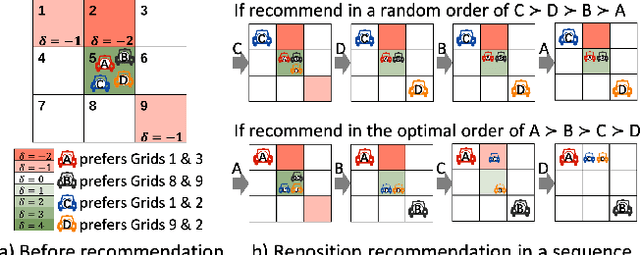
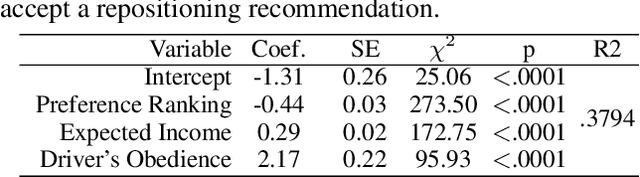
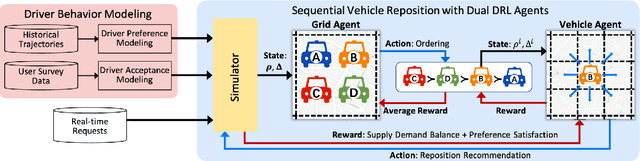
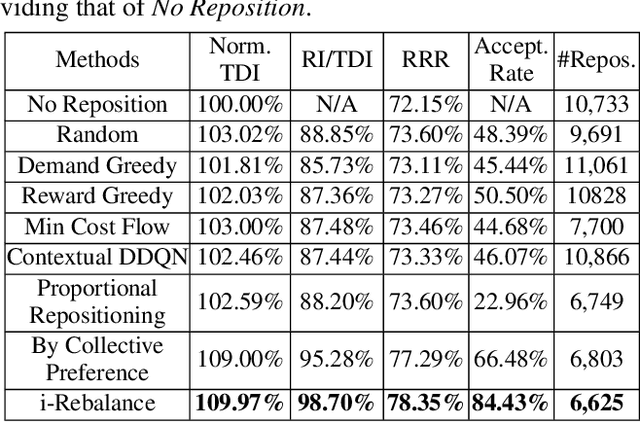
Ride-hailing platforms have been facing the challenge of balancing demand and supply. Existing vehicle reposition techniques often treat drivers as homogeneous agents and relocate them deterministically, assuming compliance with the reposition. In this paper, we consider a more realistic and driver-centric scenario where drivers have unique cruising preferences and can decide whether to take the recommendation or not on their own. We propose i-Rebalance, a personalized vehicle reposition technique with deep reinforcement learning (DRL). i-Rebalance estimates drivers' decisions on accepting reposition recommendations through an on-field user study involving 99 real drivers. To optimize supply-demand balance and enhance preference satisfaction simultaneously, i-Rebalance has a sequential reposition strategy with dual DRL agents: Grid Agent to determine the reposition order of idle vehicles, and Vehicle Agent to provide personalized recommendations to each vehicle in the pre-defined order. This sequential learning strategy facilitates more effective policy training within a smaller action space compared to traditional joint-action methods. Evaluation of real-world trajectory data shows that i-Rebalance improves driver acceptance rate by 38.07% and total driver income by 9.97%.
Debiased-CAM to mitigate systematic error with faithful visual explanations of machine learning
Jan 30, 2022Model explanations such as saliency maps can improve user trust in AI by highlighting important features for a prediction. However, these become distorted and misleading when explaining predictions of images that are subject to systematic error (bias). Furthermore, the distortions persist despite model fine-tuning on images biased by different factors (blur, color temperature, day/night). We present Debiased-CAM to recover explanation faithfulness across various bias types and levels by training a multi-input, multi-task model with auxiliary tasks for explanation and bias level predictions. In simulation studies, the approach not only enhanced prediction accuracy, but also generated highly faithful explanations about these predictions as if the images were unbiased. In user studies, debiased explanations improved user task performance, perceived truthfulness and perceived helpfulness. Debiased training can provide a versatile platform for robust performance and explanation faithfulness for a wide range of applications with data biases.
Towards Relatable Explainable AI with the Perceptual Process
Dec 28, 2021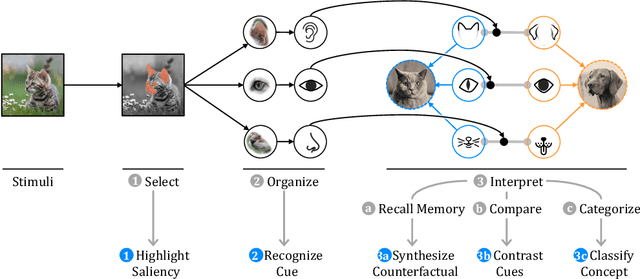
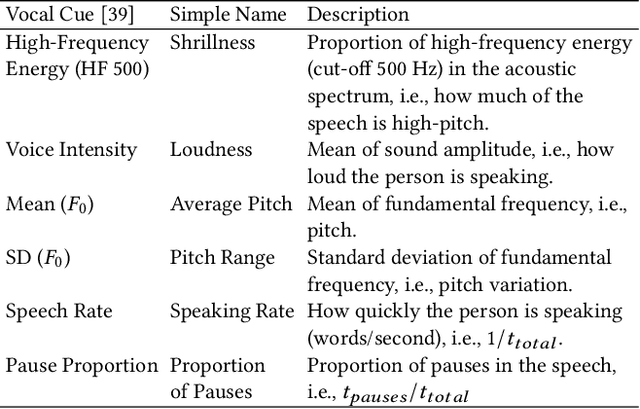
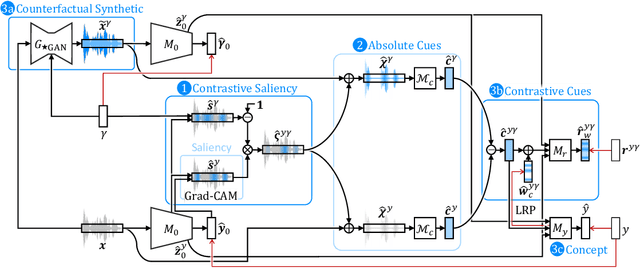
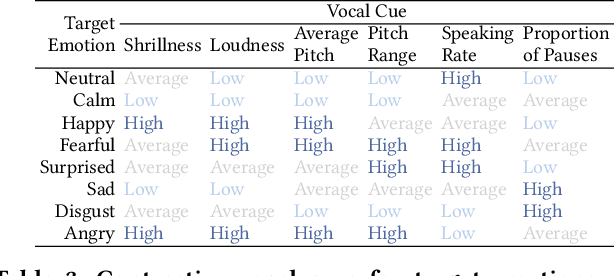
Machine learning models need to provide contrastive explanations, since people often seek to understand why a puzzling prediction occurred instead of some expected outcome. Current contrastive explanations are rudimentary comparisons between examples or raw features, which remain difficult to interpret, since they lack semantic meaning. We argue that explanations must be more relatable to other concepts, hypotheticals, and associations. Inspired by the perceptual process from cognitive psychology, we propose the XAI Perceptual Processing Framework and RexNet model for relatable explainable AI with Contrastive Saliency, Counterfactual Synthetic, and Contrastive Cues explanations. We investigated the application of vocal emotion recognition, and implemented a modular multi-task deep neural network to predict and explain emotions from speech. From think-aloud and controlled studies, we found that counterfactual explanations were useful and further enhanced with semantic cues, but not saliency explanations. This work provides insights into providing and evaluating relatable contrastive explainable AI for perception applications.
Exploiting Explanations for Model Inversion Attacks
Apr 26, 2021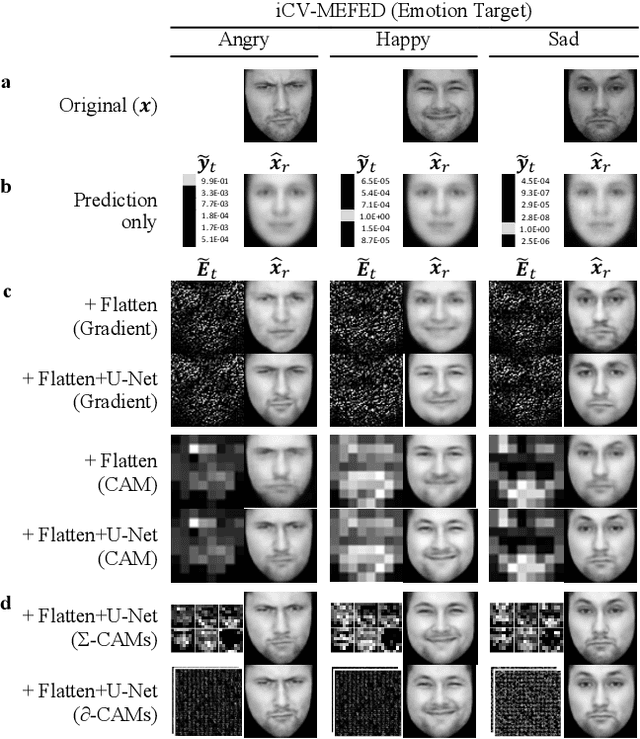
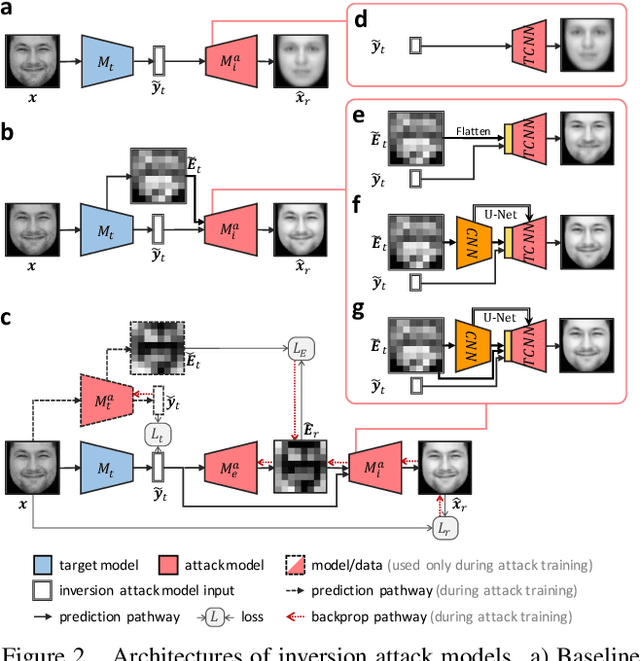
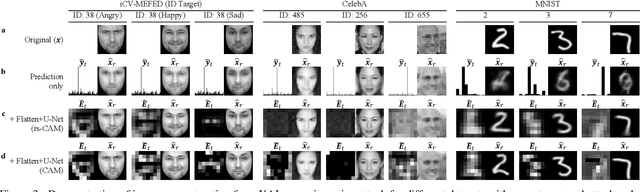
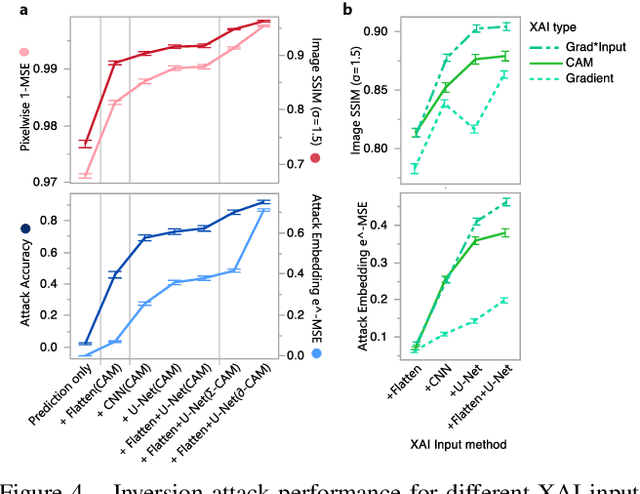
The successful deployment of artificial intelligence (AI) in many domains from healthcare to hiring requires their responsible use, particularly in model explanations and privacy. Explainable artificial intelligence (XAI) provides more information to help users to understand model decisions, yet this additional knowledge exposes additional risks for privacy attacks. Hence, providing explanation harms privacy. We study this risk for image-based model inversion attacks and identified several attack architectures with increasing performance to reconstruct private image data from model explanations. We have developed several multi-modal transposed CNN architectures that achieve significantly higher inversion performance than using the target model prediction only. These XAI-aware inversion models were designed to exploit the spatial knowledge in image explanations. To understand which explanations have higher privacy risk, we analyzed how various explanation types and factors influence inversion performance. In spite of some models not providing explanations, we further demonstrate increased inversion performance even for non-explainable target models by exploiting explanations of surrogate models through attention transfer. This method first inverts an explanation from the target prediction, then reconstructs the target image. These threats highlight the urgent and significant privacy risks of explanations and calls attention for new privacy preservation techniques that balance the dual-requirement for AI explainability and privacy.
Show or Suppress? Managing Input Uncertainty in Machine Learning Model Explanations
Jan 23, 2021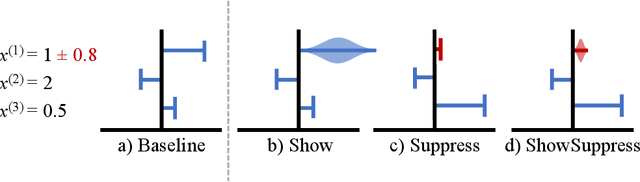
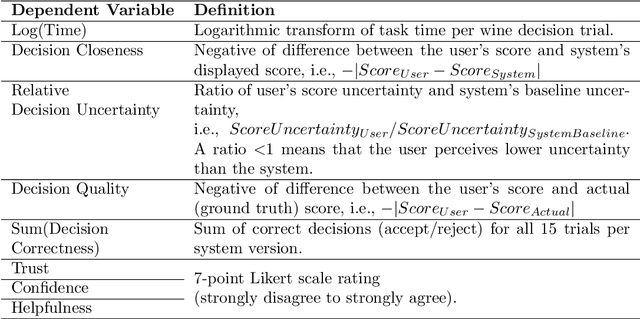
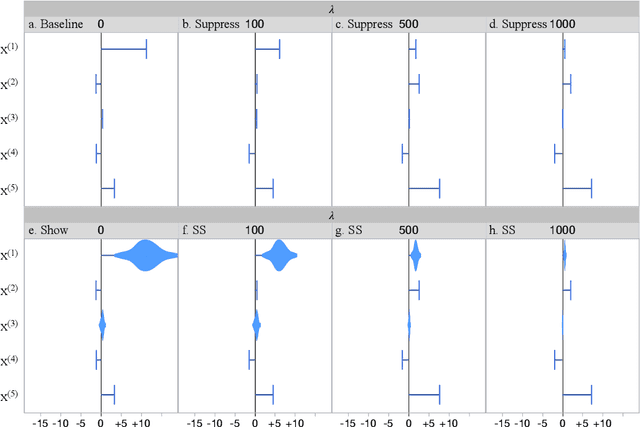
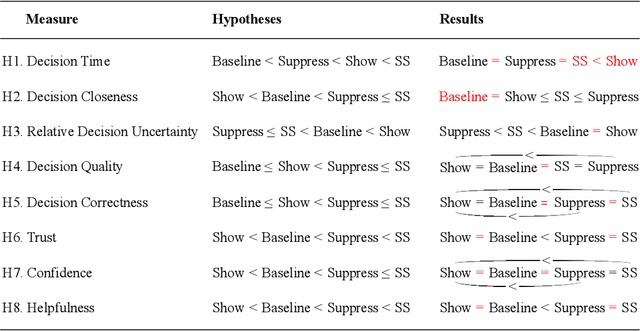
Feature attribution is widely used in interpretable machine learning to explain how influential each measured input feature value is for an output inference. However, measurements can be uncertain, and it is unclear how the awareness of input uncertainty can affect the trust in explanations. We propose and study two approaches to help users to manage their perception of uncertainty in a model explanation: 1) transparently show uncertainty in feature attributions to allow users to reflect on, and 2) suppress attribution to features with uncertain measurements and shift attribution to other features by regularizing with an uncertainty penalty. Through simulation experiments, qualitative interviews, and quantitative user evaluations, we identified the benefits of moderately suppressing attribution uncertainty, and concerns regarding showing attribution uncertainty. This work adds to the understanding of handling and communicating uncertainty for model interpretability.
Debiased-CAM for bias-agnostic faithful visual explanations of deep convolutional networks
Dec 10, 2020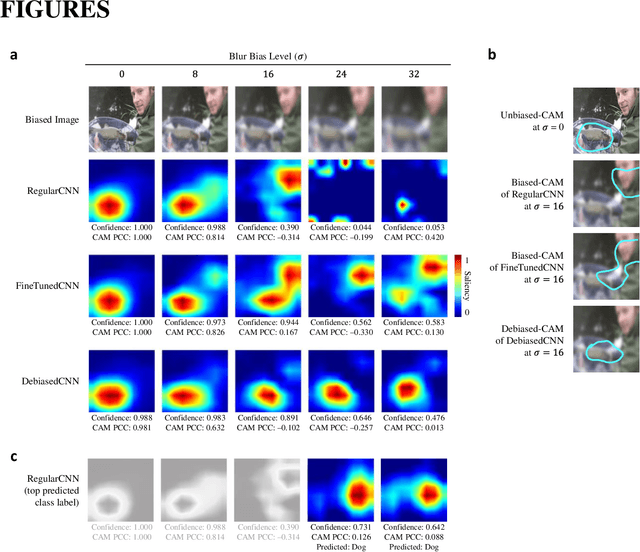
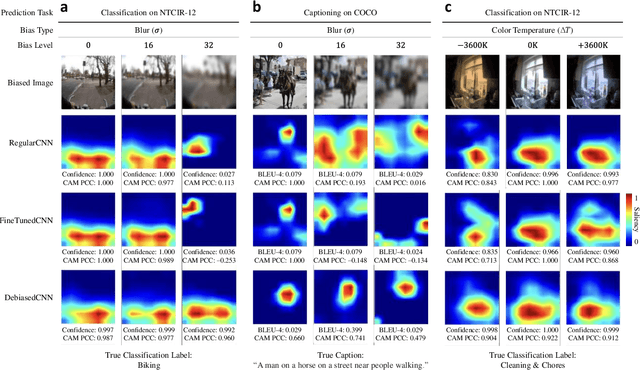
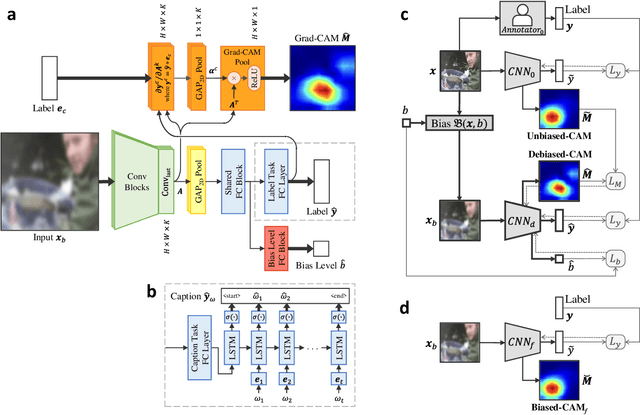
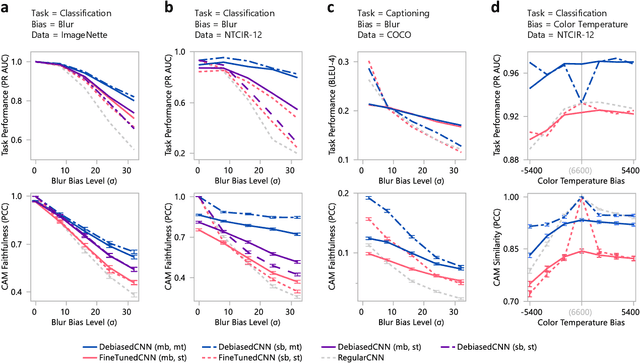
Class activation maps (CAMs) explain convolutional neural network predictions by identifying salient pixels, but they become misaligned and misleading when explaining predictions on images under bias, such as images blurred accidentally or deliberately for privacy protection, or images with improper white balance. Despite model fine-tuning to improve prediction performance on these biased images, we demonstrate that CAM explanations become more deviated and unfaithful with increased image bias. We present Debiased-CAM to recover explanation faithfulness across various bias types and levels by training a multi-input, multi-task model with auxiliary tasks for CAM and bias level predictions. With CAM as a prediction task, explanations are made tunable by retraining the main model layers and made faithful by self-supervised learning from CAMs of unbiased images. The model provides representative, bias-agnostic CAM explanations about the predictions on biased images as if generated from their unbiased form. In four simulation studies with different biases and prediction tasks, Debiased-CAM improved both CAM faithfulness and task performance. We further conducted two controlled user studies to validate its truthfulness and helpfulness, respectively. Quantitative and qualitative analyses of participant responses confirmed Debiased-CAM as more truthful and helpful. Debiased-CAM thus provides a basis to generate more faithful and relevant explanations for a wide range of real-world applications with various sources of bias.