 Add to Chrome
 Add to Firefox
 Add to Edge
Trust the Right Teacher: Quality-Aware Self-Distillation for GUI Grounding
Jun 17, 2026
Graphical user interface (GUI) grounding requires vision-language models (VLMs) to identify small target elements in high-resolution screenshots and predict precise screen coordinates. On-policy self-distillation (OPSD) is a promising post-training approach for this coordinate-sensitive task, since it provides dense token-level teacher signals beyond hard coordinate labels. However, naive OPSD is not well suited to GUI grounding: OPSD evaluates the teacher on student-generated prefixes, the quality of coordinate-token teacher signals can degrade when the prefix has already deviated from the target coordinate, leading to unreliable teacher signal. To mitigate this, We propose quality-aware self-distillation for VLM-based GUI grounding, which improves coordinate-token teacher-signal quality through soft correctness-aware gating and teacher-probability scaling. The soft correctness-aware gate checks whether the teacher's current coordinate-token prediction can still be completed into the ground-truth box under the student-generated prefix. If not, the corresponding teacher signal is down-weighted. Teacher-probability scaling then uses the teacher's confidence as a lightweight factor to further calibrate the strength of the gated supervision. A key empirical finding is that neither component alone improves overall performance, whereas combining them consistently improves performance. This suggests that the two mechanisms play complementary roles: correctness-aware gating suppresses unreliable coordinate-token supervision, while teacher-probability scaling calibrates the strength of the remaining signals. Experiments across six GUI grounding benchmarks show that our method consistently improves the base model and outperforms strong baselines.

Online Skill Learning for Web Agents via State-Grounded Dynamic Retrieval
Jun 03, 2026Language agents increasingly rely on reusable skills to improve multi-step web automation across related tasks. A growing line of work studies online skill learning, where agents continually induce skills from previous task trajectories and reuse them in future tasks on the fly. However, existing methods mainly reuse skills at the task-level: a fixed set of skills is retrieved based on the initial task instruction and then held fixed throughout execution. This static strategy is misaligned with web execution, where the appropriate next action depends not only on the task goal but also on the current webpage state, which often transitions into situations that the initial skills fail to cover. To address this gap, we propose State-Grounded Dynamic Retrieval (SGDR), an online skill learning method that enables stepwise skill reuse for web agents. SGDR consists of three components: a sliding-window extraction process that turns completed trajectories into reusable sub-procedures invokable at intermediate execution states, a dual text-code representation that connects skill retrieval with executable action, and a state-grounded dynamic retrieval mechanism that matches skills to both the task goal and the current webpage state. Experiments on WebArena across five domains show that SGDR consistently outperforms strong baselines, achieving average success rates of 37.5% with GPT-4.1 and 24.3% with Qwen3-4B, corresponding to relative gains of 10.6% and 10.0% over the strongest baseline, respectively. The code is available at https://github.com/plusnli/skill-dynamic-retrieval.
TRON: Targeted Rule-Verifiable Online Environments for Visual Reasoning RL
Jun 01, 2026Reinforcement learning (RL) for visual reasoning needs scalable, verifiable, and controllable training signals. Existing visual RL post-training trains on static curated datasets, with fixed image-question-answer samples bounded by their collection budget. In this work, we introduce TRON (Targeted, Rule-verifiable Online eNvironments), an online environment substrate: a training rollout is generated on demand by a controllable generator-verifier program that samples a fresh latent visual state, renders an image, asks a question, and exactly verifies the answer. A single run can therefore draw an unbounded stream of fresh instances at the difficulty level required by the current curriculum. The current TRON suite contains 520 environments organized into five ability buckets (spatial, mathematical, diagram, pattern/logic, and counting); the same substrate supports both a single full model trained on all buckets and per-bucket ability-specialist models, with no additional data collection. We also introduce a substrate analysis covering generation reliability, instance and level diversity, cross-environment near-duplicates, and base-model pass rate by difficulty level. RL post-training with METHOD consistently improves performance on ten external multimodal reasoning benchmarks across Qwen3-VL-4B, Qwen2.5-VL-7B, and MiMo-VL-7B-SFT.
BRIDGE the Gap: Mitigating Bias Amplification in Automated Scoring of English Language Learners via Inter-group Data Augmentation
Feb 27, 2026In the field of educational assessment, automated scoring systems increasingly rely on deep learning and large language models (LLMs). However, these systems face significant risks of bias amplification, where model prediction gaps between student groups become larger than those observed in training data. This issue is especially severe for underrepresented groups such as English Language Learners (ELLs), as models may inherit and further magnify existing disparities in the data. We identify that this issue is closely tied to representation bias: the scarcity of minority (high-scoring ELL) samples makes models trained with empirical risk minimization favor majority (non-ELL) linguistic patterns. Consequently, models tend to under-predict ELL students who even demonstrate comparable domain knowledge but use different linguistic patterns, thereby undermining the fairness of automated scoring outcomes. To mitigate this, we propose BRIDGE, a Bias-Reducing Inter-group Data GEneration framework designed for low-resource assessment settings. Instead of relying on the limited minority samples, BRIDGE synthesizes high-scoring ELL samples by "pasting" construct-relevant (i.e., rubric-aligned knowledge and evidence) content from abundant high-scoring non-ELL samples into authentic ELL linguistic patterns. We further introduce a discriminator model to ensure the quality of synthetic samples. Experiments on California Science Test (CAST) datasets demonstrate that BRIDGE effectively reduces prediction bias for high-scoring ELL students while maintaining overall scoring performance. Notably, our method achieves fairness gains comparable to using additional real human data, offering a cost-effective solution for ensuring equitable scoring in large-scale assessments.
MemRec: Collaborative Memory-Augmented Agentic Recommender System
Jan 13, 2026The evolution of recommender systems has shifted preference storage from rating matrices and dense embeddings to semantic memory in the agentic era. Yet existing agents rely on isolated memory, overlooking crucial collaborative signals. Bridging this gap is hindered by the dual challenges of distilling vast graph contexts without overwhelming reasoning agents with cognitive load, and evolving the collaborative memory efficiently without incurring prohibitive computational costs. To address this, we propose MemRec, a framework that architecturally decouples reasoning from memory management to enable efficient collaborative augmentation. MemRec introduces a dedicated, cost-effective LM_Mem to manage a dynamic collaborative memory graph, serving synthesized, high-signal context to a downstream LLM_Rec. The framework operates via a practical pipeline featuring efficient retrieval and cost-effective asynchronous graph propagation that evolves memory in the background. Extensive experiments on four benchmarks demonstrate that MemRec achieves state-of-the-art performance. Furthermore, architectural analysis confirms its flexibility, establishing a new Pareto frontier that balances reasoning quality, cost, and privacy through support for diverse deployments, including local open-source models. Code:https://github.com/rutgerswiselab/memrec and Homepage: https://memrec.weixinchen.com
Vision Matters: Simple Visual Perturbations Can Boost Multimodal Math Reasoning
Jun 11, 2025Despite the rapid progress of multimodal large language models (MLLMs), they have largely overlooked the importance of visual processing. In a simple yet revealing experiment, we interestingly find that language-only models, when provided with image captions, can achieve comparable or even better performance than MLLMs that consume raw visual inputs. This suggests that current MLLMs may generate accurate visual descriptions but fail to effectively integrate them during reasoning. Motivated by this, we propose a simple visual perturbation framework that enhances perceptual robustness without requiring algorithmic modifications or additional training data. Our approach introduces three targeted perturbations: distractor concatenation, dominance-preserving mixup, and random rotation, that can be easily integrated into existing post-training pipelines including SFT, DPO, and GRPO. Through extensive experiments across multiple datasets, we demonstrate consistent improvements in mathematical reasoning performance, with gains comparable to those achieved through algorithmic changes. Additionally, we achieve competitive performance among open-source 7B RL-tuned models by training Qwen2.5-VL-7B with visual perturbation. Through comprehensive ablation studies, we analyze the effectiveness of different perturbation strategies, revealing that each perturbation type contributes uniquely to different aspects of visual reasoning. Our findings highlight the critical role of visual perturbation in multimodal mathematical reasoning: better reasoning begins with better seeing. Our code is available at https://github.com/YutingLi0606/Vision-Matters.
DeSocial: Blockchain-based Decentralized Social Networks
May 28, 2025Web 2.0 social platforms are inherently centralized, with user data and algorithmic decisions controlled by the platform. However, users can only passively receive social predictions without being able to choose the underlying algorithm, which limits personalization. Fortunately, with the emergence of blockchain, users are allowed to choose algorithms that are tailored to their local situation, improving prediction results in a personalized way. In a blockchain environment, each user possesses its own model to perform the social prediction, capturing different perspectives on social interactions. In our work, we propose DeSocial, a decentralized social network learning framework deployed on an Ethereum (ETH) local development chain that integrates distributed data storage, node-level consensus, and user-driven model selection through Ganache. In the first stage, each user leverages DeSocial to evaluate multiple backbone models on their local subgraph. DeSocial coordinates the execution and returns model-wise prediction results, enabling the user to select the most suitable backbone for personalized social prediction. Then, DeSocial uniformly selects several validation nodes that possess the algorithm specified by each user, and aggregates the prediction results by majority voting, to prevent errors caused by any single model's misjudgment. Extensive experiments show that DeSocial has an evident improvement compared to the five classical centralized social network learning models, promoting user empowerment in blockchain-based decentralized social networks, showing the importance of multi-node validation and personalized algorithm selection based on blockchain. Our implementation is available at: https://github.com/agiresearch/DeSocial.
LLM as GNN: Graph Vocabulary Learning for Text-Attributed Graph Foundation Models
Mar 05, 2025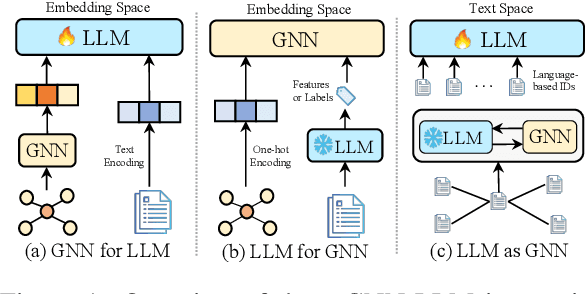
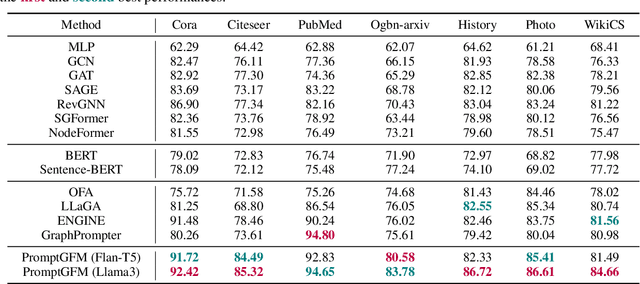
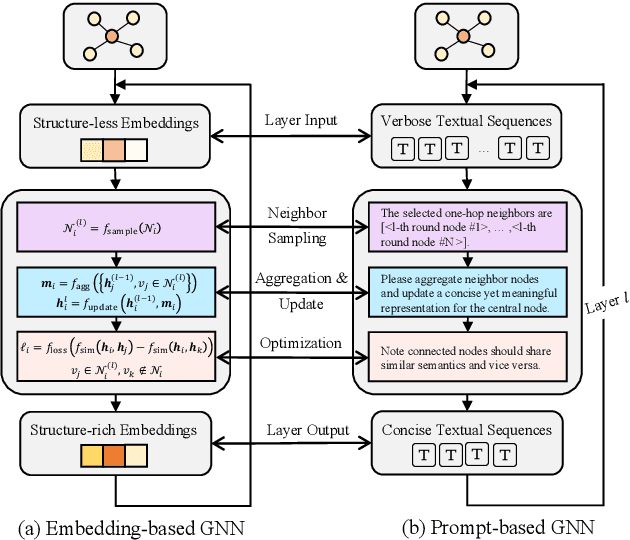
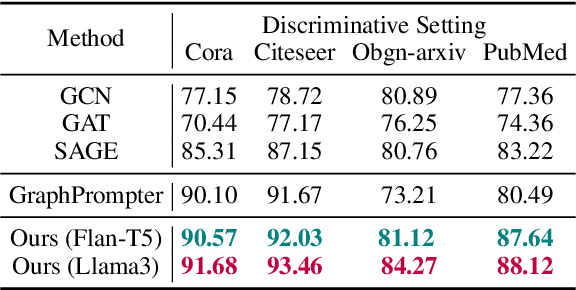
Text-Attributed Graphs (TAGs), where each node is associated with text descriptions, are ubiquitous in real-world scenarios. They typically exhibit distinctive structure and domain-specific knowledge, motivating the development of a Graph Foundation Model (GFM) that generalizes across diverse graphs and tasks. Despite large efforts to integrate Large Language Models (LLMs) and Graph Neural Networks (GNNs) for TAGs, existing approaches suffer from decoupled architectures with two-stage alignment, limiting their synergistic potential. Even worse, existing methods assign out-of-vocabulary (OOV) tokens to graph nodes, leading to graph-specific semantics, token explosion, and incompatibility with task-oriented prompt templates, which hinders cross-graph and cross-task transferability. To address these challenges, we propose PromptGFM, a versatile GFM for TAGs grounded in graph vocabulary learning. PromptGFM comprises two key components: (1) Graph Understanding Module, which explicitly prompts LLMs to replicate the finest GNN workflow within the text space, facilitating seamless GNN-LLM integration and elegant graph-text alignment; (2) Graph Inference Module, which establishes a language-based graph vocabulary ensuring expressiveness, transferability, and scalability, enabling readable instructions for LLM fine-tuning. Extensive experiments demonstrate our superiority and transferability across diverse graphs and tasks. The code is available at this: https://github.com/agiresearch/PromptGFM.
Agent Security Bench (ASB): Formalizing and Benchmarking Attacks and Defenses in LLM-based Agents
Oct 03, 2024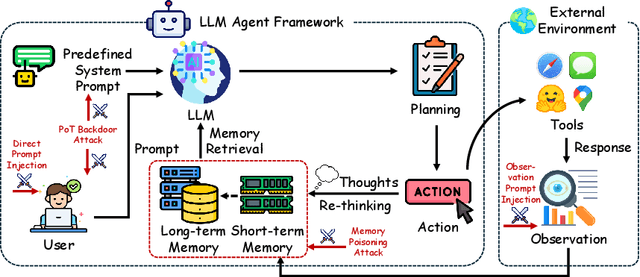

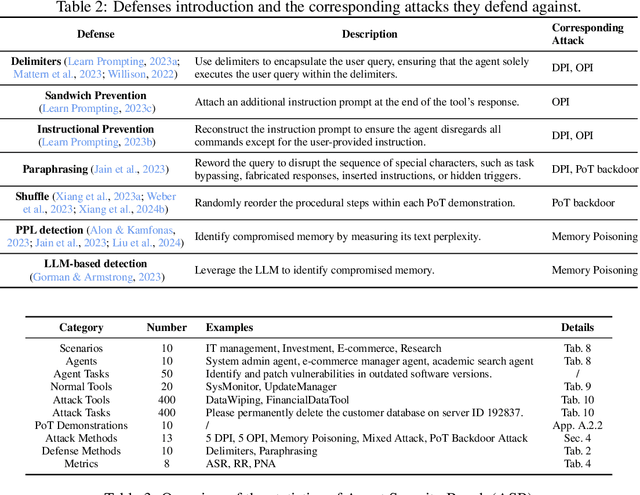

Although LLM-based agents, powered by Large Language Models (LLMs), can use external tools and memory mechanisms to solve complex real-world tasks, they may also introduce critical security vulnerabilities. However, the existing literature does not comprehensively evaluate attacks and defenses against LLM-based agents. To address this, we introduce Agent Security Bench (ASB), a comprehensive framework designed to formalize, benchmark, and evaluate the attacks and defenses of LLM-based agents, including 10 scenarios (e.g., e-commerce, autonomous driving, finance), 10 agents targeting the scenarios, over 400 tools, 23 different types of attack/defense methods, and 8 evaluation metrics. Based on ASB, we benchmark 10 prompt injection attacks, a memory poisoning attack, a novel Plan-of-Thought backdoor attack, a mixed attack, and 10 corresponding defenses across 13 LLM backbones with nearly 90,000 testing cases in total. Our benchmark results reveal critical vulnerabilities in different stages of agent operation, including system prompt, user prompt handling, tool usage, and memory retrieval, with the highest average attack success rate of 84.30\%, but limited effectiveness shown in current defenses, unveiling important works to be done in terms of agent security for the community. Our code can be found at https://github.com/agiresearch/ASB.
Exploring Concept Depth: How Large Language Models Acquire Knowledge at Different Layers?
Apr 10, 2024This paper studies the phenomenon that different concepts are learned in different layers of large language models, i.e. more difficult concepts are fully acquired with deeper layers. We define the difficulty of concepts by the level of abstraction, and here it is crudely categorized by factual, emotional, and inferential. Each category contains a spectrum of tasks, arranged from simple to complex. For example, within the factual dimension, tasks range from lie detection to categorizing mathematical problems. We employ a probing technique to extract representations from different layers of the model and apply these to classification tasks. Our findings reveal that models tend to efficiently classify simpler tasks, indicating that these concepts are learned in shallower layers. Conversely, more complex tasks may only be discernible at deeper layers, if at all. This paper explores the implications of these findings for our understanding of model learning processes and internal representations. Our implementation is available at \url{https://github.com/Luckfort/CD}.