 Add to Chrome
 Add to Firefox
 Add to Edge
MemGym: a Long-Horizon Memory Environment for LLM Agents
May 20, 2026
Memory is a central capability for LLM agents operating across long-horizon tasks. Existing memory benchmarks predominantly evaluate retention of personalized information in multi-turn chat scenarios, overlooking the dynamic memory formation that occurs during extended agent execution. Consequently, the memory systems they produce transfer poorly to realistic agentic environments, such as coding and web navigation. We present MemGym, a benchmark for agentic memory that unifies existing agent gyms and in-house memory-grounded pipelines behind one memory-reasoning interface. MemGym spans five evaluation tracks grouped into four agentic regimes: tool-use dialogue (tau2-bench), multi-turn deep-research search (MEMGYM-DR), coding (SWE-Gym and MEMGYM-CODEQA), and computer use (WebArena-Infinity). MemGym reports memory-isolated scores that decouple memory performance from reasoning, retrieval, and tool-use ability, so memory strategies can be ranked without those confounders. Our synthetic pipelines for MEMGYM-CODEQA and MEMGYM-DR are length-controllable, ablation-verified at every stage, and tightly aligned with downstream scenarios. To make evaluation on coding environments academically tractable, we train MemRM, a lightweight reward model (Qwen3-1.7B fine-tuned with QLoRA) that scores compression quality as a fast scalar read in place of full Docker rollouts.

MemEye: A Visual-Centric Evaluation Framework for Multimodal Agent Memory
May 14, 2026Long-term agent memory is increasingly multimodal, yet existing evaluations rarely test whether agents preserve the visual evidence needed for later reasoning. In prior work, many visually grounded questions can be answered using only captions or textual traces, allowing answers to be inferred without preserving the fine-grained visual evidence. Meanwhile, harder cases that require reasoning over changing visual states are largely absent. Therefore, we introduce MemEye, a framework that evaluates memory capabilities from two dimensions: one measures the granularity of decisive visual evidence (from scene-level to pixel-level evidence), and the other measures how retrieved evidence must be used (from single evidence to evolutionary synthesis). Under this framework, we construct a new benchmark across 8 life-scenario tasks, with ablation-driven validation gates for assessing answerability, shortcut resistance, visual necessity, and reasoning structure. By evaluating 13 memory methods across 4 VLM backbones, we show that current architectures still struggle to preserve fine-grained visual details and reason about state changes over time. Our findings show that long-term multimodal memory depends on evidence routing, temporal tracking, and detail extraction.
AEL: Agent Evolving Learning for Open-Ended Environments
Apr 23, 2026LLM agents increasingly operate in open-ended environments spanning hundreds of sequential episodes, yet they remain largely stateless: each task is solved from scratch without converting past experience into better future behavior. The central obstacle is not \emph{what} to remember but \emph{how to use} what has been remembered, including which retrieval policy to apply, how to interpret prior outcomes, and when the current strategy itself must change. We introduce \emph{Agent Evolving Learning} (\ael{}), a two-timescale framework that addresses this obstacle. At the fast timescale, a Thompson Sampling bandit learns which memory retrieval policy to apply at each episode; at the slow timescale, LLM-driven reflection diagnoses failure patterns and injects causal insights into the agent's decision prompt, giving it an interpretive frame for the evidence it retrieves. On a sequential portfolio benchmark (10 sector-diverse tickers, 208 episodes, 5 random seeds), \ael{} achieves a Sharpe ratio of 2.13$\pm$0.47, outperforming five published self-improving methods and all non-LLM baselines while maintaining the lowest variance among all LLM-based approaches. A nine-variant ablation reveals a ``less is more'' pattern: memory and reflection together produce a 58\% cumulative improvement over the stateless baseline, yet every additional mechanism we test (planner evolution, per-tool selection, cold-start initialization, skill extraction, and three credit assignment methods) \emph{degrades} performance. This demonstrates that the bottleneck in agent self-improvement is \emph{self-diagnosing how to use} experience rather than adding architectural complexity. Code and data: https://github.com/WujiangXu/AEL.
GAM: Hierarchical Graph-based Agentic Memory for LLM Agents
Apr 14, 2026To sustain coherent long-term interactions, Large Language Model (LLM) agents must navigate the tension between acquiring new information and retaining prior knowledge. Current unified stream-based memory systems facilitate context updates but remain vulnerable to interference from transient noise. Conversely, discrete structured memory architectures provide robust knowledge retention but often struggle to adapt to evolving narratives. To address this, we propose GAM, a hierarchical Graph-based Agentic Memory framework that explicitly decouples memory encoding from consolidation to effectively resolve the conflict between rapid context perception and stable knowledge retention. By isolating ongoing dialogue in an event progression graph and integrating it into a topic associative network only upon semantic shifts, our approach minimizes interference while preserving long-term consistency. Additionally, we introduce a graph-guided, multi-factor retrieval strategy to enhance context precision. Experiments on LoCoMo and LongDialQA indicate that our method consistently outperforms state-of-the-art baselines in both reasoning accuracy and efficiency.
AgentSelect: Benchmark for Narrative Query-to-Agent Recommendation
Mar 04, 2026LLM agents are rapidly becoming the practical interface for task automation, yet the ecosystem lacks a principled way to choose among an exploding space of deployable configurations. Existing LLM leaderboards and tool/agent benchmarks evaluate components in isolation and remain fragmented across tasks, metrics, and candidate pools, leaving a critical research gap: there is little query-conditioned supervision for learning to recommend end-to-end agent configurations that couple a backbone model with a toolkit. We address this gap with AgentSelect, a benchmark that reframes agent selection as narrative query-to-agent recommendation over capability profiles and systematically converts heterogeneous evaluation artifacts into unified, positive-only interaction data. AgentSelectcomprises 111,179 queries, 107,721 deployable agents, and 251,103 interaction records aggregated from 40+ sources, spanning LLM-only, toolkit-only, and compositional agents. Our analyses reveal a regime shift from dense head reuse to long-tail, near one-off supervision, where popularity-based CF/GNN methods become fragile and content-aware capability matching is essential. We further show that Part~III synthesized compositional interactions are learnable, induce capability-sensitive behavior under controlled counterfactual edits, and improve coverage over realistic compositions; models trained on AgentSelect also transfer to a public agent marketplace (MuleRun), yielding consistent gains on an unseen catalog. Overall, AgentSelect provides the first unified data and evaluation infrastructure for agent recommendation, which establishes a reproducible foundation to study and accelerate the emerging agent ecosystem.
Farther the Shift, Sparser the Representation: Analyzing OOD Mechanisms in LLMs
Mar 03, 2026In this work, we investigate how Large Language Models (LLMs) adapt their internal representations when encountering inputs of increasing difficulty, quantified as the degree of out-of-distribution (OOD) shift. We reveal a consistent and quantifiable phenomenon: as task difficulty increases, whether through harder reasoning questions, longer contexts, or adding answer choices, the last hidden states of LLMs become substantially sparser. In short, \textbf{\textit{the farther the shift, the sparser the representations}}. This sparsity--difficulty relation is observable across diverse models and domains, suggesting that language models respond to unfamiliar or complex inputs by concentrating computation into specialized subspaces in the last hidden state. Through a series of controlled analyses with a learning dynamic explanation, we demonstrate that this sparsity is not incidental but an adaptive mechanism for stabilizing reasoning under OOD. Leveraging this insight, we design \textit{Sparsity-Guided Curriculum In-Context Learning (SG-ICL)}, a strategy that explicitly uses representation sparsity to schedule few-shot demonstrations, leading to considerable performance enhancements. Our study provides new mechanistic insights into how LLMs internalize OOD challenges. The source code is available at the URL: https://github.com/MingyuJ666/sparsityLLM.
Individual Turing Test: A Case Study of LLM-based Simulation Using Longitudinal Personal Data
Mar 01, 2026Large Language Models (LLMs) have demonstrated remarkable human-like capabilities, yet their ability to replicate a specific individual remains under-explored. This paper presents a case study to investigate LLM-based individual simulation with a volunteer-contributed archive of private messaging history spanning over ten years. Based on the messaging data, we propose the "Individual Turing Test" to evaluate whether acquaintances of the volunteer can correctly identify which response in a multi-candidate pool most plausibly comes from the volunteer. We investigate prevalent LLM-based individual simulation approaches including: fine-tuning, retrieval-augmented generation (RAG), memory-based approach, and hybrid methods that integrate fine-tuning and RAG or memory. Empirical results show that current LLM-based simulation methods do not pass the Individual Turing Test, but they perform substantially better when the same test is conducted on strangers to the target individual. Additionally, while fine-tuning improves the simulation in daily chats representing the language style of the individual, retrieval-augmented and memory-based approaches demonstrate stronger performance on questions involving personal opinions and preferences. These findings reveal a fundamental trade-off between parametric and non-parametric approaches to individual simulation with LLMs when given a longitudinal context.
LLM as GNN: Graph Vocabulary Learning for Text-Attributed Graph Foundation Models
Mar 05, 2025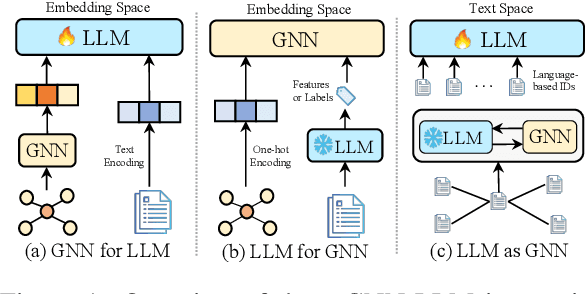
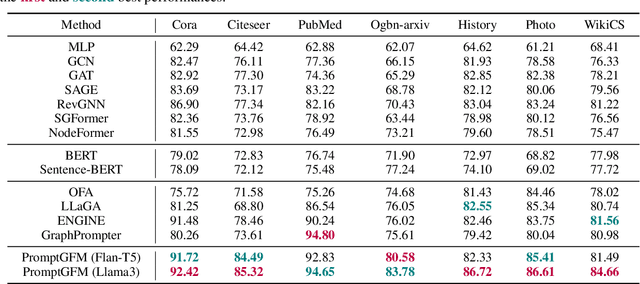
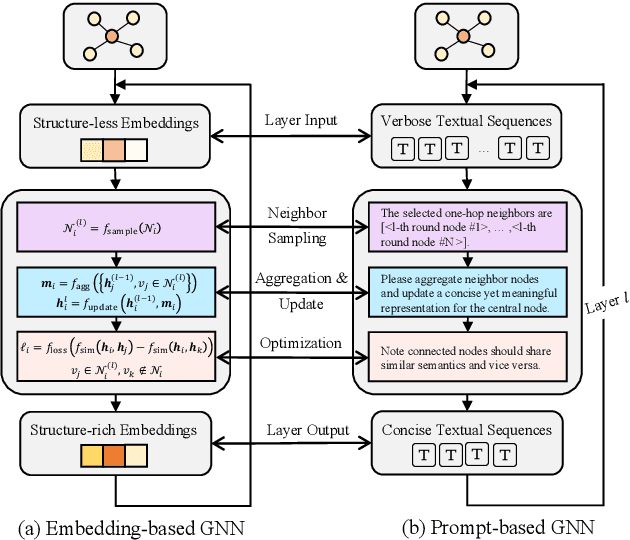
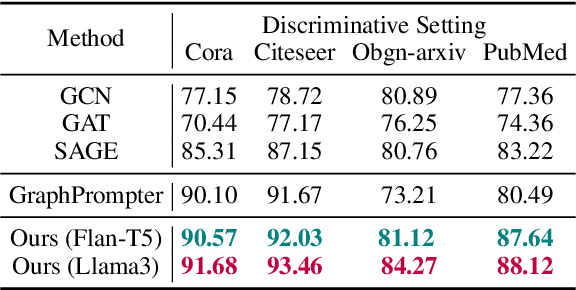
Text-Attributed Graphs (TAGs), where each node is associated with text descriptions, are ubiquitous in real-world scenarios. They typically exhibit distinctive structure and domain-specific knowledge, motivating the development of a Graph Foundation Model (GFM) that generalizes across diverse graphs and tasks. Despite large efforts to integrate Large Language Models (LLMs) and Graph Neural Networks (GNNs) for TAGs, existing approaches suffer from decoupled architectures with two-stage alignment, limiting their synergistic potential. Even worse, existing methods assign out-of-vocabulary (OOV) tokens to graph nodes, leading to graph-specific semantics, token explosion, and incompatibility with task-oriented prompt templates, which hinders cross-graph and cross-task transferability. To address these challenges, we propose PromptGFM, a versatile GFM for TAGs grounded in graph vocabulary learning. PromptGFM comprises two key components: (1) Graph Understanding Module, which explicitly prompts LLMs to replicate the finest GNN workflow within the text space, facilitating seamless GNN-LLM integration and elegant graph-text alignment; (2) Graph Inference Module, which establishes a language-based graph vocabulary ensuring expressiveness, transferability, and scalability, enabling readable instructions for LLM fine-tuning. Extensive experiments demonstrate our superiority and transferability across diverse graphs and tasks. The code is available at this: https://github.com/agiresearch/PromptGFM.
PersonaX: A Recommendation Agent Oriented User Modeling Framework for Long Behavior Sequence
Mar 04, 2025Recommendation agents leverage large language models for user modeling LLM UM to construct textual personas guiding alignment with real users. However existing LLM UM methods struggle with long user generated content UGC due to context limitations and performance degradation. To address this sampling strategies prioritize relevance or recency are often applied yet they inevitably neglect the diverse user interests embedded within the discarded behaviors resulting in incomplete modeling and degraded profiling quality. Furthermore relevance based sampling requires real time retrieval forcing the user modeling process to operate online which introduces significant latency overhead. In this paper we propose PersonaX an agent agnostic LLM UM framework that tackles these challenges through sub behavior sequence SBS selection and offline multi persona construction. PersonaX extracts compact SBS segments offline to capture diverse user interests generating fine grained textual personas that are cached for efficient online retrieval. This approach ensures that the user persona used for prompting remains highly relevant to the current context while eliminating the need for online user modeling. For SBS selection we ensure both efficiency length less than five and high representational quality by balancing prototypicality and diversity within the sampled data. Extensive experiments validate the effectiveness and versatility of PersonaX in high quality user profiling. Utilizing only 30 to 50 percent of the behavioral data with a sequence length of 480 integrating PersonaX with AgentCF yields an absolute performance improvement of 3 to 11 percent while integration with Agent4Rec results in a gain of 10 to 50 percent. PersonaX as an agent agnostic framework sets a new benchmark for scalable user modeling paving the way for more accurate and efficient LLM driven recommendation agents.
ECCOS: Efficient Capability and Cost Coordinated Scheduling for Multi-LLM Serving
Feb 27, 2025As large language models (LLMs) are increasingly deployed as service endpoints in systems, the surge in query volume creates significant scheduling challenges. Existing scheduling frameworks mainly target at latency optimization while neglecting the capability of LLMs to serve different level of queries, which could lead to computational resource waste. This paper addresses this challenge by proposing a capability-cost coordinated scheduling framework, ECCOS, for multi-LLM serving, which explicitly constrains response quality and workload to optimize LLM inference cost. Specifically, it introduces the two-stage scheduling by designing a multi-objective predictor and a constrained optimizer. The predictor estimates both model capabilities and computational costs through training-based and retrieval-based approaches, while the optimizer determines cost-optimal assignments under quality and workload constraints. It also introduces QAServe, a dataset collected for sample-wise response quality and costs by zero-shot prompting different LLMs on knowledge QA and mathematical reasoning. Extensive experiments demonstrate that ECCOS improves success rates by 6.30% while reducing costs by 10.15% compared to existing methods, consuming less than 0.5% of LLM response time. The code is available at: https://github.com/agiresearch/ECCOS.