 Add to Chrome
 Add to Firefox
 Add to Edge
OmniShow: Unifying Multimodal Conditions for Human-Object Interaction Video Generation
Apr 13, 2026
In this work, we study Human-Object Interaction Video Generation (HOIVG), which aims to synthesize high-quality human-object interaction videos conditioned on text, reference images, audio, and pose. This task holds significant practical value for automating content creation in real-world applications, such as e-commerce demonstrations, short video production, and interactive entertainment. However, existing approaches fail to accommodate all these requisite conditions. We present OmniShow, an end-to-end framework tailored for this practical yet challenging task, capable of harmonizing multimodal conditions and delivering industry-grade performance. To overcome the trade-off between controllability and quality, we introduce Unified Channel-wise Conditioning for efficient image and pose injection, and Gated Local-Context Attention to ensure precise audio-visual synchronization. To effectively address data scarcity, we develop a Decoupled-Then-Joint Training strategy that leverages a multi-stage training process with model merging to efficiently harness heterogeneous sub-task datasets. Furthermore, to fill the evaluation gap in this field, we establish HOIVG-Bench, a dedicated and comprehensive benchmark for HOIVG. Extensive experiments demonstrate that OmniShow achieves overall state-of-the-art performance across various multimodal conditioning settings, setting a solid standard for the emerging HOIVG task.

HiFi-Inpaint: Towards High-Fidelity Reference-Based Inpainting for Generating Detail-Preserving Human-Product Images
Mar 03, 2026Human-product images, which showcase the integration of humans and products, play a vital role in advertising, e-commerce, and digital marketing. The essential challenge of generating such images lies in ensuring the high-fidelity preservation of product details. Among existing paradigms, reference-based inpainting offers a targeted solution by leveraging product reference images to guide the inpainting process. However, limitations remain in three key aspects: the lack of diverse large-scale training data, the struggle of current models to focus on product detail preservation, and the inability of coarse supervision for achieving precise guidance. To address these issues, we propose HiFi-Inpaint, a novel high-fidelity reference-based inpainting framework tailored for generating human-product images. HiFi-Inpaint introduces Shared Enhancement Attention (SEA) to refine fine-grained product features and Detail-Aware Loss (DAL) to enforce precise pixel-level supervision using high-frequency maps. Additionally, we construct a new dataset, HP-Image-40K, with samples curated from self-synthesis data and processed with automatic filtering. Experimental results show that HiFi-Inpaint achieves state-of-the-art performance, delivering detail-preserving human-product images.
Text-to-Edit: Controllable End-to-End Video Ad Creation via Multimodal LLMs
Jan 10, 2025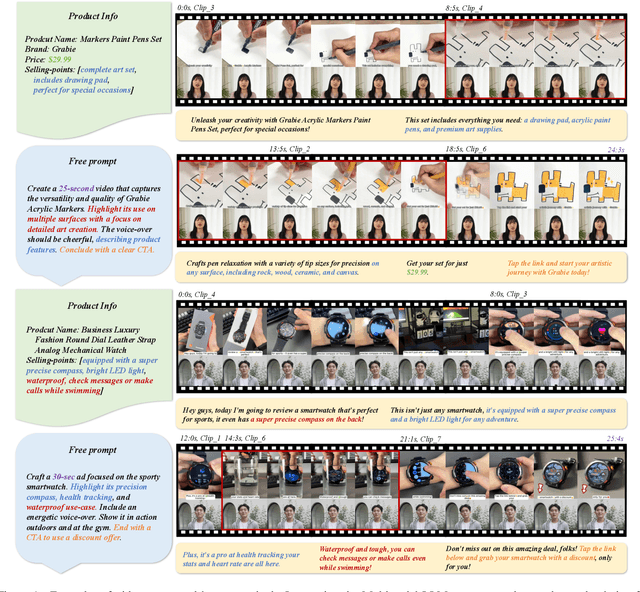
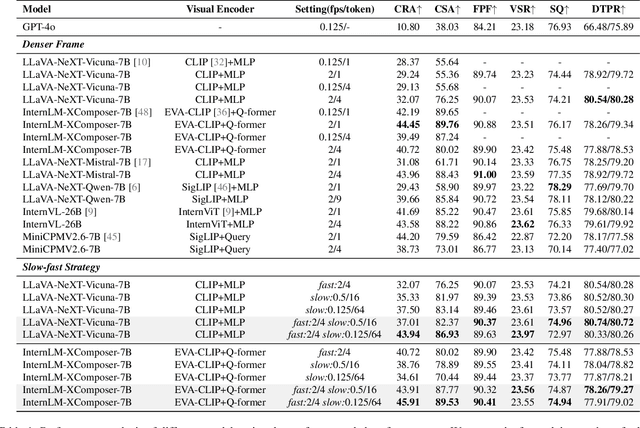
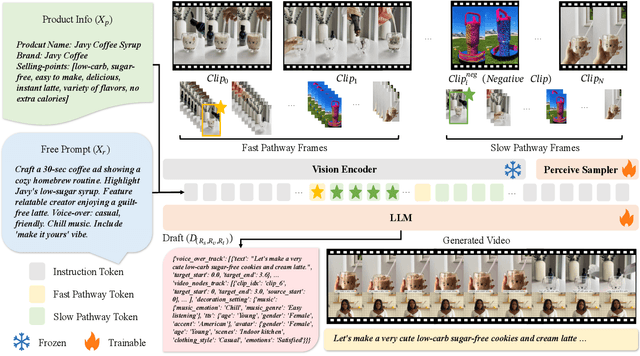

The exponential growth of short-video content has ignited a surge in the necessity for efficient, automated solutions to video editing, with challenges arising from the need to understand videos and tailor the editing according to user requirements. Addressing this need, we propose an innovative end-to-end foundational framework, ultimately actualizing precise control over the final video content editing. Leveraging the flexibility and generalizability of Multimodal Large Language Models (MLLMs), we defined clear input-output mappings for efficient video creation. To bolster the model's capability in processing and comprehending video content, we introduce a strategic combination of a denser frame rate and a slow-fast processing technique, significantly enhancing the extraction and understanding of both temporal and spatial video information. Furthermore, we introduce a text-to-edit mechanism that allows users to achieve desired video outcomes through textual input, thereby enhancing the quality and controllability of the edited videos. Through comprehensive experimentation, our method has not only showcased significant effectiveness within advertising datasets, but also yields universally applicable conclusions on public datasets.
Prefix-diffusion: A Lightweight Diffusion Model for Diverse Image Captioning
Sep 10, 2023


While impressive performance has been achieved in image captioning, the limited diversity of the generated captions and the large parameter scale remain major barriers to the real-word application of these systems. In this work, we propose a lightweight image captioning network in combination with continuous diffusion, called Prefix-diffusion. To achieve diversity, we design an efficient method that injects prefix image embeddings into the denoising process of the diffusion model. In order to reduce trainable parameters, we employ a pre-trained model to extract image features and further design an extra mapping network. Prefix-diffusion is able to generate diverse captions with relatively less parameters, while maintaining the fluency and relevance of the captions benefiting from the generative capabilities of the diffusion model. Our work paves the way for scaling up diffusion models for image captioning, and achieves promising performance compared with recent approaches.