 Add to Chrome
 Add to Firefox
 Add to Edge
CompetitorFormer: Competitor Transformer for 3D Instance Segmentation
Nov 21, 2024
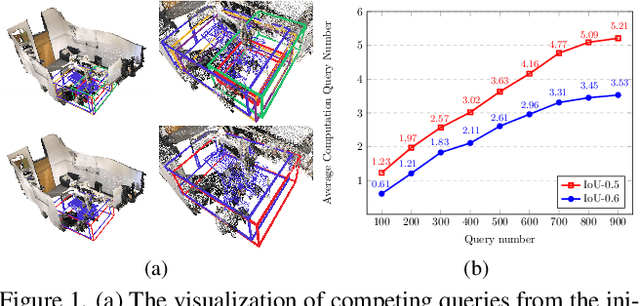
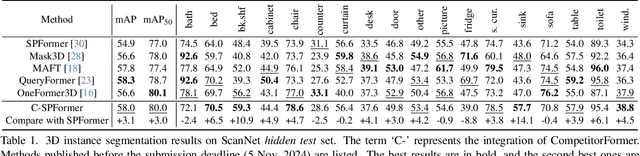
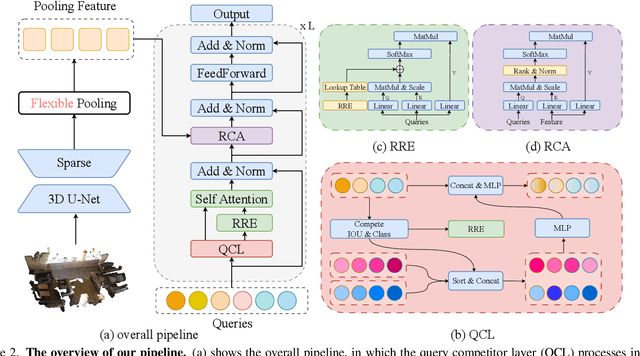

Transformer-based methods have become the dominant approach for 3D instance segmentation. These methods predict instance masks via instance queries, ranking them by classification confidence and IoU scores to select the top prediction as the final outcome. However, it has been observed that the current models employ a fixed and higher number of queries than the instances present within a scene. In such instances, multiple queries predict the same instance, yet only a single query is ultimately optimized. The close scores of queries in the lower-level decoders make it challenging for the dominant query to distinguish itself rapidly, which ultimately impairs the model's accuracy and convergence efficiency. This phenomenon is referred to as inter-query competition. To address this challenge, we put forth a series of plug-and-play competition-oriented designs, collectively designated as the CompetitorFormer, with the aim of reducing competition and facilitating a dominant query. Experiments showed that integrating our designs with state-of-the-art frameworks consistently resulted in significant performance improvements in 3D instance segmentation across a range of datasets.

ID-Patch: Robust ID Association for Group Photo Personalization
Nov 20, 2024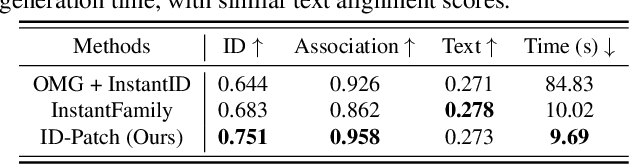

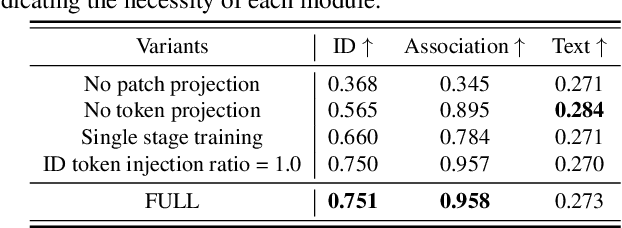
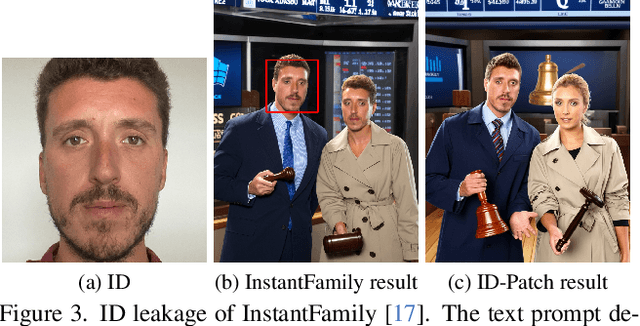
The ability to synthesize personalized group photos and specify the positions of each identity offers immense creative potential. While such imagery can be visually appealing, it presents significant challenges for existing technologies. A persistent issue is identity (ID) leakage, where injected facial features interfere with one another, resulting in low face resemblance, incorrect positioning, and visual artifacts. Existing methods suffer from limitations such as the reliance on segmentation models, increased runtime, or a high probability of ID leakage. To address these challenges, we propose ID-Patch, a novel method that provides robust association between identities and 2D positions. Our approach generates an ID patch and ID embeddings from the same facial features: the ID patch is positioned on the conditional image for precise spatial control, while the ID embeddings integrate with text embeddings to ensure high resemblance. Experimental results demonstrate that ID-Patch surpasses baseline methods across metrics, such as face ID resemblance, ID-position association accuracy, and generation efficiency. Project Page is: https://byteaigc.github.io/ID-Patch/
Self-Calibrated Listwise Reranking with Large Language Models
Nov 07, 2024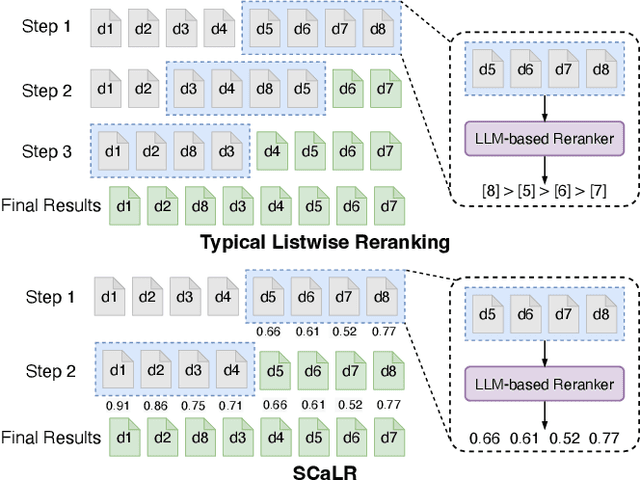
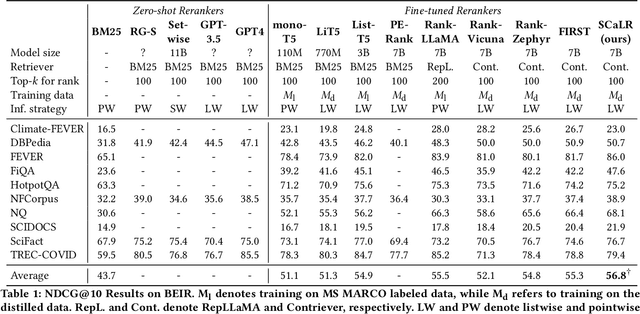
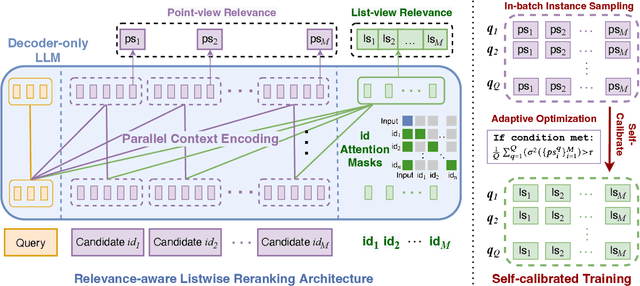

Large language models (LLMs), with advanced linguistic capabilities, have been employed in reranking tasks through a sequence-to-sequence approach. In this paradigm, multiple passages are reranked in a listwise manner and a textual reranked permutation is generated. However, due to the limited context window of LLMs, this reranking paradigm requires a sliding window strategy to iteratively handle larger candidate sets. This not only increases computational costs but also restricts the LLM from fully capturing all the comparison information for all candidates. To address these challenges, we propose a novel self-calibrated listwise reranking method, which aims to leverage LLMs to produce global relevance scores for ranking. To achieve it, we first propose the relevance-aware listwise reranking framework, which incorporates explicit list-view relevance scores to improve reranking efficiency and enable global comparison across the entire candidate set. Second, to ensure the comparability of the computed scores, we propose self-calibrated training that uses point-view relevance assessments generated internally by the LLM itself to calibrate the list-view relevance assessments. Extensive experiments and comprehensive analysis on the BEIR benchmark and TREC Deep Learning Tracks demonstrate the effectiveness and efficiency of our proposed method.
Quantum Diffusion Models for Few-Shot Learning
Nov 06, 2024
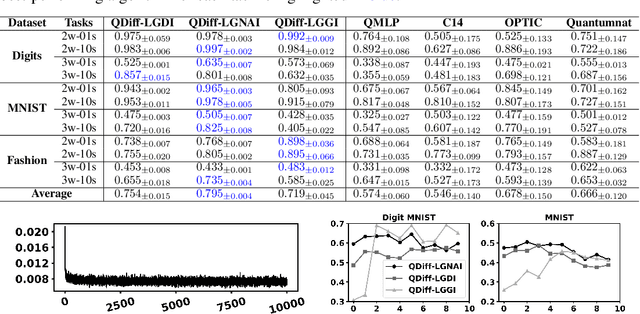

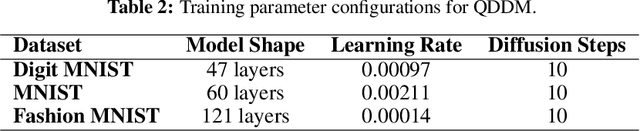
Modern quantum machine learning (QML) methods involve the variational optimization of parameterized quantum circuits on training datasets, followed by predictions on testing datasets. Most state-of-the-art QML algorithms currently lack practical advantages due to their limited learning capabilities, especially in few-shot learning tasks. In this work, we propose three new frameworks employing quantum diffusion model (QDM) as a solution for the few-shot learning: label-guided generation inference (LGGI); label-guided denoising inference (LGDI); and label-guided noise addition inference (LGNAI). Experimental results demonstrate that our proposed algorithms significantly outperform existing methods.
Deep Insights into Automated Optimization with Large Language Models and Evolutionary Algorithms
Oct 28, 2024Designing optimization approaches, whether heuristic or meta-heuristic, usually demands extensive manual intervention and has difficulty generalizing across diverse problem domains. The combination of Large Language Models (LLMs) and Evolutionary Algorithms (EAs) offers a promising new approach to overcome these limitations and make optimization more automated. In this setup, LLMs act as dynamic agents that can generate, refine, and interpret optimization strategies, while EAs efficiently explore complex solution spaces through evolutionary operators. Since this synergy enables a more efficient and creative search process, we first conduct an extensive review of recent research on the application of LLMs in optimization. We focus on LLMs' dual functionality as solution generators and algorithm designers. Then, we summarize the common and valuable designs in existing work and propose a novel LLM-EA paradigm for automated optimization. Furthermore, centered on this paradigm, we conduct an in-depth analysis of innovative methods for three key components: individual representation, variation operators, and fitness evaluation. We address challenges related to heuristic generation and solution exploration, especially from the LLM prompts' perspective. Our systematic review and thorough analysis of the paradigm can assist researchers in better understanding the current research and promoting the development of combining LLMs with EAs for automated optimization.
ChatSearch: a Dataset and a Generative Retrieval Model for General Conversational Image Retrieval
Oct 24, 2024

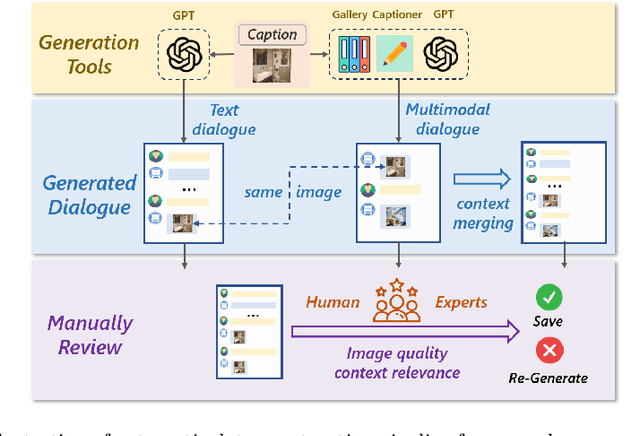

In this paper, we investigate the task of general conversational image retrieval on open-domain images. The objective is to search for images based on interactive conversations between humans and computers. To advance this task, we curate a dataset called ChatSearch. This dataset includes a multi-round multimodal conversational context query for each target image, thereby requiring the retrieval system to find the accurate image from database. Simultaneously, we propose a generative retrieval model named ChatSearcher, which is trained end-to-end to accept/produce interleaved image-text inputs/outputs. ChatSearcher exhibits strong capability in reasoning with multimodal context and can leverage world knowledge to yield visual retrieval results. It demonstrates superior performance on the ChatSearch dataset and also achieves competitive results on other image retrieval tasks and visual conversation tasks. We anticipate that this work will inspire further research on interactive multimodal retrieval systems. Our dataset will be available at https://github.com/joez17/ChatSearch.
AutoRNet: Automatically Optimizing Heuristics for Robust Network Design via Large Language Models
Oct 23, 2024Achieving robust networks is a challenging problem due to its NP-hard nature and complex solution space. Current methods, from handcrafted feature extraction to deep learning, have made progress but remain rigid, requiring manual design and large labeled datasets. To address these issues, we propose AutoRNet, a framework that integrates large language models (LLMs) with evolutionary algorithms to generate heuristics for robust network design. We design network optimization strategies to provide domain-specific prompts for LLMs, utilizing domain knowledge to generate advanced heuristics. Additionally, we introduce an adaptive fitness function to balance convergence and diversity while maintaining degree distributions. AutoRNet is evaluated on sparse and dense scale-free networks, outperforming current methods by reducing the need for manual design and large datasets.
Ada-K Routing: Boosting the Efficiency of MoE-based LLMs
Oct 15, 2024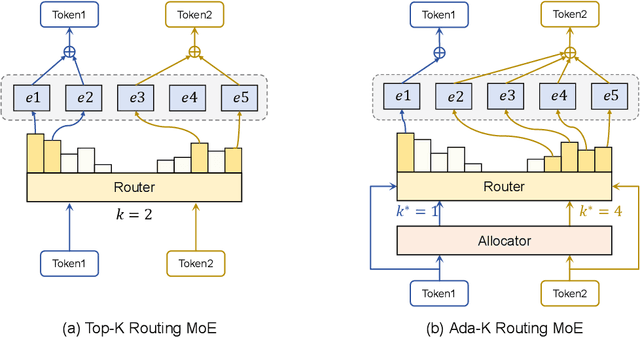
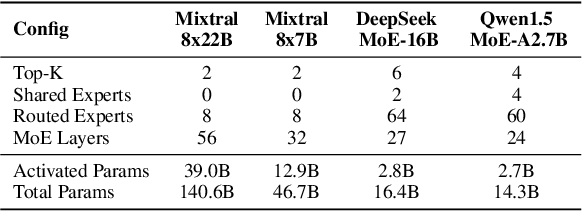
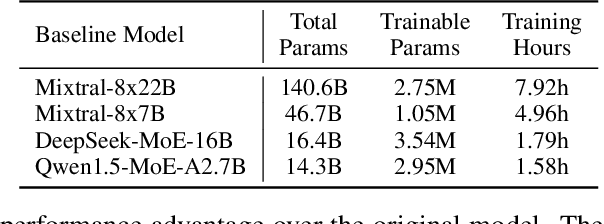
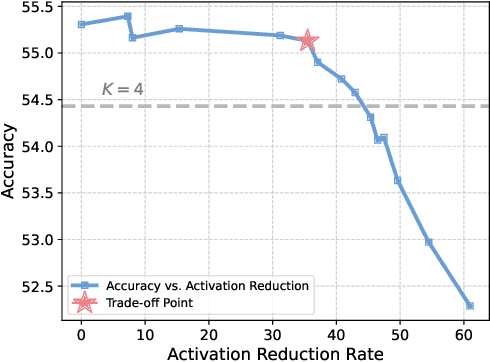
In the era of Large Language Models (LLMs), Mixture-of-Experts (MoE) architectures offer a promising approach to managing computational costs while scaling up model parameters. Conventional MoE-based LLMs typically employ static Top-K routing, which activates a fixed and equal number of experts for each token regardless of their significance within the context. In this paper, we propose a novel Ada-K routing strategy that dynamically adjusts the number of activated experts for each token, thereby improving the balance between computational efficiency and model performance. Specifically, our strategy incorporates learnable and lightweight allocator modules that decide customized expert resource allocation tailored to the contextual needs for each token. These allocators are designed to be fully pluggable, making it broadly applicable across all mainstream MoE-based LLMs. We leverage the Proximal Policy Optimization (PPO) algorithm to facilitate an end-to-end learning process for this non-differentiable decision-making framework. Extensive evaluations on four popular baseline models demonstrate that our Ada-K routing method significantly outperforms conventional Top-K routing. Compared to Top-K, our method achieves over 25% reduction in FLOPs and more than 20% inference speedup while still improving performance across various benchmarks. Moreover, the training of Ada-K is highly efficient. Even for Mixtral-8x22B, a MoE-based LLM with more than 140B parameters, the training time is limited to 8 hours. Detailed analysis shows that harder tasks, middle layers, and content words tend to activate more experts, providing valuable insights for future adaptive MoE system designs. Both the training code and model checkpoints will be publicly available.
ZipVL: Efficient Large Vision-Language Models with Dynamic Token Sparsification and KV Cache Compression
Oct 11, 2024The efficiency of large vision-language models (LVLMs) is constrained by the computational bottleneck of the attention mechanism during the prefill phase and the memory bottleneck of fetching the key-value (KV) cache in the decoding phase, particularly in scenarios involving high-resolution images or videos. Visual content often exhibits substantial redundancy, resulting in highly sparse attention maps within LVLMs. This sparsity can be leveraged to accelerate attention computation or compress the KV cache through various approaches. However, most studies focus on addressing only one of these bottlenecks and do not adequately support dynamic adjustment of sparsity concerning distinct layers or tasks. In this paper, we present ZipVL, an efficient inference framework designed for LVLMs that resolves both computation and memory bottlenecks through a dynamic ratio allocation strategy of important tokens. This ratio is adaptively determined based on the layer-specific distribution of attention scores, rather than fixed hyper-parameters, thereby improving efficiency for less complex tasks while maintaining high performance for more challenging ones. Then we select important tokens based on their normalized attention scores and perform attention mechanism solely on those important tokens to accelerate the prefill phase. To mitigate the memory bottleneck in the decoding phase, we employ mixed-precision quantization to the KV cache, where high-bit quantization is used for caches of important tokens, while low-bit quantization is applied to those of less importance. Our experiments demonstrate that ZipVL can accelerate the prefill phase by 2.6$\times$ and reduce GPU memory usage by 50.0%, with a minimal accuracy reduction of only 0.2% on Video-MME benchmark over LongVA-7B model, effectively enhancing the generation efficiency of LVLMs.
Gap Preserving Distillation by Building Bidirectional Mappings with A Dynamic Teacher
Oct 05, 2024
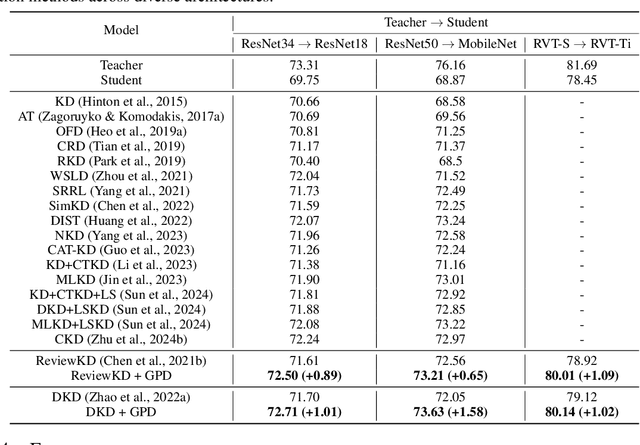
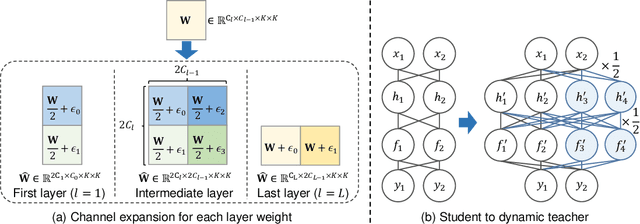

Knowledge distillation aims to transfer knowledge from a large teacher model to a compact student counterpart, often coming with a significant performance gap between them. We find that a too-large performance gap can hamper the training process, which is also verified in recent studies. To address this, we propose a Gap Preserving Distillation (GPD) method that trains an additional dynamic teacher model from scratch along with training the student to bridge this gap. In this way, it becomes possible to maintain a reasonable performance gap between teacher and student during the whole distillation process. To further strengthen distillation from the dynamic teacher to the student, we develop a hard strategy by enforcing them to share parameters and encouraging parameter inheritance. Besides hard strategy, we also build the soft bidirectional mappings between them which are built on an Inverse Reparameterization (IR) method and a Channel-Branch Reparameterization (CBR) strategy. We highlight that our IR is able to initialize a larger dynamic teacher with an arbitrary expansion ratio, while preserving exactly the same accuracy as the given student model. In this way, it guarantees that the dynamic teacher and student start from the same point and avoid a too large gap in early stage of training. As for our CBR, with parameter-sharing, it directly extracts an effective student model from the well-learned dynamic teacher without any post-training, making our method highly flexible for model deployment. In the experiments, GPD significantly outperforms existing distillation methods on top of both CNNs and transformers architectures, achieving up to 1.58% accuracy improvement. Interestingly, GPD also generalizes well to the scenarios without a pre-trained teacher, including training from scratch and fine-tuning, yielding a large improvement of 1.80% and 0.89% on ResNet18, respectively.