 Add to Chrome
 Add to Firefox
 Add to Edge
PointQ-Bench: Benchmarking Diagnostic and Interpretable Point Cloud Quality Assessment
May 27, 2026
Point cloud quality plays a critical role in 3D acquisition, reconstruction, rendering, and perception, yet existing point cloud quality assessment (PCQA) research remains largely centered on scalar score prediction. In practical inspection scenarios, quality assessment often involves identifying defects, characterizing dominant issue types, assessing downstream usability, and providing evidence-supported descriptions, which are not explicitly evaluated by current benchmarks. We introduce PointQ-Bench, a benchmark designed to extend PCQA from scalar scoring toward comprehensive quality understanding. PointQ-Bench consists of 3,083 point clouds spanning authentic scans, simulated distortions, and AI-generated content, covering eight major issue types. Each sample is annotated with mean opinion scores (MOS), quality levels, issue tags, expert-grounded descriptions, and 12,332 question-answer pairs. The benchmark supports three perception-oriented tasks: anomaly sensing, defect diagnosis, and usability grading, as well as a cognition-oriented task of open-ended quality reporting. To evaluate free-form quality descriptions, we further propose SSFRQ-5D, a five-dimensional evaluation protocol validated through human-AI agreement analysis. Extensive experiments on 14 vision-language models and traditional PCQA baselines reveal a consistent perception-diagnosis gap: while current models exhibit emerging abilities in coarse defect perception, they struggle with grounded diagnosis and quality calibration. Strong 2D MLLMs generally outperform existing 3D VLMs, and the benefit of additional views or point-level inputs is non-uniform, varying across tasks, data sources, and models, particularly under boundary-ambiguous conditions. Overall, PointQ-Bench provides a diagnostic testbed for advancing reliable and interpretable point cloud quality understanding.

ForestHG-Trace: Traceable Long-Horizon Ecological Reasoning over Large-Scale Forest Scenes
May 26, 2026Remote sensing question answering (RS-QA) often requires more than direct semantic prediction, especially in large-scale forest scenes where ecological analysis involves multi-step filtering, numerical aggregation, neighborhood reasoning, and verifiable evidence. We introduce ForestHG-Trace, a framework for traceable long-horizon ecological reasoning over forest environments. It represents multimodal NEON forest scenes as ecological hypergraphs, where tree instances, spatial units, semantic groups, and neighborhood relations support higher-order reasoning beyond pairwise scene graphs. An LLM-guided agent then invokes deterministic tools for reading, filtering, expansion, aggregation, comparison, and auditing, producing replayable execution traces and compact evidence records rather than only free-form answers. We further construct ForestTraceQA, an executable benchmark for evaluating ecological QA across diverse task types and reasoning depths. Experiments show that ForestHG-Trace substantially improves answer accuracy and execution faithfulness over single-step baselines and scene-graph agents, while highlighting execution depth as the main bottleneck for long-horizon ecological QA.
VertiCue-Bench: Diagnosing Whether MLLMs Use Height Cues to Resolve 2D Ambiguity in Remote Sensing Natural Scenes
May 25, 2026Multimodal Large Language Models (MLLMs) have recently shown promising progress in geospatial reasoning. However, existing remote sensing benchmarks remain largely 2D-centric, evaluating models primarily on optical appearance. In natural environments, this paradigm breaks down due to severe spectral confusion, where ecologically distinct regions share similar textures but differ fundamentally in vertical structure. In such cases, explicit 3D structural data, such as Canopy Height Models (CHMs), become essential geometric evidence for semantic disambiguation. Yet, it remains unclear whether current MLLMs can genuinely leverage vertical cues to resolve appearance-level ambiguity. To address this gap, we introduce VertiCue-Bench, the first diagnostic benchmark for CHM-grounded geospatial reasoning. VertiCue-Bench comprises 1,534 carefully curated instances across 17 tasks, explicitly disentangling low-level height perception from ambiguity-aware semantic reasoning. Evaluations on 14 state-of-the-art general and remote-sensing-specialized MLLMs, combined with counterfactual modality testing, reveal a striking perception-reasoning dissociation. While models exhibit emerging competence in reading raw CHM height cues, they largely fail to translate geometric perception into reliable semantic reasoning, often underperforming RGB-only baselines when joint constraints are required. Overall, VertiCue-Bench exposes a critical geometry-to-semantics gap in natural scene understanding, offering actionable insights for advancing geospatial MLLMs.
Advancing the Understanding of Fine-Grained 3D Forest Structures using Digital Cousins and Simulation-to-Reality: Methods and Datasets
Jan 07, 2025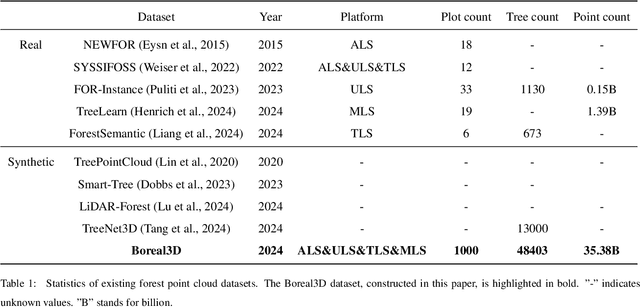
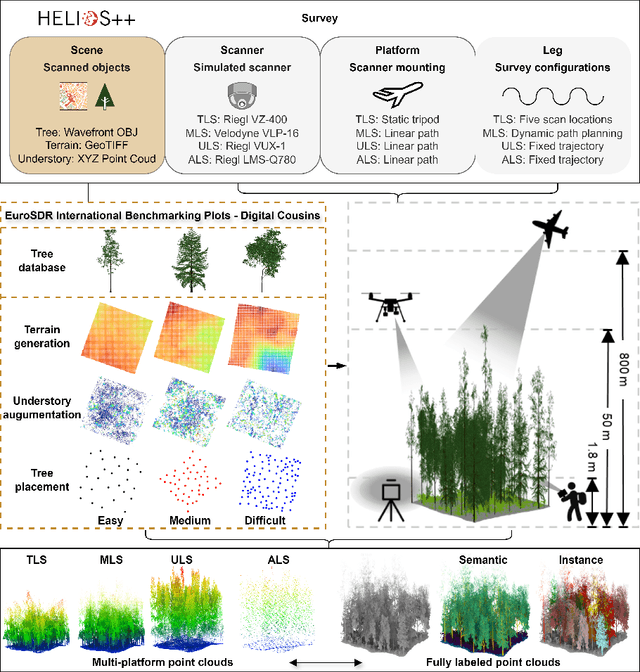
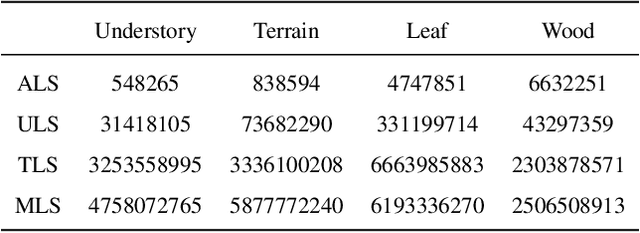
Understanding and analyzing the spatial semantics and structure of forests is essential for accurate forest resource monitoring and ecosystem research. However, the lack of large-scale and annotated datasets has limited the widespread use of advanced intelligent techniques in this field. To address this challenge, a fully automated synthetic data generation and processing framework based on the concepts of Digital Cousins and Simulation-to-Reality (Sim2Real) is proposed, offering versatility and scalability to any size and platform. Using this process, we created the Boreal3D, the world's largest forest point cloud dataset. It includes 1000 highly realistic and structurally diverse forest plots across four different platforms, totaling 48,403 trees and over 35.3 billion points. Each point is labeled with semantic, instance, and viewpoint information, while each tree is described with structural parameters such as diameter, crown width, leaf area, and total volume. We designed and conducted extensive experiments to evaluate the potential of Boreal3D in advancing fine-grained 3D forest structure analysis in real-world applications. The results demonstrate that with certain strategies, models pre-trained on synthetic data can significantly improve performance when applied to real forest datasets. Especially, the findings reveal that fine-tuning with only 20% of real-world data enables the model to achieve performance comparable to models trained exclusively on entire real-world data, highlighting the value and potential of our proposed framework. The Boreal3D dataset, and more broadly, the synthetic data augmentation framework, is poised to become a critical resource for advancing research in large-scale 3D forest scene understanding and structural parameter estimation.
CompetitorFormer: Competitor Transformer for 3D Instance Segmentation
Nov 21, 2024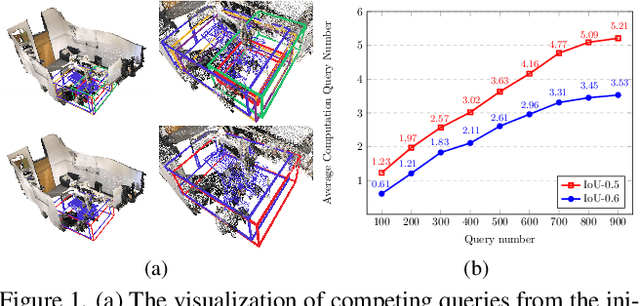
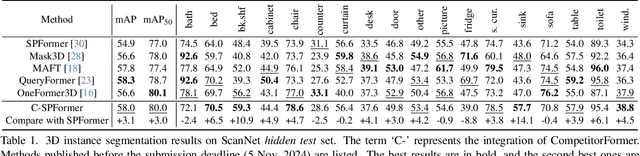
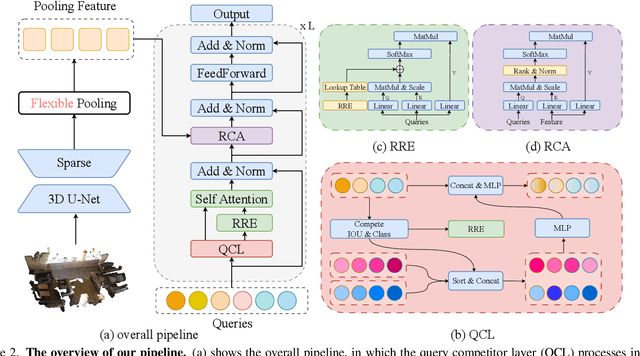

Transformer-based methods have become the dominant approach for 3D instance segmentation. These methods predict instance masks via instance queries, ranking them by classification confidence and IoU scores to select the top prediction as the final outcome. However, it has been observed that the current models employ a fixed and higher number of queries than the instances present within a scene. In such instances, multiple queries predict the same instance, yet only a single query is ultimately optimized. The close scores of queries in the lower-level decoders make it challenging for the dominant query to distinguish itself rapidly, which ultimately impairs the model's accuracy and convergence efficiency. This phenomenon is referred to as inter-query competition. To address this challenge, we put forth a series of plug-and-play competition-oriented designs, collectively designated as the CompetitorFormer, with the aim of reducing competition and facilitating a dominant query. Experiments showed that integrating our designs with state-of-the-art frameworks consistently resulted in significant performance improvements in 3D instance segmentation across a range of datasets.