 Add to Chrome
 Add to Firefox
 Add to Edge
CSPF: A Constrained Shared-Private Fusion Method for Non-Verifiable Preference Evaluation
Jul 23, 2026
At present, reliable evaluation of non-verifiable tasks remains challenging. Existing approaches often fail to adequately capture the diverse evaluative criteria underlying human preferences in such tasks. To this end, we propose Constrained Shared-Private Fusion (CSPF), a fusion method that treats heterogeneous frozen reward models as complementary evaluators and learns to integrate their hidden-state representations under pairwise human-preference supervision. CSPF decomposes each expert signal into shared and expert-private representations, encouraging cross-expert alignment while preserving complementary viewpoints. Across experiments on LM-Arena target-domain adaptation and PPE out-of-distribution preference evaluation, CSPF achieves the best performance on the primary metrics among the evaluated single-expert reward-model, scalar-score multi-expert, and rubric-judge baselines. Overall, CSPF suggests that fusing hidden-state representations provides a more expressive basis for preference assessment, offering a practical route toward integrated evaluative signals for non-verifiable preference tasks.

Ada-K Routing: Boosting the Efficiency of MoE-based LLMs
Oct 15, 2024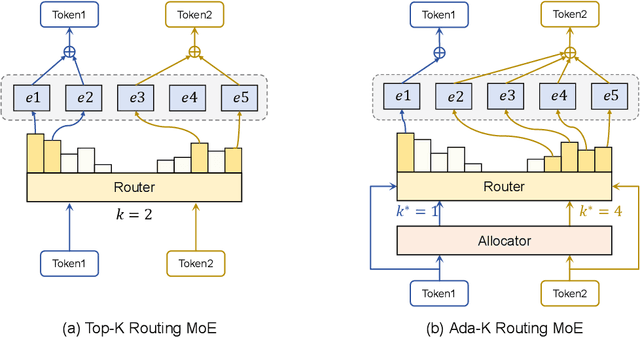
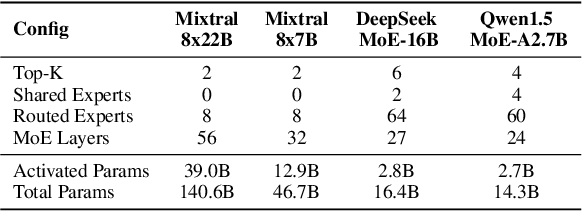
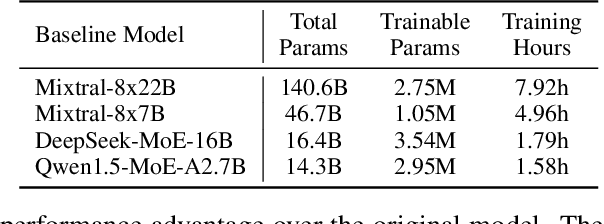
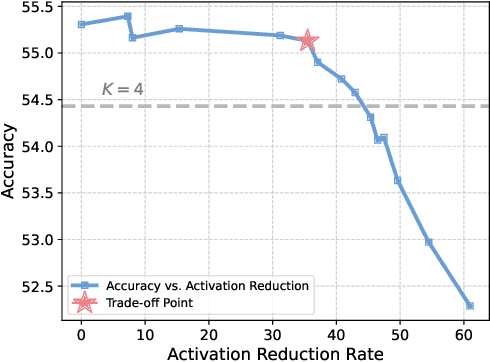
In the era of Large Language Models (LLMs), Mixture-of-Experts (MoE) architectures offer a promising approach to managing computational costs while scaling up model parameters. Conventional MoE-based LLMs typically employ static Top-K routing, which activates a fixed and equal number of experts for each token regardless of their significance within the context. In this paper, we propose a novel Ada-K routing strategy that dynamically adjusts the number of activated experts for each token, thereby improving the balance between computational efficiency and model performance. Specifically, our strategy incorporates learnable and lightweight allocator modules that decide customized expert resource allocation tailored to the contextual needs for each token. These allocators are designed to be fully pluggable, making it broadly applicable across all mainstream MoE-based LLMs. We leverage the Proximal Policy Optimization (PPO) algorithm to facilitate an end-to-end learning process for this non-differentiable decision-making framework. Extensive evaluations on four popular baseline models demonstrate that our Ada-K routing method significantly outperforms conventional Top-K routing. Compared to Top-K, our method achieves over 25% reduction in FLOPs and more than 20% inference speedup while still improving performance across various benchmarks. Moreover, the training of Ada-K is highly efficient. Even for Mixtral-8x22B, a MoE-based LLM with more than 140B parameters, the training time is limited to 8 hours. Detailed analysis shows that harder tasks, middle layers, and content words tend to activate more experts, providing valuable insights for future adaptive MoE system designs. Both the training code and model checkpoints will be publicly available.