 Add to Chrome
 Add to Firefox
 Add to Edge
PRISM of Opinions: A Persona-Reasoned Multimodal Framework for User-centric Conversational Stance Detection
Nov 15, 2025
The rapid proliferation of multimodal social media content has driven research in Multimodal Conversational Stance Detection (MCSD), which aims to interpret users' attitudes toward specific targets within complex discussions. However, existing studies remain limited by: **1) pseudo-multimodality**, where visual cues appear only in source posts while comments are treated as text-only, misaligning with real-world multimodal interactions; and **2) user homogeneity**, where diverse users are treated uniformly, neglecting personal traits that shape stance expression. To address these issues, we introduce **U-MStance**, the first user-centric MCSD dataset, containing over 40k annotated comments across six real-world targets. We further propose **PRISM**, a **P**ersona-**R**easoned mult**I**modal **S**tance **M**odel for MCSD. PRISM first derives longitudinal user personas from historical posts and comments to capture individual traits, then aligns textual and visual cues within conversational context via Chain-of-Thought to bridge semantic and pragmatic gaps across modalities. Finally, a mutual task reinforcement mechanism is employed to jointly optimize stance detection and stance-aware response generation for bidirectional knowledge transfer. Experiments on U-MStance demonstrate that PRISM yields significant gains over strong baselines, underscoring the effectiveness of user-centric and context-grounded multimodal reasoning for realistic stance understanding.

Data Trajectory Alignment for LLM Domain Adaptation: A Two-Phase Synthesis Framework for Telecommunications Mathematics
Nov 10, 2025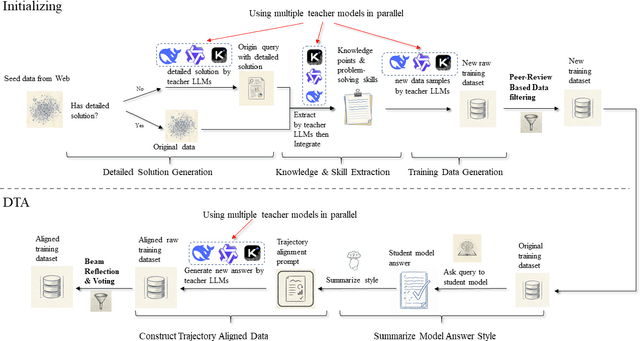
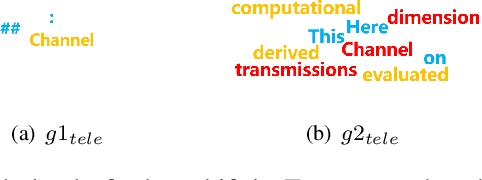
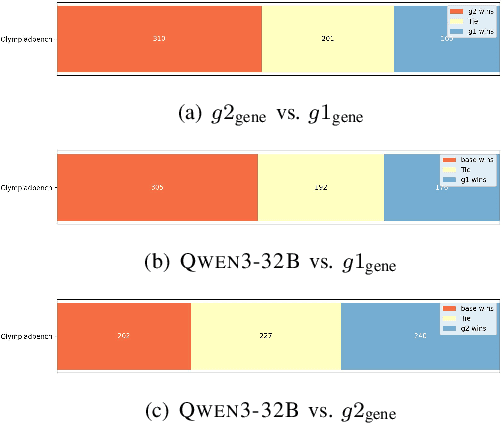
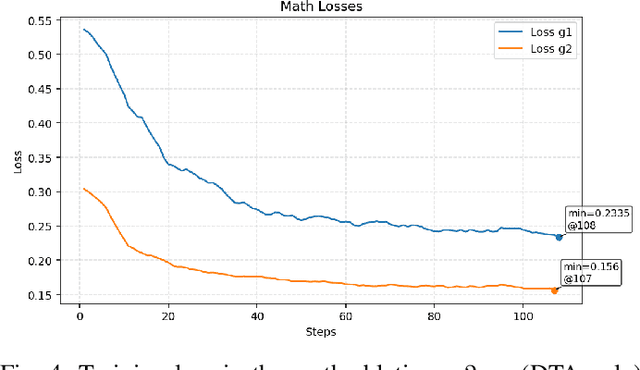
General-purpose large language models (LLMs) are increasingly deployed in verticals such as telecommunications, where adaptation is hindered by scarce, low-information-density corpora and tight mobile/edge constraints. We propose Data Trajectory Alignment (DTA), a two-phase, model-agnostic data curation framework that treats solution processes - not only final answers - as first-class supervision. Phase I (Initializing) synthesizes diverse, high-coverage candidates using an ensemble of strong teachers. Phase II (DTA) rewrites teacher solutions to align intermediate steps and presentation style with the target student's inductive biases and then performs signal-aware exemplar selection via agreement checks and reflection-based judging. Instantiated on telecommunications mathematics (e.g., link budgets, SNR/AMC selection, and power-control feasibility), DTA yields state-of-the-art (SOTA) accuracy on TELEMATH without enabling explicit "thinking" modes: 72.45% pass@1, surpassing distilled-only training by +17.65 points and outperforming a strong baseline (Qwen3-32B with thinking enabled) by +2.94 points. Token-shift analyses indicate that DTA concentrates gains on logical-structural discourse markers rather than merely amplifying domain nouns, indicating improved reasoning scaffolding. Under edge-like inference settings, DTA improves efficiency by reducing reliance on multi-sample voting and disabling expensive reasoning heuristics, cutting energy per output token by ~42% versus Qwen3-32B (thinking mode enabled) and end-to-end latency by ~60% versus Qwen3-32B (thinking mode disabled). These results demonstrate that aligning how solutions are produced enables compact, high-yield supervision that is effective for both accuracy and efficiency, offering a practical recipe for domain adaptation in low-resource verticals beyond telecom.
ReMoD: Rethinking Modality Contribution in Multimodal Stance Detection via Dual Reasoning
Nov 08, 2025Multimodal Stance Detection (MSD) is a crucial task for understanding public opinion on social media. Existing work simply fuses information from various modalities to learn stance representations, overlooking the varying contributions of stance expression from different modalities. Therefore, stance misunderstanding noises may be drawn into the stance learning process due to the risk of learning errors by rough modality combination. To address this, we get inspiration from the dual-process theory of human cognition and propose **ReMoD**, a framework that **Re**thinks **Mo**dality contribution of stance expression through a **D**ual-reasoning paradigm. ReMoD integrates *experience-driven intuitive reasoning* to capture initial stance cues with *deliberate reflective reasoning* to adjust for modality biases, refine stance judgments, and thereby dynamically weight modality contributions based on their actual expressive power for the target stance. Specifically, the intuitive stage queries the Modality Experience Pool (MEP) and Semantic Experience Pool (SEP) to form an initial stance hypothesis, prioritizing historically impactful modalities. This hypothesis is then refined in the reflective stage via two reasoning chains: Modality-CoT updates MEP with adaptive fusion strategies to amplify relevant modalities, while Semantic-CoT refines SEP with deeper contextual insights of stance semantics. These dual experience structures are continuously refined during training and recalled at inference to guide robust and context-aware stance decisions. Extensive experiments on the public MMSD benchmark demonstrate that our ReMoD significantly outperforms most baseline models and exhibits strong generalization capabilities.
Unveiling Modality Bias: Automated Sample-Specific Analysis for Multimodal Misinformation Benchmarks
Nov 08, 2025Numerous multimodal misinformation benchmarks exhibit bias toward specific modalities, allowing detectors to make predictions based solely on one modality. While previous research has quantified bias at the dataset level or manually identified spurious correlations between modalities and labels, these approaches lack meaningful insights at the sample level and struggle to scale to the vast amount of online information. In this paper, we investigate the design for automated recognition of modality bias at the sample level. Specifically, we propose three bias quantification methods based on theories/views of different levels of granularity: 1) a coarse-grained evaluation of modality benefit; 2) a medium-grained quantification of information flow; and 3) a fine-grained causality analysis. To verify the effectiveness, we conduct a human evaluation on two popular benchmarks. Experimental results reveal three interesting findings that provide potential direction toward future research: 1)~Ensembling multiple views is crucial for reliable automated analysis; 2)~Automated analysis is prone to detector-induced fluctuations; and 3)~Different views produce a higher agreement on modality-balanced samples but diverge on biased ones.
Carbon Price Forecasting with Structural Breaks: A Comparative Study of Deep Learning Models
Nov 07, 2025Accurately forecasting carbon prices is essential for informed energy market decision-making, guiding sustainable energy planning, and supporting effective decarbonization strategies. However, it remains challenging due to structural breaks and high-frequency noise caused by frequent policy interventions and market shocks. Existing studies, including the most recent baseline approaches, have attempted to incorporate breakpoints but often treat denoising and modeling as separate processes and lack systematic evaluation across advanced deep learning architectures, limiting the robustness and the generalization capability. To address these gaps, this paper proposes a comprehensive hybrid framework that integrates structural break detection (Bai-Perron, ICSS, and PELT algorithms), wavelet signal denoising, and three state-of-the-art deep learning models (LSTM, GRU, and TCN). Using European Union Allowance (EUA) spot prices from 2007 to 2024 and exogenous features such as energy prices and policy indicators, the framework constructs univariate and multivariate datasets for comparative evaluation. Experimental results demonstrate that our proposed PELT-WT-TCN achieves the highest prediction accuracy, reducing forecasting errors by 22.35% in RMSE and 18.63% in MAE compared to the state-of-the-art baseline model (Breakpoints with Wavelet and LSTM), and by 70.55% in RMSE and 74.42% in MAE compared to the original LSTM without decomposition from the same baseline study. These findings underscore the value of integrating structural awareness and multiscale decomposition into deep learning architectures to enhance accuracy and interpretability in carbon price forecasting and other nonstationary financial time series.
A Clinical-grade Universal Foundation Model for Intraoperative Pathology
Oct 06, 2025Intraoperative pathology is pivotal to precision surgery, yet its clinical impact is constrained by diagnostic complexity and the limited availability of high-quality frozen-section data. While computational pathology has made significant strides, the lack of large-scale, prospective validation has impeded its routine adoption in surgical workflows. Here, we introduce CRISP, a clinical-grade foundation model developed on over 100,000 frozen sections from eight medical centers, specifically designed to provide Clinical-grade Robust Intraoperative Support for Pathology (CRISP). CRISP was comprehensively evaluated on more than 15,000 intraoperative slides across nearly 100 retrospective diagnostic tasks, including benign-malignant discrimination, key intraoperative decision-making, and pan-cancer detection, etc. The model demonstrated robust generalization across diverse institutions, tumor types, and anatomical sites-including previously unseen sites and rare cancers. In a prospective cohort of over 2,000 patients, CRISP sustained high diagnostic accuracy under real-world conditions, directly informing surgical decisions in 92.6% of cases. Human-AI collaboration further reduced diagnostic workload by 35%, avoided 105 ancillary tests and enhanced detection of micrometastases with 87.5% accuracy. Together, these findings position CRISP as a clinical-grade paradigm for AI-driven intraoperative pathology, bridging computational advances with surgical precision and accelerating the translation of artificial intelligence into routine clinical practice.
Hunyuan3D Studio: End-to-End AI Pipeline for Game-Ready 3D Asset Generation
Sep 16, 2025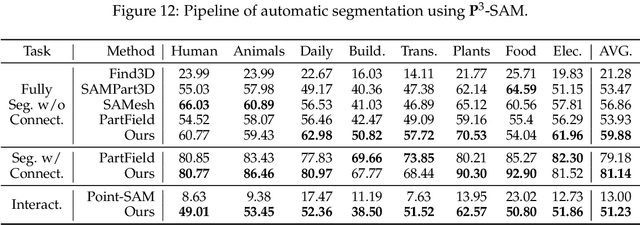
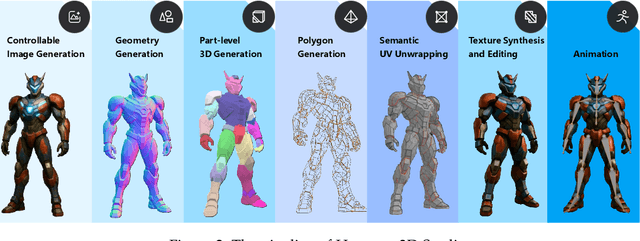

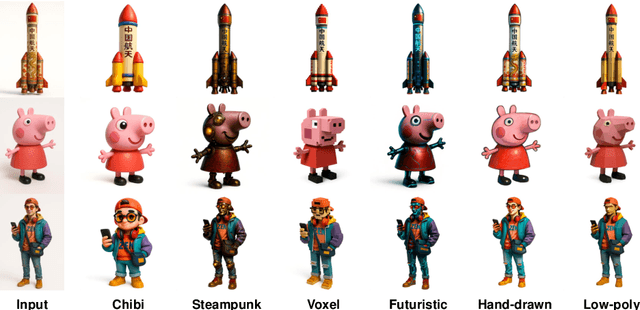
The creation of high-quality 3D assets, a cornerstone of modern game development, has long been characterized by labor-intensive and specialized workflows. This paper presents Hunyuan3D Studio, an end-to-end AI-powered content creation platform designed to revolutionize the game production pipeline by automating and streamlining the generation of game-ready 3D assets. At its core, Hunyuan3D Studio integrates a suite of advanced neural modules (such as Part-level 3D Generation, Polygon Generation, Semantic UV, etc.) into a cohesive and user-friendly system. This unified framework allows for the rapid transformation of a single concept image or textual description into a fully-realized, production-quality 3D model complete with optimized geometry and high-fidelity PBR textures. We demonstrate that assets generated by Hunyuan3D Studio are not only visually compelling but also adhere to the stringent technical requirements of contemporary game engines, significantly reducing iteration time and lowering the barrier to entry for 3D content creation. By providing a seamless bridge from creative intent to technical asset, Hunyuan3D Studio represents a significant leap forward for AI-assisted workflows in game development and interactive media.
STARE at the Structure: Steering ICL Exemplar Selection with Structural Alignment
Aug 28, 2025In-Context Learning (ICL) has become a powerful paradigm that enables LLMs to perform a wide range of tasks without task-specific fine-tuning. However, the effectiveness of ICL heavily depends on the quality of exemplar selection. In particular, for structured prediction tasks such as semantic parsing, existing ICL selection strategies often overlook structural alignment, leading to suboptimal performance and poor generalization. To address this issue, we propose a novel two-stage exemplar selection strategy that achieves a strong balance between efficiency, generalizability, and performance. First, we fine-tune a BERT-based retriever using structure-aware supervision, guiding it to select exemplars that are both semantically relevant and structurally aligned. Then, we enhance the retriever with a plug-in module, which amplifies syntactically meaningful information in the hidden representations. This plug-in is model-agnostic, requires minimal overhead, and can be seamlessly integrated into existing pipelines. Experiments on four benchmarks spanning three semantic parsing tasks demonstrate that our method consistently outperforms existing baselines with multiple recent LLMs as inference-time models.
GRASP: Geospatial pixel Reasoning viA Structured Policy learning
Aug 23, 2025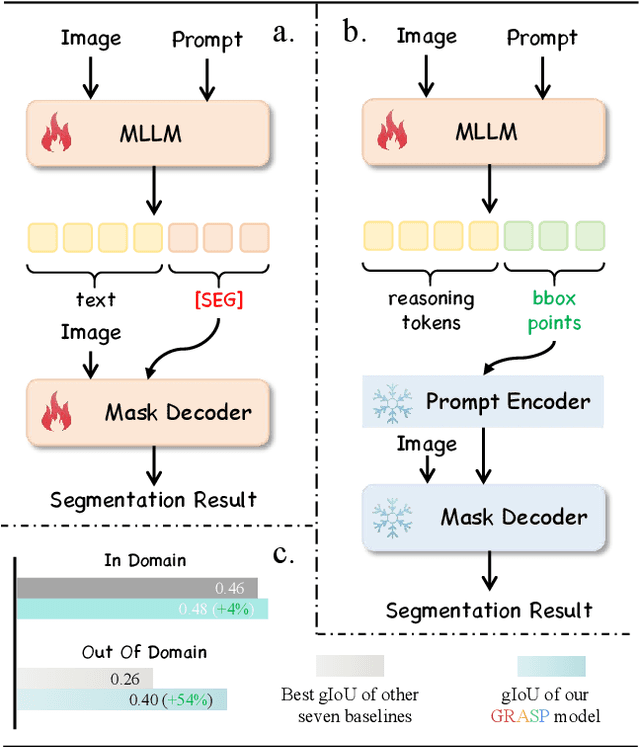
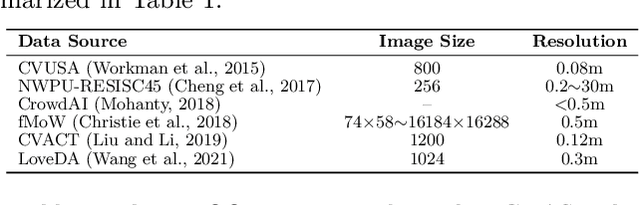
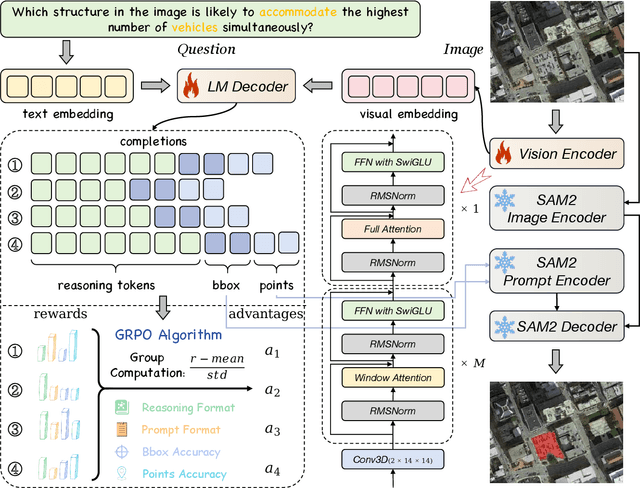
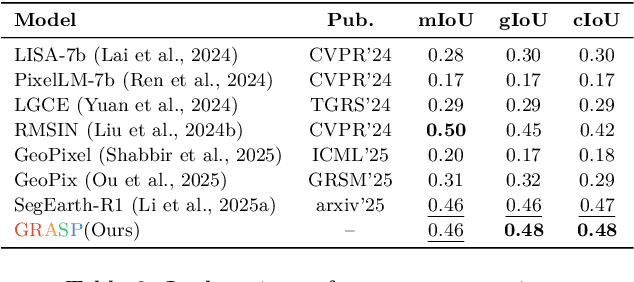
Geospatial pixel reasoning is a nascent remote-sensing task that aims to generate segmentation masks directly from natural-language instructions. Prevailing MLLM-based systems co-train a language model and a mask decoder with dense pixel supervision, which is expensive and often weak on out-of-domain (OOD) data. We introduce GRASP, a structured policy-learning framework. In our design, a multimodal large language model first emits task-relevant bounding boxes and positive points from a vision-language instruction. These outputs are then passed to a pre-trained segmentation model, which consumes them as prompts to generate the final mask. Instead of supervised fine-tuning, we optimize the system purely with reinforcement learning: the model is trained solely with GRPO, guided by format rewards and accuracy rewards computed on boxes and points (no mask supervision). This leverages strong priors in foundation models, minimizes trainable parameters, and enables learning from inexpensive annotations. We additionally curate GRASP-1k, which contains reasoning-intensive queries, detailed reasoning traces, and fine-grained segmentation annotations. Evaluations on both in-domain and out-of-domain test sets show state-of-the-art results: about 4% improvement in-domain and up to 54% on OOD benchmarks. The experiment results evidence our model's robust generalization and demonstrate that complex geospatial segmentation behaviors can be learned via RL from weak spatial cues. Code and the dataset will be released open-source.
GLM-4.5: Agentic, Reasoning, and Coding (ARC) Foundation Models
Aug 08, 2025We present GLM-4.5, an open-source Mixture-of-Experts (MoE) large language model with 355B total parameters and 32B activated parameters, featuring a hybrid reasoning method that supports both thinking and direct response modes. Through multi-stage training on 23T tokens and comprehensive post-training with expert model iteration and reinforcement learning, GLM-4.5 achieves strong performance across agentic, reasoning, and coding (ARC) tasks, scoring 70.1% on TAU-Bench, 91.0% on AIME 24, and 64.2% on SWE-bench Verified. With much fewer parameters than several competitors, GLM-4.5 ranks 3rd overall among all evaluated models and 2nd on agentic benchmarks. We release both GLM-4.5 (355B parameters) and a compact version, GLM-4.5-Air (106B parameters), to advance research in reasoning and agentic AI systems. Code, models, and more information are available at https://github.com/zai-org/GLM-4.5.