 Add to Chrome
 Add to Firefox
 Add to Edge
Model-Agnostic Lifelong LLM Safety via Externalized Attack-Defense Co-Evolution
May 13, 2026
Large language models remain vulnerable to adversarial prompts that elicit harmful outputs. Existing safety paradigms typically couple red-teaming and post-training in a closed, policy-centric loop, causing attack discovery to suffer from rapid saturation and limiting the exposure of novel failure modes, while leaving defenses inefficient, rigid, and difficult to transfer across victim models. To this end, we propose EvoSafety, an LLM safety framework built around persistent, inspectable, and reusable external structures. For red teaming, EvoSafety equips the attack policy with an adversarial skill library, enabling continued vulnerability probing through simple library expansion after saturation, while supporting the evolution of adversarial vectors. For defense learning, EvoSafety replaces model-specific safety fine-tuning with a lightweight auxiliary defense model augmented with memory retrieval. This enables efficient, transferable, and model-agnostic safety improvements, while allowing robustness to be enhanced solely through memory updates. With a single training procedure, the defense policy can operate in both Steer and Guard modes: the former activates the victim model's intrinsic defense mechanisms, while the latter directly filters harmful inputs. Extensive experiments demonstrate the superiority of EvoSafety: in Guard mode, it achieves a 99.61% defense success rate, outperforming Qwen3Guard-8B by 14.13% with only 37.5% of its parameters, while preserving reasoning performance on benign queries. Warning: This paper contains potentially harmful text.

Self-Distilled Trajectory-Aware Boltzmann Modeling: Bridging the Training-Inference Discrepancy in Diffusion Language Models
May 12, 2026Diffusion Language Models (DLMs) have recently emerged as a promising alternative to autoregressive language models, offering stronger global awareness and highly parallel generation. However, post-training DLMs with standard Negative Evidence Lower Bound (NELBO)-based supervised fine-tuning remains inefficient: training reconstructs randomly masked tokens in a single step, whereas inference follows a confidence-guided, multi-step easy-to-hard denoising trajectory. Recent trajectory-based self-distillation methods exploit such inference trajectories mainly for sampling-step compression and acceleration, often improving decoding efficiency without substantially enhancing the model's underlying capability, and may even degrade performance under full diffusion decoding. In this work, we ask whether self-distilled trajectories can be used not merely for faster inference, but for genuine knowledge acquisition. Although these trajectories lie on the pretrained DLM's own distributional manifold and thus offer a potentially lower optimization barrier, we find that naively fine-tuning on them with standard NELBO objectives yields only marginal gains. To address this limitation, we propose \textbf{T}rajectory-\textbf{A}ligned optimization via \textbf{Bo}ltzmann \textbf{M}odeling (\textbf{TABOM}), a self-distilled trajectory-based post-training framework that aligns training with the easy-to-hard structure of inference. TABOM models the inference unmasking preference as a Boltzmann distribution over predictive entropies and derives a tractable pairwise ranking objective to align the model's certainty ordering with the observed decoding trajectory. Empirically, TABOM achieves substantial gains in new domains, expands the effective knowledge boundary of DLMs, and significantly mitigates catastrophic forgetting compared with standard SFT.
Task-Aware LLM Routing with Multi-Level Task-Profile-Guided Data Synthesis for Cold-Start Scenarios
Apr 10, 2026Large language models (LLMs) exhibit substantial variability in performance and computational cost across tasks and queries, motivating routing systems that select models to meet user-specific cost-performance trade-offs. However, existing routers generalize poorly in cold-start scenarios where in-domain training data is unavailable. We address this limitation with a multi-level task-profile-guided data synthesis framework that constructs a hierarchical task taxonomy and produces diverse question-answer pairs to approximate the test-time query distribution. Building on this, we introduce TRouter, a task-type-aware router approach that models query-conditioned cost and performance via latent task-type variables, with prior regularization derived from the synthesized task taxonomy. This design enhances TRouter's routing utility under both cold-start and in-domain settings. Across multiple benchmarks, we show that our synthesis framework alleviates cold-start issues and that TRouter delivers effective LLM routing.
Beyond Heuristic Prompting: A Concept-Guided Bayesian Framework for Zero-Shot Image Recognition
Mar 09, 2026Vision-Language Models (VLMs), such as CLIP, have significantly advanced zero-shot image recognition. However, their performance remains limited by suboptimal prompt engineering and poor adaptability to target classes. While recent methods attempt to improve prompts through diverse class descriptions, they often rely on heuristic designs, lack versatility, and are vulnerable to outlier prompts. This paper enhances prompt by incorporating class-specific concepts. By treating concepts as latent variables, we rethink zero-shot image classification from a Bayesian perspective, casting prediction as marginalization over the concept space, where each concept is weighted by a prior and a test-image conditioned likelihood. This formulation underscores the importance of both a well-structured concept proposal distribution and the refinement of concept priors. To construct an expressive and efficient proposal distribution, we introduce a multi-stage concept synthesis pipeline driven by LLMs to generate discriminative and compositional concepts, followed by a Determinantal Point Process to enforce diversity. To mitigate the influence of outlier concepts, we propose a training-free, adaptive soft-trim likelihood, which attenuates their impact in a single forward pass. We further provide robustness guarantees and derive multi-class excess risk bounds for our framework. Extensive experiments demonstrate that our method consistently outperforms state-of-the-art approaches, validating its effectiveness in zero-shot image classification. Our code is available at https://github.com/less-and-less-bugs/CGBC.
Variation-Bounded Loss for Noise-Tolerant Learning
Nov 15, 2025Mitigating the negative impact of noisy labels has been aperennial issue in supervised learning. Robust loss functions have emerged as a prevalent solution to this problem. In this work, we introduce the Variation Ratio as a novel property related to the robustness of loss functions, and propose a new family of robust loss functions, termed Variation-Bounded Loss (VBL), which is characterized by a bounded variation ratio. We provide theoretical analyses of the variation ratio, proving that a smaller variation ratio would lead to better robustness. Furthermore, we reveal that the variation ratio provides a feasible method to relax the symmetric condition and offers a more concise path to achieve the asymmetric condition. Based on the variation ratio, we reformulate several commonly used loss functions into a variation-bounded form for practical applications. Positive experiments on various datasets exhibit the effectiveness and flexibility of our approach.
Unveiling Modality Bias: Automated Sample-Specific Analysis for Multimodal Misinformation Benchmarks
Nov 08, 2025Numerous multimodal misinformation benchmarks exhibit bias toward specific modalities, allowing detectors to make predictions based solely on one modality. While previous research has quantified bias at the dataset level or manually identified spurious correlations between modalities and labels, these approaches lack meaningful insights at the sample level and struggle to scale to the vast amount of online information. In this paper, we investigate the design for automated recognition of modality bias at the sample level. Specifically, we propose three bias quantification methods based on theories/views of different levels of granularity: 1) a coarse-grained evaluation of modality benefit; 2) a medium-grained quantification of information flow; and 3) a fine-grained causality analysis. To verify the effectiveness, we conduct a human evaluation on two popular benchmarks. Experimental results reveal three interesting findings that provide potential direction toward future research: 1)~Ensembling multiple views is crucial for reliable automated analysis; 2)~Automated analysis is prone to detector-induced fluctuations; and 3)~Different views produce a higher agreement on modality-balanced samples but diverge on biased ones.
Propose and Rectify: A Forensics-Driven MLLM Framework for Image Manipulation Localization
Aug 25, 2025The increasing sophistication of image manipulation techniques demands robust forensic solutions that can both reliably detect alterations and precisely localize tampered regions. Recent Multimodal Large Language Models (MLLMs) show promise by leveraging world knowledge and semantic understanding for context-aware detection, yet they struggle with perceiving subtle, low-level forensic artifacts crucial for accurate manipulation localization. This paper presents a novel Propose-Rectify framework that effectively bridges semantic reasoning with forensic-specific analysis. In the proposal stage, our approach utilizes a forensic-adapted LLaVA model to generate initial manipulation analysis and preliminary localization of suspicious regions based on semantic understanding and contextual reasoning. In the rectification stage, we introduce a Forensics Rectification Module that systematically validates and refines these initial proposals through multi-scale forensic feature analysis, integrating technical evidence from several specialized filters. Additionally, we present an Enhanced Segmentation Module that incorporates critical forensic cues into SAM's encoded image embeddings, thereby overcoming inherent semantic biases to achieve precise delineation of manipulated regions. By synergistically combining advanced multimodal reasoning with established forensic methodologies, our framework ensures that initial semantic proposals are systematically validated and enhanced through concrete technical evidence, resulting in comprehensive detection accuracy and localization precision. Extensive experimental validation demonstrates state-of-the-art performance across diverse datasets with exceptional robustness and generalization capabilities.
Temporal Unlearnable Examples: Preventing Personal Video Data from Unauthorized Exploitation by Object Tracking
Jul 10, 2025With the rise of social media, vast amounts of user-uploaded videos (e.g., YouTube) are utilized as training data for Visual Object Tracking (VOT). However, the VOT community has largely overlooked video data-privacy issues, as many private videos have been collected and used for training commercial models without authorization. To alleviate these issues, this paper presents the first investigation on preventing personal video data from unauthorized exploitation by deep trackers. Existing methods for preventing unauthorized data use primarily focus on image-based tasks (e.g., image classification), directly applying them to videos reveals several limitations, including inefficiency, limited effectiveness, and poor generalizability. To address these issues, we propose a novel generative framework for generating Temporal Unlearnable Examples (TUEs), and whose efficient computation makes it scalable for usage on large-scale video datasets. The trackers trained w/ TUEs heavily rely on unlearnable noises for temporal matching, ignoring the original data structure and thus ensuring training video data-privacy. To enhance the effectiveness of TUEs, we introduce a temporal contrastive loss, which further corrupts the learning of existing trackers when using our TUEs for training. Extensive experiments demonstrate that our approach achieves state-of-the-art performance in video data-privacy protection, with strong transferability across VOT models, datasets, and temporal matching tasks.
Disentangling Instruction Influence in Diffusion Transformers for Parallel Multi-Instruction-Guided Image Editing
Apr 07, 2025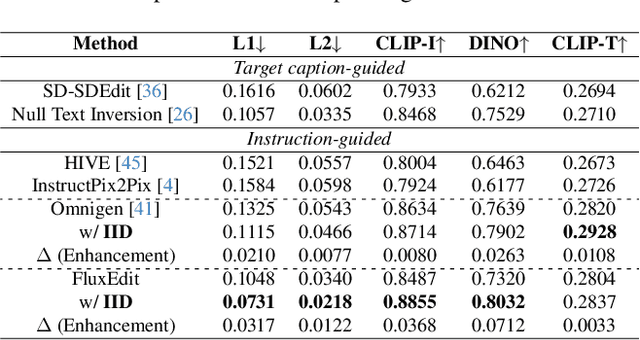
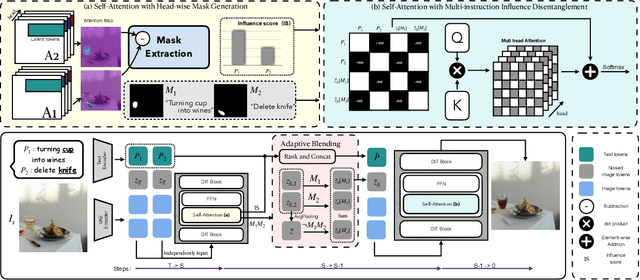

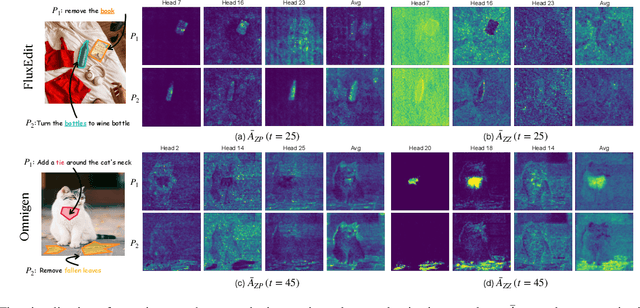
Instruction-guided image editing enables users to specify modifications using natural language, offering more flexibility and control. Among existing frameworks, Diffusion Transformers (DiTs) outperform U-Net-based diffusion models in scalability and performance. However, while real-world scenarios often require concurrent execution of multiple instructions, step-by-step editing suffers from accumulated errors and degraded quality, and integrating multiple instructions with a single prompt usually results in incomplete edits due to instruction conflicts. We propose Instruction Influence Disentanglement (IID), a novel framework enabling parallel execution of multiple instructions in a single denoising process, designed for DiT-based models. By analyzing self-attention mechanisms in DiTs, we identify distinctive attention patterns in multi-instruction settings and derive instruction-specific attention masks to disentangle each instruction's influence. These masks guide the editing process to ensure localized modifications while preserving consistency in non-edited regions. Extensive experiments on open-source and custom datasets demonstrate that IID reduces diffusion steps while improving fidelity and instruction completion compared to existing baselines. The codes will be publicly released upon the acceptance of the paper.
SPACE: SPike-Aware Consistency Enhancement for Test-Time Adaptation in Spiking Neural Networks
Apr 03, 2025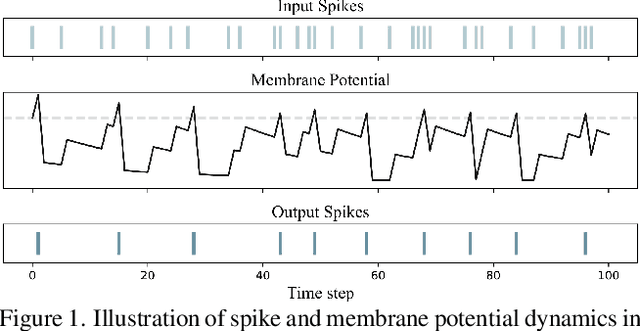
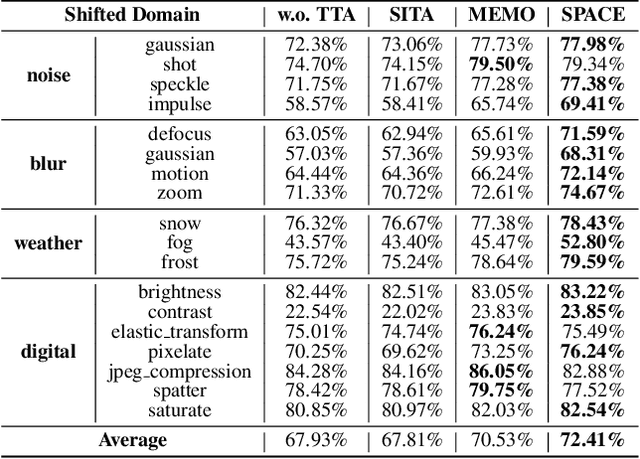
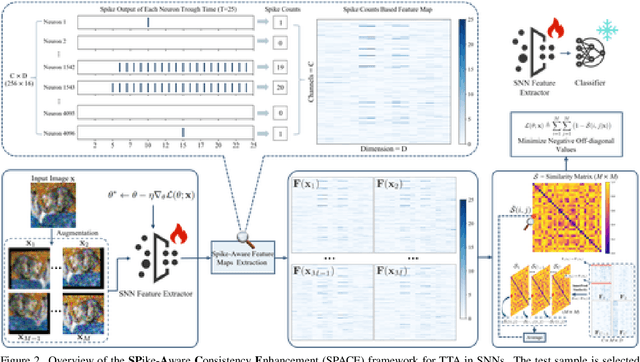
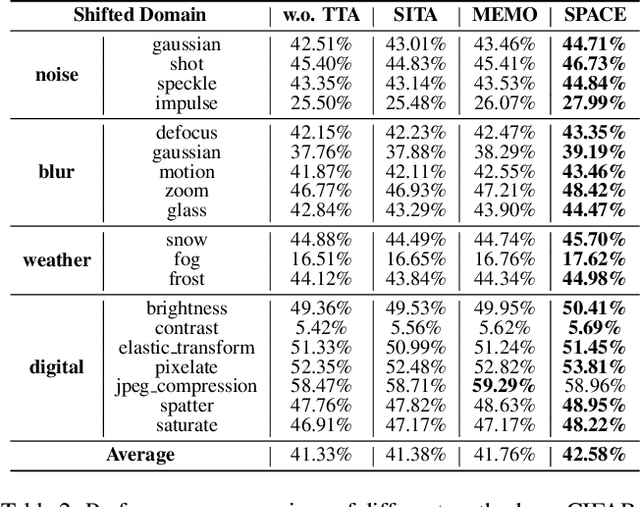
Spiking Neural Networks (SNNs), as a biologically plausible alternative to Artificial Neural Networks (ANNs), have demonstrated advantages in terms of energy efficiency, temporal processing, and biological plausibility. However, SNNs are highly sensitive to distribution shifts, which can significantly degrade their performance in real-world scenarios. Traditional test-time adaptation (TTA) methods designed for ANNs often fail to address the unique computational dynamics of SNNs, such as sparsity and temporal spiking behavior. To address these challenges, we propose $\textbf{SP}$ike-$\textbf{A}$ware $\textbf{C}$onsistency $\textbf{E}$nhancement (SPACE), the first source-free and single-instance TTA method specifically designed for SNNs. SPACE leverages the inherent spike dynamics of SNNs to maximize the consistency of spike-behavior-based local feature maps across augmented versions of a single test sample, enabling robust adaptation without requiring source data. We evaluate SPACE on multiple datasets, including CIFAR-10-C, CIFAR-100-C, Tiny-ImageNet-C and DVS Gesture-C. Furthermore, SPACE demonstrates strong generalization across different model architectures, achieving consistent performance improvements on both VGG9 and ResNet11. Experimental results show that SPACE outperforms state-of-the-art methods, highlighting its effectiveness and robustness in real-world settings.