 Add to Chrome
 Add to Firefox
 Add to Edge
CausalNav: Reliability-Certified Causal World Models for Control under Physical-Parameter Shift
Aug 07, 2026
A world model is only useful for physical AI if it changes what the agent does, and only safe if it declines to do so when it is wrong. We study both halves of that requirement with CausalNav, a controller built around a signed, action-conditioned transition graph over identified state coordinates. At deployment CausalNav simulates a small library of intervention sequences, converts their objective error into policy-logit advice, and admits that advice only when a scale-free predictive-reliability certificate, a policy-margin gate, and an argmax-agreement gate all pass; otherwise it falls back exactly to its own model-based base controller. We evaluate against nine controlled baselines (transformer, recurrent, split-latent, graph, causal-induction, and three recent model-based reasoning modules) on CartPole-v1 and discretized Pendulum-v1 with physical-parameter shifts, under one shared PPO trainer, one interaction budget, and ten held-out seeds (200 runs). CausalNav attains the best average rank (1.25 of ten). The diagnostic result is more informative than the ranking: the learned graph recovers structure well above chance (CartPole F1 = 0.59 +/- 0.09), yet per-seed structural fidelity is uncorrelated with per-seed control benefit (r = -0.15, p = 0.67), and the certificate abstains on 10/10 Pendulum seeds, where forcing the planner on costs return. Model fidelity did not predict downstream control utility in our setting; certified abstention, not better prediction, is what made the world model safe to deploy.

When the Judge Should Not Decide: Evidence-Locked, Non-Compensatory Selection Bounds LLM-Judge Failure in Reasoning Pipelines
Aug 07, 2026An LLM judge deployed inside a reasoning pipeline does not merely measure quality, it decides which answer ships. We show that the cost of that decision depends less on judge accuracy than on the decision rule the judge is embedded in. On frozen candidate pools from four GRPO policies, an unconstrained scalar DeepSeek-R1-7B judge buys almost nothing over answer-level majority vote (+1.0 pp on 500 GSM8K questions, +0.34 EM on 300 HotpotQA questions), and on a frozen-rule 30-question confirmation split it is 10 points worse than majority, a judge that destroys accuracy while scoring candidates confidently. We then subordinate the same judge to Evidence-Locked Derive-Gate-Repair (EL-DGR), a task-adaptive non-compensatory rule under which a judge preference may override evidence-supported consensus only with an extractive evidence certificate, and a repair only when neither alternative is certified and the repair is. With no change to the judge, the candidates, or the budget, EL-DGR reaches 58.2% on GSM8K (vs. 56.8% judge, 55.8% majority, 55.4% first candidate) and 17.33 EM / 25.46 F1 on HotpotQA (vs. 15.67/23.49, 15.33/23.19, 15.33/22.97), improving on first-candidate GRPO by +2.8 pp (exact McNemar p=0.0026) and +2.00 EM (p=0.070, borderline). A decision audit shows why: EL-DGR overturns consensus on only 8 of 30 pilot questions and never converts a correct consensus into an incorrect answer. We also report what did not work: the same seven-channel decomposition used as a step-level gated training reward is null, and corrected channel-drop ablations show no channel is individually necessary (p=1.0 throughout). The practitioner-facing finding is negative about judges and positive about admissibility, bound the judge's blast radius rather than trying to make it accurate.
Alignment-Guided Largest Table Overlap Size Estimation
Jul 03, 2026Fast estimation of the size of the largest overlap between tables enables blocking and query-by-table retrieval in large table repositories. The first and the state-of-the-art estimator Armadillo improves efficiency by embedding each table independently and approximating overlap ratio via embedding similarity. However, accurate estimation in heterogeneous repositories remains limited by three challenges: (C1) overlap depends on row-column structure, i.e., each matched cell must preserve both its row and column membership under a joint alignment of the two tables, but existing encodings leave this structure to be inferred indirectly; (C2) independent encoding provides no explicit channel for inter-table alignment signals, biasing prediction toward global similarity; (C3) naive value encodings overfit to corpus-specific distributions, causing cross-domain degradation. Hence, we propose ALORE, a scalable and domain-robust overlap ratio estimator built on three principles: (P1) explicitly represent row-column structure; (P2) expose inter-table alignment signals during training without expensive alignment search; (P3) reduce sensitivity to corpus-specific value distributions. ALORE instantiates these principles with a Two-View Row-Column Hypergraph encoder, alignment-guided objectives with inexpensive interaction signals, and a domain-robust value mapping. Experiments on multiple datasets spanning diverse domains and scales, including a large real-world corpus beyond prior benchmarks, show that ALORE outperforms the state of the art. ALORE reduces MAE by up to 55% overall and 69% in zero-shot transfer, while achieving up to 89x speedup. We further validate its effectiveness for query-by-table retrieval.
A Cross-graph Tuning-free GNN Prompting Framework
Apr 01, 2026GNN prompting aims to adapt models across tasks and graphs without requiring extensive retraining. However, most existing graph prompt methods still require task-specific parameter updates and face the issue of generalizing across graphs, limiting their performance and undermining the core promise of prompting. In this work, we introduce a Cross-graph Tuning-free Prompting Framework (CTP), which supports both homogeneous and heterogeneous graphs, can be directly deployed to unseen graphs without further parameter tuning, and thus enables a plug-and-play GNN inference engine. Extensive experiments on few-shot prediction tasks show that, compared to SOTAs, CTP achieves an average accuracy gain of 30.8% and a maximum gain of 54%, confirming its effectiveness and offering a new perspective on graph prompt learning.
Carbon Price Forecasting with Structural Breaks: A Comparative Study of Deep Learning Models
Nov 07, 2025Accurately forecasting carbon prices is essential for informed energy market decision-making, guiding sustainable energy planning, and supporting effective decarbonization strategies. However, it remains challenging due to structural breaks and high-frequency noise caused by frequent policy interventions and market shocks. Existing studies, including the most recent baseline approaches, have attempted to incorporate breakpoints but often treat denoising and modeling as separate processes and lack systematic evaluation across advanced deep learning architectures, limiting the robustness and the generalization capability. To address these gaps, this paper proposes a comprehensive hybrid framework that integrates structural break detection (Bai-Perron, ICSS, and PELT algorithms), wavelet signal denoising, and three state-of-the-art deep learning models (LSTM, GRU, and TCN). Using European Union Allowance (EUA) spot prices from 2007 to 2024 and exogenous features such as energy prices and policy indicators, the framework constructs univariate and multivariate datasets for comparative evaluation. Experimental results demonstrate that our proposed PELT-WT-TCN achieves the highest prediction accuracy, reducing forecasting errors by 22.35% in RMSE and 18.63% in MAE compared to the state-of-the-art baseline model (Breakpoints with Wavelet and LSTM), and by 70.55% in RMSE and 74.42% in MAE compared to the original LSTM without decomposition from the same baseline study. These findings underscore the value of integrating structural awareness and multiscale decomposition into deep learning architectures to enhance accuracy and interpretability in carbon price forecasting and other nonstationary financial time series.
Temporal Network Representation Learning via Historical Neighborhoods Aggregation
Mar 30, 2020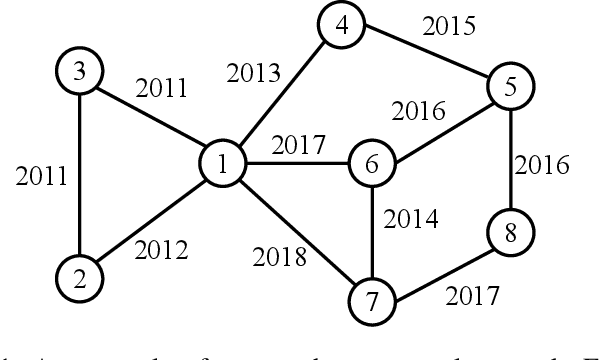
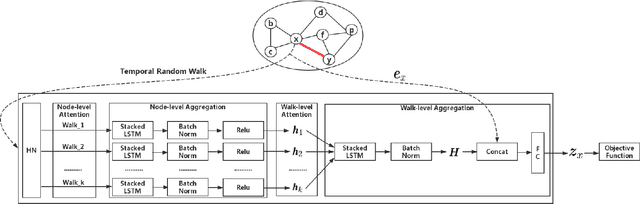
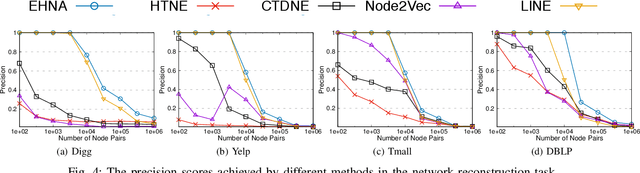
Network embedding is an effective method to learn low-dimensional representations of nodes, which can be applied to various real-life applications such as visualization, node classification, and link prediction. Although significant progress has been made on this problem in recent years, several important challenges remain, such as how to properly capture temporal information in evolving networks. In practice, most networks are continually evolving. Some networks only add new edges or nodes such as authorship networks, while others support removal of nodes or edges such as internet data routing. If patterns exist in the changes of the network structure, we can better understand the relationships between nodes and the evolution of the network, which can be further leveraged to learn node representations with more meaningful information. In this paper, we propose the Embedding via Historical Neighborhoods Aggregation (EHNA) algorithm. More specifically, we first propose a temporal random walk that can identify relevant nodes in historical neighborhoods which have impact on edge formations. Then we apply a deep learning model which uses a custom attention mechanism to induce node embeddings that directly capture temporal information in the underlying feature representation. We perform extensive experiments on a range of real-world datasets, and the results demonstrate the effectiveness of our new approach in the network reconstruction task and the link prediction task.