 Add to Chrome
 Add to Firefox
 Add to Edge
RadioMaster: Multi-Agent System for Autonomous Radio Signal Generation
Jun 01, 2026
Translating user intents into physical radio signals represents the critical yet notoriously tedious final step in wireless prototyping, as it requires intricate knowledge of physical layer details and presents immense implementation challenges. Large Language Models (LLMs) and multi-agent systems have revolutionized conventional software engineering, raising the compelling question of whether they can resolve these formidable difficulties. However, our investigations reveal that current models experience significant limitations and fail to accomplish this task when applied to radio signal generation. This performance degradation primarily stems from severe domain ignorance and a fundamental insensitivity to physical hardware constraints. To bridge this gap, we introduce RadioMaster, a fully autonomous multi-agent framework designed to seamlessly translate user input into real-world wireless emissions. RadioMaster operates on three synergistic pillars: RadioWiki for domain-specific knowledge retrieval, RadioAgent for collaborative I/Q sample generation alongside hardware configuration, and RadioEmulator for closed-loop physical layer verification. Furthermore, we construct RadioBench, the first comprehensive benchmark tailored specifically for the radio signal generation domain. Extensive real-world evaluations demonstrate that RadioMaster significantly outperforms state-of-the-art (SOTA) baselines regarding configuration viability and signal fidelity.

Connecting the Dots: Benchmarking Reflective Memory in Long-Horizon Dialogue
May 31, 2026Despite substantial progress in long-context modeling, existing benchmarks remain confined to factual memory for explicit recall, failing to measure the reflective memory required to synthesize fragmented, multimodal cues into high-level interpretations. To address this gap, we introduce RefMem-Bench, a benchmark for reflective memory in long-horizon dialogue. RefMem-Bench contains 26K annotated QA instances with eight reflective-memory dimensions and three task formats, requiring models to move beyond surface-level retrieval and infer latent meanings from evidence distributed across interaction histories. To enhance reflective memory capability, we propose REflective Memory INDuction (REMIND), a hierarchical framework that treats reflective memory as progressive meaning construction. REMIND couples question-conditioned evidence retrieval, salience-aware grounding, and abstraction-level supervision, and uses Progressive Reflective Alignment to distill high-level reflective reasoning into the factual inference pathway. Experiments show RefMem-Bench poses a substantial challenge to current models, while REMIND consistently improves both answer accuracy and memory recall through progressive evidence perception, grounding, and abstraction.
Ask Now, Use Later: Benchmarking the Proactivity Gap in Long-Lived LLM Agents
May 28, 2026A long-lived LLM agent, such as OpenClaw, earns its value by acting on a user's preferences and constraints across sessions, not just the current request. Yet today's agents keep what a user volunteers but rarely ask for what stays unspoken, leaving a proactivity gap in long-lived LLM agents: an agent cannot act on a preference it never obtained. As users delegate more of their affairs to agents, the impact of this gap grows. We isolate one concrete, controllable slice of this gap as Ask-to-Remember (ATR): the agent decides whether to ask now for a reusable user preference that the current task does not need but a later session with the same user will. ATR is hard even to evaluate: the right question is underdetermined and its payoff deferred to tasks that may never arise. ATRBench, to the best of our knowledge the first ATR benchmark, makes it measurable by fixing each user's preferences as hidden ground truth, so success demands asking, not recall. Across eight frontier LLM agents, defaults fall at least 62 points below an oracle handed the relevant preference, and prompting closes little of it. Diagnostics identify acquisition as the bottleneck. ATRBench surfaces this proactivity gap in current agents and offers a diagnostic testbed for closing it.
Mitigating Provenance-Role Collapse in Long-Term Agents via Typed Memory Representation
May 25, 2026Long-term memory is essential for persistent LLM agents, yet prevailing architectures store historical interactions as unstructured, flat text. This unconstrained storage induces provenance-role collapse, a critical failure mode where agents suffer from source-monitoring errors. To resolve this cognitive vulnerability at the architectural level, we propose MemIR, a typed Memory Intermediate Representation that operationalizes source monitoring as a structural constraint. MemIR writes long-term memory into grounded atoms that separate raw evidence, retrieval cues, and truth-bearing claims, with factual authorization restricted to supported claim atoms. It then applies multi-route atomic projection and provenance-scoped utilization to transform heterogeneous retrieval hits into claim-centered candidate bundles and a normalized fact interface for answer generation. Experiments on LoCoMo and BEAM-100K demonstrate that MemIR consistently outperforms existing memory baselines, especially on tasks requiring source tracking, temporal grounding, and aggregation of fragmented evidence.
Bounded State in an Infinite Horizon: Proactive Hierarchical Memory for Ad-Hoc Recall over Streaming Dialogues
Mar 05, 2026Real-world dialogue usually unfolds as an infinite stream. It thus requires bounded-state memory mechanisms to operate within an infinite horizon. However, existing read-then-think memory is fundamentally misaligned with this setting, as it cannot support ad-hoc memory recall while streams unfold. To explore this challenge, we introduce \textbf{STEM-Bench}, the first benchmark for \textbf{ST}reaming \textbf{E}valuation of \textbf{M}emory. It comprises over 14K QA pairs in dialogue streams that assess perception fidelity, temporal reasoning, and global awareness under infinite-horizon constraints. The preliminary analysis on STEM-Bench indicates a critical \textit{fidelity-efficiency dilemma}: retrieval-based methods use fragment context, while full-context models incur unbounded latency. To resolve this, we propose \textbf{ProStream}, a proactive hierarchical memory framework for streaming dialogues. It enables ad-hoc memory recall on demand by reasoning over continuous streams with multi-granular distillation. Moreover, it employs Adaptive Spatiotemporal Optimization to dynamically optimize retention based on expected utility. It enables a bounded knowledge state for lower inference latency without sacrificing reasoning fidelity. Experiments show that ProStream outperforms baselines in both accuracy and efficiency.
SynergyKGC: Reconciling Topological Heterogeneity in Knowledge Graph Completion via Topology-Aware Synergy
Feb 11, 2026Knowledge Graph Completion (KGC) fundamentally hinges on the coherent fusion of pre-trained entity semantics with heterogeneous topological structures to facilitate robust relational reasoning. However, existing paradigms encounter a critical "structural resolution mismatch," failing to reconcile divergent representational demands across varying graph densities, which precipitates structural noise interference in dense clusters and catastrophic representation collapse in sparse regions. We present SynergyKGC, an adaptive framework that advances traditional neighbor aggregation to an active Cross-Modal Synergy Expert via relation-aware cross-attention and semantic-intent-driven gating. By coupling a density-dependent Identity Anchoring strategy with a Double-tower Coherent Consistency architecture, SynergyKGC effectively reconciles topological heterogeneity while ensuring representational stability across training and inference phases. Systematic evaluations on two public benchmarks validate the superiority of our method in significantly boosting KGC hit rates, providing empirical evidence for a generalized principle of resilient information integration in non-homogeneous structured data.
Robust Outlier Detection and Low-Latency Concept Drift Adaptation for Data Stream Regression: A Dual-Channel Architecture
Dec 13, 2025
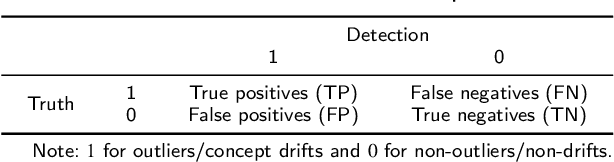
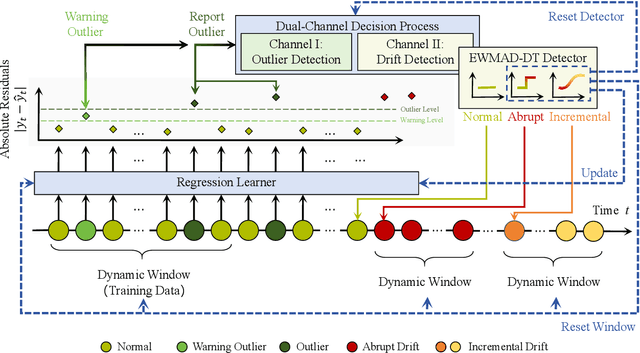
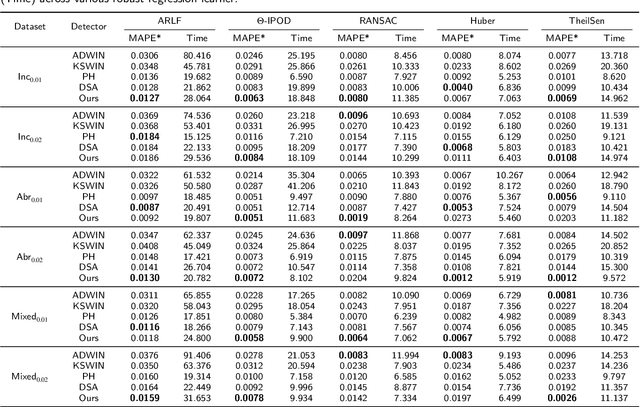
Outlier detection and concept drift detection represent two challenges in data analysis. Most studies address these issues separately. However, joint detection mechanisms in regression remain underexplored, where the continuous nature of output spaces makes distinguishing drifts from outliers inherently challenging. To address this, we propose a novel robust regression framework for joint outlier and concept drift detection. Specifically, we introduce a dual-channel decision process that orchestrates prediction residuals into two coupled logic flows: a rapid response channel for filtering point outliers and a deep analysis channel for diagnosing drifts. We further develop the Exponentially Weighted Moving Absolute Deviation with Distinguishable Types (EWMAD-DT) detector to autonomously differentiate between abrupt and incremental drifts via dynamic thresholding. Comprehensive experiments on both synthetic and real-world datasets demonstrate that our unified framework, enhanced by EWMAD-DT, exhibits superior detection performance even when point outliers and concept drifts coexist.
PRISM of Opinions: A Persona-Reasoned Multimodal Framework for User-centric Conversational Stance Detection
Nov 15, 2025The rapid proliferation of multimodal social media content has driven research in Multimodal Conversational Stance Detection (MCSD), which aims to interpret users' attitudes toward specific targets within complex discussions. However, existing studies remain limited by: **1) pseudo-multimodality**, where visual cues appear only in source posts while comments are treated as text-only, misaligning with real-world multimodal interactions; and **2) user homogeneity**, where diverse users are treated uniformly, neglecting personal traits that shape stance expression. To address these issues, we introduce **U-MStance**, the first user-centric MCSD dataset, containing over 40k annotated comments across six real-world targets. We further propose **PRISM**, a **P**ersona-**R**easoned mult**I**modal **S**tance **M**odel for MCSD. PRISM first derives longitudinal user personas from historical posts and comments to capture individual traits, then aligns textual and visual cues within conversational context via Chain-of-Thought to bridge semantic and pragmatic gaps across modalities. Finally, a mutual task reinforcement mechanism is employed to jointly optimize stance detection and stance-aware response generation for bidirectional knowledge transfer. Experiments on U-MStance demonstrate that PRISM yields significant gains over strong baselines, underscoring the effectiveness of user-centric and context-grounded multimodal reasoning for realistic stance understanding.
ReMoD: Rethinking Modality Contribution in Multimodal Stance Detection via Dual Reasoning
Nov 08, 2025Multimodal Stance Detection (MSD) is a crucial task for understanding public opinion on social media. Existing work simply fuses information from various modalities to learn stance representations, overlooking the varying contributions of stance expression from different modalities. Therefore, stance misunderstanding noises may be drawn into the stance learning process due to the risk of learning errors by rough modality combination. To address this, we get inspiration from the dual-process theory of human cognition and propose **ReMoD**, a framework that **Re**thinks **Mo**dality contribution of stance expression through a **D**ual-reasoning paradigm. ReMoD integrates *experience-driven intuitive reasoning* to capture initial stance cues with *deliberate reflective reasoning* to adjust for modality biases, refine stance judgments, and thereby dynamically weight modality contributions based on their actual expressive power for the target stance. Specifically, the intuitive stage queries the Modality Experience Pool (MEP) and Semantic Experience Pool (SEP) to form an initial stance hypothesis, prioritizing historically impactful modalities. This hypothesis is then refined in the reflective stage via two reasoning chains: Modality-CoT updates MEP with adaptive fusion strategies to amplify relevant modalities, while Semantic-CoT refines SEP with deeper contextual insights of stance semantics. These dual experience structures are continuously refined during training and recalled at inference to guide robust and context-aware stance decisions. Extensive experiments on the public MMSD benchmark demonstrate that our ReMoD significantly outperforms most baseline models and exhibits strong generalization capabilities.
Bridging the Long-Term Gap: A Memory-Active Policy for Multi-Session Task-Oriented Dialogue
May 26, 2025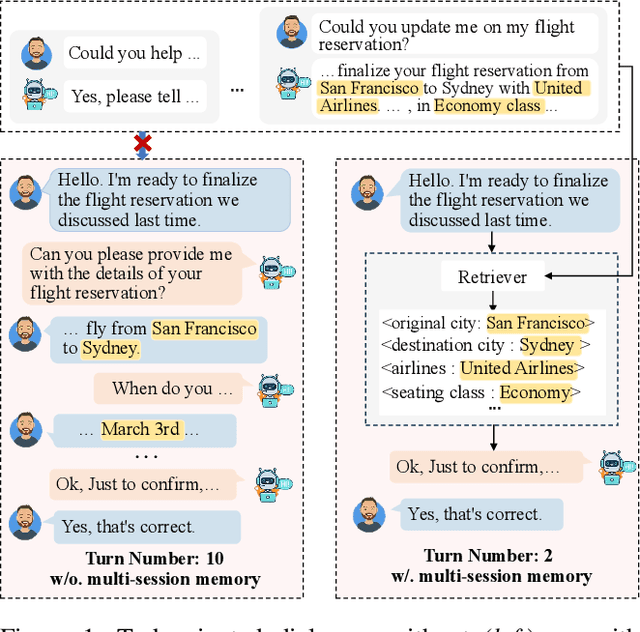
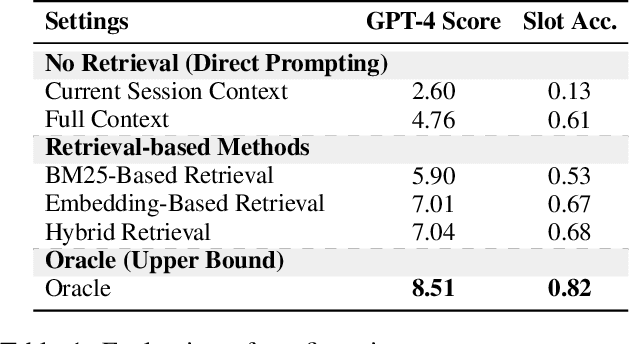
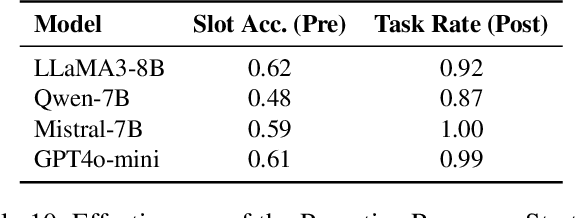
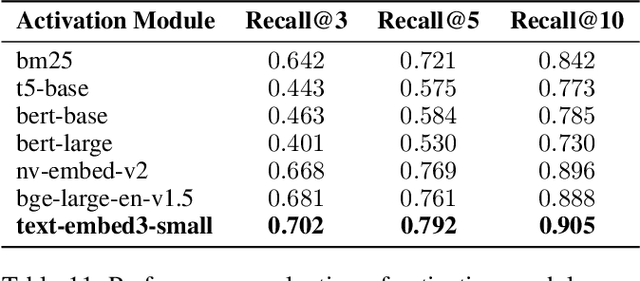
Existing Task-Oriented Dialogue (TOD) systems primarily focus on single-session dialogues, limiting their effectiveness in long-term memory augmentation. To address this challenge, we introduce a MS-TOD dataset, the first multi-session TOD dataset designed to retain long-term memory across sessions, enabling fewer turns and more efficient task completion. This defines a new benchmark task for evaluating long-term memory in multi-session TOD. Based on this new dataset, we propose a Memory-Active Policy (MAP) that improves multi-session dialogue efficiency through a two-stage approach. 1) Memory-Guided Dialogue Planning retrieves intent-aligned history, identifies key QA units via a memory judger, refines them by removing redundant questions, and generates responses based on the reconstructed memory. 2) Proactive Response Strategy detects and correct errors or omissions, ensuring efficient and accurate task completion. We evaluate MAP on MS-TOD dataset, focusing on response quality and effectiveness of the proactive strategy. Experiments on MS-TOD demonstrate that MAP significantly improves task success and turn efficiency in multi-session scenarios, while maintaining competitive performance on conventional single-session tasks.