 Add to Chrome
 Add to Firefox
 Add to Edge
MdaIF: Robust One-Stop Multi-Degradation-Aware Image Fusion with Language-Driven Semantics
Nov 16, 2025
Infrared and visible image fusion aims to integrate complementary multi-modal information into a single fused result. However, existing methods 1) fail to account for the degradation visible images under adverse weather conditions, thereby compromising fusion performance; and 2) rely on fixed network architectures, limiting their adaptability to diverse degradation scenarios. To address these issues, we propose a one-stop degradation-aware image fusion framework for multi-degradation scenarios driven by a large language model (MdaIF). Given the distinct scattering characteristics of different degradation scenarios (e.g., haze, rain, and snow) in atmospheric transmission, a mixture-of-experts (MoE) system is introduced to tackle image fusion across multiple degradation scenarios. To adaptively extract diverse weather-aware degradation knowledge and scene feature representations, collectively referred to as the semantic prior, we employ a pre-trained vision-language model (VLM) in our framework. Guided by the semantic prior, we propose degradation-aware channel attention module (DCAM), which employ degradation prototype decomposition to facilitate multi-modal feature interaction in channel domain. In addition, to achieve effective expert routing, the semantic prior and channel-domain modulated features are utilized to guide the MoE, enabling robust image fusion in complex degradation scenarios. Extensive experiments validate the effectiveness of our MdaIF, demonstrating superior performance over SOTA methods.

GRASP: Geospatial pixel Reasoning viA Structured Policy learning
Aug 23, 2025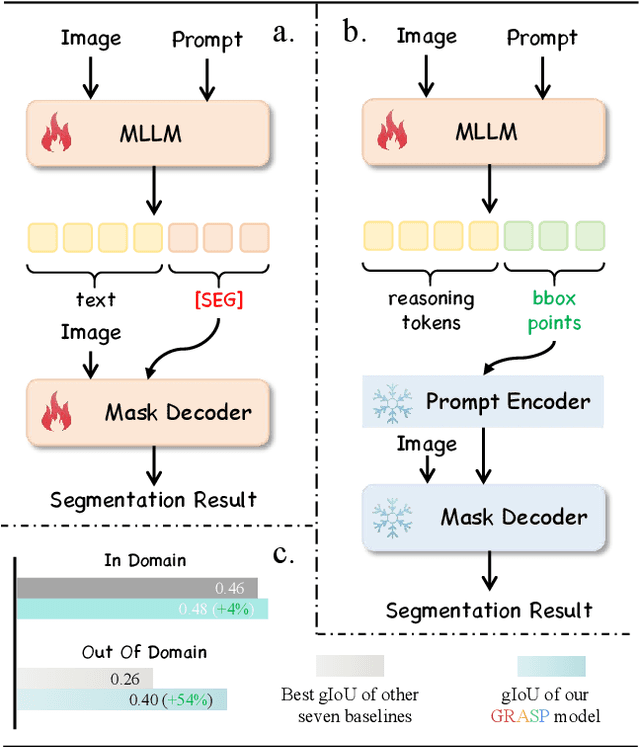
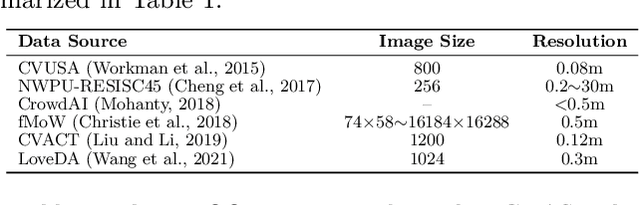
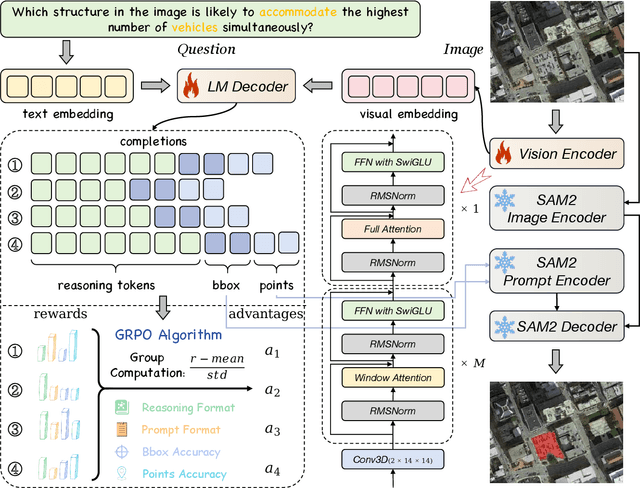
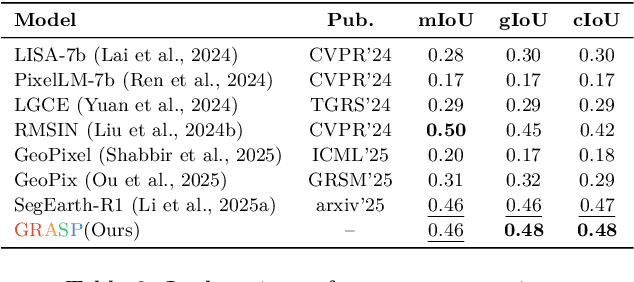
Geospatial pixel reasoning is a nascent remote-sensing task that aims to generate segmentation masks directly from natural-language instructions. Prevailing MLLM-based systems co-train a language model and a mask decoder with dense pixel supervision, which is expensive and often weak on out-of-domain (OOD) data. We introduce GRASP, a structured policy-learning framework. In our design, a multimodal large language model first emits task-relevant bounding boxes and positive points from a vision-language instruction. These outputs are then passed to a pre-trained segmentation model, which consumes them as prompts to generate the final mask. Instead of supervised fine-tuning, we optimize the system purely with reinforcement learning: the model is trained solely with GRPO, guided by format rewards and accuracy rewards computed on boxes and points (no mask supervision). This leverages strong priors in foundation models, minimizes trainable parameters, and enables learning from inexpensive annotations. We additionally curate GRASP-1k, which contains reasoning-intensive queries, detailed reasoning traces, and fine-grained segmentation annotations. Evaluations on both in-domain and out-of-domain test sets show state-of-the-art results: about 4% improvement in-domain and up to 54% on OOD benchmarks. The experiment results evidence our model's robust generalization and demonstrate that complex geospatial segmentation behaviors can be learned via RL from weak spatial cues. Code and the dataset will be released open-source.