 Add to Chrome
 Add to Firefox
 Add to Edge
SAPO: Self-Adaptive Process Optimization Makes Small Reasoners Stronger
Jan 28, 2026
Existing self-evolution methods overlook the influence of fine-grained reasoning steps, which leads to the reasoner-verifier gap. The computational inefficiency of Monte Carlo (MC) process supervision further exacerbates the difficulty in mitigating the gap. Motivated by the Error-Related Negativity (ERN), which the reasoner can localize error following incorrect decisions, guiding rapid adjustments, we propose a Self-Adaptive Process Optimization (SAPO) method for self-improvement in Small Language Models (SLMs). SAPO adaptively and efficiently introduces process supervision signals by actively minimizing the reasoner-verifier gap rather than relying on inefficient MC estimations. Extensive experiments demonstrate that the proposed method outperforms most existing self-evolution methods on two challenging task types: mathematics and code. Additionally, to further investigate SAPO's impact on verifier performance, this work introduces two new benchmarks for process reward models in both mathematical and coding tasks.

Switchcodec: Adaptive residual-expert sparse quantization for high-fidelity neural audio coding
Jan 28, 2026Recent neural audio compression models often rely on residual vector quantization for high-fidelity coding, but using a fixed number of per-frame codebooks is suboptimal for the wide variability of audio content-especially for signals that are either very simple or highly complex. To address this limitation, we propose SwitchCodec, a neural audio codec based on Residual Experts Vector Quantization (REVQ). REVQ combines a shared quantizer with dynamically routed expert quantizers that are activated according to the input audio, decoupling bitrate from codebook capacity and improving compression efficiency. This design ensures full training and utilization of each quantizer. In addition, a variable-bitrate mechanism adjusts the number of active expert quantizers at inference, enabling multi-bitrate operation without retraining. Experiments demonstrate that SwitchCodec surpasses existing baselines on both objective metrics and subjective listening tests.
LLMdoctor: Token-Level Flow-Guided Preference Optimization for Efficient Test-Time Alignment of Large Language Models
Jan 15, 2026Aligning Large Language Models (LLMs) with human preferences is critical, yet traditional fine-tuning methods are computationally expensive and inflexible. While test-time alignment offers a promising alternative, existing approaches often rely on distorted trajectory-level signals or inefficient sampling, fundamentally capping performance and failing to preserve the generative diversity of the base model. This paper introduces LLMdoctor, a novel framework for efficient test-time alignment that operates via a patient-doctor paradigm. It integrates token-level reward acquisition with token-level flow-guided preference optimization (TFPO) to steer a large, frozen patient LLM with a smaller, specialized doctor model. Unlike conventional methods that rely on trajectory-level rewards, LLMdoctor first extracts fine-grained, token-level preference signals from the patient model's behavioral variations. These signals then guide the training of the doctor model via TFPO, which establishes flow consistency across all subtrajectories, enabling precise token-by-token alignment while inherently preserving generation diversity. Extensive experiments demonstrate that LLMdoctor significantly outperforms existing test-time alignment methods and even surpasses the performance of full fine-tuning approaches like DPO.
TAGRPO: Boosting GRPO on Image-to-Video Generation with Direct Trajectory Alignment
Jan 09, 2026Recent studies have demonstrated the efficacy of integrating Group Relative Policy Optimization (GRPO) into flow matching models, particularly for text-to-image and text-to-video generation. However, we find that directly applying these techniques to image-to-video (I2V) models often fails to yield consistent reward improvements. To address this limitation, we present TAGRPO, a robust post-training framework for I2V models inspired by contrastive learning. Our approach is grounded in the observation that rollout videos generated from identical initial noise provide superior guidance for optimization. Leveraging this insight, we propose a novel GRPO loss applied to intermediate latents, encouraging direct alignment with high-reward trajectories while maximizing distance from low-reward counterparts. Furthermore, we introduce a memory bank for rollout videos to enhance diversity and reduce computational overhead. Despite its simplicity, TAGRPO achieves significant improvements over DanceGRPO in I2V generation.
Rotate Your Character: Revisiting Video Diffusion Models for High-Quality 3D Character Generation
Jan 09, 2026Generating high-quality 3D characters from single images remains a significant challenge in digital content creation, particularly due to complex body poses and self-occlusion. In this paper, we present RCM (Rotate your Character Model), an advanced image-to-video diffusion framework tailored for high-quality novel view synthesis (NVS) and 3D character generation. Compared to existing diffusion-based approaches, RCM offers several key advantages: (1) transferring characters with any complex poses into a canonical pose, enabling consistent novel view synthesis across the entire viewing orbit, (2) high-resolution orbital video generation at 1024x1024 resolution, (3) controllable observation positions given different initial camera poses, and (4) multi-view conditioning supporting up to 4 input images, accommodating diverse user scenarios. Extensive experiments demonstrate that RCM outperforms state-of-the-art methods in both novel view synthesis and 3D generation quality.
HearSay Benchmark: Do Audio LLMs Leak What They Hear?
Jan 07, 2026While Audio Large Language Models (ALLMs) have achieved remarkable progress in understanding and generation, their potential privacy implications remain largely unexplored. This paper takes the first step to investigate whether ALLMs inadvertently leak user privacy solely through acoustic voiceprints and introduces $\textit{HearSay}$, a comprehensive benchmark constructed from over 22,000 real-world audio clips. To ensure data quality, the benchmark is meticulously curated through a rigorous pipeline involving automated profiling and human verification, guaranteeing that all privacy labels are grounded in factual records. Extensive experiments on $\textit{HearSay}$ yield three critical findings: $\textbf{Significant Privacy Leakage}$: ALLMs inherently extract private attributes from voiceprints, reaching 92.89% accuracy on gender and effectively profiling social attributes. $\textbf{Insufficient Safety Mechanisms}$: Alarmingly, existing safeguards are severely inadequate; most models fail to refuse privacy-intruding requests, exhibiting near-zero refusal rates for physiological traits. $\textbf{Reasoning Amplifies Risk}$: Chain-of-Thought (CoT) reasoning exacerbates privacy risks in capable models by uncovering deeper acoustic correlations. These findings expose critical vulnerabilities in ALLMs, underscoring the urgent need for targeted privacy alignment. The codes and dataset are available at https://github.com/JinWang79/HearSay_Benchmark
ChemBART: A Pre-trained BART Model Assisting Organic Chemistry Analysis
Jan 06, 2026Recent advances in large language models (LLMs) have demonstrated transformative potential across diverse fields. While LLMs have been applied to molecular simplified molecular input line entry system (SMILES) in computer-aided synthesis planning (CASP), existing methodologies typically address single tasks, such as precursor prediction. We introduce ChemBART, a SMILES-based LLM pre-trained on chemical reactions, which enables a unified model for multiple downstream chemical tasks--achieving the paradigm of "one model, one pre-training, multiple tasks." By leveraging outputs from a mask-filling pre-training task on reaction expressions, ChemBART effectively solves a variety of chemical problems, including precursor/reagent generation, temperature-yield regression, molecular property classification, and optimizing the policy and value functions within a reinforcement learning framework, integrated with Monte Carlo tree search for multi-step synthesis route design. Unlike single-molecule pre-trained LLMs constrained to specific applications, ChemBART addresses broader chemical challenges and integrates them for comprehensive synthesis planning. Crucially, ChemBART-designed multi-step synthesis routes and reaction conditions directly inspired wet-lab validation, which confirmed shorter pathways with ~30% yield improvement over literature benchmarks. Our work validates the power of reaction-focused pre-training and showcases the broad utility of ChemBART in advancing the complete synthesis planning cycle.
Evaluating transfer learning strategies for improving dairy cattle body weight prediction in small farms using depth-image and point-cloud data
Jan 03, 2026Computer vision provides automated, non-invasive, and scalable tools for monitoring dairy cattle, thereby supporting management, health assessment, and phenotypic data collection. Although transfer learning is commonly used for predicting body weight from images, its effectiveness and optimal fine-tuning strategies remain poorly understood in livestock applications, particularly beyond the use of pretrained ImageNet or COCO weights. In addition, while both depth images and three-dimensional point-cloud data have been explored for body weight prediction, direct comparisons of these two modalities in dairy cattle are limited. Therefore, the objectives of this study were to 1) evaluate whether transfer learning from a large farm enhances body weight prediction on a small farm with limited data, and 2) compare the predictive performance of depth-image- and point-cloud-based approaches under three experimental designs. Top-view depth images and point-cloud data were collected from 1,201, 215, and 58 cows at large, medium, and small dairy farms, respectively. Four deep learning models were evaluated: ConvNeXt and MobileViT for depth images, and PointNet and DGCNN for point clouds. Transfer learning markedly improved body weight prediction on the small farm across all four models, outperforming single-source learning and achieving gains comparable to or greater than joint learning. These results indicate that pretrained representations generalize well across farms with differing imaging conditions and dairy cattle populations. No consistent performance difference was observed between depth-image- and point-cloud-based models. Overall, these findings suggest that transfer learning is well suited for small farm prediction scenarios where cross-farm data sharing is limited by privacy, logistical, or policy constraints, as it requires access only to pretrained model weights rather than raw data.
Vision-Language-Policy Model for Dynamic Robot Task Planning
Dec 22, 2025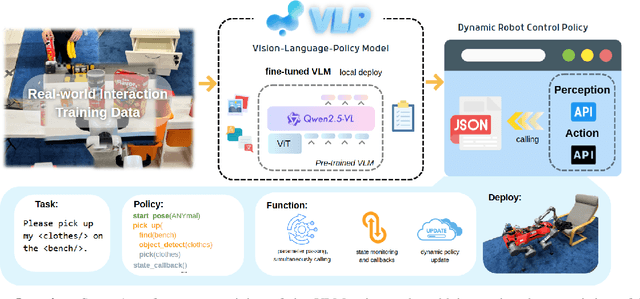
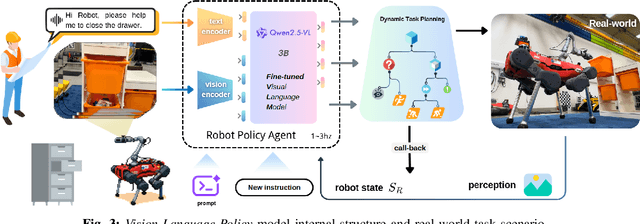
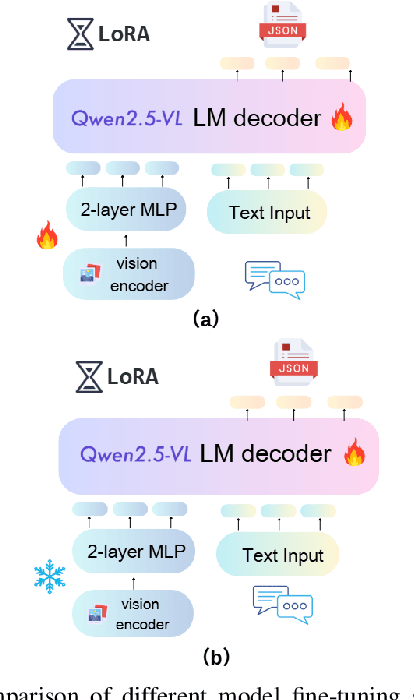
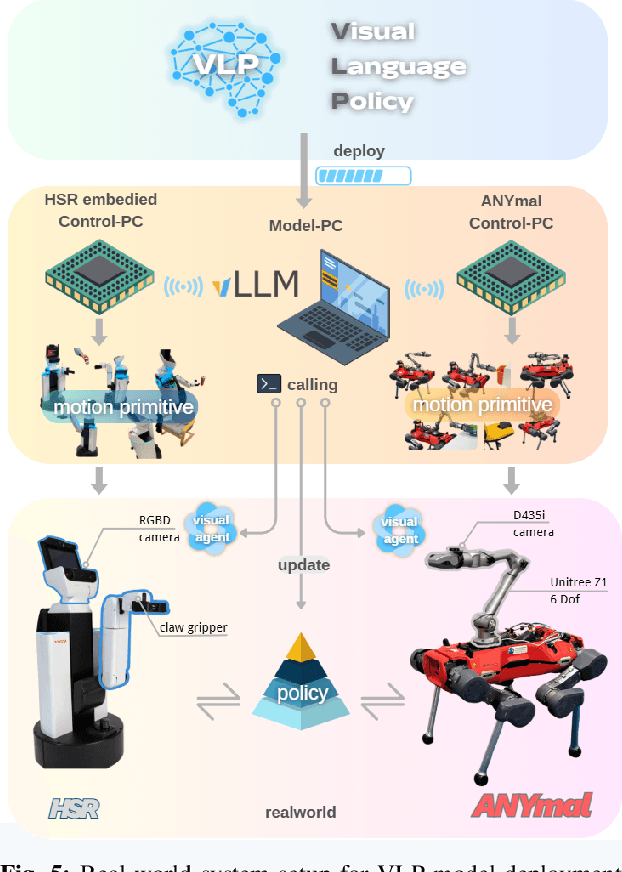
Bridging the gap between natural language commands and autonomous execution in unstructured environments remains an open challenge for robotics. This requires robots to perceive and reason over the current task scene through multiple modalities, and to plan their behaviors to achieve their intended goals. Traditional robotic task-planning approaches often struggle to bridge low-level execution with high-level task reasoning, and cannot dynamically update task strategies when instructions change during execution, which ultimately limits their versatility and adaptability to new tasks. In this work, we propose a novel language model-based framework for dynamic robot task planning. Our Vision-Language-Policy (VLP) model, based on a vision-language model fine-tuned on real-world data, can interpret semantic instructions and integrate reasoning over the current task scene to generate behavior policies that control the robot to accomplish the task. Moreover, it can dynamically adjust the task strategy in response to changes in the task, enabling flexible adaptation to evolving task requirements. Experiments conducted with different robots and a variety of real-world tasks show that the trained model can efficiently adapt to novel scenarios and dynamically update its policy, demonstrating strong planning autonomy and cross-embodiment generalization. Videos: https://robovlp.github.io/
Unbiased Semantic Decoding with Vision Foundation Models for Few-shot Segmentation
Nov 19, 2025Few-shot segmentation has garnered significant attention. Many recent approaches attempt to introduce the Segment Anything Model (SAM) to handle this task. With the strong generalization ability and rich object-specific extraction ability of the SAM model, such a solution shows great potential in few-shot segmentation. However, the decoding process of SAM highly relies on accurate and explicit prompts, making previous approaches mainly focus on extracting prompts from the support set, which is insufficient to activate the generalization ability of SAM, and this design is easy to result in a biased decoding process when adapting to the unknown classes. In this work, we propose an Unbiased Semantic Decoding (USD) strategy integrated with SAM, which extracts target information from both the support and query set simultaneously to perform consistent predictions guided by the semantics of the Contrastive Language-Image Pre-training (CLIP) model. Specifically, to enhance the unbiased semantic discrimination of SAM, we design two feature enhancement strategies that leverage the semantic alignment capability of CLIP to enrich the original SAM features, mainly including a global supplement at the image level to provide a generalize category indicate with support image and a local guidance at the pixel level to provide a useful target location with query image. Besides, to generate target-focused prompt embeddings, a learnable visual-text target prompt generator is proposed by interacting target text embeddings and clip visual features. Without requiring re-training of the vision foundation models, the features with semantic discrimination draw attention to the target region through the guidance of prompt with rich target information.