 Add to Chrome
 Add to Firefox
 Add to Edge
Generative AI and Federated Learning for Intrusion Detection Systems: A Survey
Jul 01, 2026
Intrusion Detection Systems (IDSs) are essential for monitoring network traffic and identifying malicious activities in modern cyber-physical, Internet of Things (IoT), enterprise, and distributed network environments. However, developing reliable IDS models remains challenging because attack behaviors evolve over time, realistic datasets are difficult to obtain, traffic records may be incomplete, attack classes are often imbalanced, and privacy constraints limit centralized data collection. Recent advances in generative artificial intelligence (AI) and Federated Learning (FL) provide new opportunities to address these limitations. Generative models can support anomaly detection, synthetic traffic generation, data augmentation, data imputation, adversarial traffic generation, and IDS alert explanation. FL enables distributed IDS training without directly sharing local network traffic, making it suitable for privacy-sensitive and geographically distributed environments. This survey provides a structured review of generative AI and FL techniques for IDS. We first summarize representative IDS research directions, including adversarial machine learning, anomaly-based detection, IoT-oriented IDS, explainable IDS, and benchmark datasets. We then categorize generative AI applications in IDS according to model families and task objectives, covering autoencoder-based models, Generative Adversarial Networks (GANs), diffusion models, and Large Language Models (LLMs). Finally, we review emerging studies that integrate generative AI with FL-based IDS and discuss open challenges, including synthetic data quality, realistic traffic generation, dual-use adversarial risks, non-IID client distributions, communication-efficient model sharing, federated IDS benchmarking, and domain-specific LLMs for network security.

Neuromorphic Speech Enhancement with Dual-Branch Spiking Neural Networks
Jun 22, 2026Spiking neural network (SNN)-based neuromorphic speech enhancement has emerged as a promising paradigm due to its energy efficiency, yet it still underperforms classical artificial neural network (ANN)-based approaches owing to binary activations and the lack of well-designed network architectures. To overcome this limitation, we propose a novel dual-branch spiking neural network architecture equipped with a gated spiking unit (GSU), termed GSU-DBNet. Specifically, GSU-DBNet simultaneously models the speech magnitude spectrum and complex spectrum, predicting the corresponding magnitude and complex spectral masks. Meanwhile, a dual-path GSU module is adopted to exploit temporal and frequency information for enhanced spatiotemporal feature representation. Experiments on a popular benchmark dataset show that GSU-DBNet achieves a PESQ score of 3.04 with only 394K parameters, outperforming existing SNN-based methods while using only 4.5%--10.6% of the parameters of representative ANN-based models.
Time-Unconditional Generative Speech Enhancement via Autonomous Rectified Flow
Jun 18, 2026Most generative speech enhancement methods rely on explicit time-step embeddings for temporal conditioning. In this paper, we propose the Autonomous Rectified Flow framework, which challenges the necessity of such conditioning. Using a linear interpolation path, we show that the target vector field is inherently time-invariant. We further introduce a time-unconditional network that eliminates explicit time-step information and infers the denoising direction solely from the spatial relationship between the current state and the noisy observation. Predicting this target vector field is equivalent to modeling the noise distribution. By avoiding overfitting to temporal trajectories, the proposed autonomous design significantly improves generation quality, robustness, and inference efficiency.
A Unified and Reproducible Experimentation Framework for Speech Understanding
May 29, 2026Speech foundation models and Speech LLMs have advanced speech understanding, yet deployment-oriented model selection is hindered by non-comparable evaluations caused by mismatched post-processing, and by training results that are hard to reproduce across data scales and pipelines. We present SURE, a unified experimentation framework that standardizes prediction formats, normalization, and scoring. SURE evaluates strong systems across paradigms, from conventional pipelines to Speech LLMs, on representative tasks under realistic acoustic and linguistic stressors. Beyond evaluation, SURE introduces an agent-assisted training conversion flow that maps paper and code into versioned, runnable training pipelines under a unified protocol on matched open-data subsets. Overall, SURE improves comparability and reproducibility for deployment-oriented evaluation.
AFD-INSTRUCTION: A Comprehensive Antibody Instruction Dataset with Functional Annotations for LLM-Based Understanding and Design
Feb 04, 2026Large language models (LLMs) have significantly advanced protein representation learning. However, their capacity to interpret and design antibodies through natural language remains limited. To address this challenge, we present AFD-Instruction, the first large-scale instruction dataset with functional annotations tailored to antibodies. This dataset encompasses two key components: antibody understanding, which infers functional attributes directly from sequences, and antibody design, which enables de novo sequence generation under functional constraints. These components provide explicit sequence-function alignment and support antibody design guided by natural language instructions. Extensive instruction-tuning experiments on general-purpose LLMs demonstrate that AFD-Instruction consistently improves performance across diverse antibody-related tasks. By linking antibody sequences with textual descriptions of function, AFD-Instruction establishes a new foundation for advancing antibody modeling and accelerating therapeutic discovery.
Switchcodec: Adaptive residual-expert sparse quantization for high-fidelity neural audio coding
Jan 28, 2026Recent neural audio compression models often rely on residual vector quantization for high-fidelity coding, but using a fixed number of per-frame codebooks is suboptimal for the wide variability of audio content-especially for signals that are either very simple or highly complex. To address this limitation, we propose SwitchCodec, a neural audio codec based on Residual Experts Vector Quantization (REVQ). REVQ combines a shared quantizer with dynamically routed expert quantizers that are activated according to the input audio, decoupling bitrate from codebook capacity and improving compression efficiency. This design ensures full training and utilization of each quantizer. In addition, a variable-bitrate mechanism adjusts the number of active expert quantizers at inference, enabling multi-bitrate operation without retraining. Experiments demonstrate that SwitchCodec surpasses existing baselines on both objective metrics and subjective listening tests.
SwitchCodec: A High-Fidelity Nerual Audio Codec With Sparse Quantization
May 30, 2025We present a universal high-fidelity neural audio compression algorithm that can compress speech, music, and general audio below 3 kbps bandwidth. Although current state-of-the-art audio codecs excel in audio compression, their effectiveness significantly declines when embedding space is sharply reduced, which corresponds to higher compression. To address this problem, we propose Residual Experts Vector Quantization (REVQ), which significantly expands the available embedding space and improves the performance while hardly sacrificing the bandwidth. Furthermore, we introduce a strategy to ensure that the vast embedding space can be fully utilized. Additionally, we propose a STFT-based discriminator to guide the generator in producing indistinguishable spectrograms. We demonstrate that the proposed approach outperforms baseline methods through detailed ablations.
Problem-Solving Logic Guided Curriculum In-Context Learning for LLMs Complex Reasoning
Feb 21, 2025In-context learning (ICL) can significantly enhance the complex reasoning capabilities of large language models (LLMs), with the key lying in the selection and ordering of demonstration examples. Previous methods typically relied on simple features to measure the relevance between examples. We argue that these features are not sufficient to reflect the intrinsic connections between examples. In this study, we propose a curriculum ICL strategy guided by problem-solving logic. We select demonstration examples by analyzing the problem-solving logic and order them based on curriculum learning. Specifically, we constructed a problem-solving logic instruction set based on the BREAK dataset and fine-tuned a language model to analyze the problem-solving logic of examples. Subsequently, we selected appropriate demonstration examples based on problem-solving logic and assessed their difficulty according to the number of problem-solving steps. In accordance with the principles of curriculum learning, we ordered the examples from easy to hard to serve as contextual prompts. Experimental results on multiple benchmarks indicate that our method outperforms previous ICL approaches in terms of performance and efficiency, effectively enhancing the complex reasoning capabilities of LLMs. Our project will be publicly available subsequently.
Process-Supervised Reinforcement Learning for Code Generation
Feb 03, 2025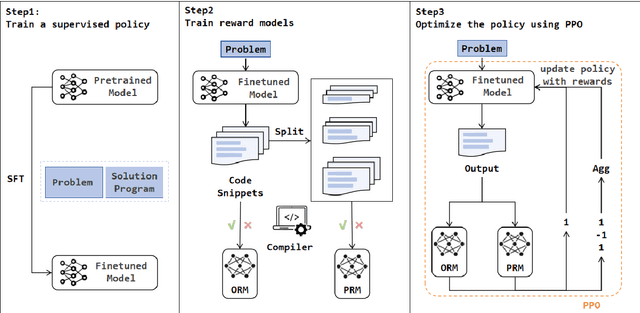
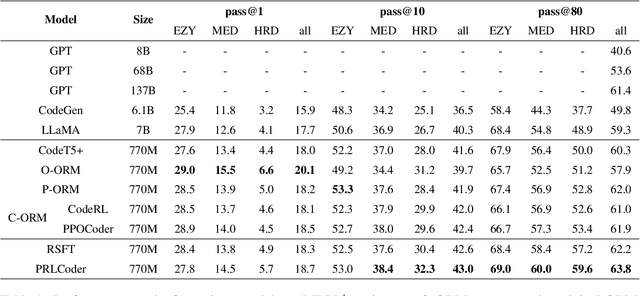
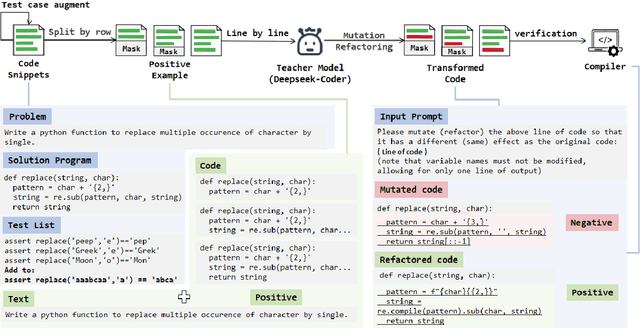
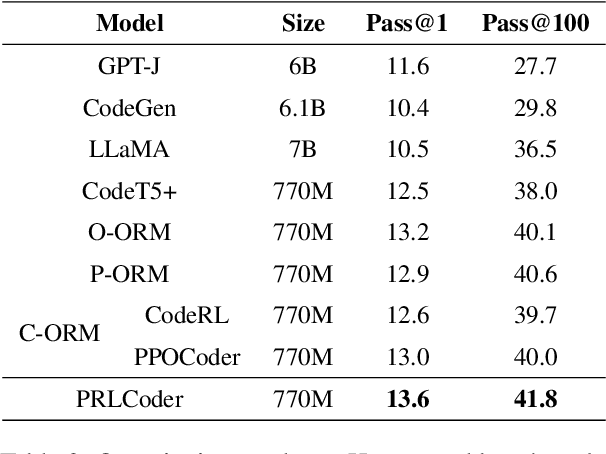
Existing reinforcement learning strategies based on outcome supervision have proven effective in enhancing the performance of large language models(LLMs) for code generation. While reinforcement learning based on process supervision has shown great promise in handling multi-step reasoning tasks, its effectiveness in code generation remains largely underexplored and underjustified. The primary obstacle stems from the resource-intensive nature of constructing high-quality process-supervised data, which demands substantial human expertise and computational resources. In response to this challenge, we propose a "statement mutation/refactoring-compile and execution verification" strategy: mutating and refactoring code line-by-line through a teacher model, and utilizing compiler execution results to automatically label each line, resulting in line-by-line process-supervised data, which is pivotal for training a process-supervised reward model. The trained reward model is then integrated into the PRLCoder framework, followed by experimental validation on several benchmarks. Experimental results demonstrate that process-supervised reinforcement learning significantly surpasses methods relying solely on outcome supervision. Notably, in tackling complex code generation tasks, process-supervised reinforcement learning shows a clear advantage, ensuring both the integrity of the code generation process and the correctness of the generation results.
Multimodal Table Understanding
Jun 12, 2024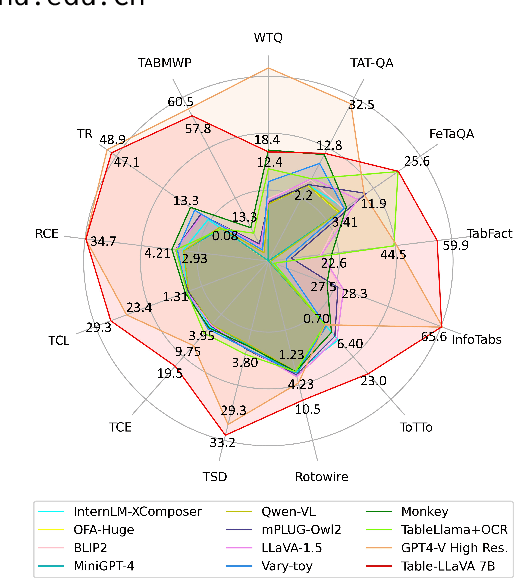
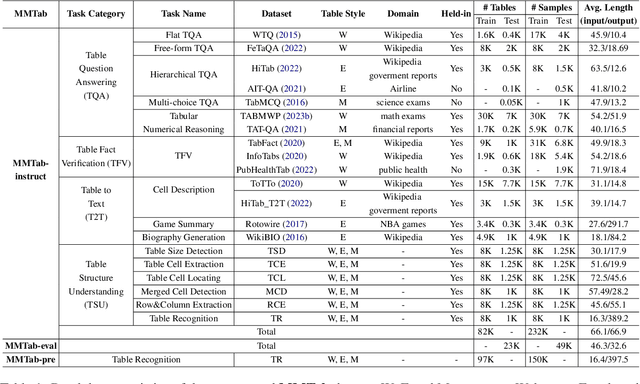
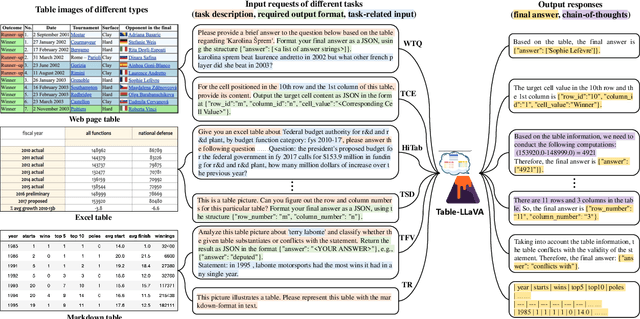
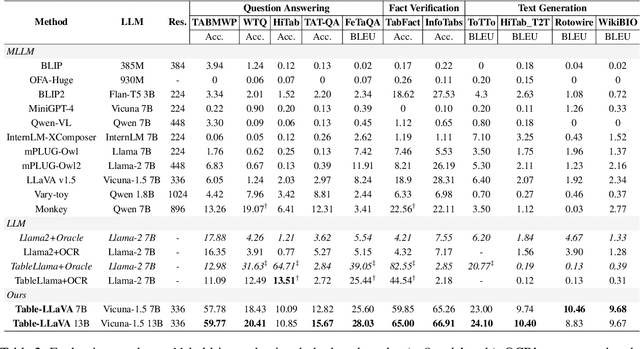
Although great progress has been made by previous table understanding methods including recent approaches based on large language models (LLMs), they rely heavily on the premise that given tables must be converted into a certain text sequence (such as Markdown or HTML) to serve as model input. However, it is difficult to access such high-quality textual table representations in some real-world scenarios, and table images are much more accessible. Therefore, how to directly understand tables using intuitive visual information is a crucial and urgent challenge for developing more practical applications. In this paper, we propose a new problem, multimodal table understanding, where the model needs to generate correct responses to various table-related requests based on the given table image. To facilitate both the model training and evaluation, we construct a large-scale dataset named MMTab, which covers a wide spectrum of table images, instructions and tasks. On this basis, we develop Table-LLaVA, a generalist tabular multimodal large language model (MLLM), which significantly outperforms recent open-source MLLM baselines on 23 benchmarks under held-in and held-out settings. The code and data is available at this https://github.com/SpursGoZmy/Table-LLaVA