 Add to Chrome
 Add to Firefox
 Add to Edge
Collaborative Optimization of Multiclass Imbalanced Learning: Density-Aware and Region-Guided Boosting
Dec 27, 2025
Numerous studies attempt to mitigate classification bias caused by class imbalance. However, existing studies have yet to explore the collaborative optimization of imbalanced learning and model training. This constraint hinders further performance improvements. To bridge this gap, this study proposes a collaborative optimization Boosting model of multiclass imbalanced learning. This model is simple but effective by integrating the density factor and the confidence factor, this study designs a noise-resistant weight update mechanism and a dynamic sampling strategy. Rather than functioning as independent components, these modules are tightly integrated to orchestrate weight updates, sample region partitioning, and region-guided sampling. Thus, this study achieves the collaborative optimization of imbalanced learning and model training. Extensive experiments on 20 public imbalanced datasets demonstrate that the proposed model significantly outperforms eight state-of-the-art baselines. The code for the proposed model is available at: https://github.com/ChuantaoLi/DARG.

AgentTutor: Empowering Personalized Learning with Multi-Turn Interactive Teaching in Intelligent Education Systems
Dec 24, 2025The rapid advancement of large-scale language models (LLMs) has shown their potential to transform intelligent education systems (IESs) through automated teaching and learning support applications. However, current IESs often rely on single-turn static question-answering, which fails to assess learners' cognitive levels, cannot adjust teaching strategies based on real-time feedback, and is limited to providing simple one-off responses. To address these issues, we introduce AgentTutor, a multi-turn interactive intelligent education system to empower personalized learning. It features an LLM-powered generative multi-agent system and a learner-specific personalized learning profile environment that dynamically optimizes and delivers teaching strategies based on learners' learning status, personalized goals, learning preferences, and multimodal study materials. It includes five key modules: curriculum decomposition, learner assessment, dynamic strategy, teaching reflection, and knowledge & experience memory. We conducted extensive experiments on multiple benchmark datasets, AgentTutor significantly enhances learners' performance while demonstrating strong effectiveness in multi-turn interactions and competitiveness in teaching quality among other baselines.
Multi-Grained Text-Guided Image Fusion for Multi-Exposure and Multi-Focus Scenarios
Dec 23, 2025Image fusion aims to synthesize a single high-quality image from a pair of inputs captured under challenging conditions, such as differing exposure levels or focal depths. A core challenge lies in effectively handling disparities in dynamic range and focus depth between the inputs. With the advent of vision-language models, recent methods incorporate textual descriptions as auxiliary guidance to enhance fusion quality. However, simply incorporating coarse-grained descriptions hampers the understanding of fine-grained details and poses challenges for precise cross-modal alignment. To address these limitations, we propose Multi-grained Text-guided Image Fusion (MTIF), a novel fusion paradigm with three key designs. First, it introduces multi-grained textual descriptions that separately capture fine details, structural cues, and semantic content, guiding image fusion through a hierarchical cross-modal modulation module. Second, it involves supervision signals at each granularity to facilitate alignment between visual and textual features and enhance the utility of auxiliary text. Third, it adopts a saliency-driven enrichment module to augment training data with dense semantic content, further strengthening the cross-modal modulation and alignment. Extensive experiments show that MTIF consistently outperforms previous methods on both multi-exposure and multi-focus image fusion tasks.
Fusion of Multiscale Features Via Centralized Sparse-attention Network for EEG Decoding
Dec 23, 2025Electroencephalography (EEG) signal decoding is a key technology that translates brain activity into executable commands, laying the foundation for direct brain-machine interfacing and intelligent interaction. To address the inherent spatiotemporal heterogeneity of EEG signals, this paper proposes a multi-branch parallel architecture, where each temporal scale is equipped with an independent spatial feature extraction module. To further enhance multi-branch feature fusion, we propose a Fusion of Multiscale Features via Centralized Sparse-attention Network (EEG-CSANet), a centralized sparse-attention network. It employs a main-auxiliary branch architecture, where the main branch models core spatiotemporal patterns via multiscale self-attention, and the auxiliary branch facilitates efficient local interactions through sparse cross-attention. Experimental results show that EEG-CSANet achieves state-of-the-art (SOTA) performance across five public datasets (BCIC-IV-2A, BCIC-IV-2B, HGD, SEED, and SEED-VIG), with accuracies of 88.54%, 91.09%, 99.43%, 96.03%, and 90.56%, respectively. Such performance demonstrates its strong adaptability and robustness across various EEG decoding tasks. Moreover, extensive ablation studies are conducted to enhance the interpretability of EEG-CSANet. In the future, we hope that EEG-CSANet could serve as a promising baseline model in the field of EEG signal decoding. The source code is publicly available at: https://github.com/Xiangrui-Cai/EEG-CSANet
Kling-Omni Technical Report
Dec 18, 2025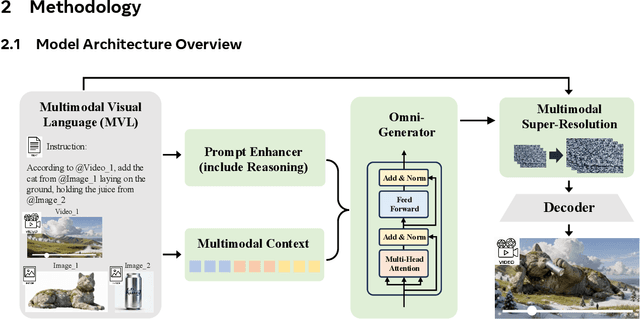
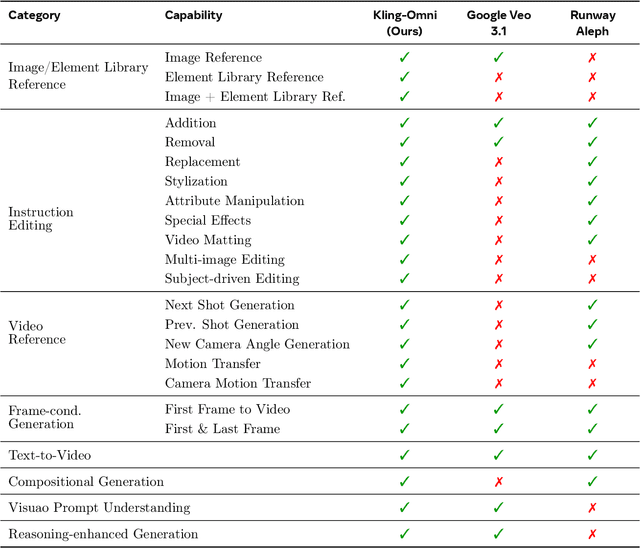
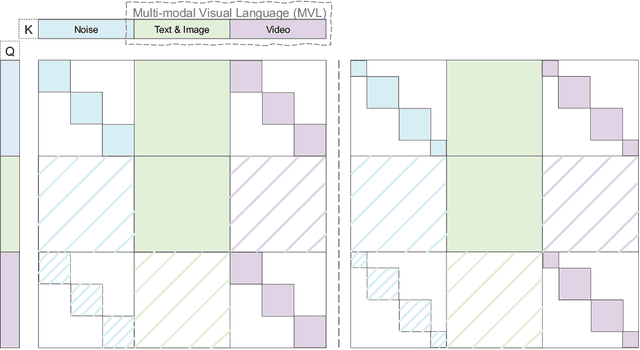
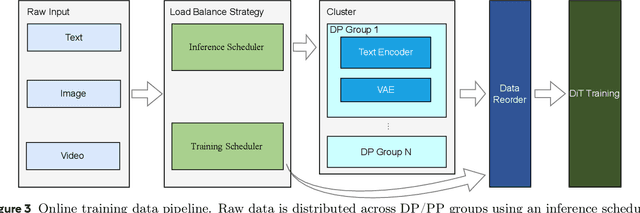
We present Kling-Omni, a generalist generative framework designed to synthesize high-fidelity videos directly from multimodal visual language inputs. Adopting an end-to-end perspective, Kling-Omni bridges the functional separation among diverse video generation, editing, and intelligent reasoning tasks, integrating them into a holistic system. Unlike disjointed pipeline approaches, Kling-Omni supports a diverse range of user inputs, including text instructions, reference images, and video contexts, processing them into a unified multimodal representation to deliver cinematic-quality and highly-intelligent video content creation. To support these capabilities, we constructed a comprehensive data system that serves as the foundation for multimodal video creation. The framework is further empowered by efficient large-scale pre-training strategies and infrastructure optimizations for inference. Comprehensive evaluations reveal that Kling-Omni demonstrates exceptional capabilities in in-context generation, reasoning-based editing, and multimodal instruction following. Moving beyond a content creation tool, we believe Kling-Omni is a pivotal advancement toward multimodal world simulators capable of perceiving, reasoning, generating and interacting with the dynamic and complex worlds.
Optimal Perturbation Budget Allocation for Data Poisoning in Offline Reinforcement Learning
Dec 10, 2025Offline Reinforcement Learning (RL) enables policy optimization from static datasets but is inherently vulnerable to data poisoning attacks. Existing attack strategies typically rely on locally uniform perturbations, which treat all samples indiscriminately. This approach is inefficient, as it wastes the perturbation budget on low-impact samples, and lacks stealthiness due to significant statistical deviations. In this paper, we propose a novel Global Budget Allocation attack strategy. Leveraging the theoretical insight that a sample's influence on value function convergence is proportional to its Temporal Difference (TD) error, we formulate the attack as a global resource allocation problem. We derive a closed-form solution where perturbation magnitudes are assigned proportional to the TD-error sensitivity under a global L2 constraint. Empirical results on D4RL benchmarks demonstrate that our method significantly outperforms baseline strategies, achieving up to 80% performance degradation with minimal perturbations that evade detection by state-of-the-art statistical and spectral defenses.
Evolve the Method, Not the Prompts: Evolutionary Synthesis of Jailbreak Attacks on LLMs
Nov 16, 2025Automated red teaming frameworks for Large Language Models (LLMs) have become increasingly sophisticated, yet they share a fundamental limitation: their jailbreak logic is confined to selecting, combining, or refining pre-existing attack strategies. This binds their creativity and leaves them unable to autonomously invent entirely new attack mechanisms. To overcome this gap, we introduce \textbf{EvoSynth}, an autonomous framework that shifts the paradigm from attack planning to the evolutionary synthesis of jailbreak methods. Instead of refining prompts, EvoSynth employs a multi-agent system to autonomously engineer, evolve, and execute novel, code-based attack algorithms. Crucially, it features a code-level self-correction loop, allowing it to iteratively rewrite its own attack logic in response to failure. Through extensive experiments, we demonstrate that EvoSynth not only establishes a new state-of-the-art by achieving an 85.5\% Attack Success Rate (ASR) against highly robust models like Claude-Sonnet-4.5, but also generates attacks that are significantly more diverse than those from existing methods. We release our framework to facilitate future research in this new direction of evolutionary synthesis of jailbreak methods. Code is available at: https://github.com/dongdongunique/EvoSynth.
Shrinking the Teacher: An Adaptive Teaching Paradigm for Asymmetric EEG-Vision Alignment
Nov 14, 2025Decoding visual features from EEG signals is a central challenge in neuroscience, with cross-modal alignment as the dominant approach. We argue that the relationship between visual and brain modalities is fundamentally asymmetric, characterized by two critical gaps: a Fidelity Gap (stemming from EEG's inherent noise and signal degradation, vs. vision's high-fidelity features) and a Semantic Gap (arising from EEG's shallow conceptual representation, vs. vision's rich semantic depth). Previous methods often overlook this asymmetry, forcing alignment between the two modalities as if they were equal partners and thereby leading to poor generalization. To address this, we propose the adaptive teaching paradigm. This paradigm empowers the ``teacher" modality (vision) to dynamically shrink and adjust its knowledge structure under task guidance, tailoring its semantically dense features to match the ``student" modality (EEG)'s capacity. We implement this paradigm with the ShrinkAdapter, a simple yet effective module featuring a residual-free design and a bottleneck structure. Through extensive experiments, we validate the underlying rationale and effectiveness of our paradigm. Our method achieves a top-1 accuracy of 60.2\% on the zero-shot brain-to-image retrieval task, surpassing previous state-of-the-art methods by a margin of 9.8\%. Our work introduces a new perspective for asymmetric alignment: the teacher must shrink and adapt to bridge the vision-brain gap.
BoRe-Depth: Self-supervised Monocular Depth Estimation with Boundary Refinement for Embedded Systems
Nov 06, 2025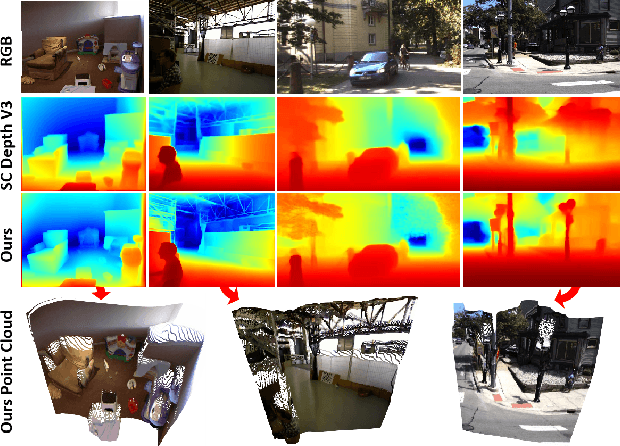
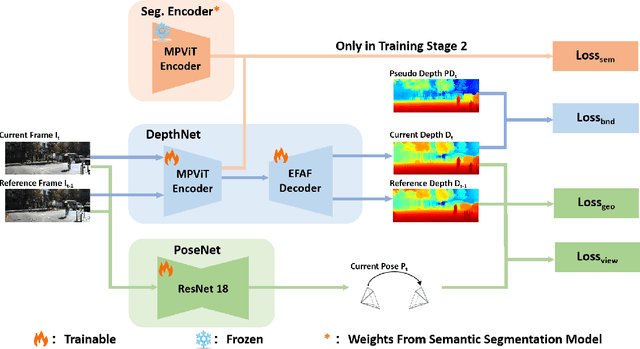
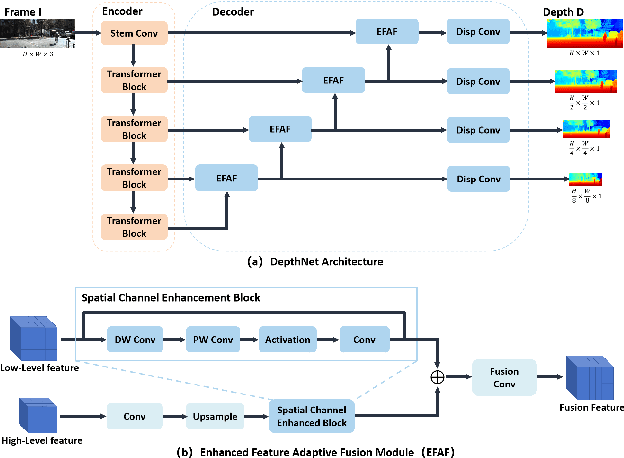
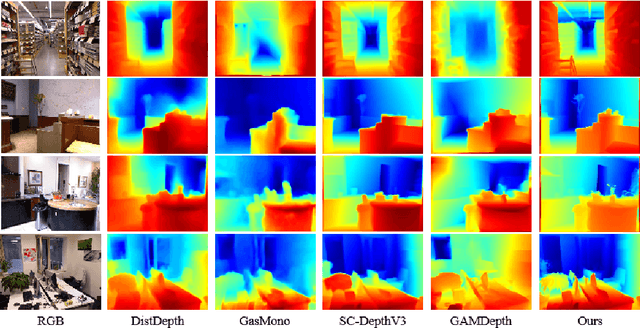
Depth estimation is one of the key technologies for realizing 3D perception in unmanned systems. Monocular depth estimation has been widely researched because of its low-cost advantage, but the existing methods face the challenges of poor depth estimation performance and blurred object boundaries on embedded systems. In this paper, we propose a novel monocular depth estimation model, BoRe-Depth, which contains only 8.7M parameters. It can accurately estimate depth maps on embedded systems and significantly improves boundary quality. Firstly, we design an Enhanced Feature Adaptive Fusion Module (EFAF) which adaptively fuses depth features to enhance boundary detail representation. Secondly, we integrate semantic knowledge into the encoder to improve the object recognition and boundary perception capabilities. Finally, BoRe-Depth is deployed on NVIDIA Jetson Orin, and runs efficiently at 50.7 FPS. We demonstrate that the proposed model significantly outperforms previous lightweight models on multiple challenging datasets, and we provide detailed ablation studies for the proposed methods. The code is available at https://github.com/liangxiansheng093/BoRe-Depth.
Less is More: Denoising Knowledge Graphs For Retrieval Augmented Generation
Oct 16, 2025Retrieval-Augmented Generation (RAG) systems enable large language models (LLMs) instant access to relevant information for the generative process, demonstrating their superior performance in addressing common LLM challenges such as hallucination, factual inaccuracy, and the knowledge cutoff. Graph-based RAG further extends this paradigm by incorporating knowledge graphs (KGs) to leverage rich, structured connections for more precise and inferential responses. A critical challenge, however, is that most Graph-based RAG systems rely on LLMs for automated KG construction, often yielding noisy KGs with redundant entities and unreliable relationships. This noise degrades retrieval and generation performance while also increasing computational cost. Crucially, current research does not comprehensively address the denoising problem for LLM-generated KGs. In this paper, we introduce DEnoised knowledge Graphs for Retrieval Augmented Generation (DEG-RAG), a framework that addresses these challenges through: (1) entity resolution, which eliminates redundant entities, and (2) triple reflection, which removes erroneous relations. Together, these techniques yield more compact, higher-quality KGs that significantly outperform their unprocessed counterparts. Beyond the methods, we conduct a systematic evaluation of entity resolution for LLM-generated KGs, examining different blocking strategies, embedding choices, similarity metrics, and entity merging techniques. To the best of our knowledge, this is the first comprehensive exploration of entity resolution in LLM-generated KGs. Our experiments demonstrate that this straightforward approach not only drastically reduces graph size but also consistently improves question answering performance across diverse popular Graph-based RAG variants.