 Add to Chrome
 Add to Firefox
 Add to Edge
DUET -- Dual User Embedding Transformers for Offsite Conversion Prediction
Jun 08, 2026
Offsite conversion rate (OCVR) prediction is an important ranking problem in computational recommendation systems. This task presents a modeling challenge: click signals are abundant and exhibit short temporal horizons, whereas conversion signals are inherently sparse, long-delayed, and frequently unattributed. Despite these statistical disparities, both signal types must inform models that operate within strict serving-latency constraints. Prior pre-training approaches address this heterogeneity with a single, undifferentiated encoder applied uniformly across both data streams. We propose DUET (Dual User Embedding Transformers), a framework that explicitly partitions user behavioral data into two domain-coherent streams -- clicks and conversions -- and pre-trains dedicated transformer encoders with architectures tailored to each stream's statistical characteristics: multi-layer self-attention for the dense click stream and interleaved cross- and self-attention for the sparse conversion stream. The resulting complementary embeddings are jointly consumed by a downstream ranker without exceeding serving-latency budgets. Evaluation demonstrates up to 0.38% normalized entropy (NE) reduction relative to the strongest baseline, and A/B test shows consistent improvements in OCVR prediction accuracy.

Multi-Grained Text-Guided Image Fusion for Multi-Exposure and Multi-Focus Scenarios
Dec 23, 2025Image fusion aims to synthesize a single high-quality image from a pair of inputs captured under challenging conditions, such as differing exposure levels or focal depths. A core challenge lies in effectively handling disparities in dynamic range and focus depth between the inputs. With the advent of vision-language models, recent methods incorporate textual descriptions as auxiliary guidance to enhance fusion quality. However, simply incorporating coarse-grained descriptions hampers the understanding of fine-grained details and poses challenges for precise cross-modal alignment. To address these limitations, we propose Multi-grained Text-guided Image Fusion (MTIF), a novel fusion paradigm with three key designs. First, it introduces multi-grained textual descriptions that separately capture fine details, structural cues, and semantic content, guiding image fusion through a hierarchical cross-modal modulation module. Second, it involves supervision signals at each granularity to facilitate alignment between visual and textual features and enhance the utility of auxiliary text. Third, it adopts a saliency-driven enrichment module to augment training data with dense semantic content, further strengthening the cross-modal modulation and alignment. Extensive experiments show that MTIF consistently outperforms previous methods on both multi-exposure and multi-focus image fusion tasks.
Async Learned User Embeddings for Ads Delivery Optimization
Jun 09, 2024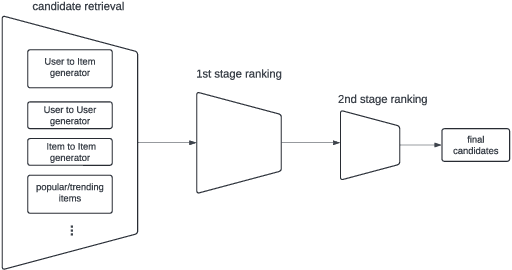
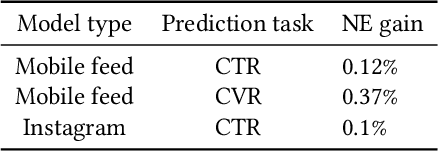
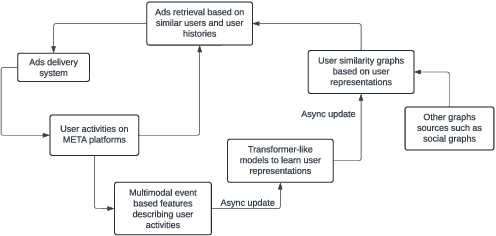
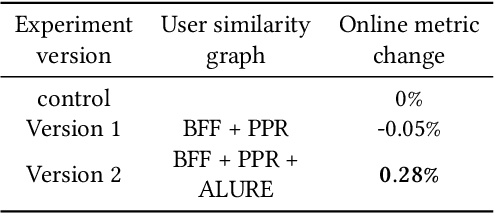
User representation is crucial for recommendation systems as it helps to deliver personalized recommendations by capturing user preferences and behaviors in low-dimensional vectors. High-quality user embeddings can capture subtle preferences, enable precise similarity calculations, and adapt to changing preferences over time to maintain relevance. The effectiveness of recommendation systems depends significantly on the quality of user embedding. We propose to asynchronously learn high fidelity user embeddings for billions of users each day from sequence based multimodal user activities in Meta platforms through a Transformer-like large scale feature learning module. The async learned user representations embeddings (ALURE) are further converted to user similarity graphs through graph learning and then combined with user realtime activities to retrieval highly related ads candidates for the entire ads delivery system. Our method shows significant gains in both offline and online experiments.