 Add to Chrome
 Add to Firefox
 Add to Edge
Demystifying Hidden-State Recurrence: Switchable Latent Reasoning with On-Policy Reinforcement Learning
Jun 11, 2026
Latent chain-of-thought compresses reasoning by replacing visible reasoning traces with continuous hidden-state recurrence, but existing formulations are difficult to optimize with standard on-policy reinforcement learning (RL) and hard to interpret causally. Our key insight is that a single pair of explicit boundary tokens can address both issues at once: discrete entry and exit anchors make the latent block compatible with standard on-policy RL, and the same anchors offer a natural foothold for mechanistic analysis. Motivated by this, we propose SWITCH, a switchable latent reasoning framework. The model emits <swi> to enter latent mode and </swi> to exit. Because the boundaries are ordinary discrete tokens, the GRPO policy ratio is well-defined at every decision point. The same anchors also expose the latent steps to direct probing and causal intervention. We train the model with a visible-to-latent curriculum and a Switch-GRPO objective that propagates gradients through recurrent latent computation. SWITCH consistently outperforms prior hidden-state-recurrence latent reasoning approaches at similar scale. Mechanistic analysis through the boundary tokens further reveals three findings: (i) <swi> is a sharply localised, learned switching policy rather than a stylistic artefact; (ii) the latent step it opens performs problem-specific, causally important computation rather than acting as an inert placeholder; and (iii) that computation is concentrated at a single hidden-state transition on entry. Together, these results show that hidden-state-recurrence latent reasoning is both RL-trainable and open to direct mechanistic analysis, including of how on-policy RL itself improves the model from the inside.

ACE: Attribution-Controlled Knowledge Editing for Multi-hop Factual Recall
Oct 09, 2025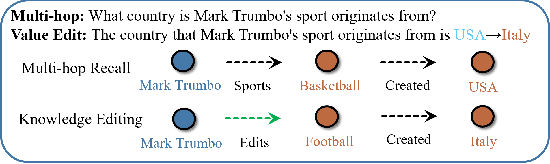
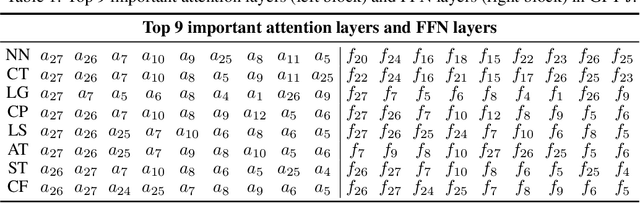
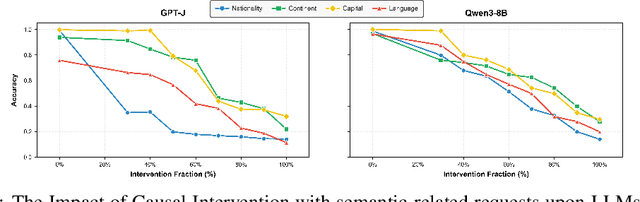
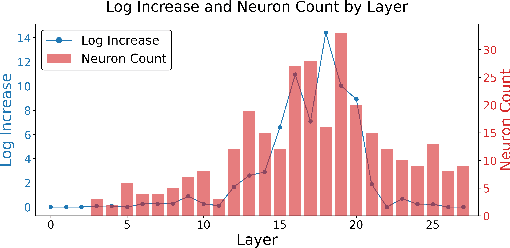
Large Language Models (LLMs) require efficient knowledge editing (KE) to update factual information, yet existing methods exhibit significant performance decay in multi-hop factual recall. This failure is particularly acute when edits involve intermediate implicit subjects within reasoning chains. Through causal analysis, we reveal that this limitation stems from an oversight of how chained knowledge is dynamically represented and utilized at the neuron level. We discover that during multi hop reasoning, implicit subjects function as query neurons, which sequentially activate corresponding value neurons across transformer layers to accumulate information toward the final answer, a dynamic prior KE work has overlooked. Guided by this insight, we propose ACE: Attribution-Controlled Knowledge Editing for Multi-hop Factual Recall, a framework that leverages neuron-level attribution to identify and edit these critical query-value (Q-V) pathways. ACE provides a mechanistically grounded solution for multi-hop KE, empirically outperforming state-of-the-art methods by 9.44% on GPT-J and 37.46% on Qwen3-8B. Our analysis further reveals more fine-grained activation patterns in Qwen3 and demonstrates that the semantic interpretability of value neurons is orchestrated by query-driven accumulation. These findings establish a new pathway for advancing KE capabilities based on the principled understanding of internal reasoning mechanisms.