 Add to Chrome
 Add to Firefox
 Add to Edge
C-MORL: Multi-Objective Reinforcement Learning through Efficient Discovery of Pareto Front
Oct 03, 2024
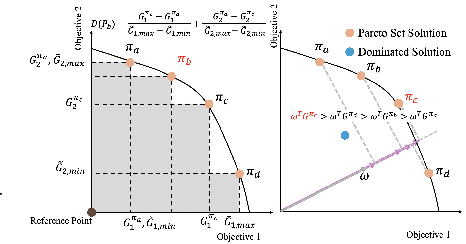

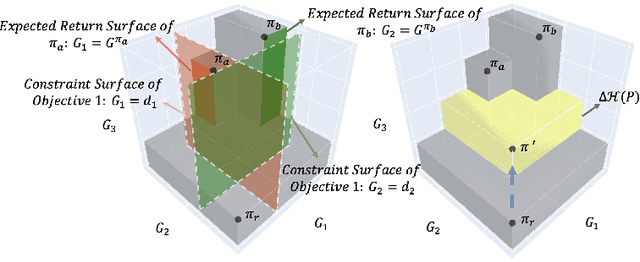

Multi-objective reinforcement learning (MORL) excels at handling rapidly changing preferences in tasks that involve multiple criteria, even for unseen preferences. However, previous dominating MORL methods typically generate a fixed policy set or preference-conditioned policy through multiple training iterations exclusively for sampled preference vectors, and cannot ensure the efficient discovery of the Pareto front. Furthermore, integrating preferences into the input of policy or value functions presents scalability challenges, in particular as the dimension of the state and preference space grow, which can complicate the learning process and hinder the algorithm's performance on more complex tasks. To address these issues, we propose a two-stage Pareto front discovery algorithm called Constrained MORL (C-MORL), which serves as a seamless bridge between constrained policy optimization and MORL. Concretely, a set of policies is trained in parallel in the initialization stage, with each optimized towards its individual preference over the multiple objectives. Then, to fill the remaining vacancies in the Pareto front, the constrained optimization steps are employed to maximize one objective while constraining the other objectives to exceed a predefined threshold. Empirically, compared to recent advancements in MORL methods, our algorithm achieves more consistent and superior performances in terms of hypervolume, expected utility, and sparsity on both discrete and continuous control tasks, especially with numerous objectives (up to nine objectives in our experiments).

FlashMask: Efficient and Rich Mask Extension of FlashAttention
Oct 02, 2024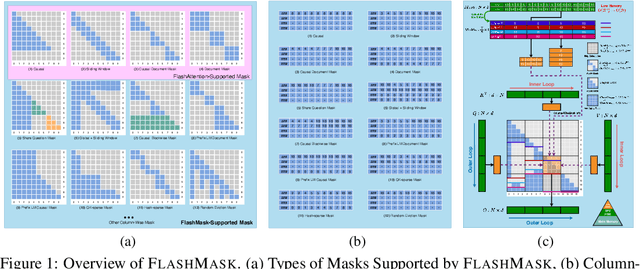
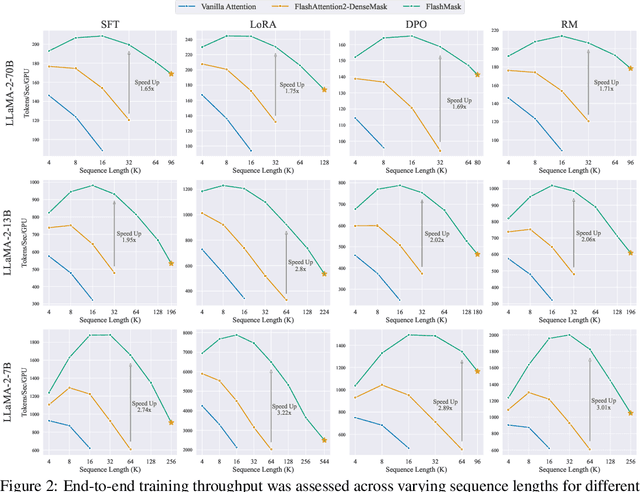

The computational and memory demands of vanilla attention scale quadratically with the sequence length $N$, posing significant challenges for processing long sequences in Transformer models. FlashAttention alleviates these challenges by eliminating the $O(N^2)$ memory dependency and reducing attention latency through IO-aware memory optimizations. However, its native support for certain attention mask types is limited, and it does not inherently accommodate more complex masking requirements. Previous approaches resort to using dense masks with $O(N^2)$ memory complexity, leading to inefficiencies. In this paper, we propose FlashMask, an extension of FlashAttention that introduces a column-wise sparse representation of attention masks. This approach efficiently represents a wide range of mask types and facilitates the development of optimized kernel implementations. By adopting this novel representation, FlashMask achieves linear memory complexity $O(N)$, suitable for modeling long-context sequences. Moreover, this representation enables kernel optimizations that eliminate unnecessary computations by leveraging sparsity in the attention mask, without sacrificing computational accuracy, resulting in higher computational efficiency. We evaluate FlashMask's performance in fine-tuning and alignment training of LLMs such as SFT, LoRA, DPO, and RM. FlashMask achieves significant throughput improvements, with end-to-end speedups ranging from 1.65x to 3.22x compared to existing FlashAttention dense method. Additionally, our kernel-level comparisons demonstrate that FlashMask surpasses the latest counterpart, FlexAttention, by 12.1% to 60.7% in terms of kernel TFLOPs/s, achieving 37.8% to 62.3% of the theoretical maximum FLOPs/s on the A100 GPU. The code is open-sourced on PaddlePaddle and integrated into PaddleNLP, supporting models with over 100 billion parameters for contexts up to 128K tokens.
Generative Pre-trained Ranking Model with Over-parameterization at Web-Scale (Extended Abstract)
Sep 25, 2024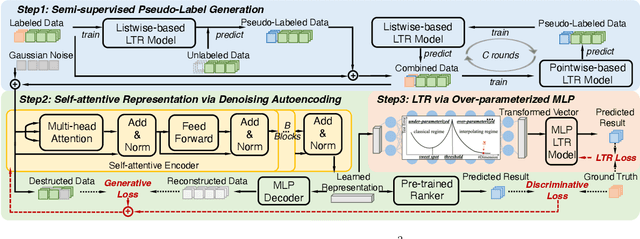

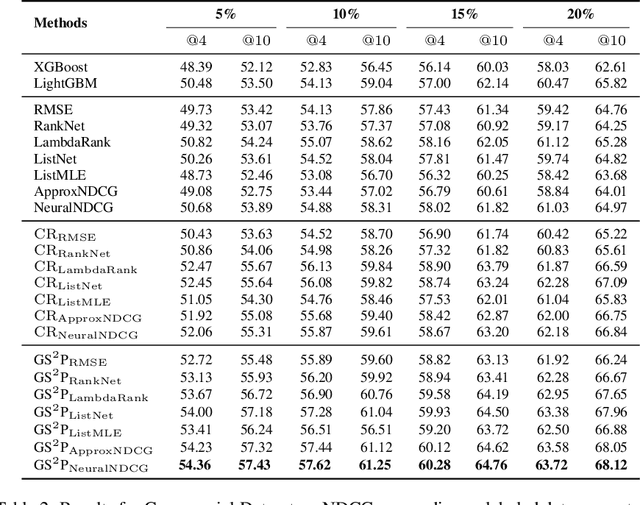
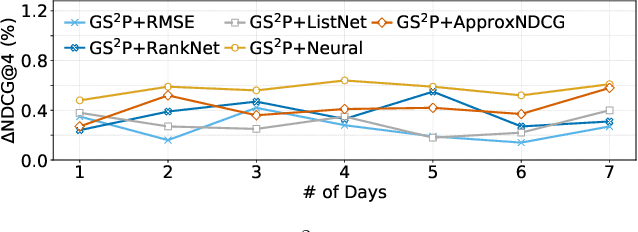
Learning to rank (LTR) is widely employed in web searches to prioritize pertinent webpages from retrieved content based on input queries. However, traditional LTR models encounter two principal obstacles that lead to suboptimal performance: (1) the lack of well-annotated query-webpage pairs with ranking scores covering a diverse range of search query popularities, which hampers their ability to address queries across the popularity spectrum, and (2) inadequately trained models that fail to induce generalized representations for LTR, resulting in overfitting. To address these challenges, we propose a \emph{\uline{G}enerative \uline{S}emi-\uline{S}upervised \uline{P}re-trained} (GS2P) LTR model. We conduct extensive offline experiments on both a publicly available dataset and a real-world dataset collected from a large-scale search engine. Furthermore, we deploy GS2P in a large-scale web search engine with realistic traffic, where we observe significant improvements in the real-world application.
WeatherReal: A Benchmark Based on In-Situ Observations for Evaluating Weather Models
Sep 14, 2024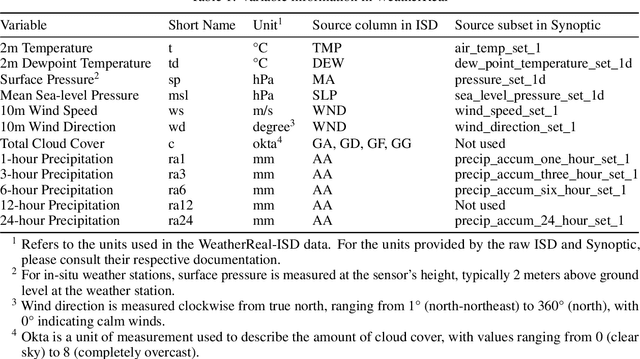
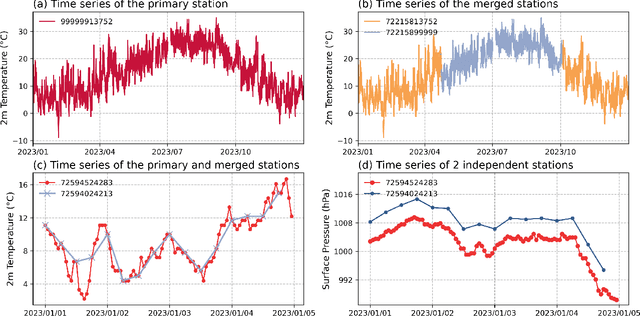
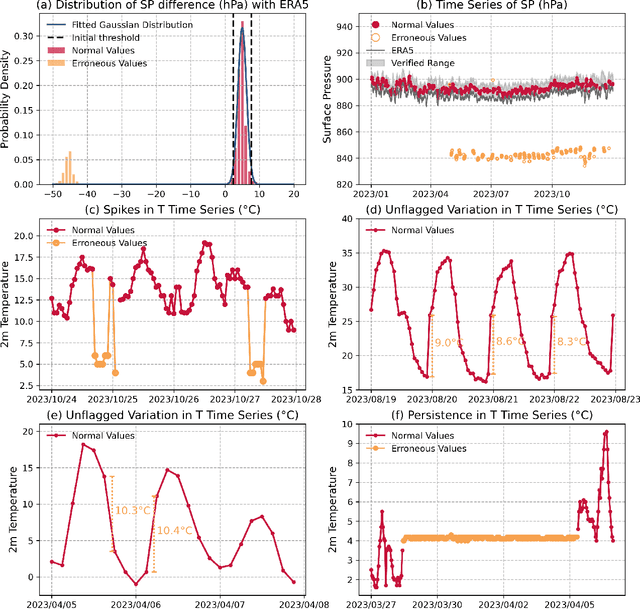
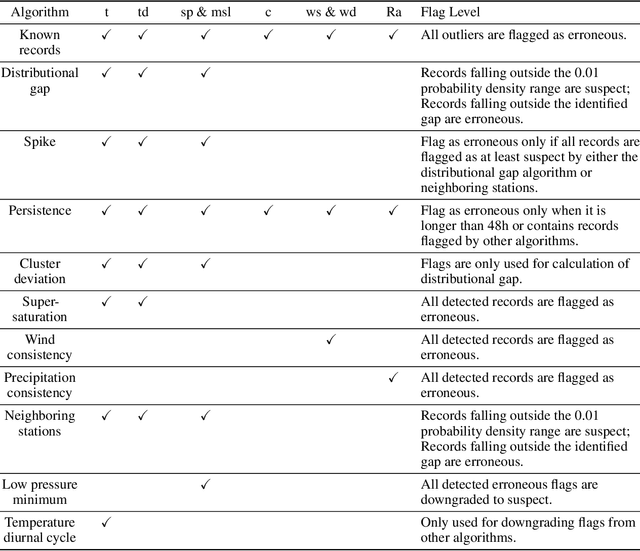
In recent years, AI-based weather forecasting models have matched or even outperformed numerical weather prediction systems. However, most of these models have been trained and evaluated on reanalysis datasets like ERA5. These datasets, being products of numerical models, often diverge substantially from actual observations in some crucial variables like near-surface temperature, wind, precipitation and clouds - parameters that hold significant public interest. To address this divergence, we introduce WeatherReal, a novel benchmark dataset for weather forecasting, derived from global near-surface in-situ observations. WeatherReal also features a publicly accessible quality control and evaluation framework. This paper details the sources and processing methodologies underlying the dataset, and further illustrates the advantage of in-situ observations in capturing hyper-local and extreme weather through comparative analyses and case studies. Using WeatherReal, we evaluated several data-driven models and compared them with leading numerical models. Our work aims to advance the AI-based weather forecasting research towards a more application-focused and operation-ready approach.
Enhancing Cross-domain Pre-Trained Decision Transformers with Adaptive Attention
Sep 11, 2024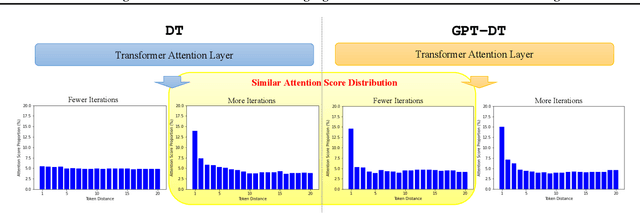
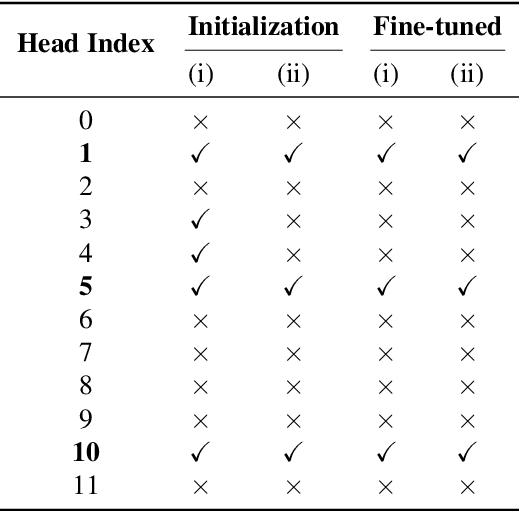
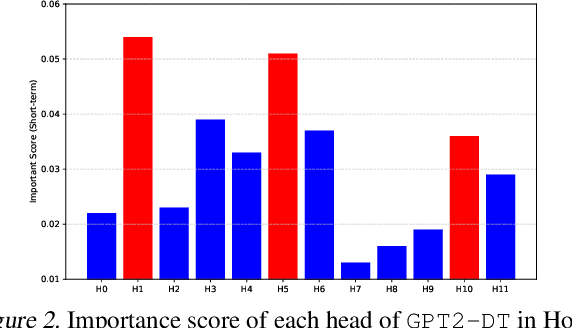
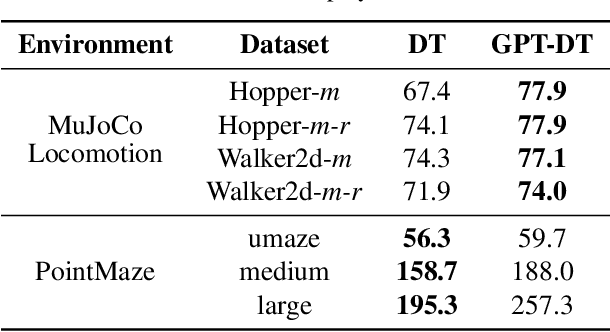
Recently, the pre-training of decision transformers (DT) using a different domain, such as natural language text, has generated significant attention in offline reinforcement learning (Offline RL). Although this cross-domain pre-training approach achieves superior performance compared to training from scratch in environments required short-term planning ability, the mechanisms by which pre-training benefits the fine-tuning phase remain unclear. Furthermore, we point out that the cross-domain pre-training approach hinders the extraction of distant information in environments like PointMaze that require long-term planning ability, leading to performance that is much worse than training DT from scratch. This work first analyzes these issues and found that Markov Matrix, a component that exists in pre-trained attention heads, is the key to explain the significant performance disparity of pre-trained models in different planning abilities. Inspired by our analysis, we propose a general method GPT-DTMA, which equips a pre-trained DT with Mixture of Attention (MoA), to enable adaptive learning and accommodating diverse attention requirements during fine-tuning. Extensive experiments demonstrate that the effectiveness of GPT-DTMA: it achieves superior performance in short-term environments compared to baselines, and in long-term environments, it mitigates the negative impact caused by Markov Matrix, achieving results comparable to those of DT trained from scratch.
Compositional 3D-aware Video Generation with LLM Director
Aug 31, 2024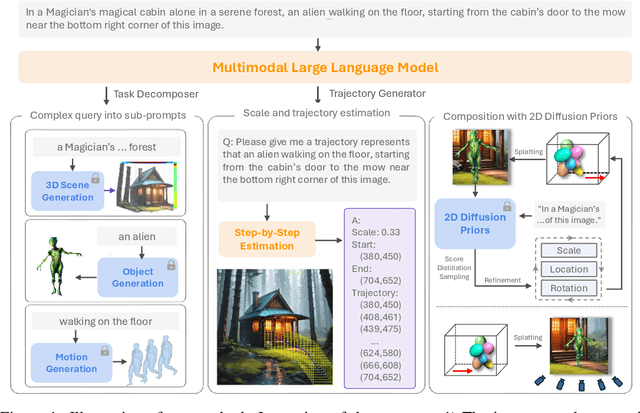


Significant progress has been made in text-to-video generation through the use of powerful generative models and large-scale internet data. However, substantial challenges remain in precisely controlling individual concepts within the generated video, such as the motion and appearance of specific characters and the movement of viewpoints. In this work, we propose a novel paradigm that generates each concept in 3D representation separately and then composes them with priors from Large Language Models (LLM) and 2D diffusion models. Specifically, given an input textual prompt, our scheme consists of three stages: 1) We leverage LLM as the director to first decompose the complex query into several sub-prompts that indicate individual concepts within the video~(\textit{e.g.}, scene, objects, motions), then we let LLM to invoke pre-trained expert models to obtain corresponding 3D representations of concepts. 2) To compose these representations, we prompt multi-modal LLM to produce coarse guidance on the scales and coordinates of trajectories for the objects. 3) To make the generated frames adhere to natural image distribution, we further leverage 2D diffusion priors and use Score Distillation Sampling to refine the composition. Extensive experiments demonstrate that our method can generate high-fidelity videos from text with diverse motion and flexible control over each concept. Project page: \url{https://aka.ms/c3v}.
Collaborative Evolving Strategy for Automatic Data-Centric Development
Jul 26, 2024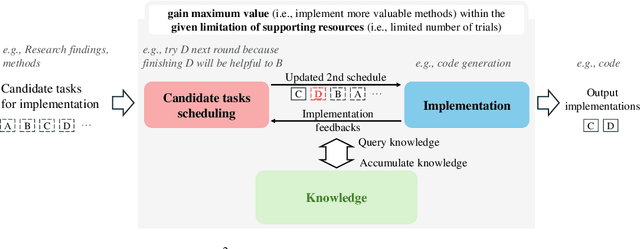

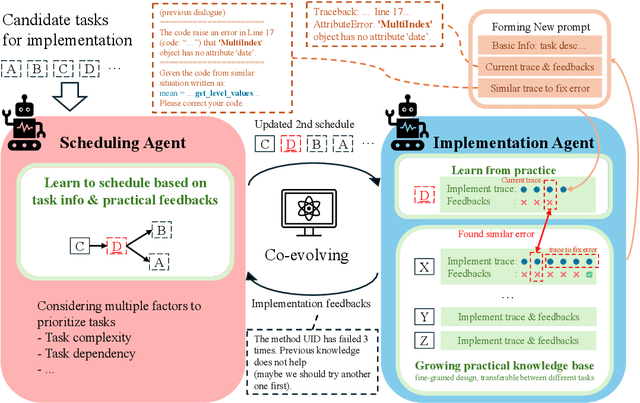
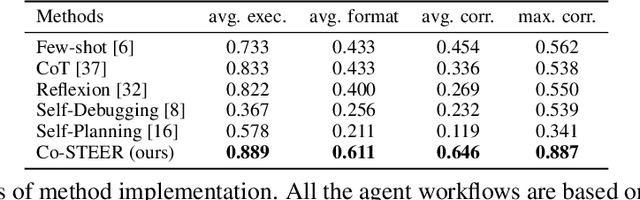
Artificial Intelligence (AI) significantly influences many fields, largely thanks to the vast amounts of high-quality data for machine learning models. The emphasis is now on a data-centric AI strategy, prioritizing data development over model design progress. Automating this process is crucial. In this paper, we serve as the first work to introduce the automatic data-centric development (AD^2) task and outline its core challenges, which require domain-experts-like task scheduling and implementation capability, largely unexplored by previous work. By leveraging the strong complex problem-solving capabilities of large language models (LLMs), we propose an LLM-based autonomous agent, equipped with a strategy named Collaborative Knowledge-STudying-Enhanced Evolution by Retrieval (Co-STEER), to simultaneously address all the challenges. Specifically, our proposed Co-STEER agent enriches its domain knowledge through our proposed evolving strategy and develops both its scheduling and implementation skills by accumulating and retrieving domain-specific practical experience. With an improved schedule, the capability for implementation accelerates. Simultaneously, as implementation feedback becomes more thorough, the scheduling accuracy increases. These two capabilities evolve together through practical feedback, enabling a collaborative evolution process. Extensive experimental results demonstrate that our Co-STEER agent breaks new ground in AD^2 research, possesses strong evolvable schedule and implementation ability, and demonstrates the significant effectiveness of its components. Our Co-STEER paves the way for AD^2 advancements.
UF-HOBI at "Discharge Me!": A Hybrid Solution for Discharge Summary Generation Through Prompt-based Tuning of GatorTronGPT Models
Jul 22, 2024



Automatic generation of discharge summaries presents significant challenges due to the length of clinical documentation, the dispersed nature of patient information, and the diverse terminology used in healthcare. This paper presents a hybrid solution for generating discharge summary sections as part of our participation in the "Discharge Me!" Challenge at the BioNLP 2024 Shared Task. We developed a two-stage generation method using both extractive and abstractive techniques, in which we first apply name entity recognition (NER) to extract key clinical concepts, which are then used as input for a prompt-tuning-based GatorTronGPT model to generate coherent text for two important sections including "Brief Hospital Course" and "Discharge Instructions". Our system was ranked 5th in this challenge, achieving an overall score of 0.284. The results demonstrate the effectiveness of our hybrid solution in improving the quality of automated discharge section generation.
* BIONLP 2024 and Shared Tasks @ ACL 2024
Towards Automated Data Sciences with Natural Language and SageCopilot: Practices and Lessons Learned
Jul 21, 2024


While the field of NL2SQL has made significant advancements in translating natural language instructions into executable SQL scripts for data querying and processing, achieving full automation within the broader data science pipeline - encompassing data querying, analysis, visualization, and reporting - remains a complex challenge. This study introduces SageCopilot, an advanced, industry-grade system system that automates the data science pipeline by integrating Large Language Models (LLMs), Autonomous Agents (AutoAgents), and Language User Interfaces (LUIs). Specifically, SageCopilot incorporates a two-phase design: an online component refining users' inputs into executable scripts through In-Context Learning (ICL) and running the scripts for results reporting & visualization, and an offline preparing demonstrations requested by ICL in the online phase. A list of trending strategies such as Chain-of-Thought and prompt-tuning have been used to augment SageCopilot for enhanced performance. Through rigorous testing and comparative analysis against prompt-based solutions, SageCopilot has been empirically validated to achieve superior end-to-end performance in generating or executing scripts and offering results with visualization, backed by real-world datasets. Our in-depth ablation studies highlight the individual contributions of various components and strategies used by SageCopilot to the end-to-end correctness for data sciences.
Hard Prompts Made Interpretable: Sparse Entropy Regularization for Prompt Tuning with RL
Jul 20, 2024With the advent of foundation models, prompt tuning has positioned itself as an important technique for directing model behaviors and eliciting desired responses. Prompt tuning regards selecting appropriate keywords included into the input, thereby adapting to the downstream task without adjusting or fine-tuning the model parameters. There is a wide range of work in prompt tuning, from approaches that directly harness the backpropagated gradient signals from the model, to those employing black-box optimization such as reinforcement learning (RL) methods. Our primary focus is on RLPrompt, which aims to find optimal prompt tokens leveraging soft Q-learning. While the results show promise, we have observed that the prompts frequently appear unnatural, which impedes their interpretability. We address this limitation by using sparse Tsallis entropy regularization, a principled approach to filtering out unlikely tokens from consideration. We extensively evaluate our approach across various tasks, including few-shot text classification, unsupervised text style transfer, and textual inversion from images. The results indicate a notable improvement over baselines, highlighting the efficacy of our approach in addressing the challenges of prompt tuning. Moreover, we show that the prompts discovered using our method are more natural and interpretable compared to those from other baselines.