 Add to Chrome
 Add to Firefox
 Add to Edge
Context as a Tool: Context Management for Long-Horizon SWE-Agents
Dec 26, 2025
Agents based on large language models have recently shown strong potential on real-world software engineering (SWE) tasks that require long-horizon interaction with repository-scale codebases. However, most existing agents rely on append-only context maintenance or passively triggered compression heuristics, which often lead to context explosion, semantic drift, and degraded reasoning in long-running interactions. We propose CAT, a new context management paradigm that elevates context maintenance to a callable tool integrated into the decision-making process of agents. CAT formalizes a structured context workspace consisting of stable task semantics, condensed long-term memory, and high-fidelity short-term interactions, and enables agents to proactively compress historical trajectories into actionable summaries at appropriate milestones. To support context management for SWE-agents, we propose a trajectory-level supervision framework, CAT-GENERATOR, based on an offline data construction pipeline that injects context-management actions into complete interaction trajectories. Using this framework, we train a context-aware model, SWE-Compressor. Experiments on SWE-Bench-Verified demonstrate that SWE-Compressor reaches a 57.6% solved rate and significantly outperforms ReAct-based agents and static compression baselines, while maintaining stable and scalable long-horizon reasoning under a bounded context budget.

RoboSafe: Safeguarding Embodied Agents via Executable Safety Logic
Dec 24, 2025Embodied agents powered by vision-language models (VLMs) are increasingly capable of executing complex real-world tasks, yet they remain vulnerable to hazardous instructions that may trigger unsafe behaviors. Runtime safety guardrails, which intercept hazardous actions during task execution, offer a promising solution due to their flexibility. However, existing defenses often rely on static rule filters or prompt-level control, which struggle to address implicit risks arising in dynamic, temporally dependent, and context-rich environments. To address this, we propose RoboSafe, a hybrid reasoning runtime safeguard for embodied agents through executable predicate-based safety logic. RoboSafe integrates two complementary reasoning processes on a Hybrid Long-Short Safety Memory. We first propose a Backward Reflective Reasoning module that continuously revisits recent trajectories in short-term memory to infer temporal safety predicates and proactively triggers replanning when violations are detected. We then propose a Forward Predictive Reasoning module that anticipates upcoming risks by generating context-aware safety predicates from the long-term safety memory and the agent's multimodal observations. Together, these components form an adaptive, verifiable safety logic that is both interpretable and executable as code. Extensive experiments across multiple agents demonstrate that RoboSafe substantially reduces hazardous actions (-36.8% risk occurrence) compared with leading baselines, while maintaining near-original task performance. Real-world evaluations on physical robotic arms further confirm its practicality. Code will be released upon acceptance.
RMLer: Synthesizing Novel Objects across Diverse Categories via Reinforcement Mixing Learning
Dec 22, 2025Novel object synthesis by integrating distinct textual concepts from diverse categories remains a significant challenge in Text-to-Image (T2I) generation. Existing methods often suffer from insufficient concept mixing, lack of rigorous evaluation, and suboptimal outputs-manifesting as conceptual imbalance, superficial combinations, or mere juxtapositions. To address these limitations, we propose Reinforcement Mixing Learning (RMLer), a framework that formulates cross-category concept fusion as a reinforcement learning problem: mixed features serve as states, mixing strategies as actions, and visual outcomes as rewards. Specifically, we design an MLP-policy network to predict dynamic coefficients for blending cross-category text embeddings. We further introduce visual rewards based on (1) semantic similarity and (2) compositional balance between the fused object and its constituent concepts, optimizing the policy via proximal policy optimization. At inference, a selection strategy leverages these rewards to curate the highest-quality fused objects. Extensive experiments demonstrate RMLer's superiority in synthesizing coherent, high-fidelity objects from diverse categories, outperforming existing methods. Our work provides a robust framework for generating novel visual concepts, with promising applications in film, gaming, and design.
CodeSimpleQA: Scaling Factuality in Code Large Language Models
Dec 22, 2025Large language models (LLMs) have made significant strides in code generation, achieving impressive capabilities in synthesizing code snippets from natural language instructions. However, a critical challenge remains in ensuring LLMs generate factually accurate responses about programming concepts, technical implementations, etc. Most previous code-related benchmarks focus on code execution correctness, overlooking the factual accuracy of programming knowledge. To address this gap, we present CodeSimpleQA, a comprehensive bilingual benchmark designed to evaluate the factual accuracy of code LLMs in answering code-related questions, which contains carefully curated question-answer pairs in both English and Chinese, covering diverse programming languages and major computer science domains. Further, we create CodeSimpleQA-Instruct, a large-scale instruction corpus with 66M samples, and develop a post-training framework combining supervised fine-tuning and reinforcement learning. Our comprehensive evaluation of diverse LLMs reveals that even frontier LLMs struggle with code factuality. Our proposed framework demonstrates substantial improvements over the base model, underscoring the critical importance of factuality-aware alignment in developing reliable code LLMs.
MatE: Material Extraction from Single-Image via Geometric Prior
Dec 20, 2025The creation of high-fidelity, physically-based rendering (PBR) materials remains a bottleneck in many graphics pipelines, typically requiring specialized equipment and expert-driven post-processing. To democratize this process, we present MatE, a novel method for generating tileable PBR materials from a single image taken under unconstrained, real-world conditions. Given an image and a user-provided mask, MatE first performs coarse rectification using an estimated depth map as a geometric prior, and then employs a dual-branch diffusion model. Leveraging a learned consistency from rotation-aligned and scale-aligned training data, this model further rectify residual distortions from the coarse result and translate it into a complete set of material maps, including albedo, normal, roughness and height. Our framework achieves invariance to the unknown illumination and perspective of the input image, allowing for the recovery of intrinsic material properties from casual captures. Through comprehensive experiments on both synthetic and real-world data, we demonstrate the efficacy and robustness of our approach, enabling users to create realistic materials from real-world image.
UCoder: Unsupervised Code Generation by Internal Probing of Large Language Models
Dec 19, 2025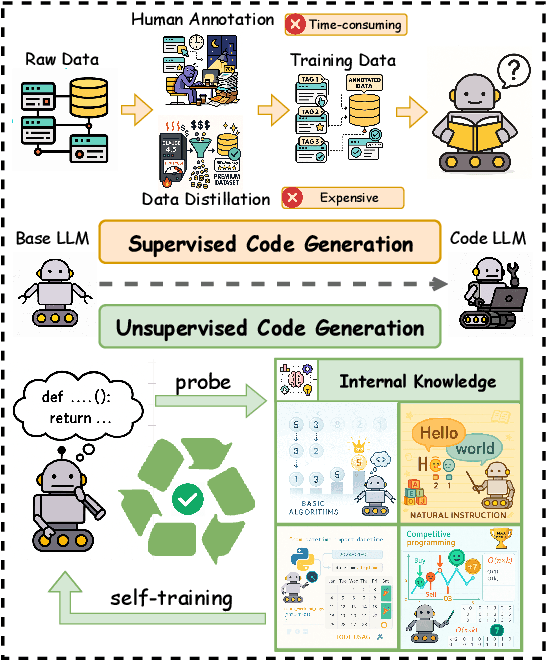
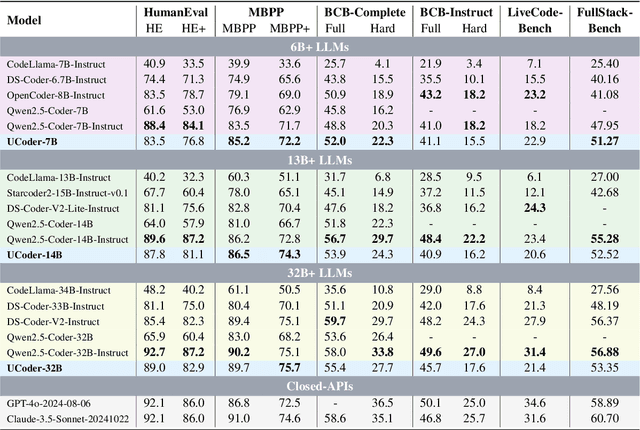
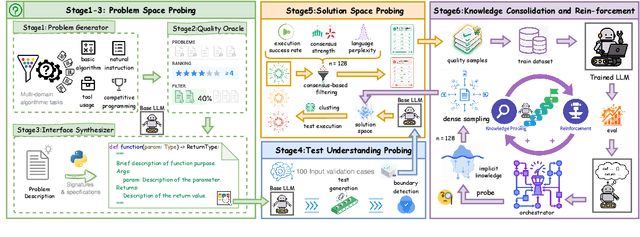
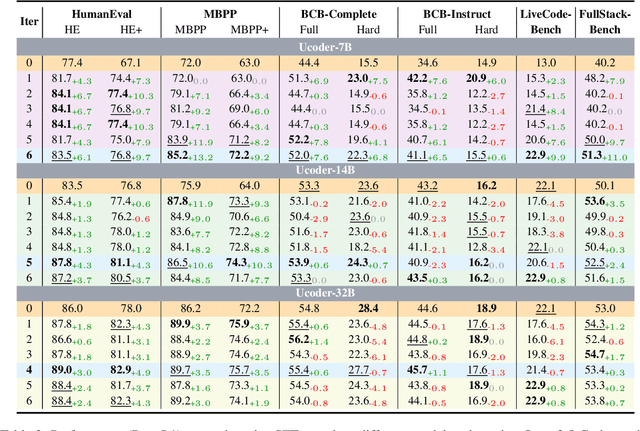
Large language models (LLMs) have demonstrated remarkable capabilities in code generation tasks. However, their effectiveness heavily relies on supervised training with extensive labeled (e.g., question-answering pairs) or unlabeled datasets (e.g., code snippets), which are often expensive and difficult to obtain at scale. To address this limitation, this paper introduces a method IPC, an unsupervised framework that leverages Internal Probing of LLMs for Code generation without any external corpus, even unlabeled code snippets. We introduce the problem space probing, test understanding probing, solution space probing, and knowledge consolidation and reinforcement to probe the internal knowledge and confidence patterns existing in LLMs. Further, IPC identifies reliable code candidates through self-consistency mechanisms and representation-based quality estimation to train UCoder (coder with unsupervised learning). We validate the proposed approach across multiple code benchmarks, demonstrating that unsupervised methods can achieve competitive performance compared to supervised approaches while significantly reducing the dependency on labeled data and computational resources. Analytic experiments reveal that internal model states contain rich signals about code quality and correctness, and that properly harnessing these signals enables effective unsupervised learning for code generation tasks, opening new directions for training code LLMs in resource-constrained scenarios.
StageVAR: Stage-Aware Acceleration for Visual Autoregressive Models
Dec 18, 2025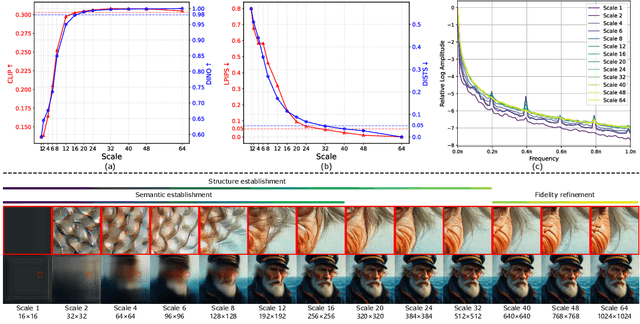
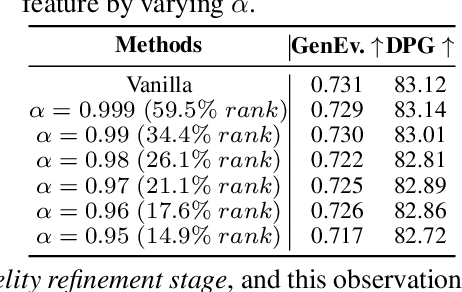
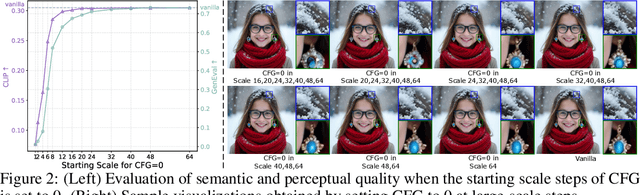
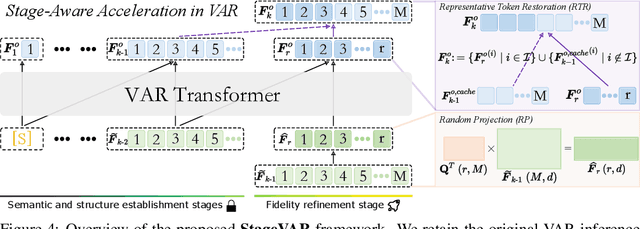
Visual Autoregressive (VAR) modeling departs from the next-token prediction paradigm of traditional Autoregressive (AR) models through next-scale prediction, enabling high-quality image generation. However, the VAR paradigm suffers from sharply increased computational complexity and running time at large-scale steps. Although existing acceleration methods reduce runtime for large-scale steps, but rely on manual step selection and overlook the varying importance of different stages in the generation process. To address this challenge, we present StageVAR, a systematic study and stage-aware acceleration framework for VAR models. Our analysis shows that early steps are critical for preserving semantic and structural consistency and should remain intact, while later steps mainly refine details and can be pruned or approximated for acceleration. Building on these insights, StageVAR introduces a plug-and-play acceleration strategy that exploits semantic irrelevance and low-rank properties in late-stage computations, without requiring additional training. Our proposed StageVAR achieves up to 3.4x speedup with only a 0.01 drop on GenEval and a 0.26 decrease on DPG, consistently outperforming existing acceleration baselines. These results highlight stage-aware design as a powerful principle for efficient visual autoregressive image generation.
Exploiting Radio Frequency Fingerprints for Device Identification: Tackling Cross-receiver Challenges in the Source-data-free Scenario
Dec 18, 2025With the rapid proliferation of edge computing, Radio Frequency Fingerprint Identification (RFFI) has become increasingly important for secure device authentication. However, practical deployment of deep learning-based RFFI models is hindered by a critical challenge: their performance often degrades significantly when applied across receivers with different hardware characteristics due to distribution shifts introduced by receiver variation. To address this, we investigate the source-data-free cross-receiver RFFI (SCRFFI) problem, where a model pretrained on labeled signals from a source receiver must adapt to unlabeled signals from a target receiver, without access to any source-domain data during adaptation. We first formulate a novel constrained pseudo-labeling-based SCRFFI adaptation framework, and provide a theoretical analysis of its generalization performance. Our analysis highlights a key insight: the target-domain performance is highly sensitive to the quality of the pseudo-labels generated during adaptation. Motivated by this, we propose Momentum Soft pseudo-label Source Hypothesis Transfer (MS-SHOT), a new method for SCRFFI that incorporates momentum-center-guided soft pseudo-labeling and enforces global structural constraints to encourage confident and diverse predictions. Notably, MS-SHOT effectively addresses scenarios involving label shift or unknown, non-uniform class distributions in the target domain -- a significant limitation of prior methods. Extensive experiments on real-world datasets demonstrate that MS-SHOT consistently outperforms existing approaches in both accuracy and robustness, offering a practical and scalable solution for source-data-free cross-receiver adaptation in RFFI.
Scaling Laws for Code: Every Programming Language Matters
Dec 15, 2025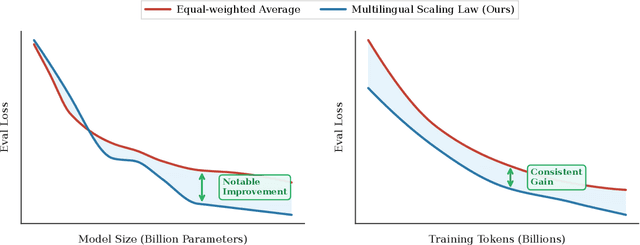
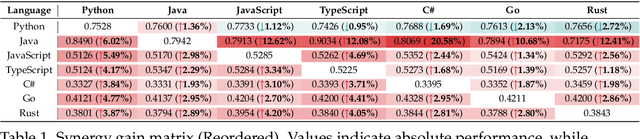
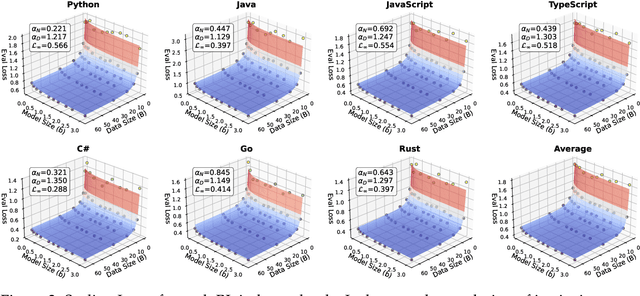

Code large language models (Code LLMs) are powerful but costly to train, with scaling laws predicting performance from model size, data, and compute. However, different programming languages (PLs) have varying impacts during pre-training that significantly affect base model performance, leading to inaccurate performance prediction. Besides, existing works focus on language-agnostic settings, neglecting the inherently multilingual nature of modern software development. Therefore, it is first necessary to investigate the scaling laws of different PLs, and then consider their mutual influences to arrive at the final multilingual scaling law. In this paper, we present the first systematic exploration of scaling laws for multilingual code pre-training, conducting over 1000+ experiments (Equivalent to 336,000+ H800 hours) across multiple PLs, model sizes (0.2B to 14B parameters), and dataset sizes (1T tokens). We establish comprehensive scaling laws for code LLMs across multiple PLs, revealing that interpreted languages (e.g., Python) benefit more from increased model size and data than compiled languages (e.g., Rust). The study demonstrates that multilingual pre-training provides synergistic benefits, particularly between syntactically similar PLs. Further, the pre-training strategy of the parallel pairing (concatenating code snippets with their translations) significantly enhances cross-lingual abilities with favorable scaling properties. Finally, a proportion-dependent multilingual scaling law is proposed to optimally allocate training tokens by prioritizing high-utility PLs (e.g., Python), balancing high-synergy pairs (e.g., JavaScript-TypeScript), and reducing allocation to fast-saturating languages (Rust), achieving superior average performance across all PLs compared to uniform distribution under the same compute budget.
NL2Repo-Bench: Towards Long-Horizon Repository Generation Evaluation of Coding Agents
Dec 14, 2025Recent advances in coding agents suggest rapid progress toward autonomous software development, yet existing benchmarks fail to rigorously evaluate the long-horizon capabilities required to build complete software systems. Most prior evaluations focus on localized code generation, scaffolded completion, or short-term repair tasks, leaving open the question of whether agents can sustain coherent reasoning, planning, and execution over the extended horizons demanded by real-world repository construction. To address this gap, we present NL2Repo Bench, a benchmark explicitly designed to evaluate the long-horizon repository generation ability of coding agents. Given only a single natural-language requirements document and an empty workspace, agents must autonomously design the architecture, manage dependencies, implement multi-module logic, and produce a fully installable Python library. Our experiments across state-of-the-art open- and closed-source models reveal that long-horizon repository generation remains largely unsolved: even the strongest agents achieve below 40% average test pass rates and rarely complete an entire repository correctly. Detailed analysis uncovers fundamental long-horizon failure modes, including premature termination, loss of global coherence, fragile cross-file dependencies, and inadequate planning over hundreds of interaction steps. NL2Repo Bench establishes a rigorous, verifiable testbed for measuring sustained agentic competence and highlights long-horizon reasoning as a central bottleneck for the next generation of autonomous coding agents.