 Add to Chrome
 Add to Firefox
 Add to Edge
From Storage to Access: Verifiable Activation of Parametric Knowledge in LLMs via Explicit Priming and Implicit Reasoning
Aug 19, 2026
Although Large Language Models (LLMs) encode rich factual knowledge in their parameters, reliably recalling and verifying such knowledge remains a key bottleneck in factual question answering. Existing end-to-end methods entangle knowledge elicitation with reasoning, making it difficult to determine whether correct answers arise from parametric knowledge or the input context. To address this challenge, we propose VAKE (Verifiable Activation of Parametric KnowledgE), a two-stage reinforcement-learning framework that externalizes latent parametric knowledge through explicit Priming and transfers the acquired elicitation capability to implicit Reasoning. Given a query and an insufficient retrieved subgraph, the Priming policy explicitly inserts bridging triples as verifiable evidence, with supervision provided by rewards derived from answers generated by a separate frozen model over the augmented subgraph. Building on the policy learned during Priming, the Reasoning stage trains the model to answer from the original input, testing whether the capability acquired through explicit knowledge elicitation transfers to implicit reasoning. Experiments across seven benchmarks and models from 3B to 14B show that VAKE consistently outperforms standard baselines, including when transferring directly from HotpotQA to OOD datasets. LLM-based evaluation further shows that over 80% of the inserted triples provide factual bridging knowledge not derivable from the retrieved context, while more than half elicit knowledge inaccessible through direct prompting. These results suggest that VAKE activates latent parametric knowledge rather than copying the input context or memorizing dataset-specific associations.

Surfacing the Unsaid: CUE-Bench for Affective Stance in Chinese Discourse
Aug 12, 2026Emotion understanding in discourse requires reasoning beyond surface sentiment because speakers often convey affect through indirect, implicit, polite, ironic, or deliberately mismatched expressions. Existing emotion benchmarks mainly annotate surface polarity or final emotion categories, while lacking a structured account of how explicit expression, implicit affect, pragmatic intent, and fine grained emotion interact. This limitation makes current evaluations insensitive to cases where affective meaning is concealed, weakened, inverted, or pragmatically reshaped, thereby obscuring model failures in deeper emotion understanding. To address this gap, we introduce CUE Bench, a Chinese Unsaid Emotion benchmark that centers on Affective Stance and covers diverse communicative scenarios. CUE Bench constructs nine human interpretable affective stances from explicit implicit polarity interaction and further provides intent and fine grained emotion annotations for structured affective inference. Experiments show that incorporating Affective Stance improves fine grained emotion recognition by 3.5 percentage points and pragmatic intent detection by 7.8 percentage points over strong baselines.
Semiotic logical hexagon theory for LLM logical reasoning
Jul 24, 2026Large language models (LLMs) have become powerful tools for language understanding and logical reasoning. However, they still make mistakes when a problem requires both understanding meaning and following logic. A key reason is that natural-language statements often carry implicit semantic relations before any formal reasoning begins. If these hidden meanings are not properly organized, the model may reach incorrect conclusions even when the subsequent reasoning process appears logically valid. Existing methods improve reasoning through decomposition, symbolic translation, external solvers, or self-verification, but pay comparatively less attention to the semantic structure on which reasoning depends. In this paper, we further investigate how semantic organization influences logical reasoning in LLMs. To this end, we propose HexLogicAgent, a framework that first organizes the meaning of natural-language statements and then guides logical reasoning through structured verification. In our investigation, we also make two observations. First, incomplete semantic representations, rather than deductive inference itself, are a major source of logical reasoning failures in LLMs. Second, explicitly modeling the complete structure of semantic opposition substantially delays the degradation of reasoning performance as logical complexity increases. Experiments on challenging logical reasoning benchmarks demonstrate that HexLogicAgent consistently improves reasoning reliability across multiple LLMs. The core idea is supported by a logical hexagon theory, which explains why a complete structure of opposing meanings is necessary for reliable reasoning.
PRISM: Synergizing Vision Foundation Models via Self-organized Expert Specialization
Jun 02, 2026Unifying the complementary strengths of diverse Vision Foundation Models (VFMs) into a single efficient model is highly desirable but challenged by the negative transfer inherent in monolithic distillation. To address these feature conflicts, we introduce \textbf{PRISM}, a novel dual-stream Mixture-of-Experts (MoE) framework that synergizes VFMs via modular specialization. We propose a two-stage paradigm: (1) expertise deconstruction, where a teacher-conditional router guides experts to specialize in distinct representational subspaces to mitigate interference, followed by (2) dynamic recomposition, where the router learns to assemble these experts into tailored computational pathways for downstream tasks. Experiments on PASCAL-Context and NYUD-v2 show that \textbf{PRISM} establishes a new state of the art, validating that sparse, emergent specialization is a scalable approach for integrating diverse visual knowledge.
HotComment: A Benchmark for Evaluating Popularity of Online Comments
Apr 28, 2026Online comments play a crucial role in shaping public sentiment and opinion dynamics on social media. However, evaluating their popularity remains challenging, not only because it depends on linguistic quality, originality, and emotional resonance, but also because stylistic preferences vary widely across platforms and user groups, causing the same comment to resonate differently in different communities. In this work, we present HotComment, a multimodal benchmark integrating video and text modalities that comprehensively quantifies popularity from three enhanced aspects: (1) Content Quality, which evaluates semantic similarity with ground-truth human comments and extends quality assessment through four interpretable dimensions; (2) Popularity Prediction, based on trends from models trained on real-world interaction data; and (3) User Behavior Simulation, which models the distribution of platform users and approximates \textbf{engagement scores} through an agent-based framework. Furthermore, we propose StyleCmt, inspired by social ripple effects, where multiple stylistic dimensions align to amplify socially resonant expressions and suppress incongruent ones.
Seeing Further and Wider: Joint Spatio-Temporal Enlargement for Micro-Video Popularity Prediction
Apr 22, 2026Micro-video popularity prediction (MVPP) aims to forecast the future popularity of videos on online media, which is essential for applications such as content recommendation and traffic allocation. In real-world scenarios, it is critical for MVPP approaches to understand both the temporal dynamics of a given video (temporal) and its historical relevance to other videos (spatial). However, existing approaches sufer from limitations in both dimensions: temporally, they rely on sparse short-range sampling that restricts content perception; spatially, they depend on flat retrieval memory with limited capacity and low efficiency, hindering scalable knowledge utilization. To overcome these limitations, we propose a unified framework that achieves joint spatio-temporal enlargement, enabling precise perception of extremely long video sequences while supporting a scalable memory bank that can infinitely expand to incorporate all relevant historical videos. Technically, we employ a Temporal Enlargement driven by a frame scoring module that extracts highlight cues from video frames through two complementary pathways: sparse sampling and dense perception. Their outputs are adaptively fused to enable robust long-sequence content understanding. For Spatial Enlargement, we construct a Topology-Aware Memory Bank that hierarchically clusters historically relevant content based on topological relationships. Instead of directly expanding memory capacity, we update the encoder features of the corresponding clusters when incorporating new videos, enabling unbounded historical association without unbounded storage growth. Extensive experiments on three widely used MVPP benchmarks demonstrate that our method consistently outperforms 11 strong baselines across mainstream metrics, achieving robust improvements in both prediction accuracy and ranking consistency.
Hypergraph-State Collaborative Reasoning for Multi-Object Tracking
Apr 14, 2026Motion reasoning serves as the cornerstone of multi-object tracking (MOT), as it enables consistent association of targets across frames. However, existing motion estimation approaches face two major limitations: (1) instability caused by noisy or probabilistic predictions, and (2) vulnerability under occlusion, where trajectories often fragment once visual cues disappear. To overcome these issues, we propose a collaborative reasoning framework that enhances motion estimation through joint inference among multiple correlated objects. By allowing objects with similar motion states to mutually constrain and refine each other, our framework stabilizes noisy trajectories and infers plausible motion continuity even when target is occluded. To realize this concept, we design HyperSSM, an architecture that integrates Hypergraph computation and a State Space Model (SSM) for unified spatial-temporal reasoning. The Hypergraph module captures spatial motion correlations through dynamic hyperedges, while the SSM enforces temporal smoothness via structured state transitions. This synergistic design enables simultaneous optimization of spatial consensus and temporal coherence, resulting in robust and stable motion estimation. Extensive experiments on four mainstream and diverse benchmarks(MOT17, MOT20, DanceTrack, and SportsMOT) covering various motion patterns and scene complexities, demonstrate that our approach achieves state-of-the-art performance across a wide range of tracking scenarios.
Logical Phase Transitions: Understanding Collapse in LLM Logical Reasoning
Jan 06, 2026Symbolic logical reasoning is a critical yet underexplored capability of large language models (LLMs), providing reliable and verifiable decision-making in high-stakes domains such as mathematical reasoning and legal judgment. In this study, we present a systematic analysis of logical reasoning under controlled increases in logical complexity, and reveal a previously unrecognized phenomenon, which we term Logical Phase Transitions: rather than degrading smoothly, logical reasoning performance remains stable within a regime but collapses abruptly beyond a critical logical depth, mirroring physical phase transitions such as water freezing beyond a critical temperature threshold. Building on this insight, we propose Neuro-Symbolic Curriculum Tuning, a principled framework that adaptively aligns natural language with logical symbols to establish a shared representation, and reshapes training dynamics around phase-transition boundaries to progressively strengthen reasoning at increasing logical depths. Experiments on five benchmarks show that our approach effectively mitigates logical reasoning collapse at high complexity, yielding average accuracy gains of +1.26 in naive prompting and +3.95 in CoT, while improving generalization to unseen logical compositions. Code and data are available at https://github.com/AI4SS/Logical-Phase-Transitions.
Cross-Modality Masked Learning for Survival Prediction in ICI Treated NSCLC Patients
Jul 09, 2025Accurate prognosis of non-small cell lung cancer (NSCLC) patients undergoing immunotherapy is essential for personalized treatment planning, enabling informed patient decisions, and improving both treatment outcomes and quality of life. However, the lack of large, relevant datasets and effective multi-modal feature fusion strategies pose significant challenges in this domain. To address these challenges, we present a large-scale dataset and introduce a novel framework for multi-modal feature fusion aimed at enhancing the accuracy of survival prediction. The dataset comprises 3D CT images and corresponding clinical records from NSCLC patients treated with immune checkpoint inhibitors (ICI), along with progression-free survival (PFS) and overall survival (OS) data. We further propose a cross-modality masked learning approach for medical feature fusion, consisting of two distinct branches, each tailored to its respective modality: a Slice-Depth Transformer for extracting 3D features from CT images and a graph-based Transformer for learning node features and relationships among clinical variables in tabular data. The fusion process is guided by a masked modality learning strategy, wherein the model utilizes the intact modality to reconstruct missing components. This mechanism improves the integration of modality-specific features, fostering more effective inter-modality relationships and feature interactions. Our approach demonstrates superior performance in multi-modal integration for NSCLC survival prediction, surpassing existing methods and setting a new benchmark for prognostic models in this context.
MCA-RG: Enhancing LLMs with Medical Concept Alignment for Radiology Report Generation
Jul 09, 2025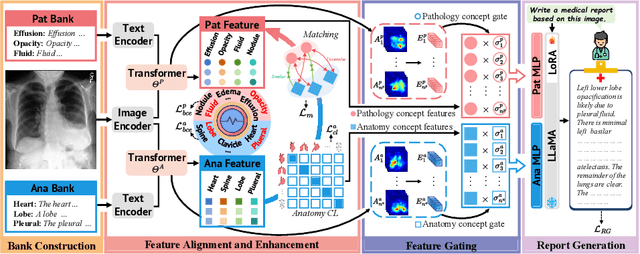
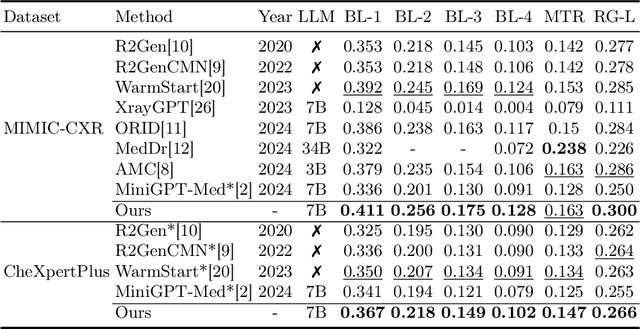
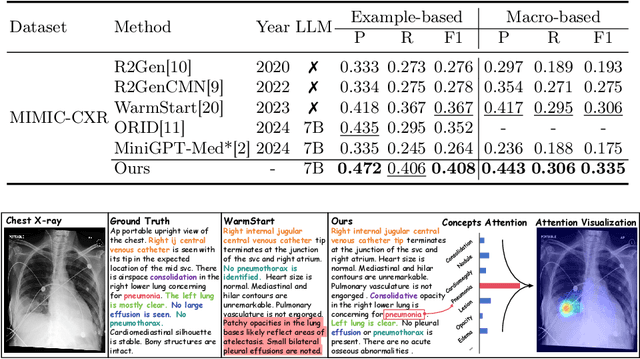
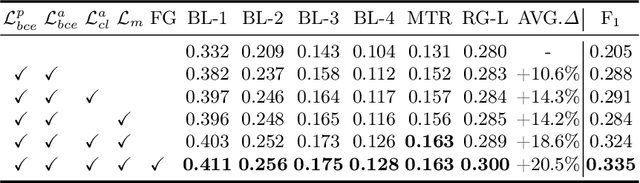
Despite significant advancements in adapting Large Language Models (LLMs) for radiology report generation (RRG), clinical adoption remains challenging due to difficulties in accurately mapping pathological and anatomical features to their corresponding text descriptions. Additionally, semantic agnostic feature extraction further hampers the generation of accurate diagnostic reports. To address these challenges, we introduce Medical Concept Aligned Radiology Report Generation (MCA-RG), a knowledge-driven framework that explicitly aligns visual features with distinct medical concepts to enhance the report generation process. MCA-RG utilizes two curated concept banks: a pathology bank containing lesion-related knowledge, and an anatomy bank with anatomical descriptions. The visual features are aligned with these medical concepts and undergo tailored enhancement. We further propose an anatomy-based contrastive learning procedure to improve the generalization of anatomical features, coupled with a matching loss for pathological features to prioritize clinically relevant regions. Additionally, a feature gating mechanism is employed to filter out low-quality concept features. Finally, the visual features are corresponding to individual medical concepts, and are leveraged to guide the report generation process. Experiments on two public benchmarks (MIMIC-CXR and CheXpert Plus) demonstrate that MCA-RG achieves superior performance, highlighting its effectiveness in radiology report generation.