 Add to Chrome
 Add to Firefox
 Add to Edge
StartupBench: Benchmarking General-Purpose Agents on Market-Validated End-to-End Workflows
Aug 18, 2026
Recent advances in Large Language Models(LLMs) and agents have substantially improved the ability of AI systems to execute complex tasks. Yet existing benchmarks largely rely on researcher-selected tasks, leaving uncertain whether such progress extends to the work that real-world users actually demand from AI systems. We introduce \textbf{StartupBench}, an E2E agent benchmark grounded in market-validated AI startup products. Rather than defining tasks from pre-defined assumptions about useful agent capabilities, we systematically study AI products with demonstrated adoption, together with their product workflows and users, to identify real-world tasks for which AI has established practical demand across diverse professional domains. We translate these workflows into complete deliverable-oriented tasks and evaluate them with fine-grained rubrics capturing their complex requirements. Across representative models evaluated under a unified agent harness, even the strongest model successfully completes only approximately 30\% of StartupBench, despite making substantial partial progress on many tasks. Further analysis identifies aspects like complex instruction following and domain-specific expertise as major sources of failure. Our results reveal that many market-validated workflows remain beyond the reliable capabilities of current general-purpose agents, establishing StartupBench as an empirical measure of progress toward E2E completions of real-world user tasks.

Workflow-GYM: Towards Long-Horizon Evaluation of Computer-use Agentic tasks in Real-World Professional Fields
Jun 09, 2026Recent years have witnessed the rapid evolution of AI agents toward handling increasingly complex, real-world tasks. However, existing benchmarks rarely evaluate whether agents can operate graphical user interfaces to complete long-horizon, high-value professional workflows across diverse domains. Current GUI benchmarks still predominantly focus on general-purpose software, relatively simple applications, and short-horizon tasks, leaving it largely unknown whether modern agents can follow user instructions to autonomously operate domain-specific professional software and accomplish economically valuable work in an end-to-end manner. To bridge this gap, we introduce Workflow-GYM, a benchmark for long-horizon GUI tasks centered on professional domains and specialized software environments. Through extensive experiments on state-of-the-art models, we find that even the strongest models achieve only slightly above 30% success rates, highlighting that professional long-horizon GUI workflows remain highly challenging for current GUI agents. Further analysis reveals that current agents struggle to maintain long-horizon workflow consistency, frequently exhibiting workflow stage omission, error propagation, objective drift, and insufficient understanding of professional software environments. Our findings provide important insights into the limitations of current agent systems and suggest key directions for the next generation of GUI-agent research.
NL2Repo-Bench: Towards Long-Horizon Repository Generation Evaluation of Coding Agents
Dec 14, 2025Recent advances in coding agents suggest rapid progress toward autonomous software development, yet existing benchmarks fail to rigorously evaluate the long-horizon capabilities required to build complete software systems. Most prior evaluations focus on localized code generation, scaffolded completion, or short-term repair tasks, leaving open the question of whether agents can sustain coherent reasoning, planning, and execution over the extended horizons demanded by real-world repository construction. To address this gap, we present NL2Repo Bench, a benchmark explicitly designed to evaluate the long-horizon repository generation ability of coding agents. Given only a single natural-language requirements document and an empty workspace, agents must autonomously design the architecture, manage dependencies, implement multi-module logic, and produce a fully installable Python library. Our experiments across state-of-the-art open- and closed-source models reveal that long-horizon repository generation remains largely unsolved: even the strongest agents achieve below 40% average test pass rates and rarely complete an entire repository correctly. Detailed analysis uncovers fundamental long-horizon failure modes, including premature termination, loss of global coherence, fragile cross-file dependencies, and inadequate planning over hundreds of interaction steps. NL2Repo Bench establishes a rigorous, verifiable testbed for measuring sustained agentic competence and highlights long-horizon reasoning as a central bottleneck for the next generation of autonomous coding agents.
TreePO: Bridging the Gap of Policy Optimization and Efficacy and Inference Efficiency with Heuristic Tree-based Modeling
Aug 24, 2025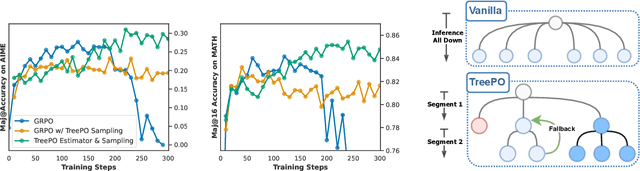

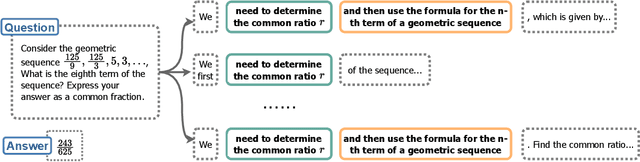
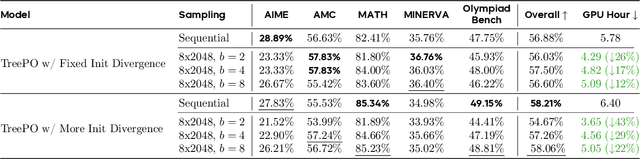
Recent advancements in aligning large language models via reinforcement learning have achieved remarkable gains in solving complex reasoning problems, but at the cost of expensive on-policy rollouts and limited exploration of diverse reasoning paths. In this work, we introduce TreePO, involving a self-guided rollout algorithm that views sequence generation as a tree-structured searching process. Composed of dynamic tree sampling policy and fixed-length segment decoding, TreePO leverages local uncertainty to warrant additional branches. By amortizing computation across common prefixes and pruning low-value paths early, TreePO essentially reduces the per-update compute burden while preserving or enhancing exploration diversity. Key contributions include: (1) a segment-wise sampling algorithm that alleviates the KV cache burden through contiguous segments and spawns new branches along with an early-stop mechanism; (2) a tree-based segment-level advantage estimation that considers both global and local proximal policy optimization. and (3) analysis on the effectiveness of probability and quality-driven dynamic divergence and fallback strategy. We empirically validate the performance gain of TreePO on a set reasoning benchmarks and the efficiency saving of GPU hours from 22\% up to 43\% of the sampling design for the trained models, meanwhile showing up to 40\% reduction at trajectory-level and 35\% at token-level sampling compute for the existing models. While offering a free lunch of inference efficiency, TreePO reveals a practical path toward scaling RL-based post-training with fewer samples and less compute. Home page locates at https://m-a-p.ai/TreePO.
First Return, Entropy-Eliciting Explore
Jul 09, 2025Reinforcement Learning from Verifiable Rewards (RLVR) improves the reasoning abilities of Large Language Models (LLMs) but it struggles with unstable exploration. We propose FR3E (First Return, Entropy-Eliciting Explore), a structured exploration framework that identifies high-uncertainty decision points in reasoning trajectories and performs targeted rollouts to construct semantically grounded intermediate feedback. Our method provides targeted guidance without relying on dense supervision. Empirical results on mathematical reasoning benchmarks(AIME24) show that FR3E promotes more stable training, produces longer and more coherent responses, and increases the proportion of fully correct trajectories. These results highlight the framework's effectiveness in improving LLM reasoning through more robust and structured exploration.
Steel-LLM:From Scratch to Open Source -- A Personal Journey in Building a Chinese-Centric LLM
Feb 10, 2025Steel-LLM is a Chinese-centric language model developed from scratch with the goal of creating a high-quality, open-source model despite limited computational resources. Launched in March 2024, the project aimed to train a 1-billion-parameter model on a large-scale dataset, prioritizing transparency and the sharing of practical insights to assist others in the community. The training process primarily focused on Chinese data, with a small proportion of English data included, addressing gaps in existing open-source LLMs by providing a more detailed and practical account of the model-building journey. Steel-LLM has demonstrated competitive performance on benchmarks such as CEVAL and CMMLU, outperforming early models from larger institutions. This paper provides a comprehensive summary of the project's key contributions, including data collection, model design, training methodologies, and the challenges encountered along the way, offering a valuable resource for researchers and practitioners looking to develop their own LLMs. The model checkpoints and training script are available at https://github.com/zhanshijinwat/Steel-LLM.