 Add to Chrome
 Add to Firefox
 Add to Edge
TOPS: First-Principles Visual Token Pruning via Constructing Token Optimal Preservation Sets for Efficient MLLM Inference
Jun 25, 2026
Multimodal large language models (MLLMs) have achieved strong multimodal reasoning capabilities, but their efficiency is limited by the large number of visual tokens, which introduces substantial computational overhead. Visual token pruning offers a natural solution, yet existing methods are imperfect: attention-based criteria tend to retain redundant tokens, while diversity-based criteria are often agnostic to user instructions. Even methods that combine multiple criteria still lack a principled formulation of the intrinsic objective of token pruning. In this paper, we revisit visual token pruning from a first-principles perspective and formulate it as constructing Token Optimal Preservation Sets. Through a top-down information-theoretic analysis, we identify three fundamental principles for effective token selection: Task Relevance, Information Coverage, and Semantic Diversity. Based on these principles, we propose TOPS, a training-free and model-agnostic pruning module that can be applied to various MLLMs. Extensive experiments on 7 MLLM backbones and 14 benchmarks demonstrate that TOPS outperforms prior methods under diverse pruning settings. Notably, on LLaVA-NeXT, TOPS removes 77.8% of visual tokens while preserving 100.0% and 100.6% performance on its 7B and 13B models, respectively, suggesting that pruning redundant visual tokens can sometimes mitigate hallucination and inspire future lightweight MLLM design.

MV-WAM: Manifold-Aware World Action Model with Value Augmentation
Jun 19, 2026Achieving robust and generalizable manipulation across diverse environments remains a fundamental challenge in embodied robotics. Recent world action models achieve strong in-domain performance, yet their gains do not extend proportionally to out-of-distribution scenarios. We attribute this to a structural mismatch between visual and action modalities, whose intrinsically heterogeneous manifolds cause joint optimization to disproportionately degrade action robustness under distribution shift. To address this, we propose MV-WAM, a novel end-to-end framework that jointly models visual prediction, action generation, and value estimation designed to effectively leverage video priors during both training and inference for enhanced action generalization. Key to this unification is a cross-modality causal mask that hierarchically grounds actions in predicted video frames and value function tokens in both modalities. To further narrow the generalization gap, MV-WAM adopts a manifold-aware optimization scheme that explicitly accounts for the structural heterogeneity across modalities. Finally, MV-WAM introduces a progress-value regulation mechanism that estimates task completion and detects misalignment between predicted frames and generated actions, enabling the policy to autonomously identify execution deviations and recover through value-guided rollback. On the RoboTwin simulation, MV-WAM achieves a 55.7% mean success rate on random scenarios without any randomized action supervision, outperforming the strongest baseline by 29.3%. MV-WAM achieves a 77.5% mean success rate across four real-world tasks of varying difficulty on a dual-arm robot. Our results demonstrate that manifold-aware cross-modal alignment is essential for robust policy generalization, offering a path toward deployable robotic manipulation.
SafeDojo: Safe Reinforcement Learning for VLA via Interactive World Model
Jun 15, 2026Safe control is a prerequisite for real-world embodied intelligence, for which safe reinforcement learning has emerged as a promising paradigm. However, existing safe reinforcement learning methods either require costly real-world exploration or depend on hand-crafted safety functions. Neither scales to vision-language-action models deployed in open-world physical environments. We propose SafeDojo, the first model-based safe reinforcement learning framework for vision-language-action policies designed to learn safe actions through world model-based imagination. Specifically, SafeDojo performs online reinforcement learning on top of an interactive video world model. The world model generates action-conditioned future predictions, from which a tailored ResNet success classifier estimates per-step task progress from imagined frames and a lightweight safety head predicts per-step safety costs from latent context together with the proposed action chunk, enabling simultaneous assessment of task execution and trajectory safety. The decoupled task-reward and safety-cost signals are balanced through a Lagrangian-based constrained GRPO objective, enabling coordinated improvement of task success and safety under explicit constraints. On SafeLIBERO, SafeDojo achieves the best aggregate task success, safe success, and execution efficiency among inference-time safety, model-free RL, and model-based RL baselines, with the best average safe-success rate on both levels and an 8.25 percentage-point improvement over the strongest baseline on Level I. Real-world Franka deployment further shows the best average task and safe-success rates across five tasks. Our results position world model-based safe reinforcement learning as a scalable and generalizable path toward safe embodied intelligence.
WAM4D: Fast 4D World Action Model via Spatial Register Tokens
Jun 12, 2026World action models (WAMs) have recently shown promise in jointly modeling future observations and executable robot actions. However, most existing WAMs still operate in 2D video or latent spaces, where visually plausible rollouts miss the 3D spatial constraints and occluded contact geometry required for precise manipulation. While geometric foundation models offer strong priors for recovering dense 3D structure and motion from visual observations, forcing WAMs to predict the dense 4D representation introduces costly geometric decoding and slows down causal action generation. To address the trade-off, we present WAM4D, a fast 4D world action model that uses lightweight spatial register tokens as training-time future-depth readouts to transfer pretrained geometric priors into a causal video-action transformer, then removes the register branch for lightweight action inference. To prevent non-causal shortcuts, we further design causal mixture attention for the Mixture-of-Transformers (MoT) WAM backbone, defining modality-specific visibility among video, action, and geometry tokens. Comprehensive experiments on RoboTwin 2.0 and challenging real-world manipulation tasks show that WAM4D improves spatial consistency and achieves competitive action prediction while maintaining efficient inference.
VEGA: Visual Encoder Grounding Alignment for Spatially-Aware Vision-Language-Action Models
May 11, 2026Precise spatial reasoning is fundamental to robotic manipulation, yet the visual backbones of current vision-language-action (VLA) models are predominantly pretrained on 2D image data without explicit 3D geometric supervision, resulting in representations that lack accurate spatial awareness. Existing implicit spatial grounding methods partially address this by aligning VLA features with those of 3D-aware foundation models, but they rely on empirical layer search and perform alignment on LLM-level visual tokens where spatial structure has already been entangled with linguistic semantics, limiting both generalizability and geometric interpretability. We propose VEGA (Visual Encoder Grounding Alignment), a simple yet effective framework that directly aligns the output of the VLA's visual encoder with spatially-aware features from DINOv2-FiT3D, a DINOv2 model fine-tuned with multi-view consistent 3D Gaussian Splatting supervision. By performing alignment at the visual encoder output level, VEGA grounds spatial awareness before any linguistic entanglement occurs, offering a more interpretable and principled alignment target. The alignment is implemented via a lightweight projector trained with a cosine similarity loss alongside the standard action prediction objective, and is discarded at inference time, introducing no additional computational overhead. Extensive experiments on simulation benchmark and real-world manipulation tasks demonstrate that VEGA consistently outperforms existing implicit spatial grounding baselines, establishing a new state-of-the-art among implicit spatial grounding methods for VLA models.
EvoDriveVLA: Evolving Autonomous Driving Vision-Language-Action Model via Collaborative Perception-Planning Distillation
Mar 10, 2026Vision-Language-Action models have shown great promise for autonomous driving, yet they suffer from degraded perception after unfreezing the visual encoder and struggle with accumulated instability in long-term planning. To address these challenges, we propose EvoDriveVLA-a novel collaborative perception-planning distillation framework that integrates self-anchored perceptual constraints and oracle-guided trajectory optimization. Specifically, self-anchored visual distillation leverages self-anchor teacher to deliver visual anchoring constraints, regularizing student representations via trajectory-guided key-region awareness. In parallel, oracle-guided trajectory distillation employs a future-aware oracle teacher with coarse-to-fine trajectory refinement and Monte Carlo dropout sampling to produce high-quality trajectory candidates, thereby selecting the optimal trajectory to guide the student's prediction. EvoDriveVLA achieves SOTA performance in open-loop evaluation and significantly enhances performance in closed-loop evaluation. Our code is available at: https://github.com/hey-cjj/EvoDriveVLA.
SpIDER: Spatially Informed Dense Embedding Retrieval for Software Issue Localization
Dec 18, 2025Retrieving code units (e.g., files, classes, functions) that are semantically relevant to a given user query, bug report, or feature request from large codebases is a fundamental challenge for LLM-based coding agents. Agentic approaches typically employ sparse retrieval methods like BM25 or dense embedding strategies to identify relevant units. While embedding-based approaches can outperform BM25 by large margins, they often lack exploration of the codebase and underutilize its underlying graph structure. To address this, we propose SpIDER (Spatially Informed Dense Embedding Retrieval), an enhanced dense retrieval approach that incorporates LLM-based reasoning over auxiliary context obtained through graph-based exploration of the codebase. Empirical results show that SpIDER consistently improves dense retrieval performance across several programming languages.
MoVE-KD: Knowledge Distillation for VLMs with Mixture of Visual Encoders
Jan 03, 2025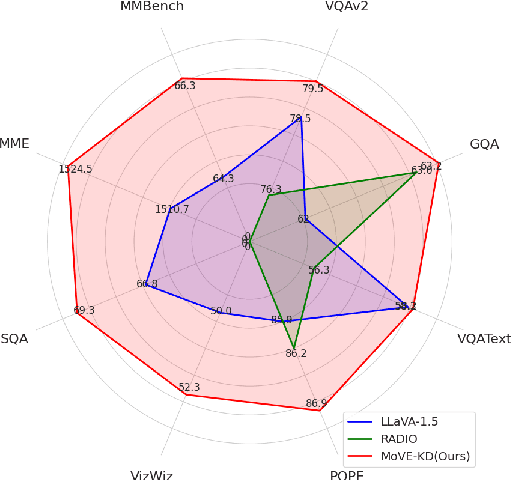
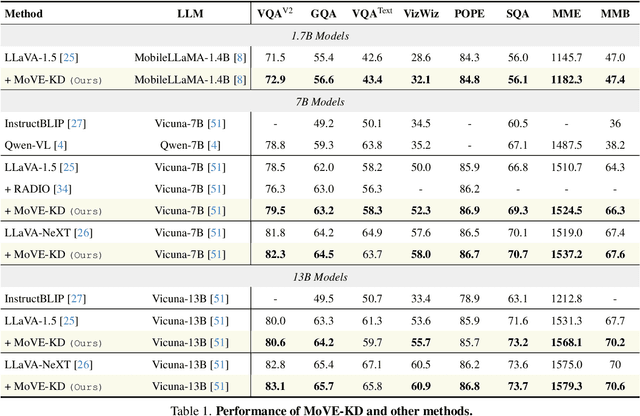
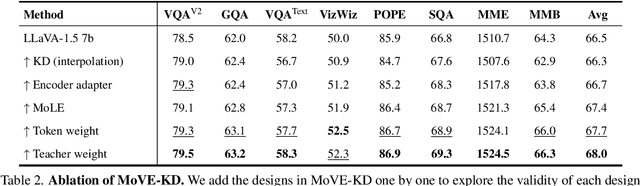
Visual encoders are fundamental components in vision-language models (VLMs), each showcasing unique strengths derived from various pre-trained visual foundation models. To leverage the various capabilities of these encoders, recent studies incorporate multiple encoders within a single VLM, leading to a considerable increase in computational cost. In this paper, we present Mixture-of-Visual-Encoder Knowledge Distillation (MoVE-KD), a novel framework that distills the unique proficiencies of multiple vision encoders into a single, efficient encoder model. Specifically, to mitigate conflicts and retain the unique characteristics of each teacher encoder, we employ low-rank adaptation (LoRA) and mixture-of-experts (MoEs) to selectively activate specialized knowledge based on input features, enhancing both adaptability and efficiency. To regularize the KD process and enhance performance, we propose an attention-based distillation strategy that adaptively weighs the different visual encoders and emphasizes valuable visual tokens, reducing the burden of replicating comprehensive but distinct features from multiple teachers. Comprehensive experiments on popular VLMs, such as LLaVA and LLaVA-NeXT, validate the effectiveness of our method. The code will be released.
[CLS] Attention is All You Need for Training-Free Visual Token Pruning: Make VLM Inference Faster
Dec 02, 2024![Figure 1 for [CLS] Attention is All You Need for Training-Free Visual Token Pruning: Make VLM Inference Faster](/_next/image?url=https%3A%2F%2Ffigures.semanticscholar.org%2Fb02159650df9813f25db4afd4f094e53bccd526c%2F8-Table1-1.png&w=640&q=75)
![Figure 2 for [CLS] Attention is All You Need for Training-Free Visual Token Pruning: Make VLM Inference Faster](/_next/image?url=https%3A%2F%2Ffigures.semanticscholar.org%2Fb02159650df9813f25db4afd4f094e53bccd526c%2F2-Figure2-1.png&w=640&q=75)
![Figure 3 for [CLS] Attention is All You Need for Training-Free Visual Token Pruning: Make VLM Inference Faster](/_next/image?url=https%3A%2F%2Ffigures.semanticscholar.org%2Fb02159650df9813f25db4afd4f094e53bccd526c%2F5-Figure3-1.png&w=640&q=75)
![Figure 4 for [CLS] Attention is All You Need for Training-Free Visual Token Pruning: Make VLM Inference Faster](/_next/image?url=https%3A%2F%2Ffigures.semanticscholar.org%2Fb02159650df9813f25db4afd4f094e53bccd526c%2F9-Table3-1.png&w=640&q=75)
Large vision-language models (VLMs) often rely on a substantial number of visual tokens when interacting with large language models (LLMs), which has proven to be inefficient. Recent efforts have aimed to accelerate VLM inference by pruning visual tokens. Most existing methods assess the importance of visual tokens based on the text-visual cross-attentions in LLMs. In this study, we find that the cross-attentions between text and visual tokens in LLMs are inaccurate. Pruning tokens based on these inaccurate attentions leads to significant performance degradation, especially at high reduction ratios. To this end, we introduce FasterVLM, a simple yet effective training-free visual token pruning method that evaluates the importance of visual tokens more accurately by utilizing attentions between the [CLS] token and image tokens from the visual encoder. Since FasterVLM eliminates redundant visual tokens immediately after the visual encoder, ensuring they do not interact with LLMs and resulting in faster VLM inference. It is worth noting that, benefiting from the accuracy of [CLS] cross-attentions, FasterVLM can prune 95\% of visual tokens while maintaining 90\% of the performance of LLaVA-1.5-7B. We apply FasterVLM to various VLMs, including LLaVA-1.5, LLaVA-NeXT, and Video-LLaVA, to demonstrate its effectiveness. Experimental results show that our FasterVLM maintains strong performance across various VLM architectures and reduction ratios, significantly outperforming existing text-visual attention-based methods. Our code is available at https://github.com/Theia-4869/FasterVLM.
MC-LLaVA: Multi-Concept Personalized Vision-Language Model
Nov 18, 2024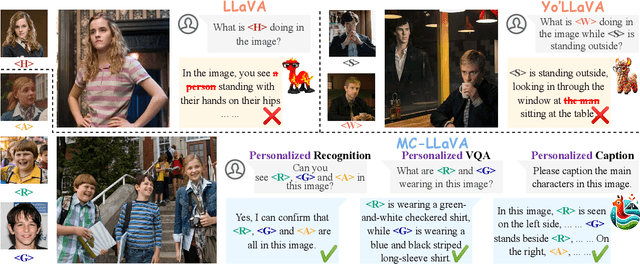
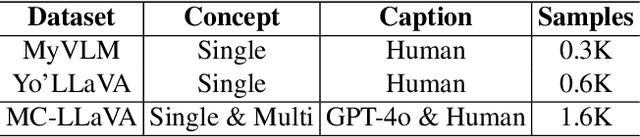
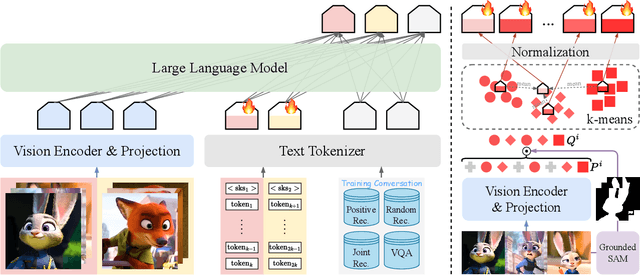
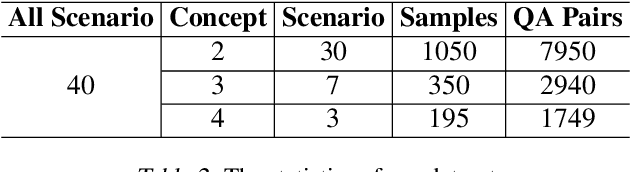
Current vision-language models (VLMs) show exceptional abilities across diverse tasks including visual question answering. To enhance user experience in practical applications, recent studies investigate VLM personalization to understand user-provided concepts. However, existing studies mainly focus on single-concept personalization, neglecting the existence and interplay of multiple concepts, which limits the real-world applicability of personalized VLMs. In this paper, we propose the first multi-concept personalization method named MC-LLaVA along with a high-quality multi-concept personalization dataset. Specifically, MC-LLaVA uses a joint training strategy incorporating multiple concepts in a single training step, allowing VLMs to perform accurately in multi-concept personalization. To reduce the cost of joint training, MC-LLaVA leverages visual token information for concept token initialization, yielding improved concept representation and accelerating joint training. To advance multi-concept personalization research, we further contribute a high-quality dataset. We carefully collect images from various movies that contain multiple characters and manually generate the multi-concept question-answer samples. Our dataset features diverse movie types and question-answer types. We conduct comprehensive qualitative and quantitative experiments to demonstrate that MC-LLaVA can achieve impressive multi-concept personalized responses, paving the way for VLMs to become better user-specific assistants. The code and dataset will be publicly available at https://github.com/arctanxarc/MC-LLaVA.