 Add to Chrome
 Add to Firefox
 Add to Edge
ARFBench: Benchmarking Time Series Question Answering Ability for Software Incident Response
Apr 23, 2026
Time series question-answering (TSQA), in which we ask natural language questions to infer and reason about properties of time series, is a promising yet underexplored capability of foundation models. In this work, we present ARFBench, a TSQA benchmark that evaluates the understanding of multimodal foundation models (FMs) on time series anomalies prevalent in software incident data. ARFBench consists of 750 questions across 142 time series and 5.38M data points from 63 production incidents sourced exclusively from internal telemetry at Datadog. We evaluate leading proprietary and open-source LLMs, VLMs, and time series FMs and observe that frontier VLMs perform markedly better than existing baselines; the leading model (GPT-5) achieves a 62.7% accuracy and 51.9% F1. We next demonstrate the promise of specialized multimodal approaches. We develop a novel TSFM + VLM hybrid prototype which we post-train on a small set of synthetic and real data that yields comparable overall F1 and accuracy with frontier models. Lastly, we find models and human domain experts exhibit complementary strengths. We define a model-expert oracle, a best-of-2 oracle selector over model and expert answers, yielding 82.8% F1 and 87.2% accuracy and establishing a new superhuman frontier for future TSQA models. The benchmark is available at https://huggingface.co/datasets/Datadog/ARFBench.

TimeSeriesExamAgent: Creating Time Series Reasoning Benchmarks at Scale
Apr 11, 2026Large Language Models (LLMs) have shown promising performance in time series modeling tasks, but do they truly understand time series data? While multiple benchmarks have been proposed to answer this fundamental question, most are manually curated and focus on narrow domains or specific skill sets. To address this limitation, we propose scalable methods for creating comprehensive time series reasoning benchmarks that combine the flexibility of templates with the creativity of LLM agents. We first develop TimeSeriesExam, a multiple-choice benchmark using synthetic time series to evaluate LLMs across five core reasoning categories: pattern recognitionnoise understandingsimilarity analysisanomaly detection, and causality. Then, with TimeSeriesExamAgent, we scale our approach by automatically generating benchmarks from real-world datasets spanning healthcare, finance and weather domains. Through multi-dimensional quality evaluation, we demonstrate that our automatically generated benchmarks achieve diversity comparable to manually curated alternatives. However, our experiments reveal that LLM performance remains limited in both abstract time series reasoning and domain-specific applications, highlighting ongoing challenges in enabling effective time series understanding in these models. TimeSeriesExamAgent is available at https://github.com/magwiazda/TimeSeriesExamAgent.
MICA: Multivariate Infini Compressive Attention for Time Series Forecasting
Apr 07, 2026Multivariate forecasting with Transformers faces a core scalability challenge: modeling cross-channel dependencies via attention compounds attention's quadratic sequence complexity with quadratic channel scaling, making full cross-channel attention impractical for high-dimensional time series. We propose Multivariate Infini Compressive Attention (MICA), an architectural design to extend channel-independent Transformers to channel-dependent forecasting. By adapting efficient attention techniques from the sequence dimension to the channel dimension, MICA adds a cross-channel attention mechanism to channel-independent backbones that scales linearly with channel count and context length. We evaluate channel-independent Transformer architectures with and without MICA across multiple forecasting benchmarks. MICA reduces forecast error over its channel-independent counterparts by 5.4% on average and up to 25.4% on individual datasets, highlighting the importance of explicit cross-channel modeling. Moreover, models with MICA rank first among deep multivariate Transformer and MLP baselines. MICA models also scale more efficiently with respect to both channel count and context length than Transformer baselines that compute attention across both the temporal and channel dimensions, establishing compressive attention as a practical solution for scalable multivariate forecasting.
Impermanent: A Live Benchmark for Temporal Generalization in Time Series Forecasting
Mar 10, 2026Recent advances in time-series forecasting increasingly rely on pre-trained foundation-style models. While these models often claim broad generalization, existing evaluation protocols provide limited evidence. Indeed, most current benchmarks use static train-test splits that can easily lead to contamination as foundation models can inadvertently train on test data or perform model selection using test scores, which can inflate performance. We introduce Impermanent, a live benchmark that evaluates forecasting models under open-world temporal change by scoring forecasts sequentially over time on continuously updated data streams, enabling the study of temporal robustness, distributional shift, and performance stability rather than one-off accuracy on a frozen test set. Impermanent is instantiated on GitHub open-source activity, providing a naturally live and highly non-stationary dataset shaped by releases, shifting contributor behavior, platform/tooling changes, and external events. We focus on the top 400 repositories by star count and construct time series from issues opened, pull requests opened, push events, and new stargazers, evaluated over a rolling window with daily updates, alongside standardized protocols and leaderboards for reproducible, ongoing comparison. By shifting evaluation from static accuracy to sustained performance, Impermanent takes a concrete step toward assessing when and whether foundation-level generalization in time-series forecasting can be meaningfully claimed. Code and a live dashboard are available at https://github.com/TimeCopilot/impermanent and https://impermanent.timecopilot.dev.
SpIDER: Spatially Informed Dense Embedding Retrieval for Software Issue Localization
Dec 18, 2025Retrieving code units (e.g., files, classes, functions) that are semantically relevant to a given user query, bug report, or feature request from large codebases is a fundamental challenge for LLM-based coding agents. Agentic approaches typically employ sparse retrieval methods like BM25 or dense embedding strategies to identify relevant units. While embedding-based approaches can outperform BM25 by large margins, they often lack exploration of the codebase and underutilize its underlying graph structure. To address this, we propose SpIDER (Spatially Informed Dense Embedding Retrieval), an enhanced dense retrieval approach that incorporates LLM-based reasoning over auxiliary context obtained through graph-based exploration of the codebase. Empirical results show that SpIDER consistently improves dense retrieval performance across several programming languages.
STAMP: Spatial-Temporal Adapter with Multi-Head Pooling
Nov 13, 2025Time series foundation models (TSFMs) pretrained on data from multiple domains have shown strong performance on diverse modeling tasks. Various efforts have been made to develop foundation models specific to electroencephalography (EEG) data, which records brain electrical activity as time series. However, no comparative analysis of EEG-specific foundation models (EEGFMs) versus general TSFMs has been performed on EEG-specific tasks. We introduce a novel Spatial-Temporal Adapter with Multi-Head Pooling (STAMP), which leverages univariate embeddings produced by a general TSFM, implicitly models spatial-temporal characteristics of EEG data, and achieves performance comparable to state-of-the-art EEGFMs. A comprehensive analysis is performed on 8 benchmark datasets of clinical tasks using EEG for classification, along with ablation studies. Our proposed adapter is lightweight in trainable parameters and flexible in the inputs it can accommodate, supporting easy modeling of EEG data using TSFMs.
TimeSeriesGym: A Scalable Benchmark for (Time Series) Machine Learning Engineering Agents
May 19, 2025We introduce TimeSeriesGym, a scalable benchmarking framework for evaluating Artificial Intelligence (AI) agents on time series machine learning engineering challenges. Existing benchmarks lack scalability, focus narrowly on model building in well-defined settings, and evaluate only a limited set of research artifacts (e.g., CSV submission files). To make AI agent benchmarking more relevant to the practice of machine learning engineering, our framework scales along two critical dimensions. First, recognizing that effective ML engineering requires a range of diverse skills, TimeSeriesGym incorporates challenges from diverse sources spanning multiple domains and tasks. We design challenges to evaluate both isolated capabilities (including data handling, understanding research repositories, and code translation) and their combinations, and rather than addressing each challenge independently, we develop tools that support designing multiple challenges at scale. Second, we implement evaluation mechanisms for multiple research artifacts, including submission files, code, and models, using both precise numeric measures and more flexible LLM-based evaluation approaches. This dual strategy balances objective assessment with contextual judgment. Although our initial focus is on time series applications, our framework can be readily extended to other data modalities, broadly enhancing the comprehensiveness and practical utility of agentic AI evaluation. We open-source our benchmarking framework to facilitate future research on the ML engineering capabilities of AI agents.
Investigating Compositional Reasoning in Time Series Foundation Models
Feb 09, 2025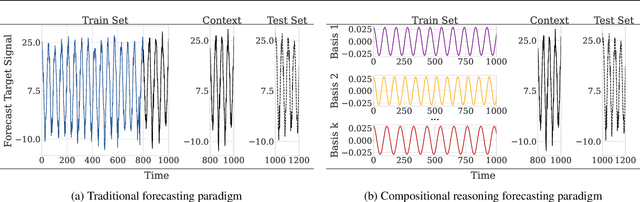
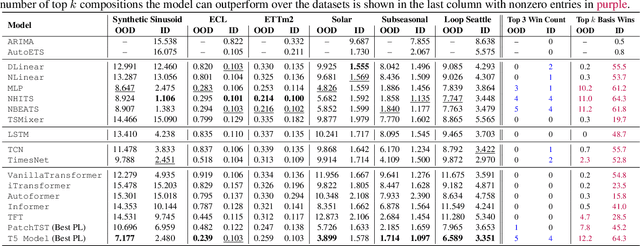
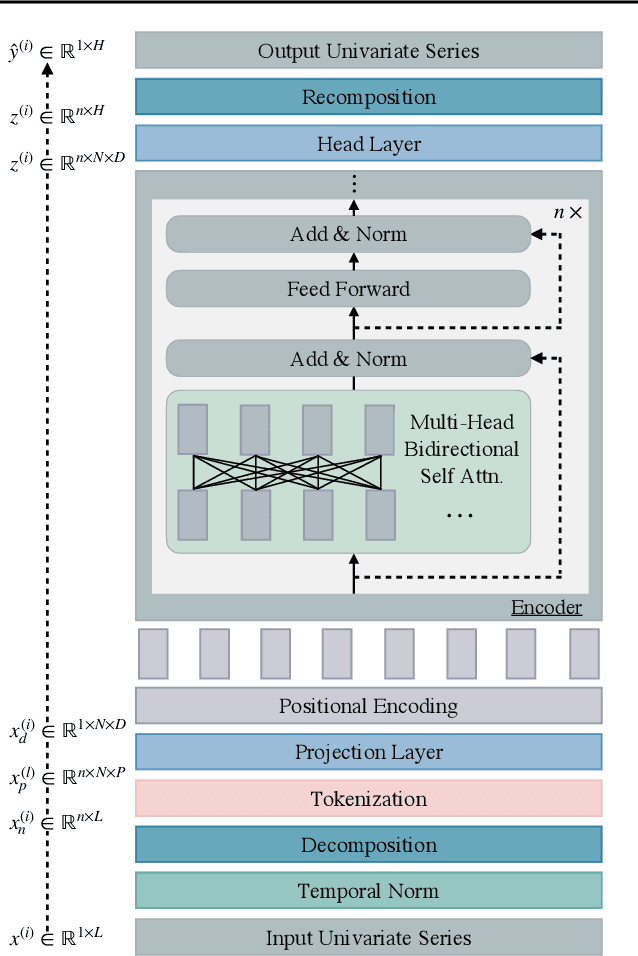
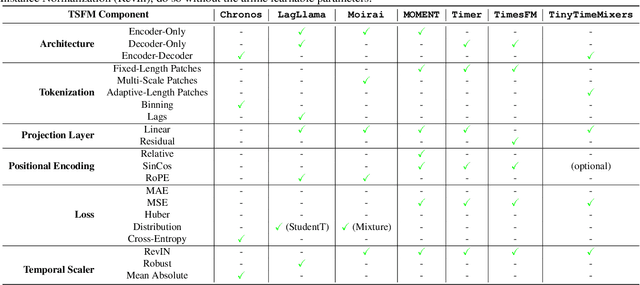
Large pre-trained time series foundation models (TSFMs) have demonstrated promising zero-shot performance across a wide range of domains. However, a question remains: Do TSFMs succeed solely by memorizing training patterns, or do they possess the ability to reason? While reasoning is a topic of great interest in the study of Large Language Models (LLMs), it is undefined and largely unexplored in the context of TSFMs. In this work, inspired by language modeling literature, we formally define compositional reasoning in forecasting and distinguish it from in-distribution generalization. We evaluate the reasoning and generalization capabilities of 23 popular deep learning forecasting models on multiple synthetic and real-world datasets. Additionally, through controlled studies, we systematically examine which design choices in TSFMs contribute to improved reasoning abilities. Our study yields key insights into the impact of TSFM architecture design on compositional reasoning and generalization. We find that patch-based Transformers have the best reasoning performance, closely followed by residualized MLP-based architectures, which are 97\% less computationally complex in terms of FLOPs and 86\% smaller in terms of the number of trainable parameters. Interestingly, in some zero-shot out-of-distribution scenarios, these models can outperform moving average and exponential smoothing statistical baselines trained on in-distribution data. Only a few design choices, such as the tokenization method, had a significant (negative) impact on Transformer model performance.
TimeSeriesExam: A time series understanding exam
Oct 18, 2024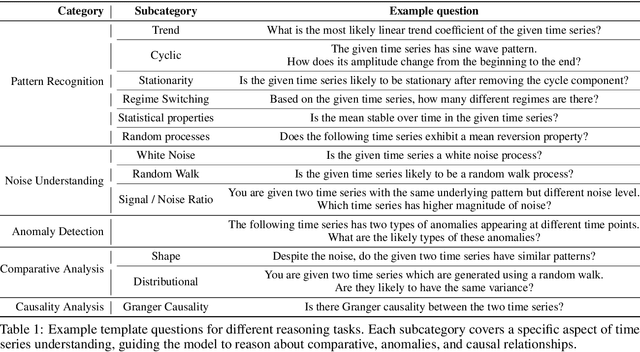
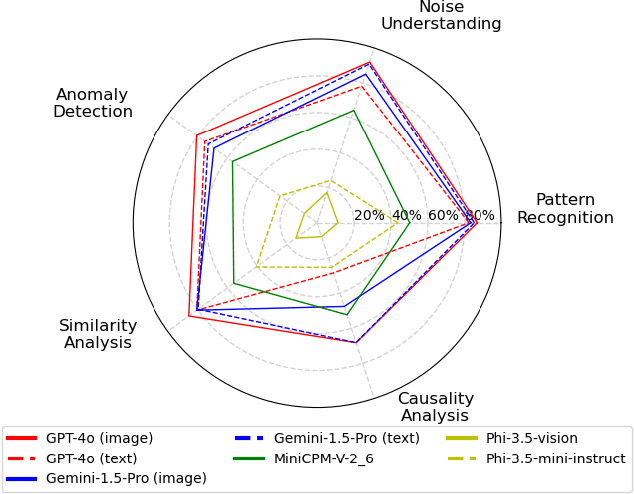
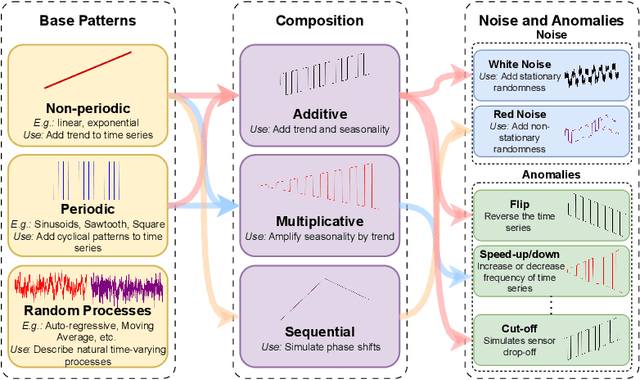
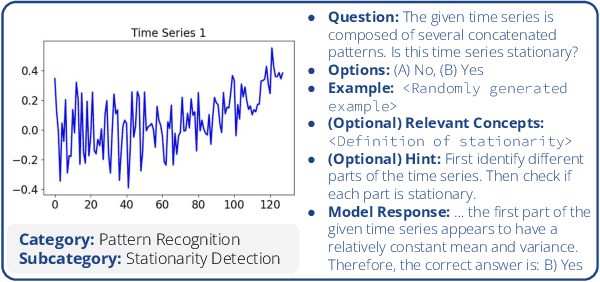
Large Language Models (LLMs) have recently demonstrated a remarkable ability to model time series data. These capabilities can be partly explained if LLMs understand basic time series concepts. However, our knowledge of what these models understand about time series data remains relatively limited. To address this gap, we introduce TimeSeriesExam, a configurable and scalable multiple-choice question exam designed to assess LLMs across five core time series understanding categories: pattern recognition, noise understanding, similarity analysis, anomaly detection, and causality analysis. TimeSeriesExam comprises of over 700 questions, procedurally generated using 104 carefully curated templates and iteratively refined to balance difficulty and their ability to discriminate good from bad models. We test 7 state-of-the-art LLMs on the TimeSeriesExam and provide the first comprehensive evaluation of their time series understanding abilities. Our results suggest that closed-source models such as GPT-4 and Gemini understand simple time series concepts significantly better than their open-source counterparts, while all models struggle with complex concepts such as causality analysis. We believe that the ability to programatically generate questions is fundamental to assessing and improving LLM's ability to understand and reason about time series data.
Implicit Reasoning in Deep Time Series Forecasting
Sep 18, 2024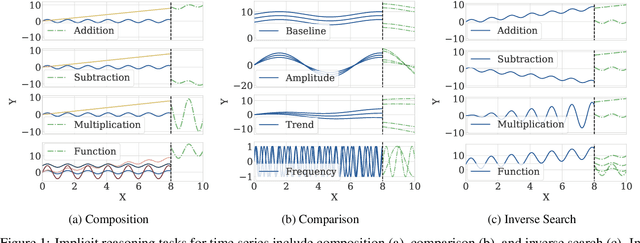
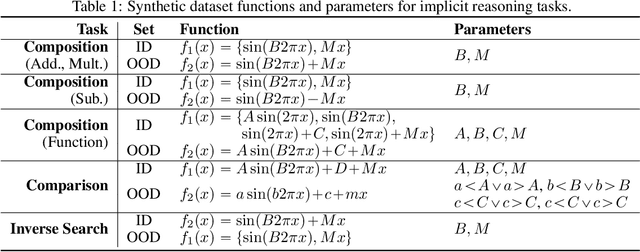


Recently, time series foundation models have shown promising zero-shot forecasting performance on time series from a wide range of domains. However, it remains unclear whether their success stems from a true understanding of temporal dynamics or simply from memorizing the training data. While implicit reasoning in language models has been studied, similar evaluations for time series models have been largely unexplored. This work takes an initial step toward assessing the reasoning abilities of deep time series forecasting models. We find that certain linear, MLP-based, and patch-based Transformer models generalize effectively in systematically orchestrated out-of-distribution scenarios, suggesting underexplored reasoning capabilities beyond simple pattern memorization.