 Add to Chrome
 Add to Firefox
 Add to Edge
HOIST: Humanoid Optimization with Imitation and Sample-efficient Tuning for Manipulating Suspended Loads
May 29, 2026
Manipulating suspended payloads with humanoid robots is challenging because the robot can only influence an underactuated, oscillatory load through whole-body motion and intermittent contact. Imitation learning provides safe initial behavior but does not directly optimize final placement, while reinforcement learning from scratch is unsafe and sample-inefficient on real humanoids. We present HOIST-Humanoid Optimized with Imitation and Sample-efficient Tuning for manipulating suspended loads. HOIST first finetunes a high-level vision-language-action (VLA) policy from virtual-reality (VR) teleoperation demonstrations and executes its commands through a whole-body controller. It then uses VLA rollouts and iterative batched RL to improve placement accuracy and stopping behavior. Experiments in simulation and on a real humanoid show that HOIST improves over imitation-only and additional-demonstration baselines; compared with pure VLA rollouts, HOIST reduces translational placement error by 19.9 cm and raw angular error by 3.56 degrees, demonstrating the potential of humanoids for underactuated material-handling tasks.

ClawKeeper: Comprehensive Safety Protection for OpenClaw Agents Through Skills, Plugins, and Watchers
Mar 25, 2026OpenClaw has rapidly established itself as a leading open-source autonomous agent runtime, offering powerful capabilities including tool integration, local file access, and shell command execution. However, these broad operational privileges introduce critical security vulnerabilities, transforming model errors into tangible system-level threats such as sensitive data leakage, privilege escalation, and malicious third-party skill execution. Existing security measures for the OpenClaw ecosystem remain highly fragmented, addressing only isolated stages of the agent lifecycle rather than providing holistic protection. To bridge this gap, we present ClawKeeper, a real-time security framework that integrates multi-dimensional protection mechanisms across three complementary architectural layers. (1) \textbf{Skill-based protection} operates at the instruction level, injecting structured security policies directly into the agent context to enforce environment-specific constraints and cross-platform boundaries. (2) \textbf{Plugin-based protection} serves as an internal runtime enforcer, providing configuration hardening, proactive threat detection, and continuous behavioral monitoring throughout the execution pipeline. (3) \textbf{Watcher-based protection} introduces a novel, decoupled system-level security middleware that continuously verifies agent state evolution. It enables real-time execution intervention without coupling to the agent's internal logic, supporting operations such as halting high-risk actions or enforcing human confirmation. We argue that this Watcher paradigm holds strong potential to serve as a foundational building block for securing next-generation autonomous agent systems. Extensive qualitative and quantitative evaluations demonstrate the effectiveness and robustness of ClawKeeper across diverse threat scenarios. We release our code.
The Devil Behind Moltbook: Anthropic Safety is Always Vanishing in Self-Evolving AI Societies
Feb 11, 2026The emergence of multi-agent systems built from large language models (LLMs) offers a promising paradigm for scalable collective intelligence and self-evolution. Ideally, such systems would achieve continuous self-improvement in a fully closed loop while maintaining robust safety alignment--a combination we term the self-evolution trilemma. However, we demonstrate both theoretically and empirically that an agent society satisfying continuous self-evolution, complete isolation, and safety invariance is impossible. Drawing on an information-theoretic framework, we formalize safety as the divergence degree from anthropic value distributions. We theoretically demonstrate that isolated self-evolution induces statistical blind spots, leading to the irreversible degradation of the system's safety alignment. Empirical and qualitative results from an open-ended agent community (Moltbook) and two closed self-evolving systems reveal phenomena that align with our theoretical prediction of inevitable safety erosion. We further propose several solution directions to alleviate the identified safety concern. Our work establishes a fundamental limit on the self-evolving AI societies and shifts the discourse from symptom-driven safety patches to a principled understanding of intrinsic dynamical risks, highlighting the need for external oversight or novel safety-preserving mechanisms.
LANCET: Neural Intervention via Structural Entropy for Mitigating Faithfulness Hallucinations in LLMs
Jan 04, 2026Large Language Models have revolutionized information processing, yet their reliability is severely compromised by faithfulness hallucinations. While current approaches attempt to mitigate this issue through node-level adjustments or coarse suppression, they often overlook the distributed nature of neural information, leading to imprecise interventions. Recognizing that hallucinations propagate through specific forward transmission pathways like an infection, we aim to surgically block this flow using precise structural analysis. To leverage this, we propose Lancet, a novel framework that achieves precise neural intervention by leveraging structural entropy and hallucination difference ratios. Lancet first locates hallucination-prone neurons via gradient-driven contrastive analysis, then maps their propagation pathways by minimizing structural entropy, and finally implements a hierarchical intervention strategy that preserves general model capabilities. Comprehensive evaluations across hallucination benchmark datasets demonstrate that Lancet significantly outperforms state-of-the-art methods, validating the effectiveness of our surgical approach to neural intervention.
How Real is Your Jailbreak? Fine-grained Jailbreak Evaluation with Anchored Reference
Jan 04, 2026Jailbreak attacks present a significant challenge to the safety of Large Language Models (LLMs), yet current automated evaluation methods largely rely on coarse classifications that focus mainly on harmfulness, leading to substantial overestimation of attack success. To address this problem, we propose FJAR, a fine-grained jailbreak evaluation framework with anchored references. We first categorized jailbreak responses into five fine-grained categories: Rejective, Irrelevant, Unhelpful, Incorrect, and Successful, based on the degree to which the response addresses the malicious intent of the query. This categorization serves as the basis for FJAR. Then, we introduce a novel harmless tree decomposition approach to construct high-quality anchored references by breaking down the original queries. These references guide the evaluator in determining whether the response genuinely fulfills the original query. Extensive experiments demonstrate that FJAR achieves the highest alignment with human judgment and effectively identifies the root causes of jailbreak failures, providing actionable guidance for improving attack strategies.
Large-Scale Mixed-Traffic and Intersection Control using Multi-agent Reinforcement Learning
Apr 07, 2025Traffic congestion remains a significant challenge in modern urban networks. Autonomous driving technologies have emerged as a potential solution. Among traffic control methods, reinforcement learning has shown superior performance over traffic signals in various scenarios. However, prior research has largely focused on small-scale networks or isolated intersections, leaving large-scale mixed traffic control largely unexplored. This study presents the first attempt to use decentralized multi-agent reinforcement learning for large-scale mixed traffic control in which some intersections are managed by traffic signals and others by robot vehicles. Evaluating a real-world network in Colorado Springs, CO, USA with 14 intersections, we measure traffic efficiency via average waiting time of vehicles at intersections and the number of vehicles reaching their destinations within a time window (i.e., throughput). At 80% RV penetration rate, our method reduces waiting time from 6.17 s to 5.09 s and increases throughput from 454 vehicles per 500 seconds to 493 vehicles per 500 seconds, outperforming the baseline of fully signalized intersections. These findings suggest that integrating reinforcement learning-based control large-scale traffic can improve overall efficiency and may inform future urban planning strategies.
TEeVTOL: Balancing Energy and Time Efficiency in eVTOL Aircraft Path Planning Across City-Scale Wind Fields
Mar 21, 2024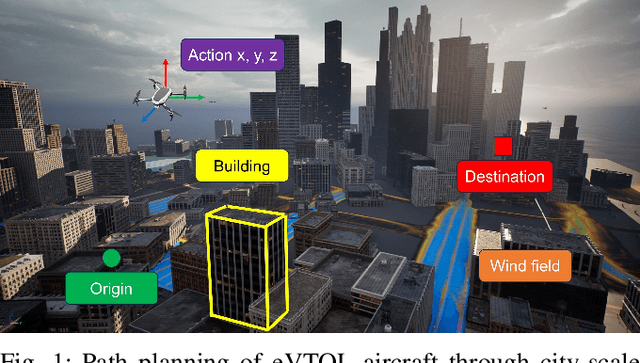
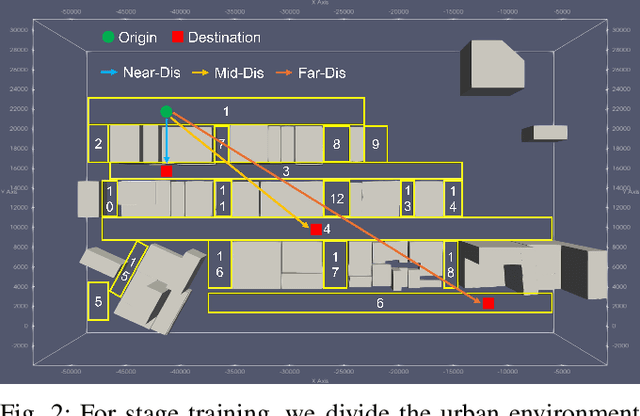
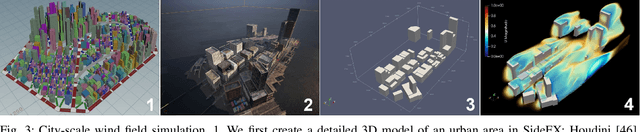
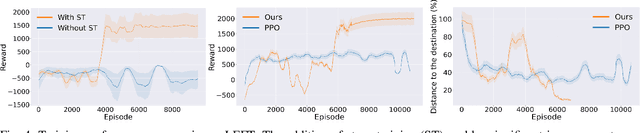
Electric vertical-takeoff and landing (eVTOL) aircraft, recognized for their maneuverability and flexibility, offer a promising alternative to our transportation system. However, the operational effectiveness of these aircraft faces many challenges, such as the delicate balance between energy and time efficiency, stemming from unpredictable environmental factors, including wind fields. Mathematical modeling-based approaches have been adopted to plan aircraft flight path in urban wind fields with the goal to save energy and time costs. While effective, they are limited in adapting to dynamic and complex environments. To optimize energy and time efficiency in eVTOL's flight through dynamic wind fields, we introduce a novel path planning method leveraging deep reinforcement learning. We assess our method with extensive experiments, comparing it to Dijkstra's algorithm -- the theoretically optimal approach for determining shortest paths in a weighted graph, where weights represent either energy or time cost. The results show that our method achieves a graceful balance between energy and time efficiency, closely resembling the theoretically optimal values for both objectives.