 Add to Chrome
 Add to Firefox
 Add to Edge
TuringViT: Making SOTA Vision Transformers Accessible to All
Jun 23, 2026
Modern VLMs and VLA systems commonly adopt off-the-shelf ViTs such as SigLIP2 as visual encoders, but diverse downstream requirements in latency, temporal modeling, and VLM integration often call for customized SOTA-level ViTs. Training such encoders remains beyond the reach of much of the community, as it requires massive image-text data, while standard softmax attention makes high-resolution or dynamic-resolution pretraining prohibitively costly and often forces low-resolution pretraining followed by post-hoc adaptation. TuringViT addresses these challenges with three key designs: Turing Linear Attention (TLA) for efficient sequence modeling, VISTA-Curation to construct supervision-rich image-video training data, and native dynamic-resolution pretraining that supports flexible inputs from the start and transfers seamlessly to downstream VLMs. As a result, TuringViT outperforms leading open-source ViT baselines with only 10% of the data, achieves stronger downstream VLM performance, and delivers substantially better latency scaling on high-resolution inputs. Our scaling-law analysis further shows that TuringViT continues to improve predictably with curated data scale, far from saturation. Its fast adaptation, hardware-friendly design, and efficient deployment have made it a unified visual foundation across XPeng's AI systems. More broadly, TuringViT provides a reproducible pipeline that dramatically lowers the cost for the community to train, customize, and deploy SOTA-level ViTs, moving toward making such Vision Transformers accessible to all.

RTFormer: Efficient Design for Real-Time Semantic Segmentation with Transformer
Oct 13, 2022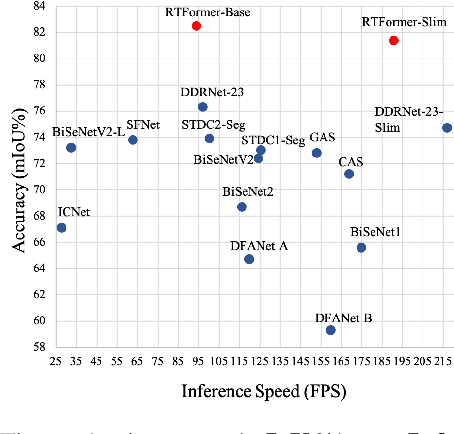

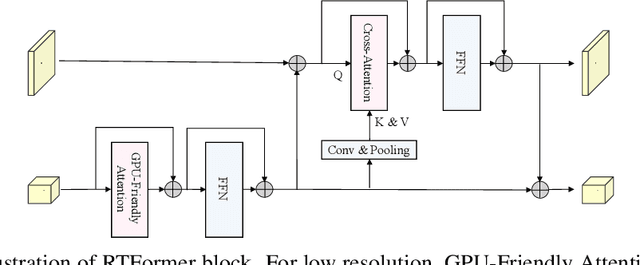
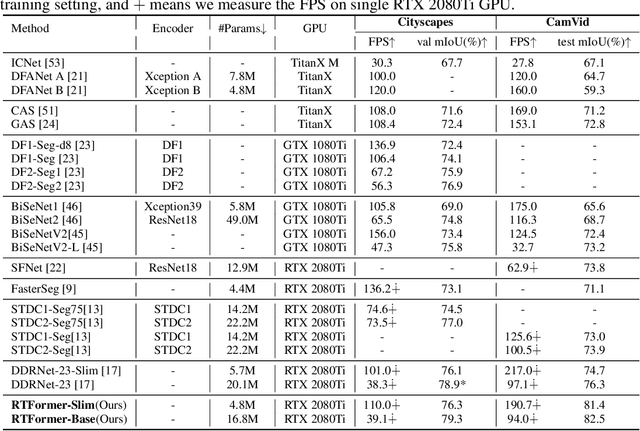
Recently, transformer-based networks have shown impressive results in semantic segmentation. Yet for real-time semantic segmentation, pure CNN-based approaches still dominate in this field, due to the time-consuming computation mechanism of transformer. We propose RTFormer, an efficient dual-resolution transformer for real-time semantic segmenation, which achieves better trade-off between performance and efficiency than CNN-based models. To achieve high inference efficiency on GPU-like devices, our RTFormer leverages GPU-Friendly Attention with linear complexity and discards the multi-head mechanism. Besides, we find that cross-resolution attention is more efficient to gather global context information for high-resolution branch by spreading the high level knowledge learned from low-resolution branch. Extensive experiments on mainstream benchmarks demonstrate the effectiveness of our proposed RTFormer, it achieves state-of-the-art on Cityscapes, CamVid and COCOStuff, and shows promising results on ADE20K. Code is available at PaddleSeg: https://github.com/PaddlePaddle/PaddleSeg.
PalQuant: Accelerating High-precision Networks on Low-precision Accelerators
Aug 03, 2022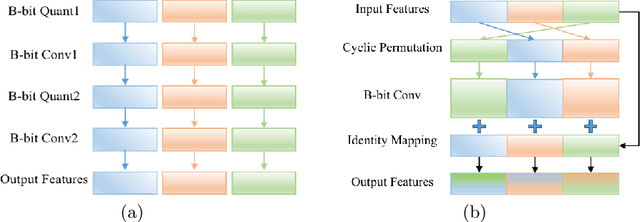
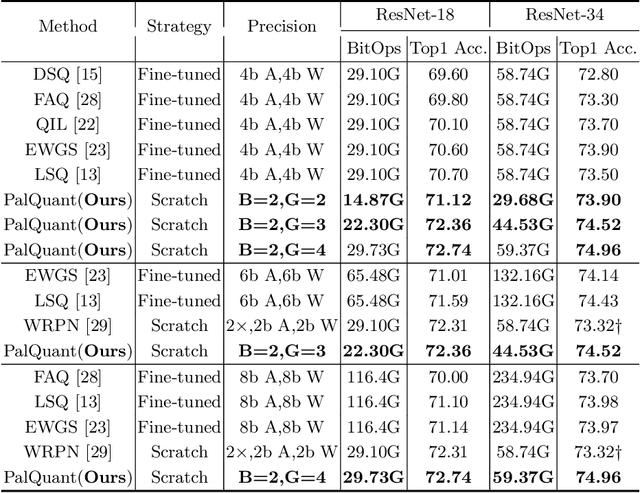
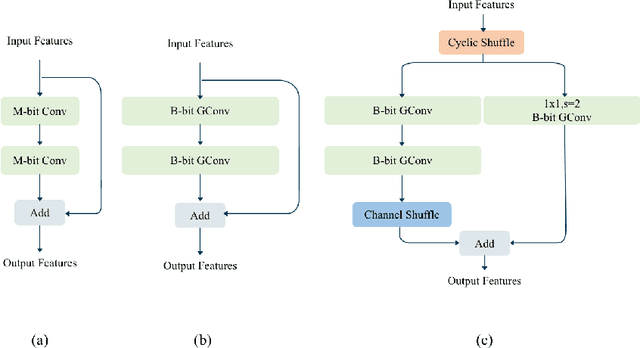
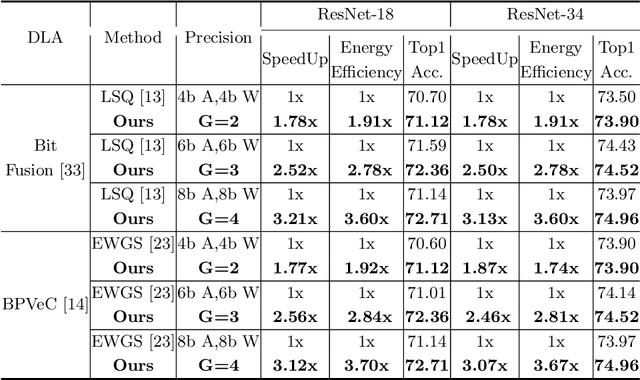
Recently low-precision deep learning accelerators (DLAs) have become popular due to their advantages in chip area and energy consumption, yet the low-precision quantized models on these DLAs bring in severe accuracy degradation. One way to achieve both high accuracy and efficient inference is to deploy high-precision neural networks on low-precision DLAs, which is rarely studied. In this paper, we propose the PArallel Low-precision Quantization (PalQuant) method that approximates high-precision computations via learning parallel low-precision representations from scratch. In addition, we present a novel cyclic shuffle module to boost the cross-group information communication between parallel low-precision groups. Extensive experiments demonstrate that PalQuant has superior performance to state-of-the-art quantization methods in both accuracy and inference speed, e.g., for ResNet-18 network quantization, PalQuant can obtain 0.52\% higher accuracy and 1.78$\times$ speedup simultaneously over their 4-bit counter-part on a state-of-the-art 2-bit accelerator. Code is available at \url{https://github.com/huqinghao/PalQuant}.
MixFormer: Mixing Features across Windows and Dimensions
Apr 12, 2022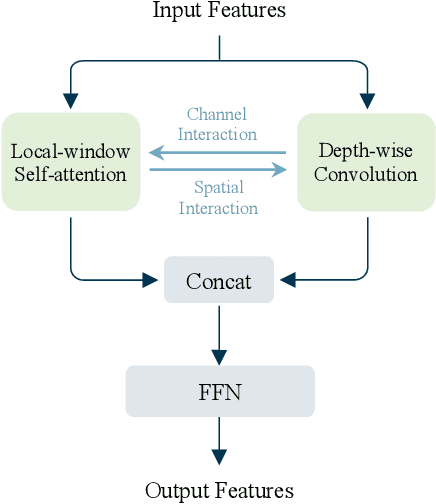

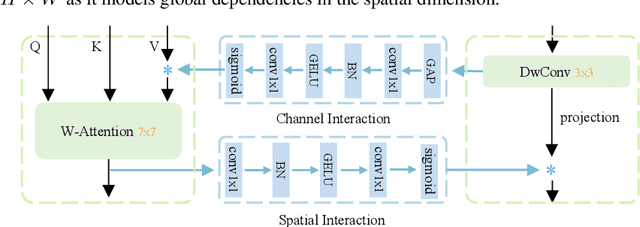
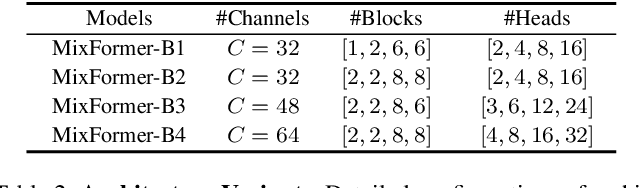
While local-window self-attention performs notably in vision tasks, it suffers from limited receptive field and weak modeling capability issues. This is mainly because it performs self-attention within non-overlapped windows and shares weights on the channel dimension. We propose MixFormer to find a solution. First, we combine local-window self-attention with depth-wise convolution in a parallel design, modeling cross-window connections to enlarge the receptive fields. Second, we propose bi-directional interactions across branches to provide complementary clues in the channel and spatial dimensions. These two designs are integrated to achieve efficient feature mixing among windows and dimensions. Our MixFormer provides competitive results on image classification with EfficientNet and shows better results than RegNet and Swin Transformer. Performance in downstream tasks outperforms its alternatives by significant margins with less computational costs in 5 dense prediction tasks on MS COCO, ADE20k, and LVIS. Code is available at \url{https://github.com/PaddlePaddle/PaddleClas}.