 Add to Chrome
 Add to Firefox
 Add to Edge
RareLens: Towards End-to-End Rare Disease Care via Aligning Divergent Large Language Model Reasoning
Jul 25, 2026
Rare diseases collectively affect an estimated 3.5% to 5.9% of the population, yet more than 70% of patients are misdiagnosed and many endure years of evaluation before a diagnosis is reached, because early presentations are nonspecific and relevant expertise is scarce and unevenly distributed. Artificial intelligence could provide support, but existing systems address isolated stages of care, overwhelmingly diagnosis. They typically depend on the results of downstream investigations, and they treat the variability between models as noise to be eliminated. Here we present RareLens, a system that supports clinical decision-making across the entire rare disease trajectory by exploiting this variability. When heterogeneous large language models evaluate the same case, they generate divergent but complementary reasoning, which RareLens aligns and calibrates into a single convergent, actionable decision at each stage. Four coordinated modules perform primary-visit risk screening, diagnosis, treatment planning and prognosis. Developed and evaluated on RareBench, a real-world dataset of 157,525 cases spanning all 33 Orphanet categories and more than 7,000 conditions, RareLens outperformed every frontier model tested, including GPT-5, DeepSeek-R1, Claude-3.7-Sonnet and Gemini-2.5-Pro, at each stage. It achieved an area under the curve of 0.917 for screening and top-1 accuracies of 65.5% and 89.8% for diagnosis and treatment. In an external study spanning 1,287 cases and 23 physicians, autonomous RareLens and physicians assisted by RareLens both substantially outperformed unaided physicians. These findings indicate that aligning divergent model reasoning, rather than scaling a single model, offers a generalizable strategy for high-uncertainty clinical decision-making.

Large Vision-Language Models Get Lost in Attention
May 07, 2026Despite the rapid evolution of training paradigms, the decoder backbone of large vision--language models (LVLMs) remains fundamentally rooted in the residual-connection Transformer architecture. Therefore, deciphering the distinct roles of internal modules is critical for understanding model mechanics and guiding architectural optimization. While prior statistical approaches have provided valuable attribution-based insights, they often lack a unified theoretical basis. To bridge this gap, we propose a unified framework grounded in information theory and geometry to quantify the geometric and entropic nature of residual updates. Applying this unified framework reveals a fundamental functional decoupling: Attention acts as a subspace-preserving operator focused on reconfiguration, whereas FFNs serve as subspace-expanding operators driving semantic innovation. Strikingly, further experiments demonstrate that replacing learned attention weights with predefined values (e.g., Gaussian noise) yields comparable or even superior performance across a majority of datasets relative to vanilla models. These results expose severe misallocation and redundancy in current mechanisms, suggesting that state-of-the-art LVLMs effectively ``get lost in attention'' rather than efficiently leveraging visual context.
SaFeR-ToolKit: Structured Reasoning via Virtual Tool Calling for Multimodal Safety
Mar 03, 2026Vision-language models remain susceptible to multimodal jailbreaks and over-refusal because safety hinges on both visual evidence and user intent, while many alignment pipelines supervise only the final response. To address this, we present SaFeR-ToolKit, which formalizes safety decision-making as a checkable protocol. Concretely, a planner specifies a persona, a Perception $\to$ Reasoning $\to$ Decision tool set, and a constrained transition graph, while a responder outputs a typed key-value tool trace before the final answer. To make the protocol reliably followed in practice, we train a single policy with a three-stage curriculum (SFT $\to$ DPO $\to$ GRPO), where GRPO directly supervises tool usage beyond answer-level feedback. Our contributions are two-fold: I. Dataset. The first tool-based safety reasoning dataset, comprising 31,654 examples (SFT 6k, DPO 18.6k, GRPO 6k) plus 1k held-out evaluation. II. Experiments. On Qwen2.5-VL, SaFeR-ToolKit significantly improves Safety/Helpfulness/Reasoning Rigor on 3B (29.39/45.04/4.98 $\to$ 84.40/71.13/78.87) and 7B (53.21/52.92/19.26 $\to$ 86.34/80.79/85.34), while preserving general capabilities (3B: 58.67 $\to$ 59.21; 7B: 66.39 $\to$ 66.81). Codes are available at https://github.com/Duebassx/SaFeR_ToolKit.
Improving Medical Visual Reinforcement Fine-Tuning via Perception and Reasoning Augmentation
Feb 11, 2026While recent advances in Reinforcement Fine-Tuning (RFT) have shown that rule-based reward schemes can enable effective post-training for large language models, their extension to cross-modal, vision-centric domains remains largely underexplored. This limitation is especially pronounced in the medical imaging domain, where effective performance requires both robust visual perception and structured reasoning. In this work, we address this gap by proposing VRFT-Aug, a visual reinforcement fine-tuning framework tailored for the medical domain. VRFT-Aug introduces a series of training strategies designed to augment both perception and reasoning, including prior knowledge injection, perception-driven policy refinement, medically informed reward shaping, and behavioral imitation. Together, these methods aim to stabilize and improve the RFT process. Through extensive experiments across multiple medical datasets, we show that our approaches consistently outperform both standard supervised fine-tuning and RFT baselines. Moreover, we provide empirically grounded insights and practical training heuristics that can be generalized to other medical image tasks. We hope this work contributes actionable guidance and fresh inspiration for the ongoing effort to develop reliable, reasoning-capable models for high-stakes medical applications.
ClueTracer: Question-to-Vision Clue Tracing for Training-Free Hallucination Suppression in Multimodal Reasoning
Feb 02, 2026Large multimodal reasoning models solve challenging visual problems via explicit long-chain inference: they gather visual clues from images and decode clues into textual tokens. Yet this capability also increases hallucinations, where the model generates content that is not supported by the input image or the question. To understand this failure mode, we identify \emph{reasoning drift}: during clue gathering, the model over-focuses on question-irrelevant entities, diluting focus on task-relevant cues and gradually decoupling the reasoning trace from visual grounding. As a consequence, many inference-time localization or intervention methods developed for non-reasoning models fail to pinpoint the true clues in reasoning settings. Motivated by these insights, we introduce ClueRecall, a metric for assessing visual clue retrieval, and present ClueTracer, a training-free, parameter-free, and architecture-agnostic plugin for hallucination suppression. ClueTracer starts from the question and traces how key clues propagate along the model's reasoning pathway (question $\rightarrow$ outputs $\rightarrow$ visual tokens), thereby localizing task-relevant patches while suppressing spurious attention to irrelevant regions. Remarkably, \textbf{without any additional training}, ClueTracer improves all \textbf{reasoning} architectures (including \texttt{R1-OneVision}, \texttt{Ocean-R1}, \texttt{MM-Eureka}, \emph{etc}.) by $\mathbf{1.21\times}$ on reasoning benchmarks. When transferred to \textbf{non-reasoning} settings, it yields a $\mathbf{1.14\times}$ gain.
RareAlert: Aligning heterogeneous large language model reasoning for early rare disease risk screening
Jan 26, 2026Missed and delayed diagnosis remains a major challenge in rare disease care. At the initial clinical encounters, physicians assess rare disease risk using only limited information under high uncertainty. When high-risk patients are not recognised at this stage, targeted diagnostic testing is often not initiated, resulting in missed diagnosis. Existing primary care triage processes are structurally insufficient to reliably identify patients with rare diseases at initial clinical presentation and universal screening is needed to reduce diagnostic delay. Here we present RareAlert, an early screening system which predict patient-level rare disease risk from routinely available primary-visit information. RareAlert integrates reasoning generated by ten LLMs, calibrates and weights these signals using machine learning, and distils the aligned reasoning into a single locally deployable model. To develop and evaluate RareAlert, we curated RareBench, a real-world dataset of 158,666 cases covering 33 Orphanet disease categories and more than 7,000 rare conditions, including both rare and non-rare presentations. The results showed that rare disease identification can be reconceptualised as a universal uncertainty resolution process applied to the general patient population. On an independent test set, RareAlert, a Qwen3-4B based model trained with calibrated reasoning signals, achieved an AUC of 0.917, outperforming the best machine learning ensemble and all evaluated LLMs, including GPT-5, DeepSeek-R1, Claude-3.7-Sonnet, o3-mini, Gemini-2.5-Pro, and Qwen3-235B. These findings demonstrate the diversity in LLM medical reasoning and the effectiveness of aligning such reasoning in highly uncertain clinical tasks. By incorporating calibrated reasoning into a single model, RareAlert enables accurate, privacy-preserving, and scalable rare disease risk screening suitable for large-scale local deployment.
SaFeR-VLM: Toward Safety-aware Fine-grained Reasoning in Multimodal Models
Oct 08, 2025Multimodal Large Reasoning Models (MLRMs) demonstrate impressive cross-modal reasoning but often amplify safety risks under adversarial or unsafe prompts, a phenomenon we call the \textit{Reasoning Tax}. Existing defenses mainly act at the output level and do not constrain the reasoning process, leaving models exposed to implicit risks. In this paper, we propose SaFeR-VLM, a safety-aligned reinforcement learning framework that embeds safety directly into multimodal reasoning. The framework integrates four components: (I) QI-Safe-10K, a curated dataset emphasizing safety-critical and reasoning-sensitive cases; (II) safety-aware rollout, where unsafe generations undergo reflection and correction instead of being discarded; (III) structured reward modeling with multi-dimensional weighted criteria and explicit penalties for hallucinations and contradictions; and (IV) GRPO optimization, which reinforces both safe and corrected trajectories. This unified design shifts safety from a passive safeguard to an active driver of reasoning, enabling scalable and generalizable safety-aware reasoning. SaFeR-VLM further demonstrates robustness against both explicit and implicit risks, supporting dynamic and interpretable safety decisions beyond surface-level filtering. SaFeR-VLM-3B achieves average performance $70.13$ and $78.97$ on safety and helpfulness across six benchmarks, surpassing both same-scale and $>10\times$ larger models such as Skywork-R1V3-38B, Qwen2.5VL-72B, and GLM4.5V-106B. Remarkably, SaFeR-VLM-7B benefits from its increased scale to surpass GPT-5-mini and Gemini-2.5-Flash by \num{6.47} and \num{16.76} points respectively on safety metrics, achieving this improvement without any degradation in helpfulness performance. Our codes are available at https://github.com/HarveyYi/SaFeR-VLM.
Guiding Medical Vision-Language Models with Explicit Visual Prompts: Framework Design and Comprehensive Exploration of Prompt Variations
Jan 04, 2025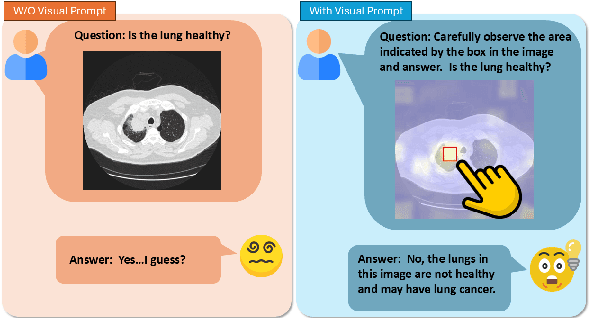
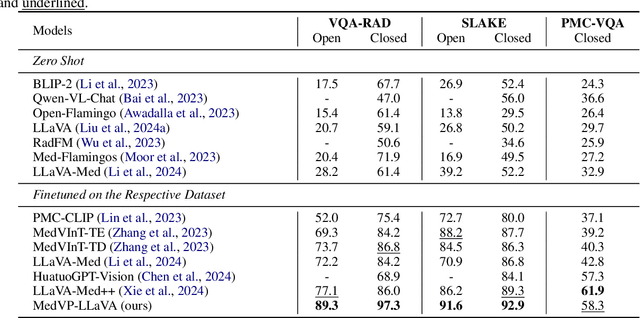
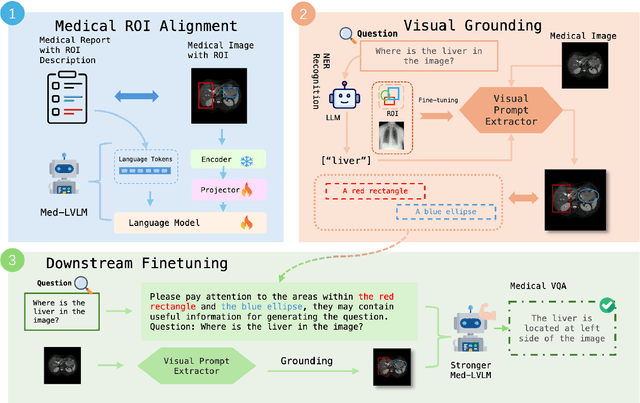
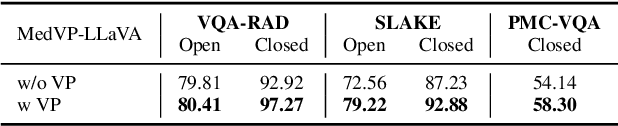
With the recent advancements in vision-language models (VLMs) driven by large language models (LLMs), many researchers have focused on models that comprised of an image encoder, an image-to-language projection layer, and a text decoder architectures, leading to the emergence of works like LLava-Med. However, these works primarily operate at the whole-image level, aligning general information from 2D medical images without attending to finer details. As a result, these models often provide irrelevant or non-clinically valuable information while missing critical details. Medical vision-language tasks differ significantly from general images, particularly in their focus on fine-grained details, while excluding irrelevant content. General domain VLMs tend to prioritize global information due to their design, which compresses the entire image into a multi-token representation that is passed into the LLM decoder. Therefore, current VLMs all lack the capability to restrict their attention to particular areas. To address this critical issue in the medical domain, we introduce MedVP, an visual prompt generation and fine-tuning framework, which involves extract medical entities, generate visual prompts, and adapt datasets for visual prompt guided fine-tuning. To the best of our knowledge, this is the first work to explicitly introduce visual prompt into medical VLMs, and we successfully outperform recent state-of-the-art large models across multiple medical VQA datasets. Extensive experiments are conducted to analyze the impact of different visual prompt forms and how they contribute to performance improvement. The results demonstrate both the effectiveness and clinical significance of our approach
Evaluating Hallucination in Text-to-Image Diffusion Models with Scene-Graph based Question-Answering Agent
Dec 07, 2024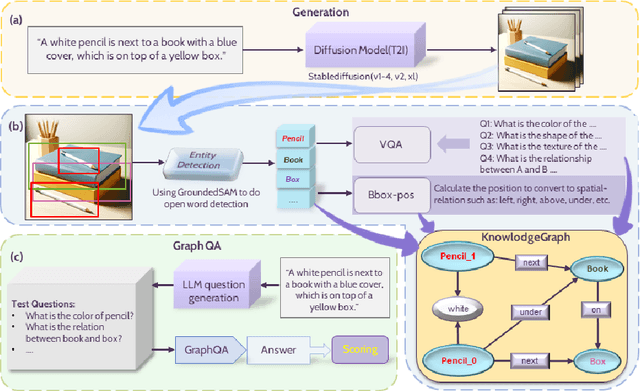
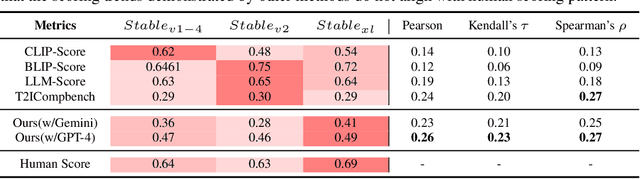


Contemporary Text-to-Image (T2I) models frequently depend on qualitative human evaluations to assess the consistency between synthesized images and the text prompts. There is a demand for quantitative and automatic evaluation tools, given that human evaluation lacks reproducibility. We believe that an effective T2I evaluation metric should accomplish the following: detect instances where the generated images do not align with the textual prompts, a discrepancy we define as the `hallucination problem' in T2I tasks; record the types and frequency of hallucination issues, aiding users in understanding the causes of errors; and provide a comprehensive and intuitive scoring that close to human standard. To achieve these objectives, we propose a method based on large language models (LLMs) for conducting question-answering with an extracted scene-graph and created a dataset with human-rated scores for generated images. From the methodology perspective, we combine knowledge-enhanced question-answering tasks with image evaluation tasks, making the evaluation metrics more controllable and easier to interpret. For the contribution on the dataset side, we generated 12,000 synthesized images based on 1,000 composited prompts using three advanced T2I models. Subsequently, we conduct human scoring on all synthesized images and prompt pairs to validate the accuracy and effectiveness of our method as an evaluation metric. All generated images and the human-labeled scores will be made publicly available in the future to facilitate ongoing research on this crucial issue. Extensive experiments show that our method aligns more closely with human scoring patterns than other evaluation metrics.
Unified Modeling Enhanced Multimodal Learning for Precision Neuro-Oncology
Jun 11, 2024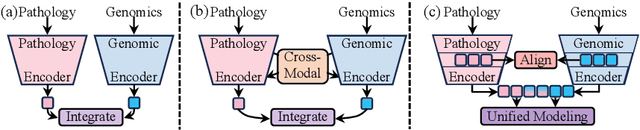
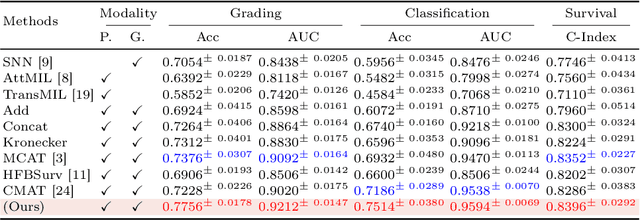
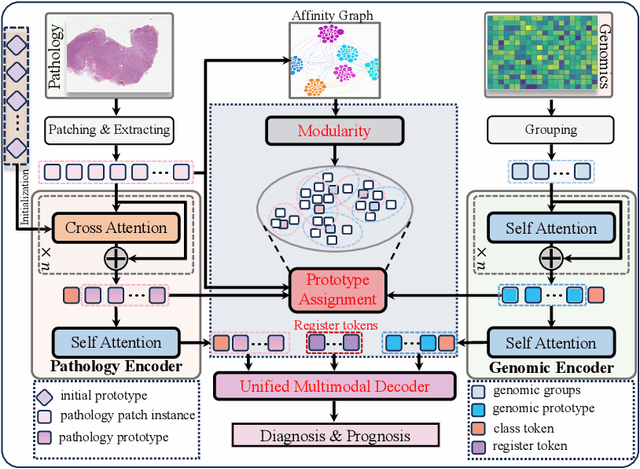
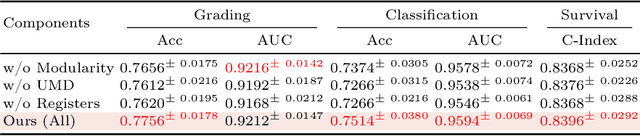
Multimodal learning, integrating histology images and genomics, promises to enhance precision oncology with comprehensive views at microscopic and molecular levels. However, existing methods may not sufficiently model the shared or complementary information for more effective integration. In this study, we introduce a Unified Modeling Enhanced Multimodal Learning (UMEML) framework that employs a hierarchical attention structure to effectively leverage shared and complementary features of both modalities of histology and genomics. Specifically, to mitigate unimodal bias from modality imbalance, we utilize a query-based cross-attention mechanism for prototype clustering in the pathology encoder. Our prototype assignment and modularity strategy are designed to align shared features and minimizes modality gaps. An additional registration mechanism with learnable tokens is introduced to enhance cross-modal feature integration and robustness in multimodal unified modeling. Our experiments demonstrate that our method surpasses previous state-of-the-art approaches in glioma diagnosis and prognosis tasks, underscoring its superiority in precision neuro-Oncology.