 Add to Chrome
 Add to Firefox
 Add to Edge
MedLoc-R1: Performance-Aware Curriculum Reward Scheduling for GRPO-Based Medical Visual Grounding
Mar 30, 2026
Medical visual grounding serves as a crucial foundation for fine-grained multimodal reasoning and interpretable clinical decision support. Despite recent advances in reinforcement learning (RL) for grounding tasks, existing approaches such as Group Relative Policy Optimization~(GRPO) suffer from severe reward sparsity when directly applied to medical images, primarily due to the inherent difficulty of localizing small or ambiguous regions of interest, which is further exacerbated by the rigid and suboptimal nature of fixed IoU-based reward schemes in RL. This leads to vanishing policy gradients and stagnated optimization, particularly during early training. To address this challenge, we propose MedLoc-R1, a performance-aware reward scheduling framework that progressively tightens the reward criterion in accordance with model readiness. MedLoc-R1 introduces a sliding-window performance tracker and a multi-condition update rule that automatically adjust the reward schedule from dense, easily obtainable signals to stricter, fine-grained localization requirements, while preserving the favorable properties of GRPO without introducing auxiliary networks or additional gradient paths. Experiments on three medical visual grounding benchmarks demonstrate that MedLoc-R1 consistently improves both localization accuracy and training stability over GRPO-based baselines. Our framework offers a general, lightweight, and effective solution for RL-based grounding in high-stakes medical applications. Code \& checkpoints are available at \hyperlink{}{https://github.com/MembrAI/MedLoc-R1}.

Improving Medical Visual Reinforcement Fine-Tuning via Perception and Reasoning Augmentation
Feb 11, 2026While recent advances in Reinforcement Fine-Tuning (RFT) have shown that rule-based reward schemes can enable effective post-training for large language models, their extension to cross-modal, vision-centric domains remains largely underexplored. This limitation is especially pronounced in the medical imaging domain, where effective performance requires both robust visual perception and structured reasoning. In this work, we address this gap by proposing VRFT-Aug, a visual reinforcement fine-tuning framework tailored for the medical domain. VRFT-Aug introduces a series of training strategies designed to augment both perception and reasoning, including prior knowledge injection, perception-driven policy refinement, medically informed reward shaping, and behavioral imitation. Together, these methods aim to stabilize and improve the RFT process. Through extensive experiments across multiple medical datasets, we show that our approaches consistently outperform both standard supervised fine-tuning and RFT baselines. Moreover, we provide empirically grounded insights and practical training heuristics that can be generalized to other medical image tasks. We hope this work contributes actionable guidance and fresh inspiration for the ongoing effort to develop reliable, reasoning-capable models for high-stakes medical applications.
Guiding Quantitative MRI Reconstruction with Phase-wise Uncertainty
Feb 28, 2025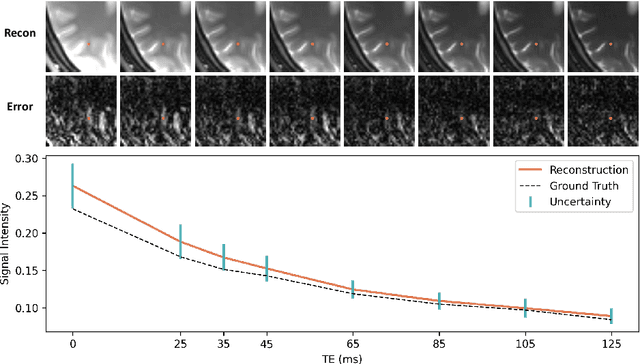
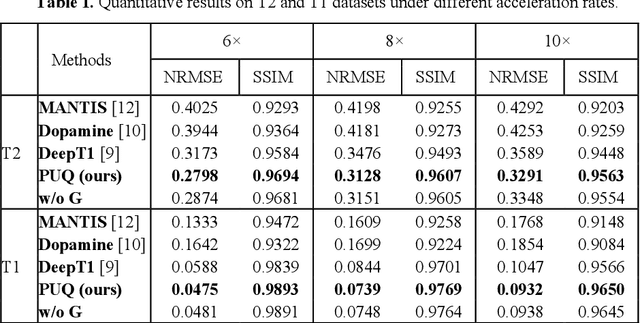
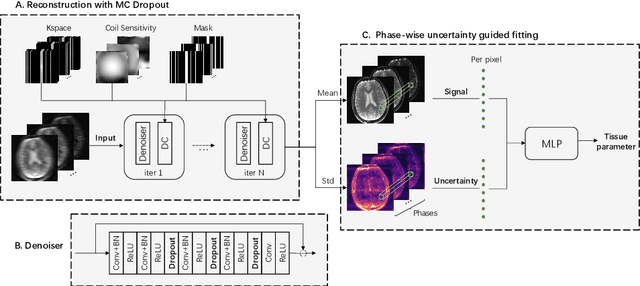
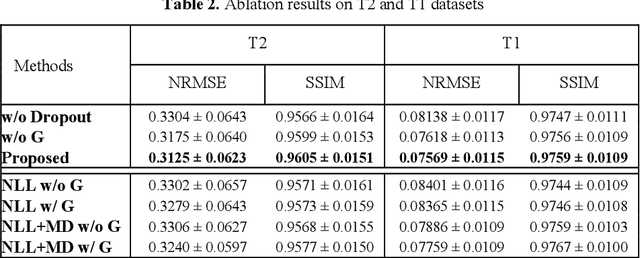
Quantitative magnetic resonance imaging (qMRI) requires multi-phase acqui-sition, often relying on reduced data sampling and reconstruction algorithms to accelerate scans, which inherently poses an ill-posed inverse problem. While many studies focus on measuring uncertainty during this process, few explore how to leverage it to enhance reconstruction performance. In this paper, we in-troduce PUQ, a novel approach that pioneers the use of uncertainty infor-mation for qMRI reconstruction. PUQ employs a two-stage reconstruction and parameter fitting framework, where phase-wise uncertainty is estimated during reconstruction and utilized in the fitting stage. This design allows uncertainty to reflect the reliability of different phases and guide information integration during parameter fitting. We evaluated PUQ on in vivo T1 and T2 mapping datasets from healthy subjects. Compared to existing qMRI reconstruction methods, PUQ achieved the state-of-the-art performance in parameter map-pings, demonstrating the effectiveness of uncertainty guidance. Our code is available at https://anonymous.4open.science/r/PUQ-75B2/.