 Add to Chrome
 Add to Firefox
 Add to Edge
Improving Medical Visual Reinforcement Fine-Tuning via Perception and Reasoning Augmentation
Feb 11, 2026
While recent advances in Reinforcement Fine-Tuning (RFT) have shown that rule-based reward schemes can enable effective post-training for large language models, their extension to cross-modal, vision-centric domains remains largely underexplored. This limitation is especially pronounced in the medical imaging domain, where effective performance requires both robust visual perception and structured reasoning. In this work, we address this gap by proposing VRFT-Aug, a visual reinforcement fine-tuning framework tailored for the medical domain. VRFT-Aug introduces a series of training strategies designed to augment both perception and reasoning, including prior knowledge injection, perception-driven policy refinement, medically informed reward shaping, and behavioral imitation. Together, these methods aim to stabilize and improve the RFT process. Through extensive experiments across multiple medical datasets, we show that our approaches consistently outperform both standard supervised fine-tuning and RFT baselines. Moreover, we provide empirically grounded insights and practical training heuristics that can be generalized to other medical image tasks. We hope this work contributes actionable guidance and fresh inspiration for the ongoing effort to develop reliable, reasoning-capable models for high-stakes medical applications.

One-to-Normal: Anomaly Personalization for Few-shot Anomaly Detection
Feb 03, 2025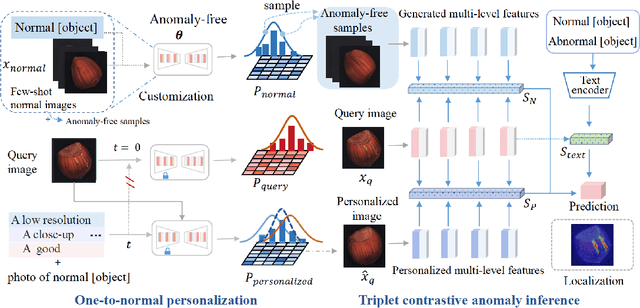

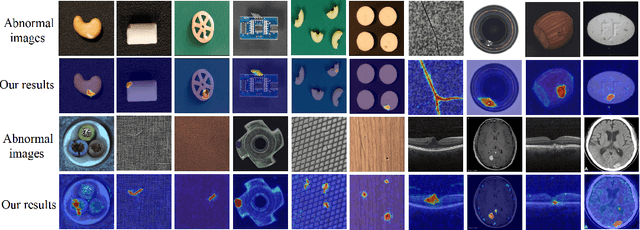

Traditional Anomaly Detection (AD) methods have predominantly relied on unsupervised learning from extensive normal data. Recent AD methods have evolved with the advent of large pre-trained vision-language models, enhancing few-shot anomaly detection capabilities. However, these latest AD methods still exhibit limitations in accuracy improvement. One contributing factor is their direct comparison of a query image's features with those of few-shot normal images. This direct comparison often leads to a loss of precision and complicates the extension of these techniques to more complex domains--an area that remains underexplored in a more refined and comprehensive manner. To address these limitations, we introduce the anomaly personalization method, which performs a personalized one-to-normal transformation of query images using an anomaly-free customized generation model, ensuring close alignment with the normal manifold. Moreover, to further enhance the stability and robustness of prediction results, we propose a triplet contrastive anomaly inference strategy, which incorporates a comprehensive comparison between the query and generated anomaly-free data pool and prompt information. Extensive evaluations across eleven datasets in three domains demonstrate our model's effectiveness compared to the latest AD methods. Additionally, our method has been proven to transfer flexibly to other AD methods, with the generated image data effectively improving the performance of other AD methods.