 Add to Chrome
 Add to Firefox
 Add to Edge
CFPO: Counterfactual Policy Optimization for Multimodal Reasoning
Jun 22, 2026
Large Vision-Language Models (LVLMs) have demonstrated remarkable capabilities in multimodal reasoning. However, prevailing reinforcement learning (RL) paradigms lack explicit counterfactual enhancement and causal learning mechanisms. This fundamental deficiency results in severe grounding failures, manifesting as a tendency to ignore visual evidence in favor of language priors or exhibiting hallucination drift during long chain-of-thought reasoning. To address this root cause, we propose CounterFactual Policy Optimization (CFPO), a novel framework that enforces causal consistency between visual perception and textual reasoning. CFPO introduces a cross-modal counterfactual enhancement mechanism, which regularizes the policy by maximizing the discrepancy between the model's predictions and those from a counterfactual state where critical visual cues are suppressed. This approach seamlessly integrates with standard algorithms like GRPO and DAPO without requiring external reward models or additional supervision. Extensive experiments demonstrate that CFPO significantly improves reasoning fidelity, achieving consistent gains of 3.17%-6.25% over standard RL baselines and 1.32%-2.13% over the state-of-the-art perception-aware method (PAPO). Code is available at https://github.com/Raven-July/CFPO.

MedLoc-R1: Performance-Aware Curriculum Reward Scheduling for GRPO-Based Medical Visual Grounding
Mar 30, 2026Medical visual grounding serves as a crucial foundation for fine-grained multimodal reasoning and interpretable clinical decision support. Despite recent advances in reinforcement learning (RL) for grounding tasks, existing approaches such as Group Relative Policy Optimization~(GRPO) suffer from severe reward sparsity when directly applied to medical images, primarily due to the inherent difficulty of localizing small or ambiguous regions of interest, which is further exacerbated by the rigid and suboptimal nature of fixed IoU-based reward schemes in RL. This leads to vanishing policy gradients and stagnated optimization, particularly during early training. To address this challenge, we propose MedLoc-R1, a performance-aware reward scheduling framework that progressively tightens the reward criterion in accordance with model readiness. MedLoc-R1 introduces a sliding-window performance tracker and a multi-condition update rule that automatically adjust the reward schedule from dense, easily obtainable signals to stricter, fine-grained localization requirements, while preserving the favorable properties of GRPO without introducing auxiliary networks or additional gradient paths. Experiments on three medical visual grounding benchmarks demonstrate that MedLoc-R1 consistently improves both localization accuracy and training stability over GRPO-based baselines. Our framework offers a general, lightweight, and effective solution for RL-based grounding in high-stakes medical applications. Code \& checkpoints are available at \hyperlink{}{https://github.com/MembrAI/MedLoc-R1}.
Improving Medical Visual Reinforcement Fine-Tuning via Perception and Reasoning Augmentation
Feb 11, 2026While recent advances in Reinforcement Fine-Tuning (RFT) have shown that rule-based reward schemes can enable effective post-training for large language models, their extension to cross-modal, vision-centric domains remains largely underexplored. This limitation is especially pronounced in the medical imaging domain, where effective performance requires both robust visual perception and structured reasoning. In this work, we address this gap by proposing VRFT-Aug, a visual reinforcement fine-tuning framework tailored for the medical domain. VRFT-Aug introduces a series of training strategies designed to augment both perception and reasoning, including prior knowledge injection, perception-driven policy refinement, medically informed reward shaping, and behavioral imitation. Together, these methods aim to stabilize and improve the RFT process. Through extensive experiments across multiple medical datasets, we show that our approaches consistently outperform both standard supervised fine-tuning and RFT baselines. Moreover, we provide empirically grounded insights and practical training heuristics that can be generalized to other medical image tasks. We hope this work contributes actionable guidance and fresh inspiration for the ongoing effort to develop reliable, reasoning-capable models for high-stakes medical applications.
MLAE: Masked LoRA Experts for Parameter-Efficient Fine-Tuning
May 29, 2024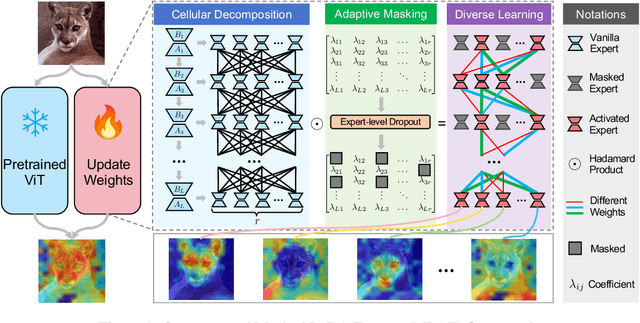
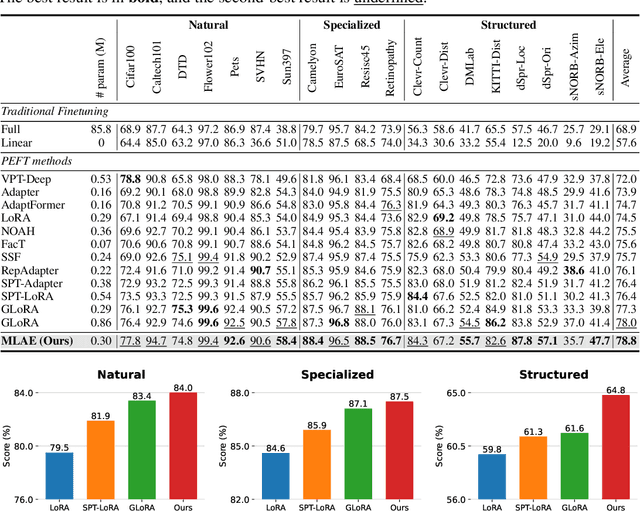
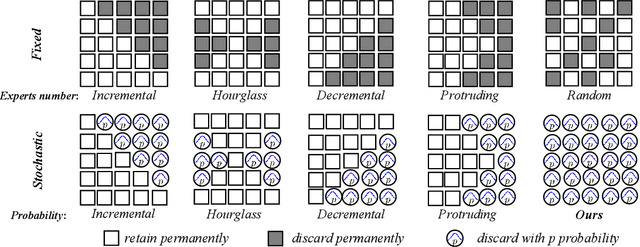

In response to the challenges posed by the extensive parameter updates required for full fine-tuning of large-scale pre-trained models, parameter-efficient fine-tuning (PEFT) methods, exemplified by Low-Rank Adaptation (LoRA), have emerged. LoRA simplifies the fine-tuning process but may still struggle with a certain level of redundancy in low-rank matrices and limited effectiveness from merely increasing their rank. To address these issues, a natural idea is to enhance the independence and diversity of the learning process for the low-rank matrices. Therefore, we propose Masked LoRA Experts (MLAE), an innovative approach that applies the concept of masking to PEFT. Our method incorporates a cellular decomposition strategy that transforms a low-rank matrix into independent rank-1 submatrices, or ``experts'', thus enhancing independence. Additionally, we introduce a binary mask matrix that selectively activates these experts during training to promote more diverse and anisotropic learning, based on expert-level dropout strategies. Our investigations reveal that this selective activation not only enhances performance but also fosters a more diverse acquisition of knowledge with a marked decrease in parameter similarity among MLAE, significantly boosting the quality of the model while barely increasing the parameter count. Remarkably, MLAE achieves new SOTA performance with an average accuracy score of 78.8% on the VTAB-1k benchmark and 90.9% on the FGVC benchmark, demonstrating superior performance. Our code is available at https://github.com/jie040109/MLAE.