 Add to Chrome
 Add to Firefox
 Add to Edge
Improving Medical Visual Reinforcement Fine-Tuning via Perception and Reasoning Augmentation
Feb 11, 2026
While recent advances in Reinforcement Fine-Tuning (RFT) have shown that rule-based reward schemes can enable effective post-training for large language models, their extension to cross-modal, vision-centric domains remains largely underexplored. This limitation is especially pronounced in the medical imaging domain, where effective performance requires both robust visual perception and structured reasoning. In this work, we address this gap by proposing VRFT-Aug, a visual reinforcement fine-tuning framework tailored for the medical domain. VRFT-Aug introduces a series of training strategies designed to augment both perception and reasoning, including prior knowledge injection, perception-driven policy refinement, medically informed reward shaping, and behavioral imitation. Together, these methods aim to stabilize and improve the RFT process. Through extensive experiments across multiple medical datasets, we show that our approaches consistently outperform both standard supervised fine-tuning and RFT baselines. Moreover, we provide empirically grounded insights and practical training heuristics that can be generalized to other medical image tasks. We hope this work contributes actionable guidance and fresh inspiration for the ongoing effort to develop reliable, reasoning-capable models for high-stakes medical applications.

Deblurring Masked Autoencoder is Better Recipe for Ultrasound Image Recognition
Jun 14, 2023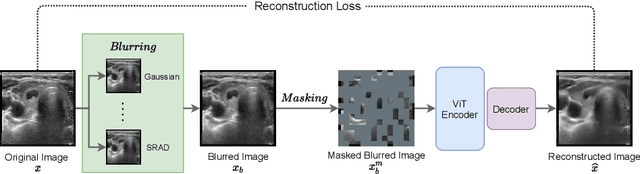
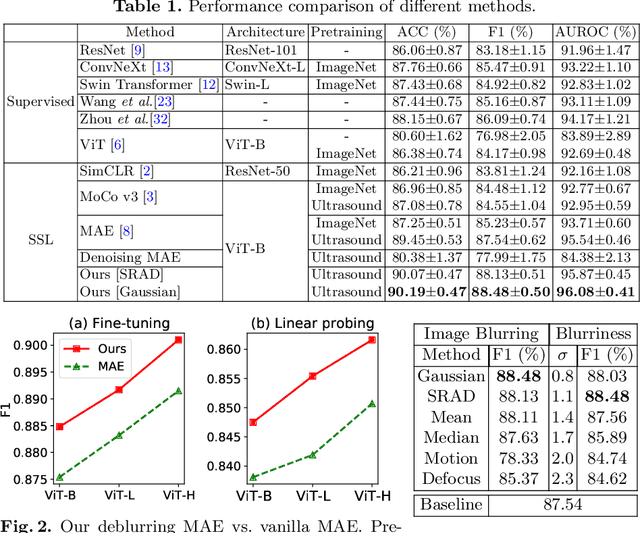
Masked autoencoder (MAE) has attracted unprecedented attention and achieves remarkable performance in many vision tasks. It reconstructs random masked image patches (known as proxy task) during pretraining and learns meaningful semantic representations that can be transferred to downstream tasks. However, MAE has not been thoroughly explored in ultrasound imaging. In this work, we investigate the potential of MAE for ultrasound image recognition. Motivated by the unique property of ultrasound imaging in high noise-to-signal ratio, we propose a novel deblurring MAE approach that incorporates deblurring into the proxy task during pretraining. The addition of deblurring facilitates the pretraining to better recover the subtle details presented in the ultrasound images, thus improving the performance of the downstream classification task. Our experimental results demonstrate the effectiveness of our deblurring MAE, achieving state-of-the-art performance in ultrasound image classification. Overall, our work highlights the potential of MAE for ultrasound image recognition and presents a novel approach that incorporates deblurring to further improve its effectiveness.