 Add to Chrome
 Add to Firefox
 Add to Edge
4D Monocular Surgical Reconstruction under Arbitrary Camera Motions
Feb 19, 2026
Reconstructing deformable surgical scenes from endoscopic videos is challenging and clinically important. Recent state-of-the-art methods based on implicit neural representations or 3D Gaussian splatting have made notable progress. However, most are designed for deformable scenes with fixed endoscope viewpoints and rely on stereo depth priors or accurate structure-from-motion for initialization and optimization, limiting their ability to handle monocular sequences with large camera motion in real clinical settings. To address this, we propose Local-EndoGS, a high-quality 4D reconstruction framework for monocular endoscopic sequences with arbitrary camera motion. Local-EndoGS introduces a progressive, window-based global representation that allocates local deformable scene models to each observed window, enabling scalability to long sequences with substantial motion. To overcome unreliable initialization without stereo depth or accurate structure-from-motion, we design a coarse-to-fine strategy integrating multi-view geometry, cross-window information, and monocular depth priors, providing a robust foundation for optimization. We further incorporate long-range 2D pixel trajectory constraints and physical motion priors to improve deformation plausibility. Experiments on three public endoscopic datasets with deformable scenes and varying camera motions show that Local-EndoGS consistently outperforms state-of-the-art methods in appearance quality and geometry. Ablation studies validate the effectiveness of our key designs. Code will be released upon acceptance at: https://github.com/IRMVLab/Local-EndoGS.

NRGS-SLAM: Monocular Non-Rigid SLAM for Endoscopy via Deformation-Aware 3D Gaussian Splatting
Feb 19, 2026Visual simultaneous localization and mapping (V-SLAM) is a fundamental capability for autonomous perception and navigation. However, endoscopic scenes violate the rigidity assumption due to persistent soft-tissue deformations, creating a strong coupling ambiguity between camera ego-motion and intrinsic deformation. Although recent monocular non-rigid SLAM methods have made notable progress, they often lack effective decoupling mechanisms and rely on sparse or low-fidelity scene representations, which leads to tracking drift and limited reconstruction quality. To address these limitations, we propose NRGS-SLAM, a monocular non-rigid SLAM system for endoscopy based on 3D Gaussian Splatting. To resolve the coupling ambiguity, we introduce a deformation-aware 3D Gaussian map that augments each Gaussian primitive with a learnable deformation probability, optimized via a Bayesian self-supervision strategy without requiring external non-rigidity labels. Building on this representation, we design a deformable tracking module that performs robust coarse-to-fine pose estimation by prioritizing low-deformation regions, followed by efficient per-frame deformation updates. A carefully designed deformable mapping module progressively expands and refines the map, balancing representational capacity and computational efficiency. In addition, a unified robust geometric loss incorporates external geometric priors to mitigate the inherent ill-posedness of monocular non-rigid SLAM. Extensive experiments on multiple public endoscopic datasets demonstrate that NRGS-SLAM achieves more accurate camera pose estimation (up to 50\% reduction in RMSE) and higher-quality photo-realistic reconstructions than state-of-the-art methods. Comprehensive ablation studies further validate the effectiveness of our key design choices. Source code will be publicly available upon paper acceptance.
PILOT: A Perceptive Integrated Low-level Controller for Loco-manipulation over Unstructured Scenes
Jan 24, 2026Humanoid robots hold great potential for diverse interactions and daily service tasks within human-centered environments, necessitating controllers that seamlessly integrate precise locomotion with dexterous manipulation. However, most existing whole-body controllers lack exteroceptive awareness of the surrounding environment, rendering them insufficient for stable task execution in complex, unstructured scenarios.To address this challenge, we propose PILOT, a unified single-stage reinforcement learning (RL) framework tailored for perceptive loco-manipulation, which synergizes perceptive locomotion and expansive whole-body control within a single policy. To enhance terrain awareness and ensure precise foot placement, we design a cross-modal context encoder that fuses prediction-based proprioceptive features with attention-based perceptive representations. Furthermore, we introduce a Mixture-of-Experts (MoE) policy architecture to coordinate diverse motor skills, facilitating better specialization across distinct motion patterns. Extensive experiments in both simulation and on the physical Unitree G1 humanoid robot validate the efficacy of our framework. PILOT demonstrates superior stability, command tracking precision, and terrain traversability compared to existing baselines. These results highlight its potential to serve as a robust, foundational low-level controller for loco-manipulation in unstructured scenes.
GaussianDWM: 3D Gaussian Driving World Model for Unified Scene Understanding and Multi-Modal Generation
Dec 29, 2025Driving World Models (DWMs) have been developing rapidly with the advances of generative models. However, existing DWMs lack 3D scene understanding capabilities and can only generate content conditioned on input data, without the ability to interpret or reason about the driving environment. Moreover, current approaches represent 3D spatial information with point cloud or BEV features do not accurately align textual information with the underlying 3D scene. To address these limitations, we propose a novel unified DWM framework based on 3D Gaussian scene representation, which enables both 3D scene understanding and multi-modal scene generation, while also enabling contextual enrichment for understanding and generation tasks. Our approach directly aligns textual information with the 3D scene by embedding rich linguistic features into each Gaussian primitive, thereby achieving early modality alignment. In addition, we design a novel task-aware language-guided sampling strategy that removes redundant 3D Gaussians and injects accurate and compact 3D tokens into LLM. Furthermore, we design a dual-condition multi-modal generation model, where the information captured by our vision-language model is leveraged as a high-level language condition in combination with a low-level image condition, jointly guiding the multi-modal generation process. We conduct comprehensive studies on the nuScenes, and NuInteract datasets to validate the effectiveness of our framework. Our method achieves state-of-the-art performance. We will release the code publicly on GitHub https://github.com/dtc111111/GaussianDWM.
SCAFusion: A Multimodal 3D Detection Framework for Small Object Detection in Lunar Surface Exploration
Dec 27, 2025Reliable and precise detection of small and irregular objects, such as meteor fragments and rocks, is critical for autonomous navigation and operation in lunar surface exploration. Existing multimodal 3D perception methods designed for terrestrial autonomous driving often underperform in off world environments due to poor feature alignment, limited multimodal synergy, and weak small object detection. This paper presents SCAFusion, a multimodal 3D object detection model tailored for lunar robotic missions. Built upon the BEVFusion framework, SCAFusion integrates a Cognitive Adapter for efficient camera backbone tuning, a Contrastive Alignment Module to enhance camera LiDAR feature consistency, a Camera Auxiliary Training Branch to strengthen visual representation, and most importantly, a Section aware Coordinate Attention mechanism explicitly designed to boost the detection performance of small, irregular targets. With negligible increase in parameters and computation, our model achieves 69.7% mAP and 72.1% NDS on the nuScenes validation set, improving the baseline by 5.0% and 2.7%, respectively. In simulated lunar environments built on Isaac Sim, SCAFusion achieves 90.93% mAP, outperforming the baseline by 11.5%, with notable gains in detecting small meteor like obstacles.
Reloc-VGGT: Visual Re-localization with Geometry Grounded Transformer
Dec 26, 2025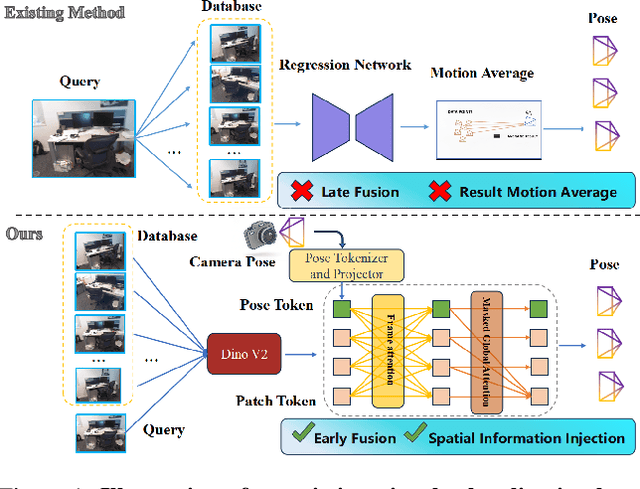
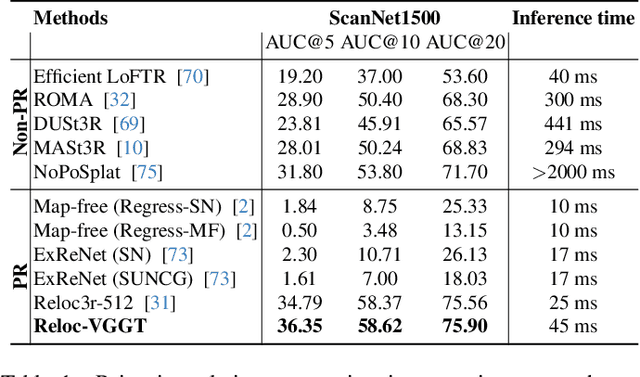
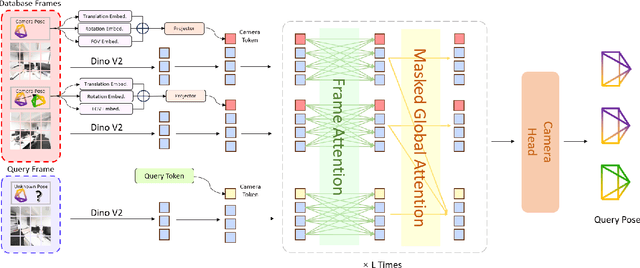
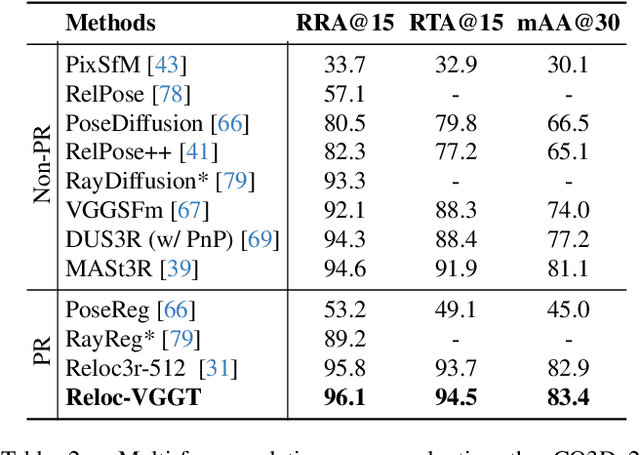
Visual localization has traditionally been formulated as a pair-wise pose regression problem. Existing approaches mainly estimate relative poses between two images and employ a late-fusion strategy to obtain absolute pose estimates. However, the late motion average is often insufficient for effectively integrating spatial information, and its accuracy degrades in complex environments. In this paper, we present the first visual localization framework that performs multi-view spatial integration through an early-fusion mechanism, enabling robust operation in both structured and unstructured environments. Our framework is built upon the VGGT backbone, which encodes multi-view 3D geometry, and we introduce a pose tokenizer and projection module to more effectively exploit spatial relationships from multiple database views. Furthermore, we propose a novel sparse mask attention strategy that reduces computational cost by avoiding the quadratic complexity of global attention, thereby enabling real-time performance at scale. Trained on approximately eight million posed image pairs, Reloc-VGGT demonstrates strong accuracy and remarkable generalization ability. Extensive experiments across diverse public datasets consistently validate the effectiveness and efficiency of our approach, delivering high-quality camera pose estimates in real time while maintaining robustness to unseen environments. Our code and models will be publicly released upon acceptance.https://github.com/dtc111111/Reloc-VGGT.
UniPR-3D: Towards Universal Visual Place Recognition with Visual Geometry Grounded Transformer
Dec 24, 2025Visual Place Recognition (VPR) has been traditionally formulated as a single-image retrieval task. Using multiple views offers clear advantages, yet this setting remains relatively underexplored and existing methods often struggle to generalize across diverse environments. In this work we introduce UniPR-3D, the first VPR architecture that effectively integrates information from multiple views. UniPR-3D builds on a VGGT backbone capable of encoding multi-view 3D representations, which we adapt by designing feature aggregators and fine-tune for the place recognition task. To construct our descriptor, we jointly leverage the 3D tokens and intermediate 2D tokens produced by VGGT. Based on their distinct characteristics, we design dedicated aggregation modules for 2D and 3D features, allowing our descriptor to capture fine-grained texture cues while also reasoning across viewpoints. To further enhance generalization, we incorporate both single- and multi-frame aggregation schemes, along with a variable-length sequence retrieval strategy. Our experiments show that UniPR-3D sets a new state of the art, outperforming both single- and multi-view baselines and highlighting the effectiveness of geometry-grounded tokens for VPR. Our code and models will be made publicly available on Github https://github.com/dtc111111/UniPR-3D.
SplatBright: Generalizable Low-Light Scene Reconstruction from Sparse Views via Physically-Guided Gaussian Enhancement
Dec 21, 2025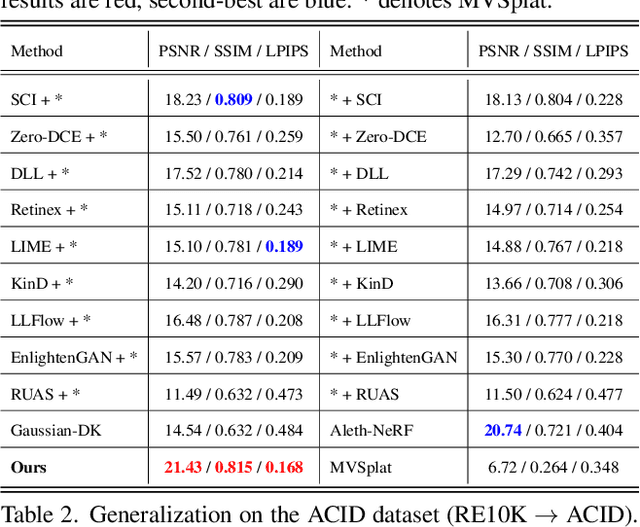
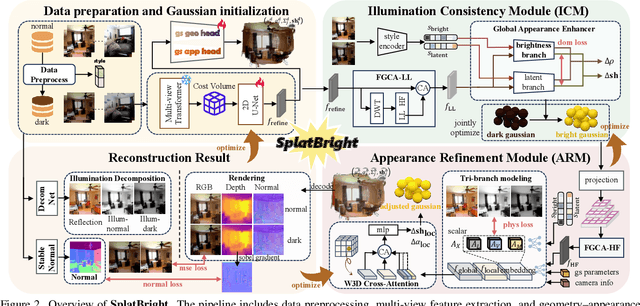
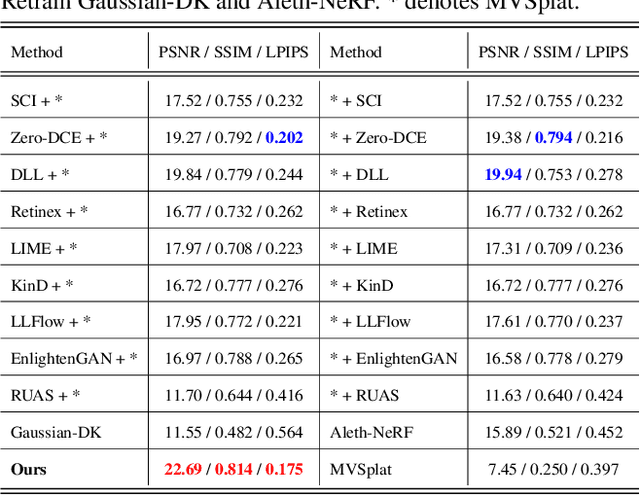
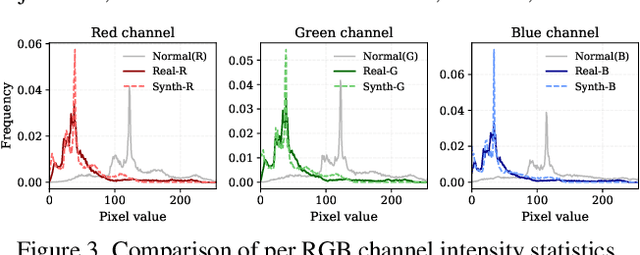
Low-light 3D reconstruction from sparse views remains challenging due to exposure imbalance and degraded color fidelity. While existing methods struggle with view inconsistency and require per-scene training, we propose SplatBright, which is, to our knowledge, the first generalizable 3D Gaussian framework for joint low-light enhancement and reconstruction from sparse sRGB inputs. Our key idea is to integrate physically guided illumination modeling with geometry-appearance decoupling for consistent low-light reconstruction. Specifically, we adopt a dual-branch predictor that provides stable geometric initialization of 3D Gaussian parameters. On the appearance side, illumination consistency leverages frequency priors to enable controllable and cross-view coherent lighting, while an appearance refinement module further separates illumination, material, and view-dependent cues to recover fine texture. To tackle the lack of large-scale geometrically consistent paired data, we synthesize dark views via a physics-based camera model for training. Extensive experiments on public and self-collected datasets demonstrate that SplatBright achieves superior novel view synthesis, cross-view consistency, and better generalization to unseen low-light scenes compared with both 2D and 3D methods.
ARMFlow: AutoRegressive MeanFlow for Online 3D Human Reaction Generation
Dec 18, 2025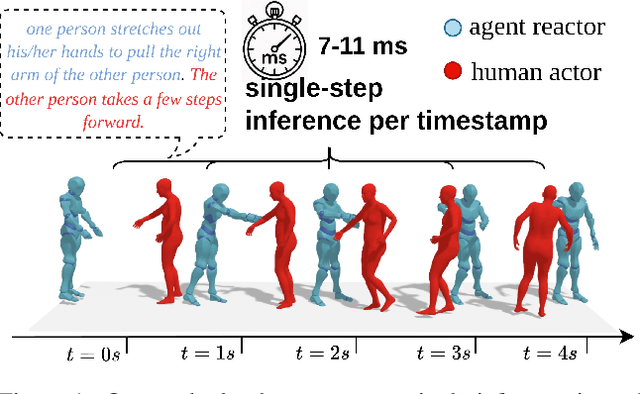

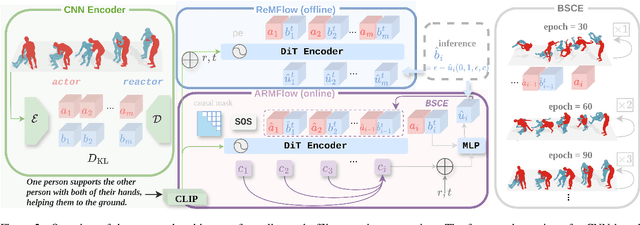

3D human reaction generation faces three main challenges:(1) high motion fidelity, (2) real-time inference, and (3) autoregressive adaptability for online scenarios. Existing methods fail to meet all three simultaneously. We propose ARMFlow, a MeanFlow-based autoregressive framework that models temporal dependencies between actor and reactor motions. It consists of a causal context encoder and an MLP-based velocity predictor. We introduce Bootstrap Contextual Encoding (BSCE) in training, encoding generated history instead of the ground-truth ones, to alleviate error accumulation in autoregressive generation. We further introduce the offline variant ReMFlow, achieving state-of-the-art performance with the fastest inference among offline methods. Our ARMFlow addresses key limitations of online settings by: (1) enhancing semantic alignment via a global contextual encoder; (2) achieving high accuracy and low latency in a single-step inference; and (3) reducing accumulated errors through BSCE. Our single-step online generation surpasses existing online methods on InterHuman and InterX by over 40% in FID, while matching offline state-of-the-art performance despite using only partial sequence conditions.
D$^2$GSLAM: 4D Dynamic Gaussian Splatting SLAM
Dec 10, 2025Recent advances in Dense Simultaneous Localization and Mapping (SLAM) have demonstrated remarkable performance in static environments. However, dense SLAM in dynamic environments remains challenging. Most methods directly remove dynamic objects and focus solely on static scene reconstruction, which ignores the motion information contained in these dynamic objects. In this paper, we present D$^2$GSLAM, a novel dynamic SLAM system utilizing Gaussian representation, which simultaneously performs accurate dynamic reconstruction and robust tracking within dynamic environments. Our system is composed of four key components: (i) We propose a geometric-prompt dynamic separation method to distinguish between static and dynamic elements of the scene. This approach leverages the geometric consistency of Gaussian representation and scene geometry to obtain coarse dynamic regions. The regions then serve as prompts to guide the refinement of the coarse mask for achieving accurate motion mask. (ii) To facilitate accurate and efficient mapping of the dynamic scene, we introduce dynamic-static composite representation that integrates static 3D Gaussians with dynamic 4D Gaussians. This representation allows for modeling the transitions between static and dynamic states of objects in the scene for composite mapping and optimization. (iii) We employ a progressive pose refinement strategy that leverages both the multi-view consistency of static scene geometry and motion information from dynamic objects to achieve accurate camera tracking. (iv) We introduce a motion consistency loss, which leverages the temporal continuity in object motions for accurate dynamic modeling. Our D$^2$GSLAM demonstrates superior performance on dynamic scenes in terms of mapping and tracking accuracy, while also showing capability in accurate dynamic modeling.