 Add to Chrome
 Add to Firefox
 Add to Edge
PhysiFlow: Physics-Aware Humanoid Whole-Body VLA via Multi-Brain Latent Flow Matching and Robust Tracking
Mar 05, 2026
In the domain of humanoid robot control, the fusion of Vision-Language-Action (VLA) with whole-body control is essential for semantically guided execution of real-world tasks. However, existing methods encounter challenges in terms of low VLA inference efficiency or an absence of effective semantic guidance for whole-body control, resulting in instability in dynamic limb-coordinated tasks. To bridge this gap, we present a semantic-motion intent guided, physics-aware multi-brain VLA framework for humanoid whole-body control. A series of experiments was conducted to evaluate the performance of the proposed framework. The experimental results demonstrated that the framework enabled reliable vision-language-guided full-body coordination for humanoid robots.

PILOT: A Perceptive Integrated Low-level Controller for Loco-manipulation over Unstructured Scenes
Jan 24, 2026Humanoid robots hold great potential for diverse interactions and daily service tasks within human-centered environments, necessitating controllers that seamlessly integrate precise locomotion with dexterous manipulation. However, most existing whole-body controllers lack exteroceptive awareness of the surrounding environment, rendering them insufficient for stable task execution in complex, unstructured scenarios.To address this challenge, we propose PILOT, a unified single-stage reinforcement learning (RL) framework tailored for perceptive loco-manipulation, which synergizes perceptive locomotion and expansive whole-body control within a single policy. To enhance terrain awareness and ensure precise foot placement, we design a cross-modal context encoder that fuses prediction-based proprioceptive features with attention-based perceptive representations. Furthermore, we introduce a Mixture-of-Experts (MoE) policy architecture to coordinate diverse motor skills, facilitating better specialization across distinct motion patterns. Extensive experiments in both simulation and on the physical Unitree G1 humanoid robot validate the efficacy of our framework. PILOT demonstrates superior stability, command tracking precision, and terrain traversability compared to existing baselines. These results highlight its potential to serve as a robust, foundational low-level controller for loco-manipulation in unstructured scenes.
AbdomenAtlas: A Large-Scale, Detailed-Annotated, & Multi-Center Dataset for Efficient Transfer Learning and Open Algorithmic Benchmarking
Jul 23, 2024

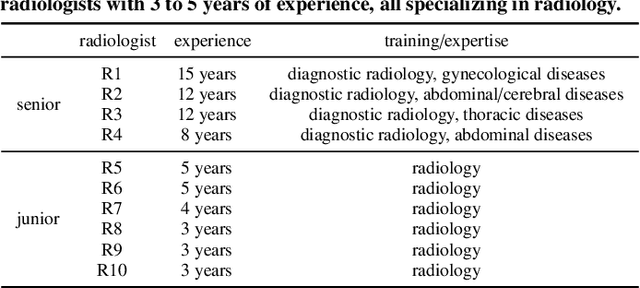

We introduce the largest abdominal CT dataset (termed AbdomenAtlas) of 20,460 three-dimensional CT volumes sourced from 112 hospitals across diverse populations, geographies, and facilities. AbdomenAtlas provides 673K high-quality masks of anatomical structures in the abdominal region annotated by a team of 10 radiologists with the help of AI algorithms. We start by having expert radiologists manually annotate 22 anatomical structures in 5,246 CT volumes. Following this, a semi-automatic annotation procedure is performed for the remaining CT volumes, where radiologists revise the annotations predicted by AI, and in turn, AI improves its predictions by learning from revised annotations. Such a large-scale, detailed-annotated, and multi-center dataset is needed for two reasons. Firstly, AbdomenAtlas provides important resources for AI development at scale, branded as large pre-trained models, which can alleviate the annotation workload of expert radiologists to transfer to broader clinical applications. Secondly, AbdomenAtlas establishes a large-scale benchmark for evaluating AI algorithms -- the more data we use to test the algorithms, the better we can guarantee reliable performance in complex clinical scenarios. An ISBI & MICCAI challenge named BodyMaps: Towards 3D Atlas of Human Body was launched using a subset of our AbdomenAtlas, aiming to stimulate AI innovation and to benchmark segmentation accuracy, inference efficiency, and domain generalizability. We hope our AbdomenAtlas can set the stage for larger-scale clinical trials and offer exceptional opportunities to practitioners in the medical imaging community. Codes, models, and datasets are available at https://www.zongweiz.com/dataset