 Add to Chrome
 Add to Firefox
 Add to Edge
Reloc-VGGT: Visual Re-localization with Geometry Grounded Transformer
Dec 26, 2025
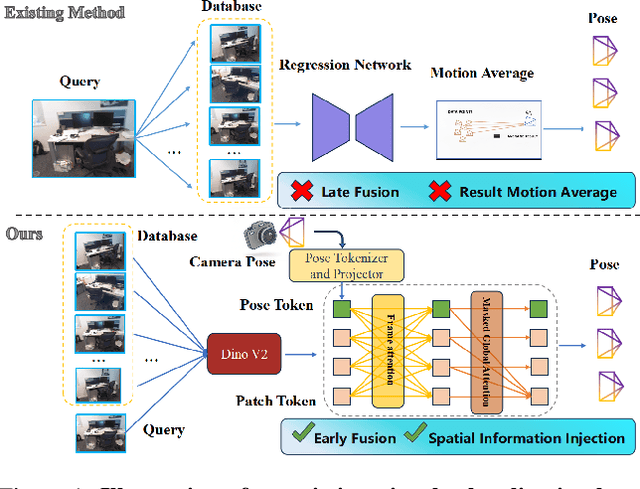
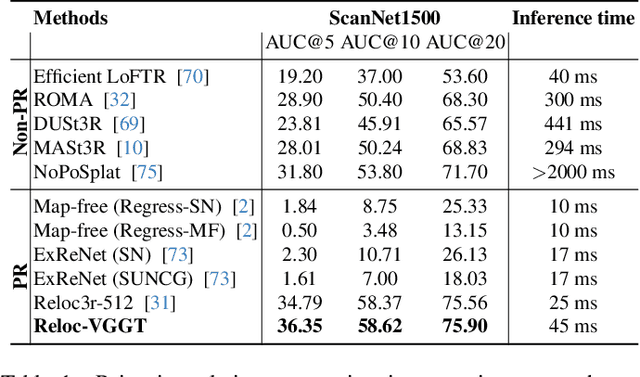
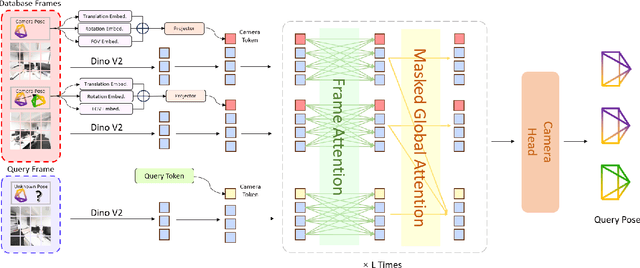
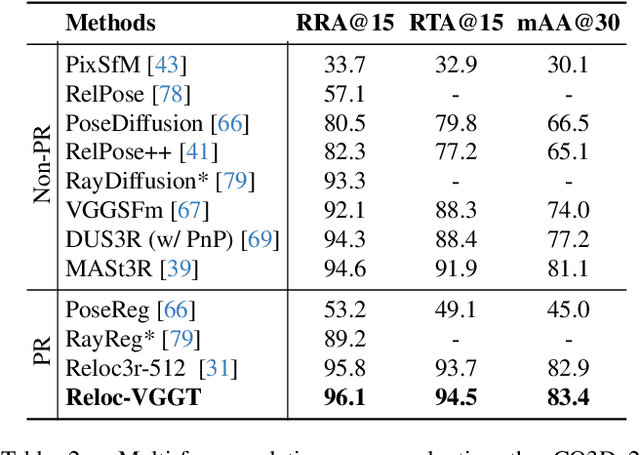
Visual localization has traditionally been formulated as a pair-wise pose regression problem. Existing approaches mainly estimate relative poses between two images and employ a late-fusion strategy to obtain absolute pose estimates. However, the late motion average is often insufficient for effectively integrating spatial information, and its accuracy degrades in complex environments. In this paper, we present the first visual localization framework that performs multi-view spatial integration through an early-fusion mechanism, enabling robust operation in both structured and unstructured environments. Our framework is built upon the VGGT backbone, which encodes multi-view 3D geometry, and we introduce a pose tokenizer and projection module to more effectively exploit spatial relationships from multiple database views. Furthermore, we propose a novel sparse mask attention strategy that reduces computational cost by avoiding the quadratic complexity of global attention, thereby enabling real-time performance at scale. Trained on approximately eight million posed image pairs, Reloc-VGGT demonstrates strong accuracy and remarkable generalization ability. Extensive experiments across diverse public datasets consistently validate the effectiveness and efficiency of our approach, delivering high-quality camera pose estimates in real time while maintaining robustness to unseen environments. Our code and models will be publicly released upon acceptance.https://github.com/dtc111111/Reloc-VGGT.

HiGS: Hierarchical Generative Scene Framework for Multi-Step Associative Semantic Spatial Composition
Oct 31, 2025Three-dimensional scene generation holds significant potential in gaming, film, and virtual reality. However, most existing methods adopt a single-step generation process, making it difficult to balance scene complexity with minimal user input. Inspired by the human cognitive process in scene modeling, which progresses from global to local, focuses on key elements, and completes the scene through semantic association, we propose HiGS, a hierarchical generative framework for multi-step associative semantic spatial composition. HiGS enables users to iteratively expand scenes by selecting key semantic objects, offering fine-grained control over regions of interest while the model completes peripheral areas automatically. To support structured and coherent generation, we introduce the Progressive Hierarchical Spatial-Semantic Graph (PHiSSG), which dynamically organizes spatial relationships and semantic dependencies across the evolving scene structure. PHiSSG ensures spatial and geometric consistency throughout the generation process by maintaining a one-to-one mapping between graph nodes and generated objects and supporting recursive layout optimization. Experiments demonstrate that HiGS outperforms single-stage methods in layout plausibility, style consistency, and user preference, offering a controllable and extensible paradigm for efficient 3D scene construction.