 Add to Chrome
 Add to Firefox
 Add to Edge
ExtraGS: Enhancing Endoscopic View Extrapolation via Diffusion-Guided 3D Gaussian Splatting
Jul 14, 2026
Robot-assisted minimally invasive surgery (MIS) critically depends on reliable endoscopic perception for navigation and safety. However, conventional endoscopes provide only a limited field of view, leaving large portions of surrounding anatomy unobserved. Recent neural rendering approaches, such as Neural Radiance Fields and 3D Gaussian Splatting, enable novel view synthesis from endoscopic videos, but their reliance on sparse observations often leads to severe artifacts when extrapolating beyond the training trajectory.In this work, we propose ExtraGS, a framework for enhancing endoscopic view extrapolation via diffusion-guided 3D Gaussian Splatting. Starting from an initial reconstruction, we introduce an uncertainty-guided virtual camera sampling strategy to actively explore blind spots and maximize information gain. The rendered views from these sampled locations are refined using a diffusion model to recover plausible anatomical structures, producing pseudo observations that guide further optimization. To prevent the generated content from degrading reliable regions, we adopt a confidence-weighted fine-tuning strategy when incorporating these pseudo observations.Extensive experiments on multiple public endoscopic datasets demonstrate that ExtraGS significantly reduces extrapolation artifacts and achieves state-of-the-art performance in endoscopic novel view synthesis.

DreamReg: Belief-Driven World Model for 2D-3D Ultrasound Registration
Jun 17, 2026Ultrasound (US) is widely used for surgical navigation, yet real-time registration between intraoperative 2D slices and preoperative 3D volumes remains challenging due to partial observability, speckle noise, and the action-dependent US acquisition. Existing methods are one-shot or short-horizon, making it hard for them to gather evidence over time or capture how surgeons adjust probe motion based on on-screen feedback. We propose DreamReg, a belief-driven world-model framework that formulates 2D-3D registration as belief updating over rigid transformations. DreamReg maintains a latent belief state that summarizes past observations and poses information, and continuously refines the transformation through learned dynamics as new slices arrive. During training, DreamReg is exposed to probe-motion trajectories that mimic clinical scanning behavior and learns to update its belief by conditioning pose refinement on the current US observation. During inference, DreamReg refines registration via internal imagination: it rolls out the learned world model to simulate candidate probe motions and their predicted observations, and integrates these imagined outcomes to converge to an accurate rigid transformation. Experiments on CAMUS and u-RegPro datasets demonstrate improved robustness and competitive registration accuracy for real-time guidance compared with state-of-the-art methods.
Information-Theoretic Geometry Optimization and Physics-Aware Learning for Calibration-Free Magnetic Localization
Apr 24, 2026Wireless localization of permanent magnets enables occlusion-free guidance for medical interventions, yet its practical accuracy is fundamentally limited by two coupled challenges: the poor observability of conventional planar sensor arrays and the simulation-to-reality (Sim-to-Real) gap of learning-based estimators. To address these issues, this article presents a unified framework that combines information-theoretic sensor geometry optimization with physics-aware deep learning. First, a rigorous Fisher Information Matrix (FIM)-based evaluation framework is established to quantify geometry-induced observability limitations. The results show that a staggered split-array topology provides a substantially stronger observability foundation for localization while remaining compatible with practical external deployment. Second, building on this optimized sensing configuration, we propose Phy-GAANet, a calibration-free estimator trained entirely on hardware-aware synthetic data. By incorporating Physics-Informed Features (PIF) for saturation modeling and Geometry-Aware Attention (GAA) for preserving cross-layer vector structure, the network effectively bridges the Sim-to-Real gap. Extensive real-world experiments demonstrate state-of-the-art performance, achieving a position error of 1.84 mm and an orientation error of 3.18 degrees at a refresh rate exceeding 270 Hz. The proposed method consistently outperforms classical Levenberg--Marquardt solvers and generic convolutional baselines, particularly in suppressing catastrophic outliers and maintaining robustness in challenging near-field boundary regions. Beyond the proposed network, the FIM-guided analysis also provides a framework for sensor geometry design in magnetic localization systems under practical deployment constraints.
Leveraging Geometric Prior Uncertainty and Complementary Constraints for High-Fidelity Neural Indoor Surface Reconstruction
Feb 27, 2026Neural implicit surface reconstruction with signed distance function has made significant progress, but recovering fine details such as thin structures and complex geometries remains challenging due to unreliable or noisy geometric priors. Existing approaches rely on implicit uncertainty that arises during optimization to filter these priors, which is indirect and inefficient, and masking supervision in high-uncertainty regions further leads to under-constrained optimization. To address these issues, we propose GPU-SDF, a neural implicit framework for indoor surface reconstruction that leverages geometric prior uncertainty and complementary constraints. We introduce a self-supervised module that explicitly estimates prior uncertainty without auxiliary networks. Based on this estimation, we design an uncertainty-guided loss that modulates prior influence rather than discarding it, thereby retaining weak but informative cues. To address regions with high prior uncertainty, GPU-SDF further incorporates two complementary constraints: an edge distance field that strengthens boundary supervision and a multi-view consistency regularization that enforces geometric coherence. Extensive experiments confirm that GPU-SDF improves the reconstruction of fine details and serves as a plug-and-play enhancement for existing frameworks. Source code will be available at https://github.com/IRMVLab/GPU-SDF
4D Monocular Surgical Reconstruction under Arbitrary Camera Motions
Feb 19, 2026Reconstructing deformable surgical scenes from endoscopic videos is challenging and clinically important. Recent state-of-the-art methods based on implicit neural representations or 3D Gaussian splatting have made notable progress. However, most are designed for deformable scenes with fixed endoscope viewpoints and rely on stereo depth priors or accurate structure-from-motion for initialization and optimization, limiting their ability to handle monocular sequences with large camera motion in real clinical settings. To address this, we propose Local-EndoGS, a high-quality 4D reconstruction framework for monocular endoscopic sequences with arbitrary camera motion. Local-EndoGS introduces a progressive, window-based global representation that allocates local deformable scene models to each observed window, enabling scalability to long sequences with substantial motion. To overcome unreliable initialization without stereo depth or accurate structure-from-motion, we design a coarse-to-fine strategy integrating multi-view geometry, cross-window information, and monocular depth priors, providing a robust foundation for optimization. We further incorporate long-range 2D pixel trajectory constraints and physical motion priors to improve deformation plausibility. Experiments on three public endoscopic datasets with deformable scenes and varying camera motions show that Local-EndoGS consistently outperforms state-of-the-art methods in appearance quality and geometry. Ablation studies validate the effectiveness of our key designs. Code will be released upon acceptance at: https://github.com/IRMVLab/Local-EndoGS.
NRGS-SLAM: Monocular Non-Rigid SLAM for Endoscopy via Deformation-Aware 3D Gaussian Splatting
Feb 19, 2026Visual simultaneous localization and mapping (V-SLAM) is a fundamental capability for autonomous perception and navigation. However, endoscopic scenes violate the rigidity assumption due to persistent soft-tissue deformations, creating a strong coupling ambiguity between camera ego-motion and intrinsic deformation. Although recent monocular non-rigid SLAM methods have made notable progress, they often lack effective decoupling mechanisms and rely on sparse or low-fidelity scene representations, which leads to tracking drift and limited reconstruction quality. To address these limitations, we propose NRGS-SLAM, a monocular non-rigid SLAM system for endoscopy based on 3D Gaussian Splatting. To resolve the coupling ambiguity, we introduce a deformation-aware 3D Gaussian map that augments each Gaussian primitive with a learnable deformation probability, optimized via a Bayesian self-supervision strategy without requiring external non-rigidity labels. Building on this representation, we design a deformable tracking module that performs robust coarse-to-fine pose estimation by prioritizing low-deformation regions, followed by efficient per-frame deformation updates. A carefully designed deformable mapping module progressively expands and refines the map, balancing representational capacity and computational efficiency. In addition, a unified robust geometric loss incorporates external geometric priors to mitigate the inherent ill-posedness of monocular non-rigid SLAM. Extensive experiments on multiple public endoscopic datasets demonstrate that NRGS-SLAM achieves more accurate camera pose estimation (up to 50\% reduction in RMSE) and higher-quality photo-realistic reconstructions than state-of-the-art methods. Comprehensive ablation studies further validate the effectiveness of our key design choices. Source code will be publicly available upon paper acceptance.
Theoretical Data-Driven MobilePosenet: Lightweight Neural Network for Accurate Calibration-Free 5-DOF Magnet Localization
Jan 06, 2025


Permanent magnet tracking using the external sensor array is crucial for the accurate localization of wireless capsule endoscope robots. Traditional tracking algorithms, based on the magnetic dipole model and Levenberg-Marquardt (LM) algorithm, face challenges related to computational delays and the need for initial position estimation. More recently proposed neural network-based approaches often require extensive hardware calibration and real-world data collection, which are time-consuming and labor-intensive. To address these challenges, we propose MobilePosenet, a lightweight neural network architecture that leverages depthwise separable convolutions to minimize computational cost and a channel attention mechanism to enhance localization accuracy. Besides, the inputs to the network integrate the sensors' coordinate information and random noise, compensating for the discrepancies between the theoretical model and the actual magnetic fields and thus allowing MobilePosenet to be trained entirely on theoretical data. Experimental evaluations conducted in a \(90 \times 90 \times 80\) mm workspace demonstrate that MobilePosenet exhibits excellent 5-DOF localization accuracy ($1.54 \pm 1.03$ mm and $2.24 \pm 1.84^{\circ}$) and inference speed (0.9 ms) against state-of-the-art methods trained on real-world data. Since network training relies solely on theoretical data, MobilePosenet can eliminate the hardware calibration and real-world data collection process, improving the generalizability of this permanent magnet localization method and the potential for rapid adoption in different clinical settings.
Deformable Gaussian Splatting for Efficient and High-Fidelity Reconstruction of Surgical Scenes
Jan 02, 2025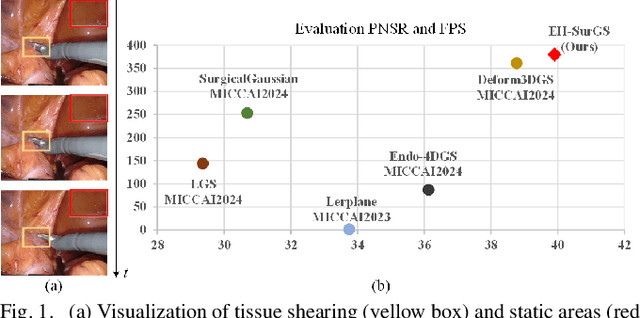
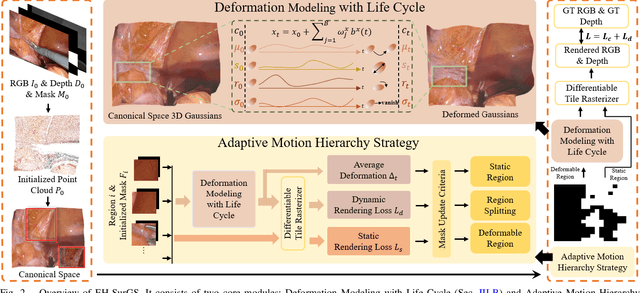
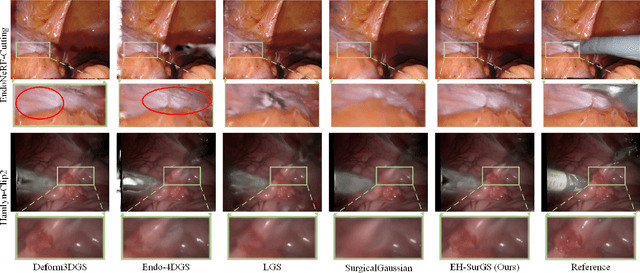

Efficient and high-fidelity reconstruction of deformable surgical scenes is a critical yet challenging task. Building on recent advancements in 3D Gaussian splatting, current methods have seen significant improvements in both reconstruction quality and rendering speed. However, two major limitations remain: (1) difficulty in handling irreversible dynamic changes, such as tissue shearing, which are common in surgical scenes; and (2) the lack of hierarchical modeling for surgical scene deformation, which reduces rendering speed. To address these challenges, we introduce EH-SurGS, an efficient and high-fidelity reconstruction algorithm for deformable surgical scenes. We propose a deformation modeling approach that incorporates the life cycle of 3D Gaussians, effectively capturing both regular and irreversible deformations, thus enhancing reconstruction quality. Additionally, we present an adaptive motion hierarchy strategy that distinguishes between static and deformable regions within the surgical scene. This strategy reduces the number of 3D Gaussians passing through the deformation field, thereby improving rendering speed. Extensive experiments demonstrate that our method surpasses existing state-of-the-art approaches in both reconstruction quality and rendering speed. Ablation studies further validate the effectiveness and necessity of our proposed components. We will open-source our code upon acceptance of the paper.
MambaXCTrack: Mamba-based Tracker with SSM Cross-correlation and Motion Prompt for Ultrasound Needle Tracking
Nov 13, 2024


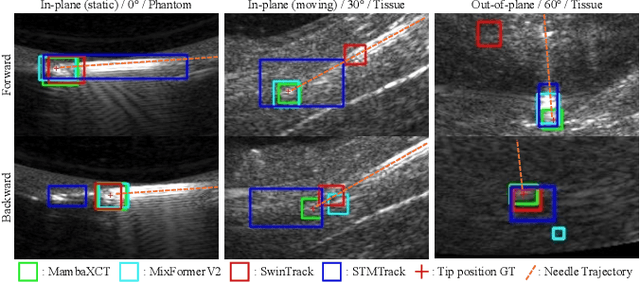
Ultrasound (US)-guided needle insertion is widely employed in percutaneous interventions. However, providing feedback on the needle tip position via US image presents challenges due to noise, artifacts, and the thin imaging plane of US, which degrades needle features and leads to intermittent tip visibility. In this paper, a Mamba-based US needle tracker MambaXCTrack utilizing structured state space models cross-correlation (SSMX-Corr) and implicit motion prompt is proposed, which is the first application of Mamba in US needle tracking. The SSMX-Corr enhances cross-correlation by long-range modeling and global searching of distant semantic features between template and search maps, benefiting the tracking under noise and artifacts by implicitly learning potential distant semantic cues. By combining with cross-map interleaved scan (CIS), local pixel-wise interaction with positional inductive bias can also be introduced to SSMX-Corr. The implicit low-level motion descriptor is proposed as a non-visual prompt to enhance tracking robustness, addressing the intermittent tip visibility problem. Extensive experiments on a dataset with motorized needle insertion in both phantom and tissue samples demonstrate that the proposed tracker outperforms other state-of-the-art trackers while ablation studies further highlight the effectiveness of each proposed tracking module.