 Add to Chrome
 Add to Firefox
 Add to Edge
ANCHOR: A Physically Grounded Closed-Loop Framework for Robust Home-Service Mobile Manipulation
Apr 28, 2026
Recent advances in open-vocabulary mobile manipulation have brought robots into real domestic environments. In such settings, reliable long-horizon execution under open-set object references and frequent disturbances becomes essential. However, many failures persist. These are not caused by semantic misunderstanding but by inconsistencies between symbolic plans and the evolving physical world, manifested as three recurring limitations: (i) existing systems often rely on pre-scanned semantic maps that become inconsistent after scene changes and disturbances; (ii) they select navigation endpoints without considering downstream manipulation feasibility, causing the "arrived but inoperable" problem; and (iii) they handle anomalies through undifferentiated global replanning, which often fails to contain local errors. To address this execution inconsistency, we present ANCHOR, a physically grounded closed-loop framework that aligns symbolic reasoning with verifiable physical state during execution. ANCHOR integrates three mechanisms: (i) physically anchored task planning, which binds symbolic predicates to observable geometric anchors and re-validates them after each action; (ii) operability-aware base alignment, which ensures that navigation endpoints satisfy kinematic reachability and local collision feasibility; and (iii) minimum-responsible-layer hierarchical recovery, which localizes failures across perception, base-arm coordination, and execution layers to prevent cascading retries. Across 60 real-robot trials in previously unseen environments, ANCHOR improves task success from 53.3% to 71.7% and achieves a 71.4% recovery rate under perturbations, demonstrating that explicit physical grounding and structured failure containment are critical for robust mobile manipulation. Our project page is available at https://anchor9178.github.io/ANCHOR/ .

NRGS-SLAM: Monocular Non-Rigid SLAM for Endoscopy via Deformation-Aware 3D Gaussian Splatting
Feb 19, 2026Visual simultaneous localization and mapping (V-SLAM) is a fundamental capability for autonomous perception and navigation. However, endoscopic scenes violate the rigidity assumption due to persistent soft-tissue deformations, creating a strong coupling ambiguity between camera ego-motion and intrinsic deformation. Although recent monocular non-rigid SLAM methods have made notable progress, they often lack effective decoupling mechanisms and rely on sparse or low-fidelity scene representations, which leads to tracking drift and limited reconstruction quality. To address these limitations, we propose NRGS-SLAM, a monocular non-rigid SLAM system for endoscopy based on 3D Gaussian Splatting. To resolve the coupling ambiguity, we introduce a deformation-aware 3D Gaussian map that augments each Gaussian primitive with a learnable deformation probability, optimized via a Bayesian self-supervision strategy without requiring external non-rigidity labels. Building on this representation, we design a deformable tracking module that performs robust coarse-to-fine pose estimation by prioritizing low-deformation regions, followed by efficient per-frame deformation updates. A carefully designed deformable mapping module progressively expands and refines the map, balancing representational capacity and computational efficiency. In addition, a unified robust geometric loss incorporates external geometric priors to mitigate the inherent ill-posedness of monocular non-rigid SLAM. Extensive experiments on multiple public endoscopic datasets demonstrate that NRGS-SLAM achieves more accurate camera pose estimation (up to 50\% reduction in RMSE) and higher-quality photo-realistic reconstructions than state-of-the-art methods. Comprehensive ablation studies further validate the effectiveness of our key design choices. Source code will be publicly available upon paper acceptance.
4D Monocular Surgical Reconstruction under Arbitrary Camera Motions
Feb 19, 2026Reconstructing deformable surgical scenes from endoscopic videos is challenging and clinically important. Recent state-of-the-art methods based on implicit neural representations or 3D Gaussian splatting have made notable progress. However, most are designed for deformable scenes with fixed endoscope viewpoints and rely on stereo depth priors or accurate structure-from-motion for initialization and optimization, limiting their ability to handle monocular sequences with large camera motion in real clinical settings. To address this, we propose Local-EndoGS, a high-quality 4D reconstruction framework for monocular endoscopic sequences with arbitrary camera motion. Local-EndoGS introduces a progressive, window-based global representation that allocates local deformable scene models to each observed window, enabling scalability to long sequences with substantial motion. To overcome unreliable initialization without stereo depth or accurate structure-from-motion, we design a coarse-to-fine strategy integrating multi-view geometry, cross-window information, and monocular depth priors, providing a robust foundation for optimization. We further incorporate long-range 2D pixel trajectory constraints and physical motion priors to improve deformation plausibility. Experiments on three public endoscopic datasets with deformable scenes and varying camera motions show that Local-EndoGS consistently outperforms state-of-the-art methods in appearance quality and geometry. Ablation studies validate the effectiveness of our key designs. Code will be released upon acceptance at: https://github.com/IRMVLab/Local-EndoGS.
Core Context Aware Attention for Long Context Language Modeling
Dec 17, 2024
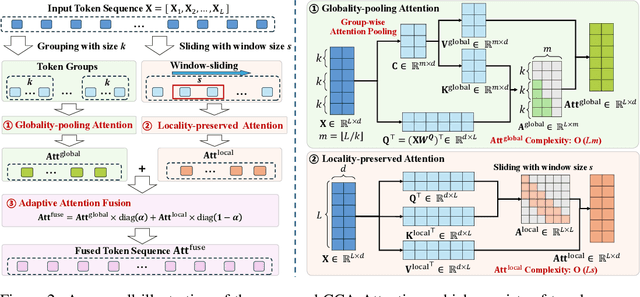
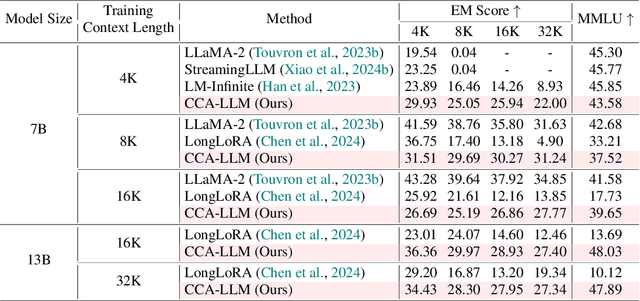
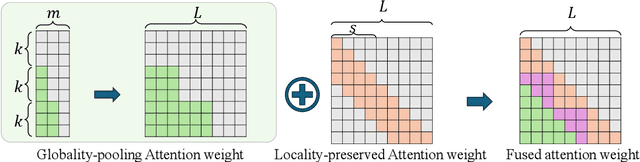
Transformer-based Large Language Models (LLMs) have exhibited remarkable success in various natural language processing tasks primarily attributed to self-attention mechanism, which requires a token to consider all preceding tokens as its context to compute the attention score. However, when the context length L becomes very large (e.g., 32K), more redundant context information will be included w.r.t. any tokens, making the self-attention suffer from two main limitations: 1) The computational and memory complexity scales quadratically w.r.t. L; 2) The presence of redundant context information may hamper the model to capture dependencies among crucial tokens, which may degrade the representation performance. In this paper, we propose a plug-and-play Core Context Aware (CCA) Attention for efficient long-range context modeling, which consists of two components: 1) Globality-pooling attention that divides input tokens into groups and then dynamically merges tokens within each group into one core token based on their significance; 2) Locality-preserved attention that incorporates neighboring tokens into the attention calculation. The two complementary attentions will then be fused to the final attention, maintaining comprehensive modeling ability as the full self-attention. In this way, the core context information w.r.t. a given token will be automatically focused and strengthened, while the context information in redundant groups will be diminished during the learning process. As a result, the computational and memory complexity will be significantly reduced. More importantly, the CCA-Attention can improve the long-context modeling ability by diminishing the redundant context information. Extensive experimental results demonstrate that our CCA-Attention significantly outperforms state-of-the-art models in terms of computational efficiency and long-context modeling ability.