 Add to Chrome
 Add to Firefox
 Add to Edge
ExtraGS: Enhancing Endoscopic View Extrapolation via Diffusion-Guided 3D Gaussian Splatting
Jul 14, 2026
Robot-assisted minimally invasive surgery (MIS) critically depends on reliable endoscopic perception for navigation and safety. However, conventional endoscopes provide only a limited field of view, leaving large portions of surrounding anatomy unobserved. Recent neural rendering approaches, such as Neural Radiance Fields and 3D Gaussian Splatting, enable novel view synthesis from endoscopic videos, but their reliance on sparse observations often leads to severe artifacts when extrapolating beyond the training trajectory.In this work, we propose ExtraGS, a framework for enhancing endoscopic view extrapolation via diffusion-guided 3D Gaussian Splatting. Starting from an initial reconstruction, we introduce an uncertainty-guided virtual camera sampling strategy to actively explore blind spots and maximize information gain. The rendered views from these sampled locations are refined using a diffusion model to recover plausible anatomical structures, producing pseudo observations that guide further optimization. To prevent the generated content from degrading reliable regions, we adopt a confidence-weighted fine-tuning strategy when incorporating these pseudo observations.Extensive experiments on multiple public endoscopic datasets demonstrate that ExtraGS significantly reduces extrapolation artifacts and achieves state-of-the-art performance in endoscopic novel view synthesis.

4D Monocular Surgical Reconstruction under Arbitrary Camera Motions
Feb 19, 2026Reconstructing deformable surgical scenes from endoscopic videos is challenging and clinically important. Recent state-of-the-art methods based on implicit neural representations or 3D Gaussian splatting have made notable progress. However, most are designed for deformable scenes with fixed endoscope viewpoints and rely on stereo depth priors or accurate structure-from-motion for initialization and optimization, limiting their ability to handle monocular sequences with large camera motion in real clinical settings. To address this, we propose Local-EndoGS, a high-quality 4D reconstruction framework for monocular endoscopic sequences with arbitrary camera motion. Local-EndoGS introduces a progressive, window-based global representation that allocates local deformable scene models to each observed window, enabling scalability to long sequences with substantial motion. To overcome unreliable initialization without stereo depth or accurate structure-from-motion, we design a coarse-to-fine strategy integrating multi-view geometry, cross-window information, and monocular depth priors, providing a robust foundation for optimization. We further incorporate long-range 2D pixel trajectory constraints and physical motion priors to improve deformation plausibility. Experiments on three public endoscopic datasets with deformable scenes and varying camera motions show that Local-EndoGS consistently outperforms state-of-the-art methods in appearance quality and geometry. Ablation studies validate the effectiveness of our key designs. Code will be released upon acceptance at: https://github.com/IRMVLab/Local-EndoGS.
Deformable Gaussian Splatting for Efficient and High-Fidelity Reconstruction of Surgical Scenes
Jan 02, 2025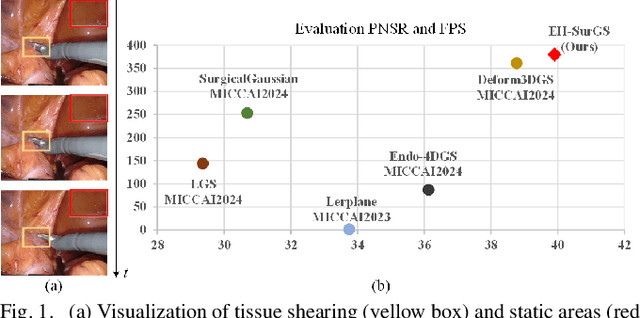
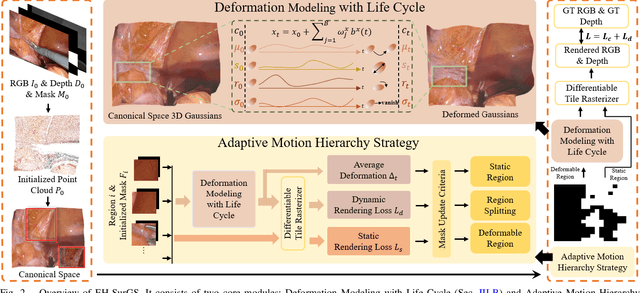
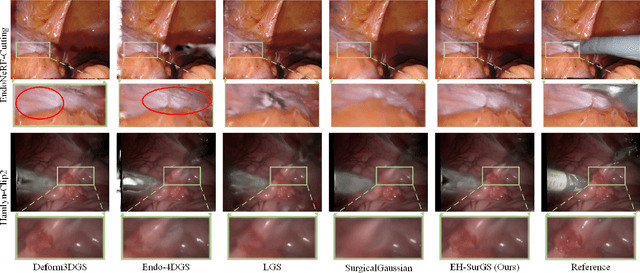

Efficient and high-fidelity reconstruction of deformable surgical scenes is a critical yet challenging task. Building on recent advancements in 3D Gaussian splatting, current methods have seen significant improvements in both reconstruction quality and rendering speed. However, two major limitations remain: (1) difficulty in handling irreversible dynamic changes, such as tissue shearing, which are common in surgical scenes; and (2) the lack of hierarchical modeling for surgical scene deformation, which reduces rendering speed. To address these challenges, we introduce EH-SurGS, an efficient and high-fidelity reconstruction algorithm for deformable surgical scenes. We propose a deformation modeling approach that incorporates the life cycle of 3D Gaussians, effectively capturing both regular and irreversible deformations, thus enhancing reconstruction quality. Additionally, we present an adaptive motion hierarchy strategy that distinguishes between static and deformable regions within the surgical scene. This strategy reduces the number of 3D Gaussians passing through the deformation field, thereby improving rendering speed. Extensive experiments demonstrate that our method surpasses existing state-of-the-art approaches in both reconstruction quality and rendering speed. Ablation studies further validate the effectiveness and necessity of our proposed components. We will open-source our code upon acceptance of the paper.