 Add to Chrome
 Add to Firefox
 Add to Edge
GaussianDWM++: Language-Grounded 3D Gaussian Driving World Model for Unified Scene Understanding, Editing, and Multi-Modal Generation
Aug 17, 2026
Driving World Models (DWMs) have recently advanced rapidly with generative models, yet most existing methods mainly focus on conditional scene generation and lack explicit 3D scene understanding, language-grounded reasoning, and controllable 4D editing capabilities. Moreover, commonly used point cloud, occupancy, or BEV representations make it difficult to achieve fine-grained alignment between textual information and the underlying 3D scene structure. To address these limitations, we propose a foundation-feature Gaussian driving world model that unifies scene understanding, language-grounded reasoning, controllable 4D editing, and multi-modal generation within a single framework. Specifically, we introduce a foundation-feature Gaussian tokenizer that directly distills Qwen/SigLIP visual-language features into 3D Gaussian primitives, building a compact open-vocabulary Gaussian semantic field. We further design a geometry-aware Gaussian adapter that combines importance-aware hierarchical selection with text-conditioned Perceiver-style cross-attention to aggregate dense Gaussian primitives into compact world tokens. To improve representation compatibility, we introduce a KL-based Gaussian--image distribution alignment objective that aligns Gaussian world tokens with foundation image tokens. Based on the aligned Gaussian representation, our framework further supports instruction-controllable scene editing, including weather-conditioned generation and dynamic vehicle manipulation. Extensive experiments on broader driving benchmarks demonstrate that our method achieves state-of-the-art performance across scene understanding, visual grounding, planning-oriented reasoning, and controllable 4D generation tasks. We will release the code and datasets publicly on Github.

GaussianDWM: 3D Gaussian Driving World Model for Unified Scene Understanding and Multi-Modal Generation
Dec 29, 2025Driving World Models (DWMs) have been developing rapidly with the advances of generative models. However, existing DWMs lack 3D scene understanding capabilities and can only generate content conditioned on input data, without the ability to interpret or reason about the driving environment. Moreover, current approaches represent 3D spatial information with point cloud or BEV features do not accurately align textual information with the underlying 3D scene. To address these limitations, we propose a novel unified DWM framework based on 3D Gaussian scene representation, which enables both 3D scene understanding and multi-modal scene generation, while also enabling contextual enrichment for understanding and generation tasks. Our approach directly aligns textual information with the 3D scene by embedding rich linguistic features into each Gaussian primitive, thereby achieving early modality alignment. In addition, we design a novel task-aware language-guided sampling strategy that removes redundant 3D Gaussians and injects accurate and compact 3D tokens into LLM. Furthermore, we design a dual-condition multi-modal generation model, where the information captured by our vision-language model is leveraged as a high-level language condition in combination with a low-level image condition, jointly guiding the multi-modal generation process. We conduct comprehensive studies on the nuScenes, and NuInteract datasets to validate the effectiveness of our framework. Our method achieves state-of-the-art performance. We will release the code publicly on GitHub https://github.com/dtc111111/GaussianDWM.
OmniDrive-R1: Reinforcement-driven Interleaved Multi-modal Chain-of-Thought for Trustworthy Vision-Language Autonomous Driving
Dec 16, 2025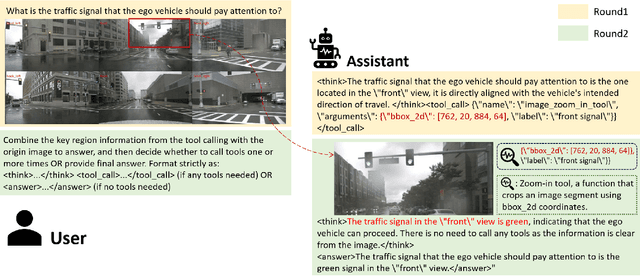
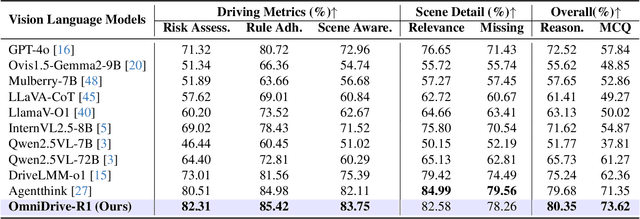
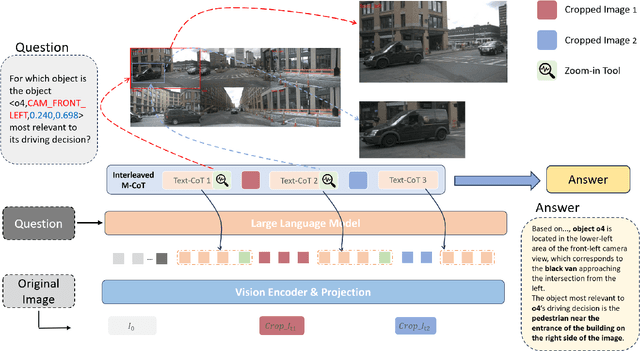

The deployment of Vision-Language Models (VLMs) in safety-critical domains like autonomous driving (AD) is critically hindered by reliability failures, most notably object hallucination. This failure stems from their reliance on ungrounded, text-based Chain-of-Thought (CoT) reasoning.While existing multi-modal CoT approaches attempt mitigation, they suffer from two fundamental flaws: (1) decoupled perception and reasoning stages that prevent end-to-end joint optimization, and (2) reliance on expensive, dense localization labels.Thus we introduce OmniDrive-R1, an end-to-end VLM framework designed for autonomous driving, which unifies perception and reasoning through an interleaved Multi-modal Chain-of-Thought (iMCoT) mechanism. Our core innovation is an Reinforcement-driven visual grounding capability, enabling the model to autonomously direct its attention and "zoom in" on critical regions for fine-grained analysis. This capability is enabled by our pure two-stage reinforcement learning training pipeline and Clip-GRPO algorithm. Crucially, Clip-GRPO introduces an annotation-free, process-based grounding reward. This reward not only eliminates the need for dense labels but also circumvents the instability of external tool calls by enforcing real-time cross-modal consistency between the visual focus and the textual reasoning. Extensive experiments on DriveLMM-o1 demonstrate our model's significant improvements. Compared to the baseline Qwen2.5VL-7B, OmniDrive-R1 improves the overall reasoning score from 51.77% to 80.35%, and the final answer accuracy from 37.81% to 73.62%.