 Add to Chrome
 Add to Firefox
 Add to Edge
What Patients Really Ask: Exploring the Effect of False Assumptions in Patient Information Seeking
Jan 22, 2026
Patients are increasingly using large language models (LLMs) to seek answers to their healthcare-related questions. However, benchmarking efforts in LLMs for question answering often focus on medical exam questions, which differ significantly in style and content from the questions patients actually raise in real life. To bridge this gap, we sourced data from Google's People Also Ask feature by querying the top 200 prescribed medications in the United States, curating a dataset of medical questions people commonly ask. A considerable portion of the collected questions contains incorrect assumptions and dangerous intentions. We demonstrate that the emergence of these corrupted questions is not uniformly random and depends heavily on the degree of incorrectness in the history of questions that led to their appearance. Current LLMs that perform strongly on other benchmarks struggle to identify incorrect assumptions in everyday questions.

MedRedFlag: Investigating how LLMs Redirect Misconceptions in Real-World Health Communication
Jan 14, 2026Real-world health questions from patients often unintentionally embed false assumptions or premises. In such cases, safe medical communication typically involves redirection: addressing the implicit misconception and then responding to the underlying patient context, rather than the original question. While large language models (LLMs) are increasingly being used by lay users for medical advice, they have not yet been tested for this crucial competency. Therefore, in this work, we investigate how LLMs react to false premises embedded within real-world health questions. We develop a semi-automated pipeline to curate MedRedFlag, a dataset of 1100+ questions sourced from Reddit that require redirection. We then systematically compare responses from state-of-the-art LLMs to those from clinicians. Our analysis reveals that LLMs often fail to redirect problematic questions, even when the problematic premise is detected, and provide answers that could lead to suboptimal medical decision making. Our benchmark and results reveal a novel and substantial gap in how LLMs perform under the conditions of real-world health communication, highlighting critical safety concerns for patient-facing medical AI systems. Code and dataset are available at https://github.com/srsambara-1/MedRedFlag.
Batch-of-Thought: Cross-Instance Learning for Enhanced LLM Reasoning
Jan 06, 2026Current Large Language Model reasoning systems process queries independently, discarding valuable cross-instance signals such as shared reasoning patterns and consistency constraints. We introduce Batch-of-Thought (BoT), a training-free method that processes related queries jointly to enable cross-instance learning. By performing comparative analysis across batches, BoT identifies high-quality reasoning templates, detects errors through consistency checks, and amortizes computational costs. We instantiate BoT within a multi-agent reflection architecture (BoT-R), where a Reflector performs joint evaluation to unlock mutual information gain unavailable in isolated processing. Experiments across three model families and six benchmarks demonstrate that BoT-R consistently improves accuracy and confidence calibration while reducing inference costs by up to 61%. Our theoretical and experimental analysis reveals when and why batch-aware reasoning benefits LLM systems.
Counting Clues: A Lightweight Probabilistic Baseline Can Match an LLM
Dec 14, 2025Large language models (LLMs) excel on multiple-choice clinical diagnosis benchmarks, yet it is unclear how much of this performance reflects underlying probabilistic reasoning. We study this through questions from MedQA, where the task is to select the most likely diagnosis. We introduce the Frequency-Based Probabilistic Ranker (FBPR), a lightweight method that scores options with a smoothed Naive Bayes over concept-diagnosis co-occurrence statistics from a large corpus. When co-occurrence statistics were sourced from the pretraining corpora for OLMo and Llama, FBPR achieves comparable performance to the corresponding LLMs pretrained on that same corpus. Direct LLM inference and FBPR largely get different questions correct, with an overlap only slightly above random chance, indicating complementary strengths of each method. These findings highlight the continued value of explicit probabilistic baselines: they provide a meaningful performance reference point and a complementary signal for potential hybridization. While the performance of LLMs seems to be driven by a mechanism other than simple frequency aggregation, we show that an approach similar to the historically grounded, low-complexity expert systems still accounts for a substantial portion of benchmark performance.
An Agentic AI System for Multi-Framework Communication Coding
Dec 09, 2025Clinical communication is central to patient outcomes, yet large-scale human annotation of patient-provider conversation remains labor-intensive, inconsistent, and difficult to scale. Existing approaches based on large language models typically rely on single-task models that lack adaptability, interpretability, and reliability, especially when applied across various communication frameworks and clinical domains. In this study, we developed a Multi-framework Structured Agentic AI system for Clinical Communication (MOSAIC), built on a LangGraph-based architecture that orchestrates four core agents, including a Plan Agent for codebook selection and workflow planning, an Update Agent for maintaining up-to-date retrieval databases, a set of Annotation Agents that applies codebook-guided retrieval-augmented generation (RAG) with dynamic few-shot prompting, and a Verification Agent that provides consistency checks and feedback. To evaluate performance, we compared MOSAIC outputs against gold-standard annotations created by trained human coders. We developed and evaluated MOSAIC using 26 gold standard annotated transcripts for training and 50 transcripts for testing, spanning rheumatology and OB/GYN domains. On the test set, MOSAIC achieved an overall F1 score of 0.928. Performance was highest in the Rheumatology subset (F1 = 0.962) and strongest for Patient Behavior (e.g., patients asking questions, expressing preferences, or showing assertiveness). Ablations revealed that MOSAIC outperforms baseline benchmarking.
"What's Up, Doc?": Analyzing How Users Seek Health Information in Large-Scale Conversational AI Datasets
Jun 26, 2025People are increasingly seeking healthcare information from large language models (LLMs) via interactive chatbots, yet the nature and inherent risks of these conversations remain largely unexplored. In this paper, we filter large-scale conversational AI datasets to achieve HealthChat-11K, a curated dataset of 11K real-world conversations composed of 25K user messages. We use HealthChat-11K and a clinician-driven taxonomy for how users interact with LLMs when seeking healthcare information in order to systematically study user interactions across 21 distinct health specialties. Our analysis reveals insights into the nature of how and why users seek health information, such as common interactions, instances of incomplete context, affective behaviors, and interactions (e.g., leading questions) that can induce sycophancy, underscoring the need for improvements in the healthcare support capabilities of LLMs deployed as conversational AI. Code and artifacts to retrieve our analyses and combine them into a curated dataset can be found here: https://github.com/yahskapar/HealthChat
Diagnosing our datasets: How does my language model learn clinical information?
May 21, 2025Large language models (LLMs) have performed well across various clinical natural language processing tasks, despite not being directly trained on electronic health record (EHR) data. In this work, we examine how popular open-source LLMs learn clinical information from large mined corpora through two crucial but understudied lenses: (1) their interpretation of clinical jargon, a foundational ability for understanding real-world clinical notes, and (2) their responses to unsupported medical claims. For both use cases, we investigate the frequency of relevant clinical information in their corresponding pretraining corpora, the relationship between pretraining data composition and model outputs, and the sources underlying this data. To isolate clinical jargon understanding, we evaluate LLMs on a new dataset MedLingo. Unsurprisingly, we find that the frequency of clinical jargon mentions across major pretraining corpora correlates with model performance. However, jargon frequently appearing in clinical notes often rarely appears in pretraining corpora, revealing a mismatch between available data and real-world usage. Similarly, we find that a non-negligible portion of documents support disputed claims that can then be parroted by models. Finally, we classified and analyzed the types of online sources in which clinical jargon and unsupported medical claims appear, with implications for future dataset composition.
Generative AI in Medicine
Dec 13, 2024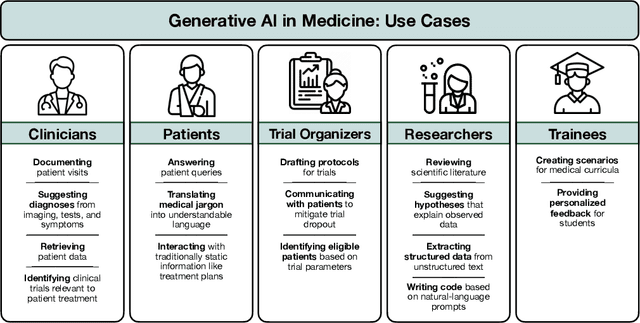
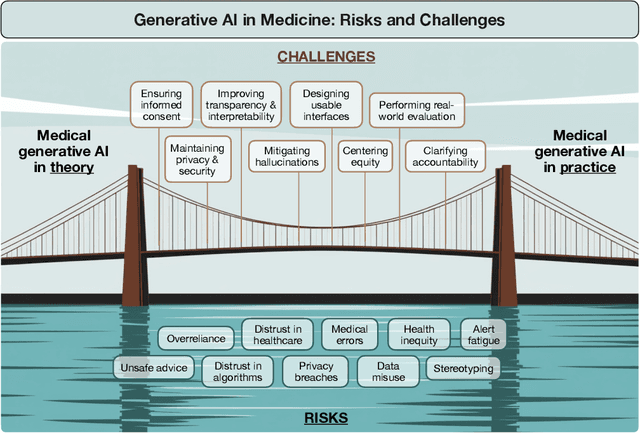
The increased capabilities of generative AI have dramatically expanded its possible use cases in medicine. We provide a comprehensive overview of generative AI use cases for clinicians, patients, clinical trial organizers, researchers, and trainees. We then discuss the many challenges -- including maintaining privacy and security, improving transparency and interpretability, upholding equity, and rigorously evaluating models -- which must be overcome to realize this potential, and the open research directions they give rise to.
Recent Advances, Applications, and Open Challenges in Machine Learning for Health: Reflections from Research Roundtables at ML4H 2023 Symposium
Mar 03, 2024The third ML4H symposium was held in person on December 10, 2023, in New Orleans, Louisiana, USA. The symposium included research roundtable sessions to foster discussions between participants and senior researchers on timely and relevant topics for the \ac{ML4H} community. Encouraged by the successful virtual roundtables in the previous year, we organized eleven in-person roundtables and four virtual roundtables at ML4H 2022. The organization of the research roundtables at the conference involved 17 Senior Chairs and 19 Junior Chairs across 11 tables. Each roundtable session included invited senior chairs (with substantial experience in the field), junior chairs (responsible for facilitating the discussion), and attendees from diverse backgrounds with interest in the session's topic. Herein we detail the organization process and compile takeaways from these roundtable discussions, including recent advances, applications, and open challenges for each topic. We conclude with a summary and lessons learned across all roundtables. This document serves as a comprehensive review paper, summarizing the recent advancements in machine learning for healthcare as contributed by foremost researchers in the field.
A Data-Centric Approach To Generate Faithful and High Quality Patient Summaries with Large Language Models
Feb 23, 2024


Patients often face difficulties in understanding their hospitalizations, while healthcare workers have limited resources to provide explanations. In this work, we investigate the potential of large language models to generate patient summaries based on doctors' notes and study the effect of training data on the faithfulness and quality of the generated summaries. To this end, we develop a rigorous labeling protocol for hallucinations, and have two medical experts annotate 100 real-world summaries and 100 generated summaries. We show that fine-tuning on hallucination-free data effectively reduces hallucinations from 2.60 to 1.55 per summary for Llama 2, while preserving relevant information. Although the effect is still present, it is much smaller for GPT-4 when prompted with five examples (0.70 to 0.40). We also conduct a qualitative evaluation using hallucination-free and improved training data. GPT-4 shows very good results even in the zero-shot setting. We find that common quantitative metrics do not correlate well with faithfulness and quality. Finally, we test GPT-4 for automatic hallucination detection, which yields promising results.