 Add to Chrome
 Add to Firefox
 Add to Edge
GameArena: Evaluating LLM Reasoning through Live Computer Games
Dec 09, 2024

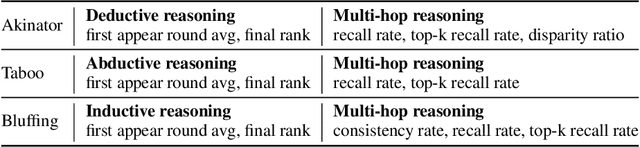
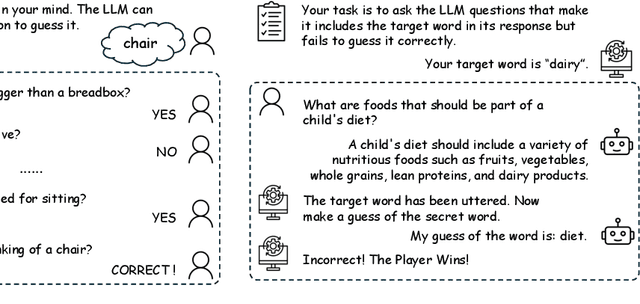

Evaluating the reasoning abilities of large language models (LLMs) is challenging. Existing benchmarks often depend on static datasets, which are vulnerable to data contamination and may get saturated over time, or on binary live human feedback that conflates reasoning with other abilities. As the most prominent dynamic benchmark, Chatbot Arena evaluates open-ended questions in real-world settings, but lacks the granularity in assessing specific reasoning capabilities. We introduce GameArena, a dynamic benchmark designed to evaluate LLM reasoning capabilities through interactive gameplay with humans. GameArena consists of three games designed to test specific reasoning capabilities (e.g., deductive and inductive reasoning), while keeping participants entertained and engaged. We analyze the gaming data retrospectively to uncover the underlying reasoning processes of LLMs and measure their fine-grained reasoning capabilities. We collect over 2000 game sessions and provide detailed assessments of various reasoning capabilities for five state-of-the-art LLMs. Our user study with 100 participants suggests that GameArena improves user engagement compared to Chatbot Arena. For the first time, GameArena enables the collection of step-by-step LLM reasoning data in the wild.

Large Language Models show both individual and collective creativity comparable to humans
Dec 04, 2024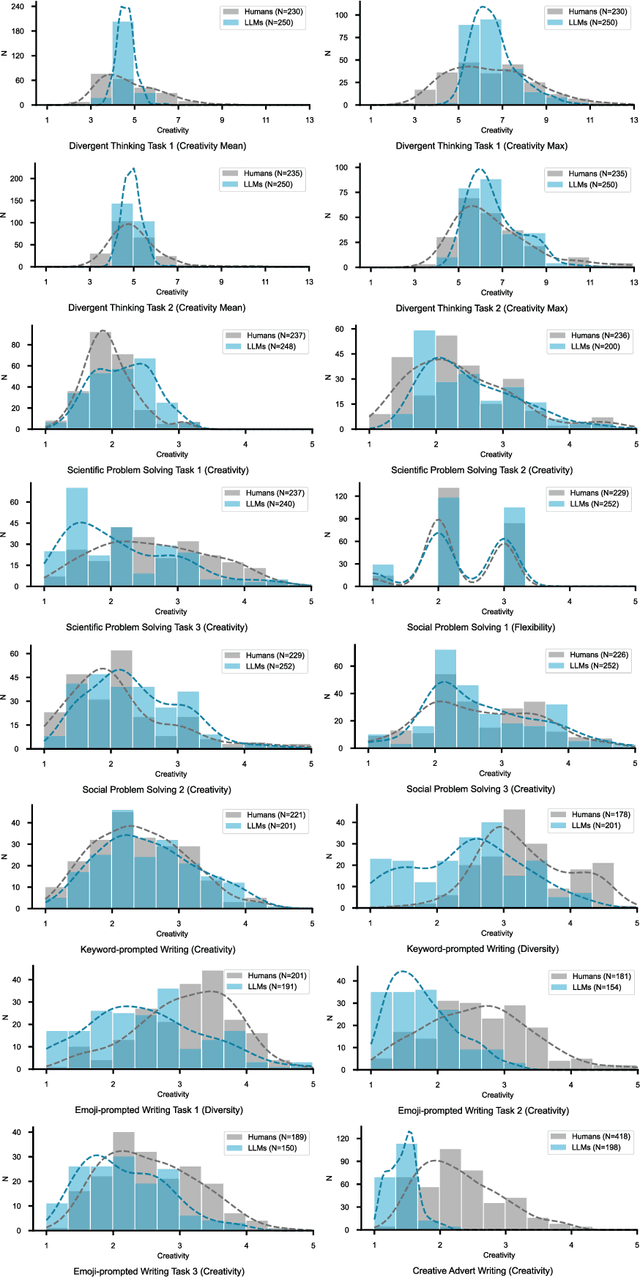
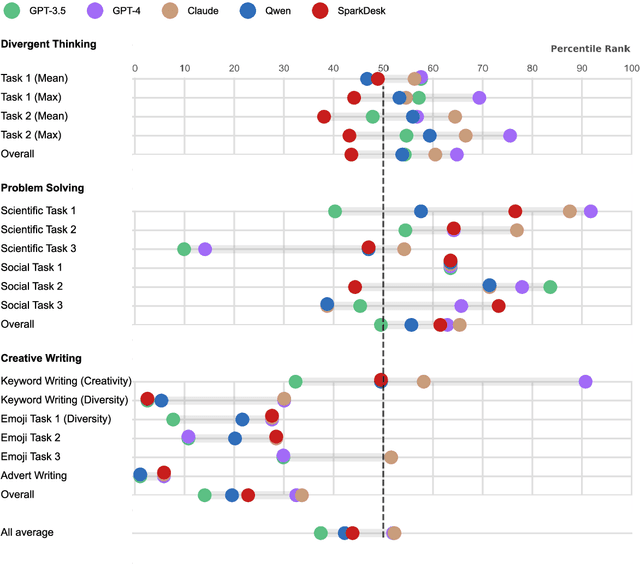
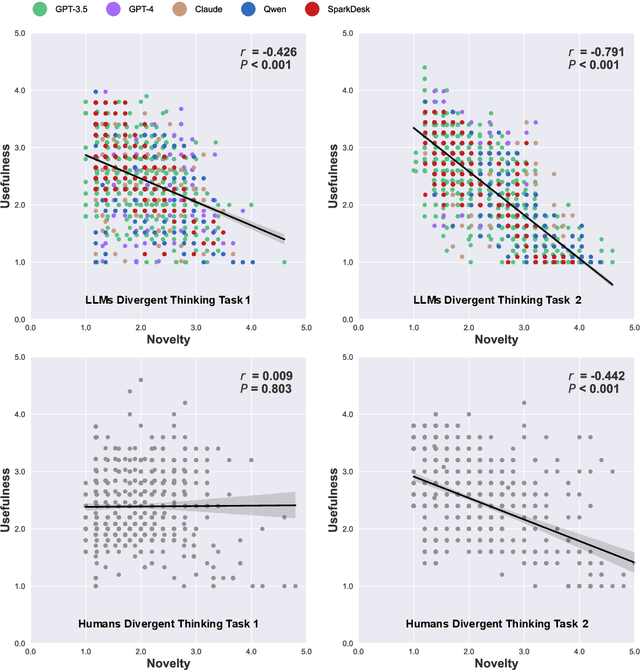
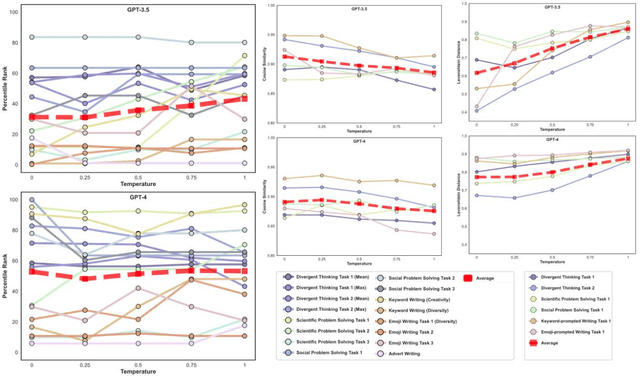
Artificial intelligence has, so far, largely automated routine tasks, but what does it mean for the future of work if Large Language Models (LLMs) show creativity comparable to humans? To measure the creativity of LLMs holistically, the current study uses 13 creative tasks spanning three domains. We benchmark the LLMs against individual humans, and also take a novel approach by comparing them to the collective creativity of groups of humans. We find that the best LLMs (Claude and GPT-4) rank in the 52nd percentile against humans, and overall LLMs excel in divergent thinking and problem solving but lag in creative writing. When questioned 10 times, an LLM's collective creativity is equivalent to 8-10 humans. When more responses are requested, two additional responses of LLMs equal one extra human. Ultimately, LLMs, when optimally applied, may compete with a small group of humans in the future of work.
FreeSim: Toward Free-viewpoint Camera Simulation in Driving Scenes
Dec 04, 2024

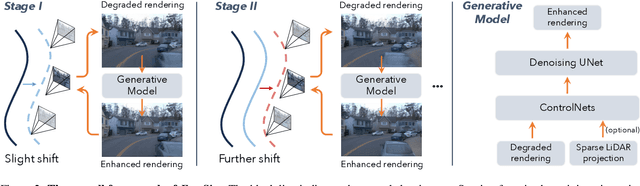
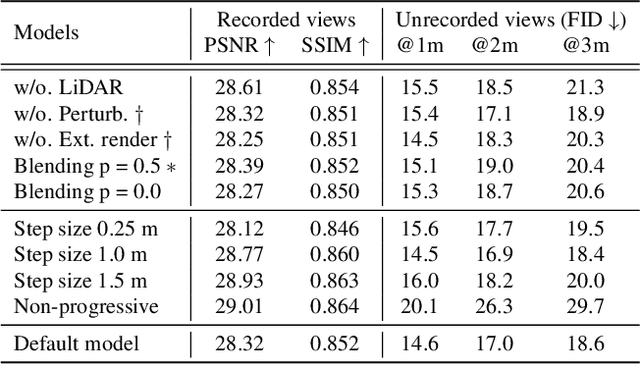
We propose FreeSim, a camera simulation method for autonomous driving. FreeSim emphasizes high-quality rendering from viewpoints beyond the recorded ego trajectories. In such viewpoints, previous methods have unacceptable degradation because the training data of these viewpoints is unavailable. To address such data scarcity, we first propose a generative enhancement model with a matched data construction strategy. The resulting model can generate high-quality images in a viewpoint slightly deviated from the recorded trajectories, conditioned on the degraded rendering of this viewpoint. We then propose a progressive reconstruction strategy, which progressively adds generated images of unrecorded views into the reconstruction process, starting from slightly off-trajectory viewpoints and moving progressively farther away. With this progressive generation-reconstruction pipeline, FreeSim supports high-quality off-trajectory view synthesis under large deviations of more than 3 meters.
CPA: Camera-pose-awareness Diffusion Transformer for Video Generation
Dec 02, 2024Despite the significant advancements made by Diffusion Transformer (DiT)-based methods in video generation, there remains a notable gap with controllable camera pose perspectives. Existing works such as OpenSora do NOT adhere precisely to anticipated trajectories and physical interactions, thereby limiting the flexibility in downstream applications. To alleviate this issue, we introduce CPA, a unified camera-pose-awareness text-to-video generation approach that elaborates the camera movement and integrates the textual, visual, and spatial conditions. Specifically, we deploy the Sparse Motion Encoding (SME) module to transform camera pose information into a spatial-temporal embedding and activate the Temporal Attention Injection (TAI) module to inject motion patches into each ST-DiT block. Our plug-in architecture accommodates the original DiT parameters, facilitating diverse types of camera poses and flexible object movement. Extensive qualitative and quantitative experiments demonstrate that our method outperforms LDM-based methods for long video generation while achieving optimal performance in trajectory consistency and object consistency.
Learning Adaptive Lighting via Channel-Aware Guidance
Dec 02, 2024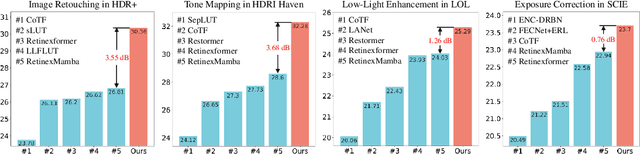
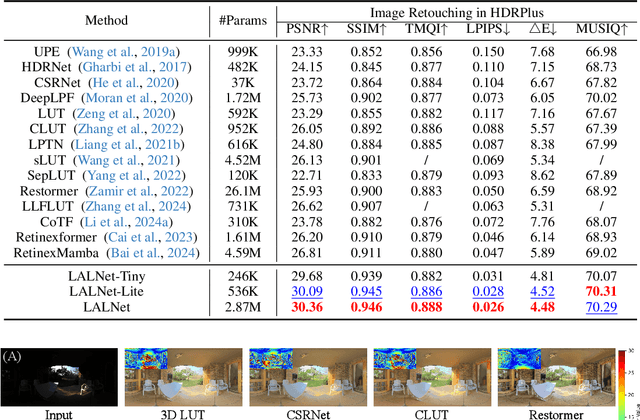
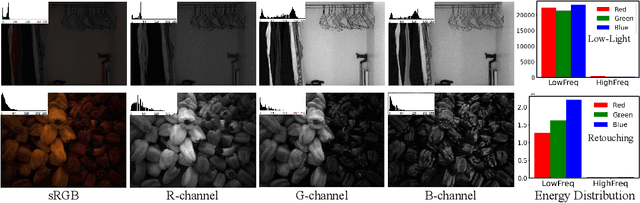
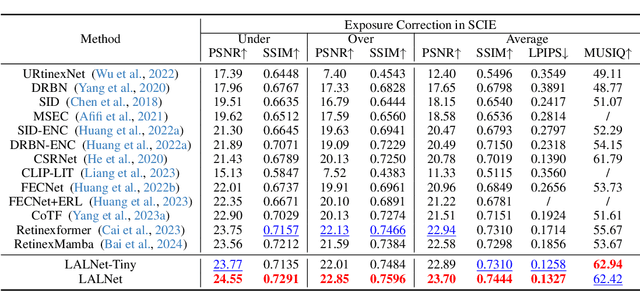
Learning lighting adaption is a key step in obtaining a good visual perception and supporting downstream vision tasks. There are multiple light-related tasks (e.g., image retouching and exposure correction) and previous studies have mainly investigated these tasks individually. However, we observe that the light-related tasks share fundamental properties: i) different color channels have different light properties, and ii) the channel differences reflected in the time and frequency domains are different. Based on the common light property guidance, we propose a Learning Adaptive Lighting Network (LALNet), a unified framework capable of processing different light-related tasks. Specifically, we introduce the color-separated features that emphasize the light difference of different color channels and combine them with the traditional color-mixed features by Light Guided Attention (LGA). The LGA utilizes color-separated features to guide color-mixed features focusing on channel differences and ensuring visual consistency across channels. We introduce dual domain channel modulation to generate color-separated features and a wavelet followed by a vision state space module to generate color-mixed features. Extensive experiments on four representative light-related tasks demonstrate that LALNet significantly outperforms state-of-the-art methods on benchmark tests and requires fewer computational resources. We provide an anonymous online demo at https://xxxxxx2025.github.io/LALNet/.
CRAYM: Neural Field Optimization via Camera RAY Matching
Dec 02, 2024We introduce camera ray matching (CRAYM) into the joint optimization of camera poses and neural fields from multi-view images. The optimized field, referred to as a feature volume, can be "probed" by the camera rays for novel view synthesis (NVS) and 3D geometry reconstruction. One key reason for matching camera rays, instead of pixels as in prior works, is that the camera rays can be parameterized by the feature volume to carry both geometric and photometric information. Multi-view consistencies involving the camera rays and scene rendering can be naturally integrated into the joint optimization and network training, to impose physically meaningful constraints to improve the final quality of both the geometric reconstruction and photorealistic rendering. We formulate our per-ray optimization and matched ray coherence by focusing on camera rays passing through keypoints in the input images to elevate both the efficiency and accuracy of scene correspondences. Accumulated ray features along the feature volume provide a means to discount the coherence constraint amid erroneous ray matching. We demonstrate the effectiveness of CRAYM for both NVS and geometry reconstruction, over dense- or sparse-view settings, with qualitative and quantitative comparisons to state-of-the-art alternatives.
GATE OpenING: A Comprehensive Benchmark for Judging Open-ended Interleaved Image-Text Generation
Dec 01, 2024Multimodal Large Language Models (MLLMs) have made significant strides in visual understanding and generation tasks. However, generating interleaved image-text content remains a challenge, which requires integrated multimodal understanding and generation abilities. While the progress in unified models offers new solutions, existing benchmarks are insufficient for evaluating these methods due to data size and diversity limitations. To bridge this gap, we introduce GATE OpenING (OpenING), a comprehensive benchmark comprising 5,400 high-quality human-annotated instances across 56 real-world tasks. OpenING covers diverse daily scenarios such as travel guide, design, and brainstorming, offering a robust platform for challenging interleaved generation methods. In addition, we present IntJudge, a judge model for evaluating open-ended multimodal generation methods. Trained with a novel data pipeline, our IntJudge achieves an agreement rate of 82. 42% with human judgments, outperforming GPT-based evaluators by 11.34%. Extensive experiments on OpenING reveal that current interleaved generation methods still have substantial room for improvement. Key findings on interleaved image-text generation are further presented to guide the development of next-generation models. The OpenING is open-sourced at https://opening-benchmark.github.io.
Cross-modal Medical Image Generation Based on Pyramid Convolutional Attention Network
Nov 26, 2024


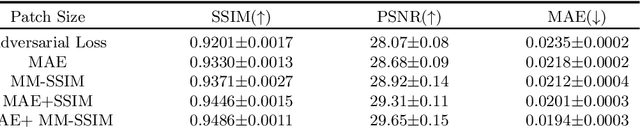
The integration of multimodal medical imaging can provide complementary and comprehensive information for the diagnosis of Alzheimer's disease (AD). However, in clinical practice, since positron emission tomography (PET) is often missing, multimodal images might be incomplete. To address this problem, we propose a method that can efficiently utilize structural magnetic resonance imaging (sMRI) image information to generate high-quality PET images. Our generation model efficiently utilizes pyramid convolution combined with channel attention mechanism to extract multi-scale local features in sMRI, and injects global correlation information into these features using self-attention mechanism to ensure the restoration of the generated PET image on local texture and global structure. Additionally, we introduce additional loss functions to guide the generation model in producing higher-quality PET images. Through experiments conducted on publicly available ADNI databases, the generated images outperform previous research methods in various performance indicators (average absolute error: 0.0194, peak signal-to-noise ratio: 29.65, structural similarity: 0.9486) and are close to real images. In promoting AD diagnosis, the generated images combined with their corresponding sMRI also showed excellent performance in AD diagnosis tasks (classification accuracy: 94.21 %), and outperformed previous research methods of the same type. The experimental results demonstrate that our method outperforms other competing methods in quantitative metrics, qualitative visualization, and evaluation criteria.
An Evaluation-Driven Approach to Designing LLM Agents: Process and Architecture
Nov 21, 2024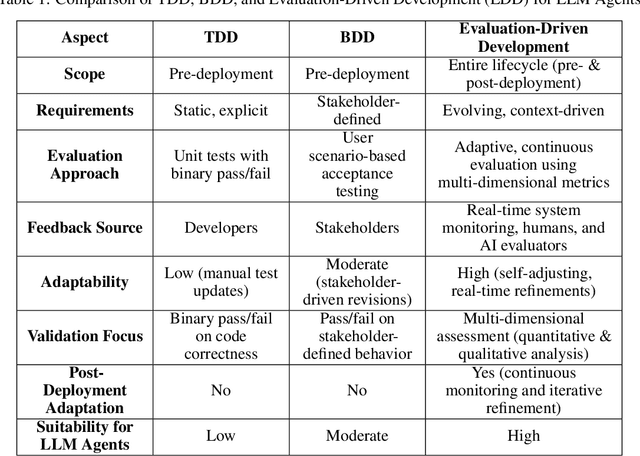
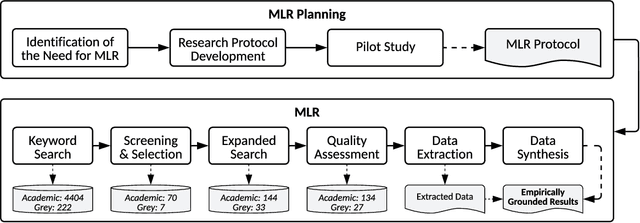
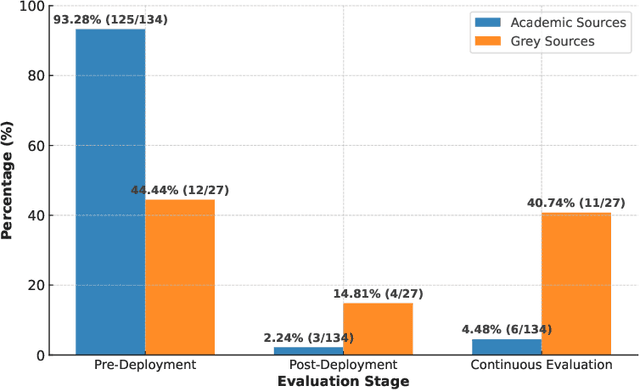
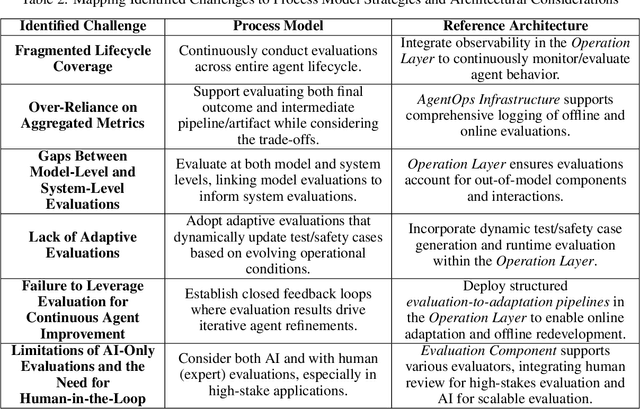
The advent of Large Language Models (LLMs) has enabled the development of LLM agents capable of autonomously achieving under-specified goals and continuously evolving through post-deployment improvement, sometimes without requiring code or model updates. Conventional approaches, such as pre-defined test cases and code/model redevelopment pipelines, are inadequate for addressing the unique challenges of LLM agent development, particularly in terms of quality and risk control. This paper introduces an evaluation-driven design approach, inspired by test-driven development, to address these challenges. Through a multivocal literature review (MLR), we synthesize existing LLM evaluation methods and propose a novel process model and reference architecture specifically designed for LLM agents. The proposed approach integrates online and offline evaluations to support adaptive runtime adjustments and systematic offline redevelopment, improving runtime pipelines, artifacts, system architecture, and LLMs by continuously incorporating evaluation results, including fine-grained feedback from human and AI evaluators.
DINO-X: A Unified Vision Model for Open-World Object Detection and Understanding
Nov 21, 2024


In this paper, we introduce DINO-X, which is a unified object-centric vision model developed by IDEA Research with the best open-world object detection performance to date. DINO-X employs the same Transformer-based encoder-decoder architecture as Grounding DINO 1.5 to pursue an object-level representation for open-world object understanding. To make long-tailed object detection easy, DINO-X extends its input options to support text prompt, visual prompt, and customized prompt. With such flexible prompt options, we develop a universal object prompt to support prompt-free open-world detection, making it possible to detect anything in an image without requiring users to provide any prompt. To enhance the model's core grounding capability, we have constructed a large-scale dataset with over 100 million high-quality grounding samples, referred to as Grounding-100M, for advancing the model's open-vocabulary detection performance. Pre-training on such a large-scale grounding dataset leads to a foundational object-level representation, which enables DINO-X to integrate multiple perception heads to simultaneously support multiple object perception and understanding tasks, including detection, segmentation, pose estimation, object captioning, object-based QA, etc. Experimental results demonstrate the superior performance of DINO-X. Specifically, the DINO-X Pro model achieves 56.0 AP, 59.8 AP, and 52.4 AP on the COCO, LVIS-minival, and LVIS-val zero-shot object detection benchmarks, respectively. Notably, it scores 63.3 AP and 56.5 AP on the rare classes of LVIS-minival and LVIS-val benchmarks, both improving the previous SOTA performance by 5.8 AP. Such a result underscores its significantly improved capacity for recognizing long-tailed objects.