 Add to Chrome
 Add to Firefox
 Add to Edge
Derail Yourself: Multi-turn LLM Jailbreak Attack through Self-discovered Clues
Oct 14, 2024


This study exposes the safety vulnerabilities of Large Language Models (LLMs) in multi-turn interactions, where malicious users can obscure harmful intents across several queries. We introduce ActorAttack, a novel multi-turn attack method inspired by actor-network theory, which models a network of semantically linked actors as attack clues to generate diverse and effective attack paths toward harmful targets. ActorAttack addresses two main challenges in multi-turn attacks: (1) concealing harmful intents by creating an innocuous conversation topic about the actor, and (2) uncovering diverse attack paths towards the same harmful target by leveraging LLMs' knowledge to specify the correlated actors as various attack clues. In this way, ActorAttack outperforms existing single-turn and multi-turn attack methods across advanced aligned LLMs, even for GPT-o1. We will publish a dataset called SafeMTData, which includes multi-turn adversarial prompts and safety alignment data, generated by ActorAttack. We demonstrate that models safety-tuned using our safety dataset are more robust to multi-turn attacks. Code is available at https://github.com/renqibing/ActorAttack.

Software Engineering and Foundation Models: Insights from Industry Blogs Using a Jury of Foundation Models
Oct 11, 2024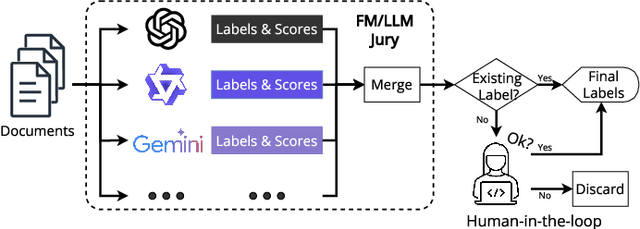
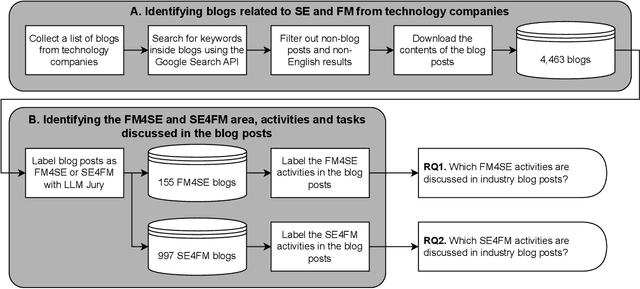
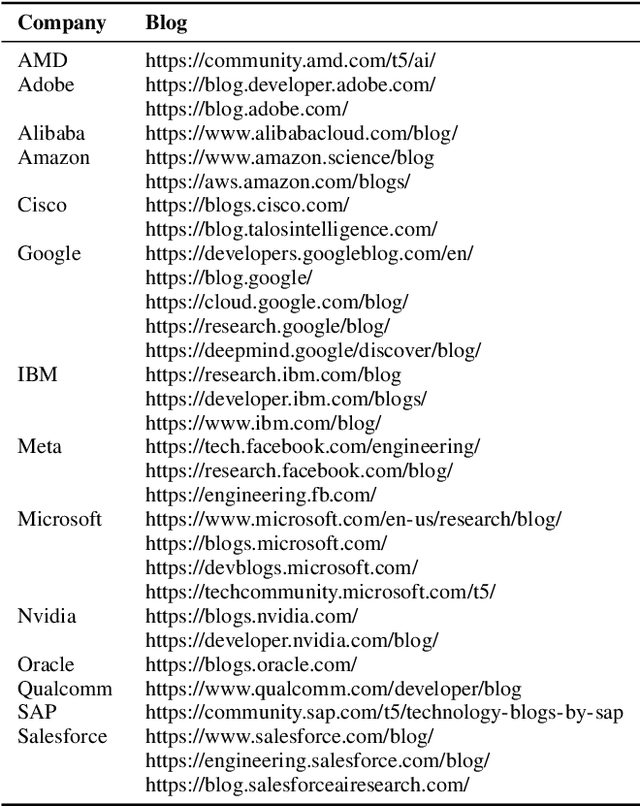
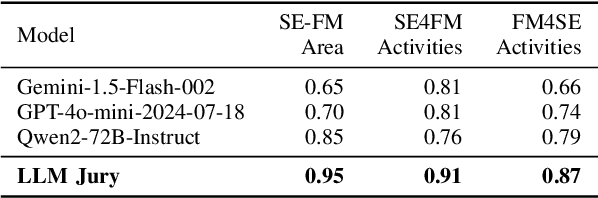
Foundation models (FMs) such as large language models (LLMs) have significantly impacted many fields, including software engineering (SE). The interaction between SE and FMs has led to the integration of FMs into SE practices (FM4SE) and the application of SE methodologies to FMs (SE4FM). While several literature surveys exist on academic contributions to these trends, we are the first to provide a practitioner's view. We analyze 155 FM4SE and 997 SE4FM blog posts from leading technology companies, leveraging an FM-powered surveying approach to systematically label and summarize the discussed activities and tasks. We observed that while code generation is the most prominent FM4SE task, FMs are leveraged for many other SE activities such as code understanding, summarization, and API recommendation. The majority of blog posts on SE4FM are about model deployment & operation, and system architecture & orchestration. Although the emphasis is on cloud deployments, there is a growing interest in compressing FMs and deploying them on smaller devices such as edge or mobile devices. We outline eight future research directions inspired by our gained insights, aiming to bridge the gap between academic findings and real-world applications. Our study not only enriches the body of knowledge on practical applications of FM4SE and SE4FM but also demonstrates the utility of FMs as a powerful and efficient approach in conducting literature surveys within technical and grey literature domains. Our dataset, results, code and used prompts can be found in our online replication package at https://github.com/SAILResearch/fmse-blogs.
CAS-GAN for Contrast-free Angiography Synthesis
Oct 11, 2024Iodinated contrast agents are widely utilized in numerous interventional procedures, yet posing substantial health risks to patients. This paper presents CAS-GAN, a novel GAN framework that serves as a ``virtual contrast agent" to synthesize X-ray angiographies via disentanglement representation learning and vessel semantic guidance, thereby reducing the reliance on iodinated agents during interventional procedures. Specifically, our approach disentangles X-ray angiographies into background and vessel components, leveraging medical prior knowledge. A specialized predictor then learns to map the interrelationships between these components. Additionally, a vessel semantic-guided generator and a corresponding loss function are introduced to enhance the visual fidelity of generated images. Experimental results on the XCAD dataset demonstrate the state-of-the-art performance of our CAS-GAN, achieving a FID of 5.94 and a MMD of 0.017. These promising results highlight CAS-GAN's potential for clinical applications.
Compressing high-resolution data through latent representation encoding for downscaling large-scale AI weather forecast model
Oct 10, 2024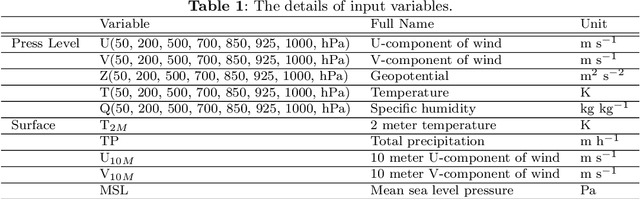
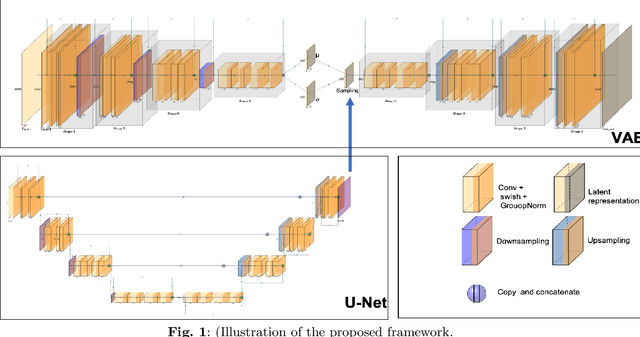

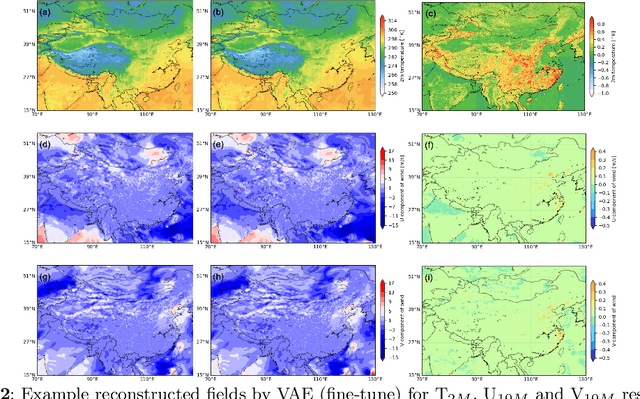
The rapid advancement of artificial intelligence (AI) in weather research has been driven by the ability to learn from large, high-dimensional datasets. However, this progress also poses significant challenges, particularly regarding the substantial costs associated with processing extensive data and the limitations of computational resources. Inspired by the Neural Image Compression (NIC) task in computer vision, this study seeks to compress weather data to address these challenges and enhance the efficiency of downstream applications. Specifically, we propose a variational autoencoder (VAE) framework tailored for compressing high-resolution datasets, specifically the High Resolution China Meteorological Administration Land Data Assimilation System (HRCLDAS) with a spatial resolution of 1 km. Our framework successfully reduced the storage size of 3 years of HRCLDAS data from 8.61 TB to just 204 GB, while preserving essential information. In addition, we demonstrated the utility of the compressed data through a downscaling task, where the model trained on the compressed dataset achieved accuracy comparable to that of the model trained on the original data. These results highlight the effectiveness and potential of the compressed data for future weather research.
Enhancing Playback Performance in Video Recommender Systems with an On-Device Gating and Ranking Framework
Oct 08, 2024Video recommender systems (RSs) have gained increasing attention in recent years. Existing mainstream RSs focus on optimizing the matching function between users and items. However, we noticed that users frequently encounter playback issues such as slow loading or stuttering while browsing the videos, especially in weak network conditions, which will lead to a subpar browsing experience, and may cause users to leave, even when the video content and recommendations are superior. It is quite a serious issue, yet easily overlooked. To tackle this issue, we propose an on-device Gating and Ranking Framework (GRF) that cooperates with server-side RS. Specifically, we utilize a gate model to identify videos that may have playback issues in real-time, and then we employ a ranking model to select the optimal result from a locally-cached pool to replace the stuttering videos. Our solution has been fully deployed on Kwai, a large-scale short video platform with hundreds of millions of users globally. Moreover, it significantly enhances video playback performance and improves overall user experience and retention rates.
Leverage Knowledge Graph and Large Language Model for Law Article Recommendation: A Case Study of Chinese Criminal Law
Oct 07, 2024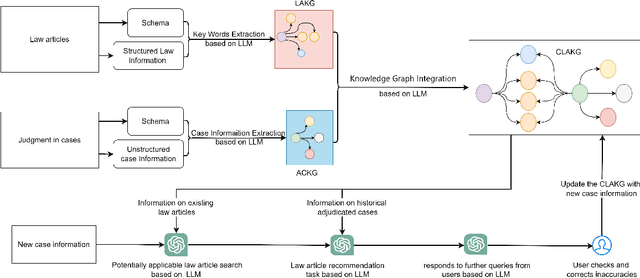
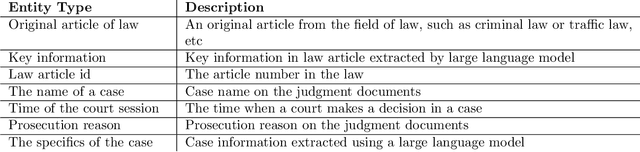
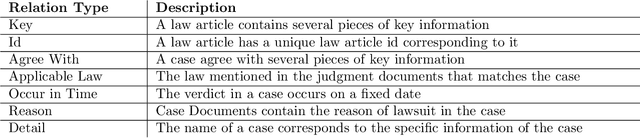
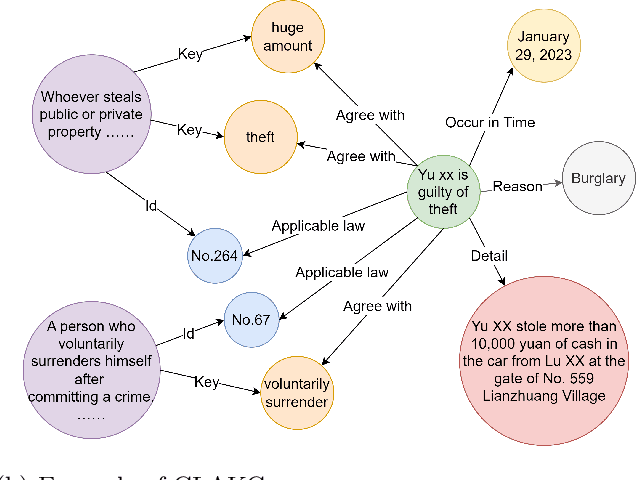
Court efficiency is vital for social stability. However, in most countries around the world, the grassroots courts face case backlogs, with decisions relying heavily on judicial personnel's cognitive labor, lacking intelligent tools to improve efficiency. To address this issue, we propose an efficient law article recommendation approach utilizing a Knowledge Graph (KG) and a Large Language Model (LLM). Firstly, we propose a Case-Enhanced Law Article Knowledge Graph (CLAKG) as a database to store current law statutes, historical case information, and correspondence between law articles and historical cases. Additionally, we introduce an automated CLAKG construction method based on LLM. On this basis, we propose a closed-loop law article recommendation method. Finally, through a series of experiments using judgment documents from the website "China Judgements Online", we have improved the accuracy of law article recommendation in cases from 0.549 to 0.694, demonstrating that our proposed method significantly outperforms baseline approaches.
AdaptDiff: Cross-Modality Domain Adaptation via Weak Conditional Semantic Diffusion for Retinal Vessel Segmentation
Oct 06, 2024Deep learning has shown remarkable performance in medical image segmentation. However, despite its promise, deep learning has many challenges in practice due to its inability to effectively transition to unseen domains, caused by the inherent data distribution shift and the lack of manual annotations to guide domain adaptation. To tackle this problem, we present an unsupervised domain adaptation (UDA) method named AdaptDiff that enables a retinal vessel segmentation network trained on fundus photography (FP) to produce satisfactory results on unseen modalities (e.g., OCT-A) without any manual labels. For all our target domains, we first adopt a segmentation model trained on the source domain to create pseudo-labels. With these pseudo-labels, we train a conditional semantic diffusion probabilistic model to represent the target domain distribution. Experimentally, we show that even with low quality pseudo-labels, the diffusion model can still capture the conditional semantic information. Subsequently, we sample on the target domain with binary vessel masks from the source domain to get paired data, i.e., target domain synthetic images conditioned on the binary vessel map. Finally, we fine-tune the pre-trained segmentation network using the synthetic paired data to mitigate the domain gap. We assess the effectiveness of AdaptDiff on seven publicly available datasets across three distinct modalities. Our results demonstrate a significant improvement in segmentation performance across all unseen datasets. Our code is publicly available at https://github.com/DeweiHu/AdaptDiff.
One-step Noisy Label Mitigation
Oct 02, 2024


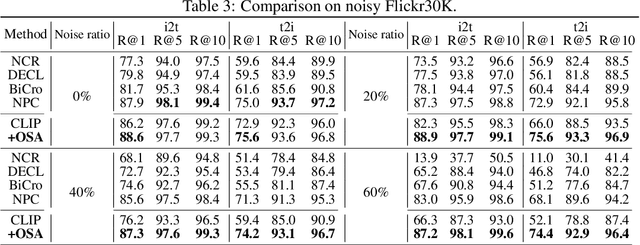
Mitigating the detrimental effects of noisy labels on the training process has become increasingly critical, as obtaining entirely clean or human-annotated samples for large-scale pre-training tasks is often impractical. Nonetheless, existing noise mitigation methods often encounter limitations in practical applications due to their task-specific design, model dependency, and significant computational overhead. In this work, we exploit the properties of high-dimensional orthogonality to identify a robust and effective boundary in cone space for separating clean and noisy samples. Building on this, we propose One-step Anti-Noise (OSA), a model-agnostic noisy label mitigation paradigm that employs an estimator model and a scoring function to assess the noise level of input pairs through just one-step inference, a cost-efficient process. We empirically demonstrate the superiority of OSA, highlighting its enhanced training robustness, improved task transferability, ease of deployment, and reduced computational costs across various benchmarks, models, and tasks. Our code is released at https://github.com/leolee99/OSA.
Multimodal LLM Enhanced Cross-lingual Cross-modal Retrieval
Sep 30, 2024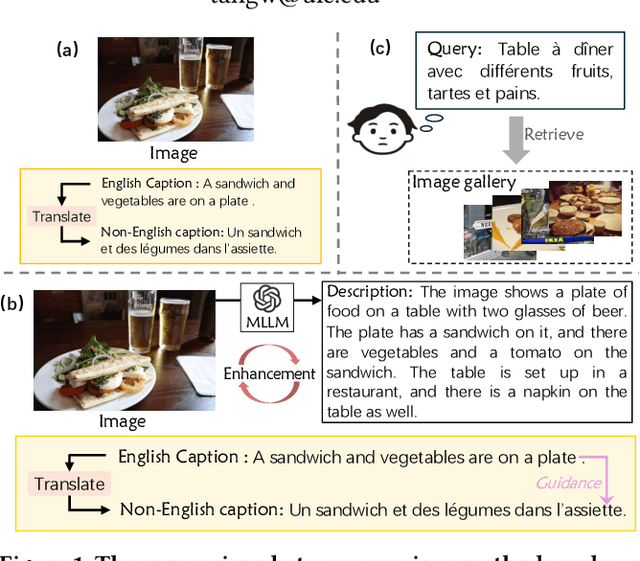


Cross-lingual cross-modal retrieval (CCR) aims to retrieve visually relevant content based on non-English queries, without relying on human-labeled cross-modal data pairs during training. One popular approach involves utilizing machine translation (MT) to create pseudo-parallel data pairs, establishing correspondence between visual and non-English textual data. However, aligning their representations poses challenges due to the significant semantic gap between vision and text, as well as the lower quality of non-English representations caused by pre-trained encoders and data noise. To overcome these challenges, we propose LECCR, a novel solution that incorporates the multi-modal large language model (MLLM) to improve the alignment between visual and non-English representations. Specifically, we first employ MLLM to generate detailed visual content descriptions and aggregate them into multi-view semantic slots that encapsulate different semantics. Then, we take these semantic slots as internal features and leverage them to interact with the visual features. By doing so, we enhance the semantic information within the visual features, narrowing the semantic gap between modalities and generating local visual semantics for subsequent multi-level matching. Additionally, to further enhance the alignment between visual and non-English features, we introduce softened matching under English guidance. This approach provides more comprehensive and reliable inter-modal correspondences between visual and non-English features. Extensive experiments on four CCR benchmarks, \ie Multi30K, MSCOCO, VATEX, and MSR-VTT-CN, demonstrate the effectiveness of our proposed method. Code: \url{https://github.com/LiJiaBei-7/leccr}.
HealthQ: Unveiling Questioning Capabilities of LLM Chains in Healthcare Conversations
Sep 28, 2024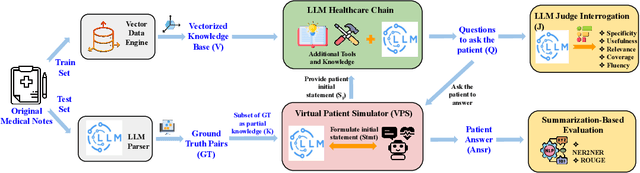


In digital healthcare, large language models (LLMs) have primarily been utilized to enhance question-answering capabilities and improve patient interactions. However, effective patient care necessitates LLM chains that can actively gather information by posing relevant questions. This paper presents HealthQ, a novel framework designed to evaluate the questioning capabilities of LLM healthcare chains. We implemented several LLM chains, including Retrieval-Augmented Generation (RAG), Chain of Thought (CoT), and reflective chains, and introduced an LLM judge to assess the relevance and informativeness of the generated questions. To validate HealthQ, we employed traditional Natural Language Processing (NLP) metrics such as Recall-Oriented Understudy for Gisting Evaluation (ROUGE) and Named Entity Recognition (NER)-based set comparison, and constructed two custom datasets from public medical note datasets, ChatDoctor and MTS-Dialog. Our contributions are threefold: we provide the first comprehensive study on the questioning capabilities of LLMs in healthcare conversations, develop a novel dataset generation pipeline, and propose a detailed evaluation methodology.