 Add to Chrome
 Add to Firefox
 Add to Edge
IMPA-Net: Meteorology-Aware Multi-Scale Attention and Dynamic Loss for Extreme Convective Radar Nowcasting
Apr 27, 2026
Short-range prediction of convective precipitation from weather radar observations is essential for severe weather warnings. However, deep learning models trained with pixel-wise error metrics tend to produce overly smooth forecasts that suppress intense echoes critical for hazard detection. This issue is exacerbated by insufficient multi-scale feature interaction and suboptimal fusion of heterogeneous geophysical inputs. We propose IMPA-Net (Integrated Multi-scale Predictive Attention Network), a deterministic 0-2 hour nowcasting framework that addresses these limitations through meteorologically-informed designs at the input, architecture, and loss function levels. A parameter-free Spatial Mixer reorganizes heterogeneous input channels at the mesoscale-$γ$ neighborhood (~2 km) via deterministic channel permutation, providing a structured cross-field prior. An integrated multi-scale predictive attention module serves as the spatiotemporal translator, capturing dynamics from mesoscale-$β$ to mesoscale-$γ$ scales. A Meteorologically-Aware Dynamic Loss employs three-level asymmetric weighting -- adapting across training epochs, storm intensity, and forecast lead time -- to counteract regression-to-the-mean. Evaluated against seven baselines on a multi-source radar dataset over eastern China, IMPA-Net raises the Heidke Skill Score at $\geq$45 dBZ from 0.049 (SimVP baseline) to 0.143 under matched settings. Relative to pySTEPS, it provides a better trade-off between severe-event detection and false-alarm control. Spectral analysis confirms preserved energy across mesoscale bands where competing methods show progressive smoothing. These improvements are shown within a single domain and convective regime; generalizability to other orographic and climatic regions remains to be tested.

Compressing high-resolution data through latent representation encoding for downscaling large-scale AI weather forecast model
Oct 10, 2024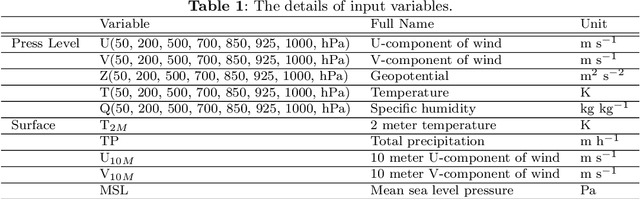
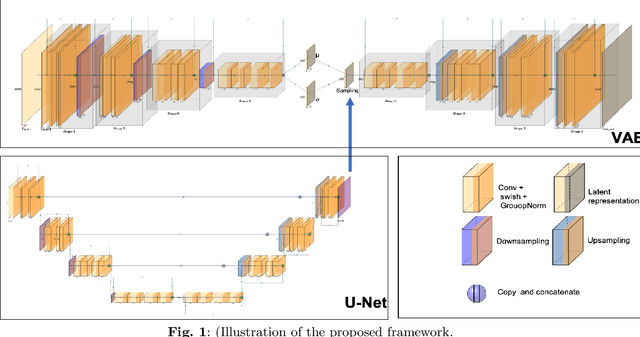

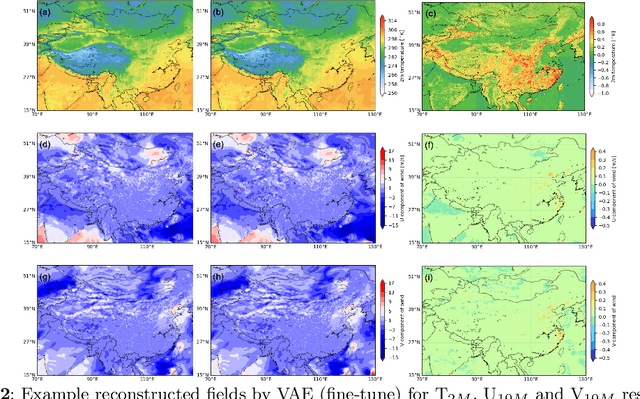
The rapid advancement of artificial intelligence (AI) in weather research has been driven by the ability to learn from large, high-dimensional datasets. However, this progress also poses significant challenges, particularly regarding the substantial costs associated with processing extensive data and the limitations of computational resources. Inspired by the Neural Image Compression (NIC) task in computer vision, this study seeks to compress weather data to address these challenges and enhance the efficiency of downstream applications. Specifically, we propose a variational autoencoder (VAE) framework tailored for compressing high-resolution datasets, specifically the High Resolution China Meteorological Administration Land Data Assimilation System (HRCLDAS) with a spatial resolution of 1 km. Our framework successfully reduced the storage size of 3 years of HRCLDAS data from 8.61 TB to just 204 GB, while preserving essential information. In addition, we demonstrated the utility of the compressed data through a downscaling task, where the model trained on the compressed dataset achieved accuracy comparable to that of the model trained on the original data. These results highlight the effectiveness and potential of the compressed data for future weather research.