 Add to Chrome
 Add to Firefox
 Add to Edge
Personalized Lower-limb Exoskeleton Assistance via Preference-based Bayesian Optimization
Aug 10, 2026
A significant challenge in exoskeleton robotics is the need to dynamically adapt control profiles to individual motion preferences, thereby ensuring both efficient and comfortable assistance. Currently, since user experience can serve as a comprehensive metric for evaluating the effectiveness of assistance, user preference-based optimization methods have been widely studied for parameter tuning. However, the existing methods rely heavily on extensive human-robot online interactions and suffer from slow optimization speed, which not only induces user fatigue but also compromises optimization effectiveness. Therefore, this paper aims to explore an efficient preference-based optimization framework for personalized exoskeleton assistance that can learn optimal parameters with minimal interaction. We propose a preference-based Bayesian optimization (PbBO) approach that can improve sample efficiency by leveraging knowledge about the sampling distribution of candidate sets. For optimizing six control parameters, PbBO can converge to user-preferred parameters with 90.7% validation accuracy via 20 iterations. Moreover, the hierarchical controller is designed to generate personalized torque for different tasks and achieve interaction torque tracking in real time. The results of treadmill and outdoor experiments demonstrate that the optimized parameters can reduce metabolic rate by 14.5%-15.4%, heart rate by 6.3%-7.6%, and muscle activation by 6.7%-31.5% compared to unassisted walking.

DINO-Med3D: Bridging Dimension and Domain Gaps in Volumetric Segmentation via Progressive Adaptation
Jun 17, 2026Although DINOv3 has demonstrated remarkable semantic discrimination in natural imagery, its direct application to volumetric medical segmentation is hindered by inherent dimension and domain disparities. To resolve these issues, we propose DINO-Med3D, a two-stage progressive framework that repurpose the pre-trained DINOv3 encoder for 3D medical tasks. In the first stage, we mitigate the dimension gap by introducing a multi-slice embedding module that incorporates pseudo-3D context, while simultaneously employing a segmentation proxy task to adapt representations learned from natural scenes to the medical domain. Subsequently, we further enhance volumetric understanding by adding lightweight 3D adapters into the frozen backbone to enforce global inter-slice continuity. Finally, to compensate for the spatial information loss inherent in the embedding process, we design a parallel detail recovery stream to explicitly preserve high-frequency boundary cues. Extensive experiments on five public datasets demonstrate that our approach successfully adapts DINOv3 to the medical domain and significantly outperforms state-of-the-art baselines.
ExoTraj: A General Lower-limb Exoskeleton Assistance Policy for Complex Environments
Jun 15, 2026Adaptive torque prediction in dynamic exoskeleton scenarios requires expensive motion capture systems, which are infeasible in complex outdoor environments. Trajectory prediction has emerged as one of the effective approaches to address such an issue. However, the core challenges of exoskeleton trajectory prediction are twofold: establishing the mapping from multi-modal features to trajectory information; constructing the mapping from trajectory to torque. For the former, most existing methods perform only single-step prediction and neglect inter-subject trajectory variability, thereby limiting the trajectory optimization space and prediction generalization. To address this, this paper proposes a fast flow matching method that enables accurate trajectory prediction and better generalization for real-time performance, where trajectory generation errors and encoded observations are used to guide the training direction. For the second challenge, due to the high dynamics of the human-robot system and the strong coupling between perception and control, simple control methods struggle to achieve efficient assistance based on the predicted trajectory. This paper utilizes model predictive control and designs a novel optimization objective to optimize torque, ensuring the exoskeleton achieves comfortable and robust assistance. By integrating the above two components, the unified policy, denoted as ExoTraj, is developed to enable adaptive assistance in complex outdoor scenarios without high data acquisition cost. Experimental results show that compared to traditional methods, ExoTraj reduces cross-subject prediction error by 14.0% during the online phase and maintains robustness against external noise. Relative to the zero torque condition, ExoTraj decreases metabolic rate by 11.5-24.4%, heart rate by 1.7-19.5%, and peak muscle activation levels by 10.9-41.3%, respectively.
Vascular anatomy-aware self-supervised pre-training for X-ray angiogram analysis
Feb 12, 2026X-ray angiography is the gold standard imaging modality for cardiovascular diseases. However, current deep learning approaches for X-ray angiogram analysis are severely constrained by the scarcity of annotated data. While large-scale self-supervised learning (SSL) has emerged as a promising solution, its potential in this domain remains largely unexplored, primarily due to the lack of effective SSL frameworks and large-scale datasets. To bridge this gap, we introduce a vascular anatomy-aware masked image modeling (VasoMIM) framework that explicitly integrates domain-specific anatomical knowledge. Specifically, VasoMIM comprises two key designs: an anatomy-guided masking strategy and an anatomical consistency loss. The former strategically masks vessel-containing patches to compel the model to learn robust vascular semantics, while the latter preserves structural consistency of vessels between original and reconstructed images, enhancing the discriminability of the learned representations. In conjunction with VasoMIM, we curate XA-170K, the largest X-ray angiogram pre-training dataset to date. We validate VasoMIM on four downstream tasks across six datasets, where it demonstrates superior transferability and achieves state-of-the-art performance compared to existing methods. These findings highlight the significant potential of VasoMIM as a foundation model for advancing a wide range of X-ray angiogram analysis tasks. VasoMIM and XA-170K will be available at https://github.com/Dxhuang-CASIA/XA-SSL.
HGATSolver: A Heterogeneous Graph Attention Solver for Fluid-Structure Interaction
Jan 14, 2026Fluid-structure interaction (FSI) systems involve distinct physical domains, fluid and solid, governed by different partial differential equations and coupled at a dynamic interface. While learning-based solvers offer a promising alternative to costly numerical simulations, existing methods struggle to capture the heterogeneous dynamics of FSI within a unified framework. This challenge is further exacerbated by inconsistencies in response across domains due to interface coupling and by disparities in learning difficulty across fluid and solid regions, leading to instability during prediction. To address these challenges, we propose the Heterogeneous Graph Attention Solver (HGATSolver). HGATSolver encodes the system as a heterogeneous graph, embedding physical structure directly into the model via distinct node and edge types for fluid, solid, and interface regions. This enables specialized message-passing mechanisms tailored to each physical domain. To stabilize explicit time stepping, we introduce a novel physics-conditioned gating mechanism that serves as a learnable, adaptive relaxation factor. Furthermore, an Inter-domain Gradient-Balancing Loss dynamically balances the optimization objectives across domains based on predictive uncertainty. Extensive experiments on two constructed FSI benchmarks and a public dataset demonstrate that HGATSolver achieves state-of-the-art performance, establishing an effective framework for surrogate modeling of coupled multi-physics systems.
Task-Oriented Learning for Automatic EEG Denoising
Sep 18, 2025Electroencephalography (EEG) denoising methods typically depend on manual intervention or clean reference signals. This work introduces a task-oriented learning framework for automatic EEG denoising that uses only task labels without clean reference signals. EEG recordings are first decomposed into components based on blind source separation (BSS) techniques. Then, a learning-based selector assigns a retention probability to each component, and the denoised signal is reconstructed as a probability-weighted combination. A downstream proxy-task model evaluates the reconstructed signal, with its task loss supervising the selector in a collaborative optimization scheme that relies solely on task labels, eliminating the need for clean EEG references. Experiments on three datasets spanning two paradigms and multiple noise conditions show consistent gains in both task performance (accuracy: $2.56\%\uparrow$) and standard signal-quality metrics (signal-to-noise-ratio: $0.82$\,dB\,$\uparrow$). Further analyses demonstrate that the task-oriented learning framework is algorithm-agnostic, as it accommodates diverse decomposition techniques and network backbones for both the selector and the proxy model. These promising results indicate that the proposed task-oriented learning framework is a practical EEG denoising solution with potential implications for neuroscience research and EEG-based interaction systems.
Parallels Between VLA Model Post-Training and Human Motor Learning: Progress, Challenges, and Trends
Jun 26, 2025Vision-language-action (VLA) models extend vision-language models (VLM) by integrating action generation modules for robotic manipulation. Leveraging strengths of VLM in vision perception and instruction understanding, VLA models exhibit promising generalization across diverse manipulation tasks. However, applications demanding high precision and accuracy reveal performance gaps without further adaptation. Evidence from multiple domains highlights the critical role of post-training to align foundational models with downstream applications, spurring extensive research on post-training VLA models. VLA model post-training aims to address the challenge of improving an embodiment's ability to interact with the environment for the given tasks, analogous to the process of humans motor skills acquisition. Accordingly, this paper reviews post-training strategies for VLA models through the lens of human motor learning, focusing on three dimensions: environments, embodiments, and tasks. A structured taxonomy is introduced aligned with human learning mechanisms: (1) enhancing environmental perception, (2) improving embodiment awareness, (3) deepening task comprehension, and (4) multi-component integration. Finally, key challenges and trends in post-training VLA models are identified, establishing a conceptual framework to guide future research. This work delivers both a comprehensive overview of current VLA model post-training methods from a human motor learning perspective and practical insights for VLA model development. (Project website: https://github.com/AoqunJin/Awesome-VLA-Post-Training)
CAS-IQA: Teaching Vision-Language Models for Synthetic Angiography Quality Assessment
May 23, 2025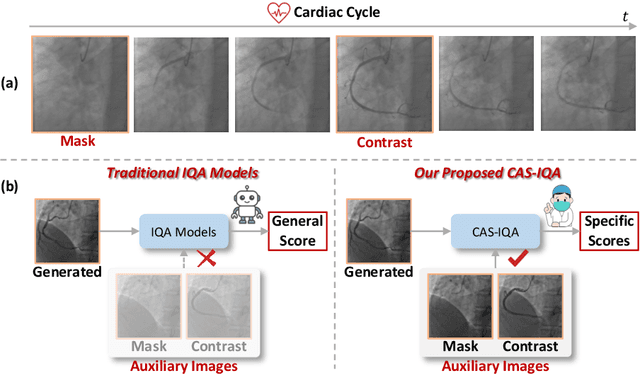
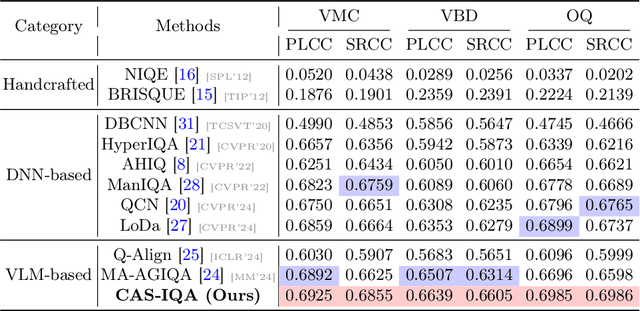
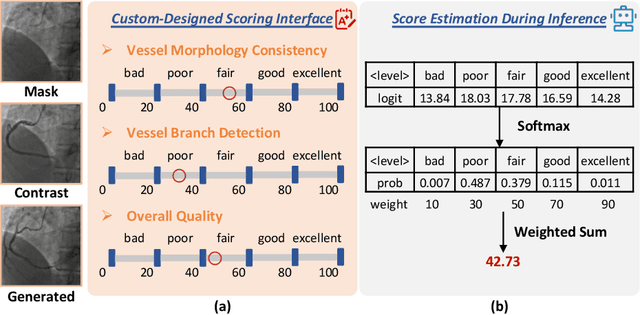

Synthetic X-ray angiographies generated by modern generative models hold great potential to reduce the use of contrast agents in vascular interventional procedures. However, low-quality synthetic angiographies can significantly increase procedural risk, underscoring the need for reliable image quality assessment (IQA) methods. Existing IQA models, however, fail to leverage auxiliary images as references during evaluation and lack fine-grained, task-specific metrics necessary for clinical relevance. To address these limitations, this paper proposes CAS-IQA, a vision-language model (VLM)-based framework that predicts fine-grained quality scores by effectively incorporating auxiliary information from related images. In the absence of angiography datasets, CAS-3K is constructed, comprising 3,565 synthetic angiographies along with score annotations. To ensure clinically meaningful assessment, three task-specific evaluation metrics are defined. Furthermore, a Multi-path featUre fuSion and rouTing (MUST) module is designed to enhance image representations by adaptively fusing and routing visual tokens to metric-specific branches. Extensive experiments on the CAS-3K dataset demonstrate that CAS-IQA significantly outperforms state-of-the-art IQA methods by a considerable margin.
Dexterous Manipulation through Imitation Learning: A Survey
Apr 04, 2025Dexterous manipulation, which refers to the ability of a robotic hand or multi-fingered end-effector to skillfully control, reorient, and manipulate objects through precise, coordinated finger movements and adaptive force modulation, enables complex interactions similar to human hand dexterity. With recent advances in robotics and machine learning, there is a growing demand for these systems to operate in complex and unstructured environments. Traditional model-based approaches struggle to generalize across tasks and object variations due to the high-dimensionality and complex contact dynamics of dexterous manipulation. Although model-free methods such as reinforcement learning (RL) show promise, they require extensive training, large-scale interaction data, and carefully designed rewards for stability and effectiveness. Imitation learning (IL) offers an alternative by allowing robots to acquire dexterous manipulation skills directly from expert demonstrations, capturing fine-grained coordination and contact dynamics while bypassing the need for explicit modeling and large-scale trial-and-error. This survey provides an overview of dexterous manipulation methods based on imitation learning (IL), details recent advances, and addresses key challenges in the field. Additionally, it explores potential research directions to enhance IL-driven dexterous manipulation. Our goal is to offer researchers and practitioners a comprehensive introduction to this rapidly evolving domain.
VLA Model-Expert Collaboration for Bi-directional Manipulation Learning
Mar 06, 2025The emergence of vision-language-action (VLA) models has given rise to foundation models for robot manipulation. Although these models have achieved significant improvements, their generalization in multi-task manipulation remains limited. This study proposes a VLA model-expert collaboration framework that leverages a limited number of expert actions to enhance VLA model performance. This approach reduces expert workload relative to manual operation while simultaneously improving the reliability and generalization of VLA models. Furthermore, manipulation data collected during collaboration can further refine the VLA model, while human participants concurrently enhance their skills. This bi-directional learning loop boosts the overall performance of the collaboration system. Experimental results across various VLA models demonstrate the effectiveness of the proposed system in collaborative manipulation and learning, as evidenced by improved success rates across tasks. Additionally, validation using a brain-computer interface (BCI) indicates that the collaboration system enhances the efficiency of low-speed action systems by involving VLA model during manipulation. These promising results pave the way for advancing human-robot interaction in the era of foundation models for robotics. (Project website: https://aoqunjin.github.io/Expert-VLA/)