 Add to Chrome
 Add to Firefox
 Add to Edge
FinProBench: Evaluating Financial AI Agents with Role-Grounded Rubrics Derived from Professional Deliverables
Aug 04, 2026
Evaluating financial AI agents requires criteria aligned with real professional work. Existing rubric methods typically derive criteria from task prompts or model outputs, overlooking tacit standards visible only in practitioner deliverables. We introduce FinProBench, a benchmark for professional financial tasks, and Role-Grounded Rubric Construction (RGRC), a reusable pipeline that derives rubrics from deliverables produced by practitioners in the same role. RGRC comprises four stages: Deliverable Collection, Competency Extraction, Rubric Synthesis, and Validation. Its rubrics capture tacit standards, distinguish quality levels, and transfer across tasks within a role. Before analysis, we classified 57 occupations by deliverable genre into 30 prior-rich conventional roles and 27 prior-sparse role-specialized roles. Across all roles, Prompt-only nearly matches RGRC for conventional roles (89.2% vs. 90.7%), but RGRC substantially outperforms it for role-specialized roles (99.1% vs. 78.0%). This split indicates that prompt engineering can approximate rubrics when conventions are well represented in model priors, while professional grounding is essential for standards beyond those priors. FinProBench is built from 1,723 curated deliverables spanning 57 occupations, 8 financial sub-industries, and 161 deliverable types, and releases an initial evaluation set of 20 complete tasks covering 20 roles in 7 sub-industries. With heterogeneous LLM judges and role-level rubrics, human deliverables rank first on average (73.7 vs. 70.3, 70.2, and 69.6 out of 100), while all four systems show overlapping 95% confidence intervals and complementary strengths. Reusing rubrics at the role level reduces estimated per-task construction effort by 6.7 times relative to authoring each rubric from scratch.

FinPerMA: A Theory-Informed, Event-Grounded Personalized-Memory Benchmark for LLM Agents
Aug 04, 2026Large language model (LLM) agents are increasingly used as personalized assistants in high-stakes domains such as financial advising, yet it remains unclear whether they can maintain and update an individualized user model over long horizons. Existing personalized-memory benchmarks primarily test factual retention or rely on weakly constrained model-generated trajectories, leaving event-driven preference adaptation underexplored. We introduce FinPerMA, an event-grounded benchmark that evaluates personalized memory against frozen longitudinal investor trajectories. Its generation pipeline combines deterministic, theory-informed impact rules, controlled LLM narration, and automated quality screening; a Post-Shock checkpoint isolates whether an agent has integrated a material event into its persistent user model. On 2,994 questions from 276 personas, seven frontier LLMs and up to seven memory configurations remain far from saturated: no full-context configuration exceeds approximately 0.47 overall accuracy or approximately 39% on multiple-choice questions. Attribution analysis shows that summary-based memory often preserves factual details while losing the preference signals needed for personalization; simple retrieval can therefore outperform purpose-built memory systems, with the gap widening after shocks.
BilliardPhys-Bench: Benchmarking Physical Reasoning and Visual Dynamics of Multimodal LLMs
May 29, 2026Current multimodal models handle static image recognition well, but intuitive physical reasoning remains a weakness. Predicting how objects will move and interact from a single image is still difficult for these systems. We present BilliardPhys-Bench, a benchmark for physical reasoning in synthetic billiards environments. Its procedural engine generates randomized scenarios with friction and elastic collisions. The benchmark tests three abilities: (1) predicting ball-to-ball collisions, (2) reasoning about wall bounces, and (3) estimating final ball positions after motion stops. We evaluate recent MLLMs from the GPT, Claude, Gemini, and Qwen families. Performance drops as simulation time increases and scene geometry grows more complex. We also observe a consistent failure mode we call "stasis bias": when the correct physical outcome is harder to infer, models tend to predict no interaction. These findings show where current MLLMs break down on visual dynamics and point toward the need for better physical inductive biases in multimodal architectures.
FeynmanBench: Benchmarking Multimodal LLMs on Diagrammatic Physics Reasoning
Apr 04, 2026Breakthroughs in frontier theory often depend on the combination of concrete diagrammatic notations with rigorous logic. While multimodal large language models (MLLMs) show promise in general scientific tasks, current benchmarks often focus on local information extraction rather than the global structural logic inherent in formal scientific notations. In this work, we introduce FeynmanBench, the first benchmark centered on Feynman diagram tasks. It is designed to evaluate AI's capacity for multistep diagrammatic reasoning, which requires satisfying conservation laws and symmetry constraints, identifying graph topology, converting between diagrammatic and algebraic representations, and constructing scattering amplitudes under specific conventions and gauges. To support large-scale and reproducible evaluation, we developed an automated pipeline producing diverse Feynman diagrams along with verifiable topological annotations and amplitude results. Our database spans the electromagnetic, weak, and strong interactions of the Standard Model, encompasses over 100 distinct types and includes more than 2000 tasks. Experiments on state-of-the-art MLLMs reveal systematic failure modes, including unstable enforcement of physical constraints and violations of global topological conditions, highlighting the need for physics-grounded benchmarks for visual reasoning over scientific notation. FeynmanBench provides a logically rigorous test of whether AI can effectively engage in scientific discovery, particularly within theoretical physics.
ResAdapt: Adaptive Resolution for Efficient Multimodal Reasoning
Mar 31, 2026Multimodal Large Language Models (MLLMs) achieve stronger visual understanding by scaling input fidelity, yet the resulting visual token growth makes jointly sustaining high spatial resolution and long temporal context prohibitive. We argue that the bottleneck lies not in how post-encoding representations are compressed but in the volume of pixels the encoder receives, and address it with ResAdapt, an Input-side adaptation framework that learns how much visual budget each frame should receive before encoding. ResAdapt couples a lightweight Allocator with an unchanged MLLM backbone, so the backbone retains its native visual-token interface while receiving an operator-transformed input. We formulate allocation as a contextual bandit and train the Allocator with Cost-Aware Policy Optimization (CAPO), which converts sparse rollout feedback into a stable accuracy-cost learning signal. Across budget-controlled video QA, temporal grounding, and image reasoning tasks, ResAdapt improves low-budget operating points and often lies on or near the efficiency-accuracy frontier, with the clearest gains on reasoning-intensive benchmarks under aggressive compression. Notably, ResAdapt supports up to 16x more frames at the same visual budget while delivering over 15% performance gain. Code is available at https://github.com/Xnhyacinth/ResAdapt.
SPM-Bench: Benchmarking Large Language Models for Scanning Probe Microscopy
Feb 26, 2026As LLMs achieved breakthroughs in general reasoning, their proficiency in specialized scientific domains reveals pronounced gaps in existing benchmarks due to data contamination, insufficient complexity, and prohibitive human labor costs. Here we present SPM-Bench, an original, PhD-level multimodal benchmark specifically designed for scanning probe microscopy (SPM). We propose a fully automated data synthesis pipeline that ensures both high authority and low-cost. By employing Anchor-Gated Sieve (AGS) technology, we efficiently extract high-value image-text pairs from arXiv and journal papers published between 2023 and 2025. Through a hybrid cloud-local architecture where VLMs return only spatial coordinates "llbox" for local high-fidelity cropping, our pipeline achieves extreme token savings while maintaining high dataset purity. To accurately and objectively evaluate the performance of the LLMs, we introduce the Strict Imperfection Penalty F1 (SIP-F1) score. This metric not only establishes a rigorous capability hierarchy but also, for the first time, quantifies model "personalities" (Conservative, Aggressive, Gambler, or Wise). By correlating these results with model-reported confidence and perceived difficulty, we expose the true reasoning boundaries of current AI in complex physical scenarios. These insights establish SPM-Bench as a generalizable paradigm for automated scientific data synthesis.
HLE-Verified: A Systematic Verification and Structured Revision of Humanity's Last Exam
Feb 17, 2026Humanity's Last Exam (HLE) has become a widely used benchmark for evaluating frontier large language models on challenging, multi-domain questions. However, community-led analyses have raised concerns that HLE contains a non-trivial number of noisy items, which can bias evaluation results and distort cross-model comparisons. To address this challenge, we introduce HLE-Verified, a verified and revised version of HLE with a transparent verification protocol and fine-grained error taxonomy. Our construction follows a two-stage validation-and-repair workflow resulting in a certified benchmark. In Stage I, each item undergoes binary validation of the problem and final answer through domain-expert review and model-based cross-checks, yielding 641 verified items. In Stage II, flawed but fixable items are revised under strict constraints preserving the original evaluation intent, through dual independent expert repairs, model-assisted auditing, and final adjudication, resulting in 1,170 revised-and-certified items. The remaining 689 items are released as a documented uncertain set with explicit uncertainty sources and expertise tags for future refinement. We evaluate seven state-of-the-art language models on HLE and HLE-Verified, observing an average absolute accuracy gain of 7--10 percentage points on HLE-Verified. The improvement is particularly pronounced on items where the original problem statement and/or reference answer is erroneous, with gains of 30--40 percentage points. Our analyses further reveal a strong association between model confidence and the presence of errors in the problem statement or reference answer, supporting the effectiveness of our revisions. Overall, HLE-Verified improves HLE-style evaluations by reducing annotation noise and enabling more faithful measurement of model capabilities. Data is available at: https://github.com/SKYLENAGE-AI/HLE-Verified
MMSF: Multitask and Multimodal Supervised Framework for WSI Classification and Survival Analysis
Jan 28, 2026Multimodal evidence is critical in computational pathology: gigapixel whole slide images capture tumor morphology, while patient-level clinical descriptors preserve complementary context for prognosis. Integrating such heterogeneous signals remains challenging because feature spaces exhibit distinct statistics and scales. We introduce MMSF, a multitask and multimodal supervised framework built on a linear-complexity MIL backbone that explicitly decomposes and fuses cross-modal information. MMSF comprises a graph feature extraction module embedding tissue topology at the patch level, a clinical data embedding module standardizing patient attributes, a feature fusion module aligning modality-shared and modality-specific representations, and a Mamba-based MIL encoder with multitask prediction heads. Experiments on CAMELYON16 and TCGA-NSCLC demonstrate 2.1--6.6\% accuracy and 2.2--6.9\% AUC improvements over competitive baselines, while evaluations on five TCGA survival cohorts yield 7.1--9.8\% C-index improvements compared with unimodal methods and 5.6--7.1\% over multimodal alternatives.
The Geometric Reasoner: Manifold-Informed Latent Foresight Search for Long-Context Reasoning
Jan 25, 2026Scaling test-time compute enhances long chain-of-thought (CoT) reasoning, yet existing approaches face a fundamental trade-off between computational cost and coverage quality: either incurring high training expense or yielding redundant trajectories. We introduce The Geometric Reasoner (TGR), a training-free framework that performs manifold-informed latent foresight search under strict memory bounds. At each chunk boundary, TGR scores candidate latent anchors via a lightweight look-ahead estimate combined with soft geometric regularizers that encourage smooth trajectories and diverse exploration. Chunk-wise KV cache resets keep memory linear in chunk length. On challenging math and code benchmarks, TGR improves robust trajectory coverage, measured by the area under the Pass@$k$ curve (AUC), by up to 13 points on Qwen3-8B, with negligible overhead of about 1.1--1.3 times.
Solar PV Installation Potential Assessment on Building Facades Based on Vision and Language Foundation Models
Oct 01, 2025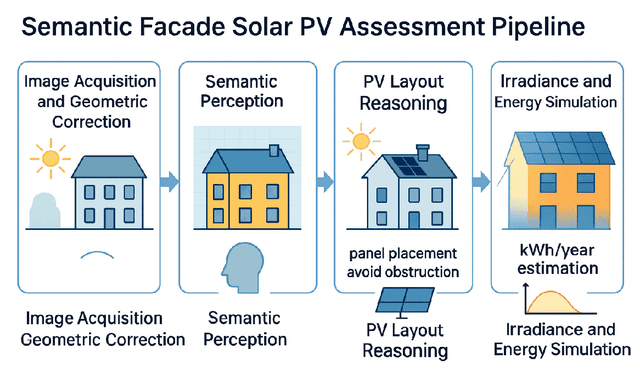
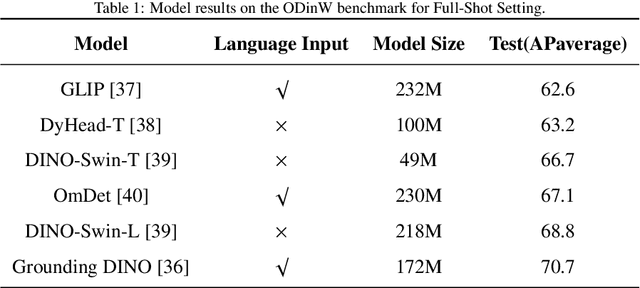
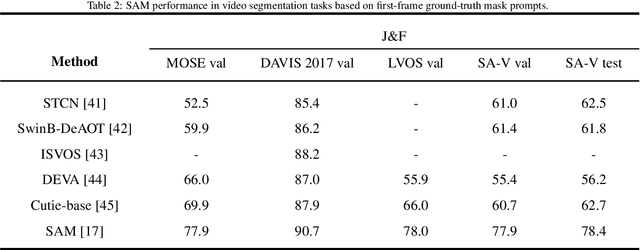
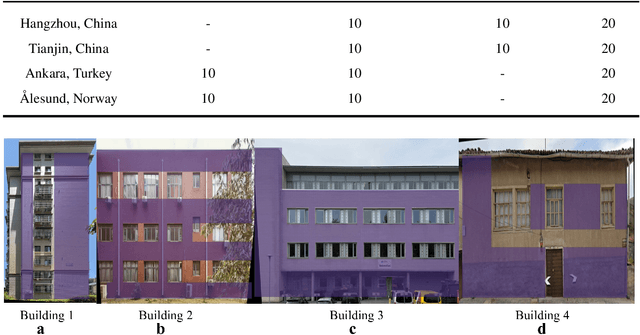
Building facades represent a significant untapped resource for solar energy generation in dense urban environments, yet assessing their photovoltaic (PV) potential remains challenging due to complex geometries and semantic com ponents. This study introduces SF-SPA (Semantic Facade Solar-PV Assessment), an automated framework that transforms street-view photographs into quantitative PV deployment assessments. The approach combines com puter vision and artificial intelligence techniques to address three key challenges: perspective distortion correction, semantic understanding of facade elements, and spatial reasoning for PV layout optimization. Our four-stage pipeline processes images through geometric rectification, zero-shot semantic segmentation, Large Language Model (LLM) guided spatial reasoning, and energy simulation. Validation across 80 buildings in four countries demonstrates ro bust performance with mean area estimation errors of 6.2% ± 2.8% compared to expert annotations. The auto mated assessment requires approximately 100 seconds per building, a substantial gain in efficiency over manual methods. Simulated energy yield predictions confirm the method's reliability and applicability for regional poten tial studies, urban energy planning, and building-integrated photovoltaic (BIPV) deployment. Code is available at: https:github.com/CodeAXu/Solar-PV-Installation