 Add to Chrome
 Add to Firefox
 Add to Edge
VQ-VAE Based Digital Semantic Communication with Importance-Aware OFDM Transmission
Aug 12, 2025
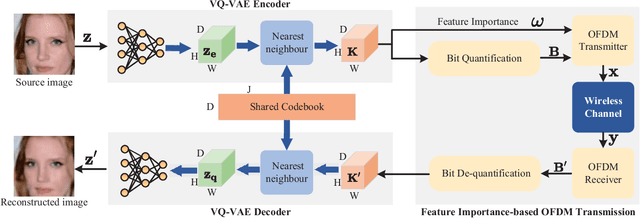
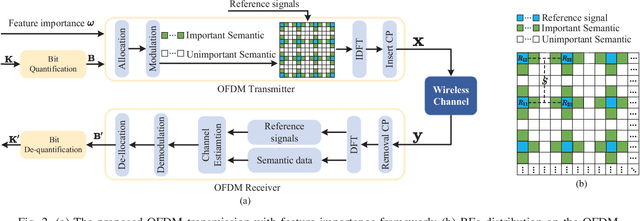
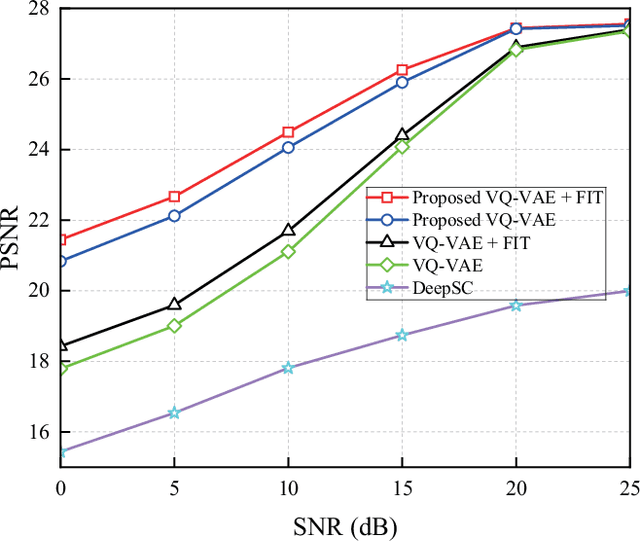
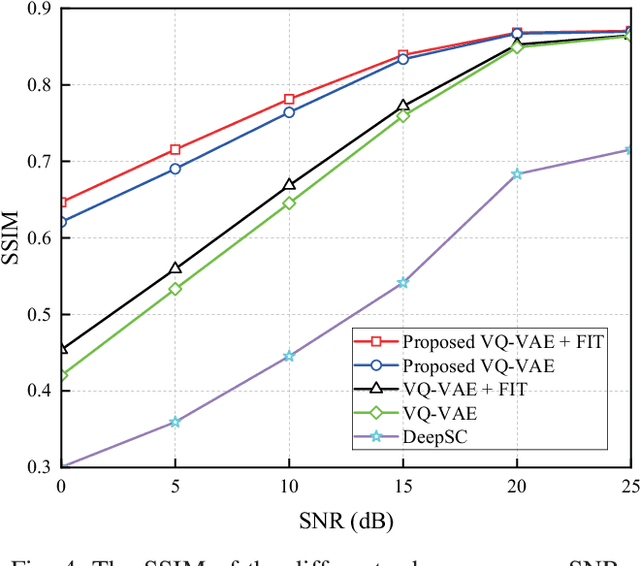
Semantic communication (SemCom) significantly reduces redundant data and improves transmission efficiency by extracting the latent features of information. However, most of the conventional deep learning-based SemCom systems focus on analog transmission and lack in compatibility with practical digital communications. This paper proposes a vector quantized-variational autoencoder (VQ-VAE) based digital SemCom system that directly transmits the semantic features and incorporates the importance-aware orthogonal frequency division multiplexing (OFDM) transmission to enhance the SemCom performance, where the VQ-VAE generates a discrete codebook shared between the transmitter and receiver. At transmitter, the latent semantic features are firstly extracted by VQ-VAE, and then the shared codebook is adopted to match these features, which are subsequently transformed into a discrete version to adapt the digital transmission. To protect the semantic information, an importance-aware OFDM transmission strategy is proposed to allocate the key features near the OFDM reference signals, where the feature importance is derived from the gradient-based method. At the receiver, the features are rematched with the shared codebook to further correct errors. Finally, experimental results demonstrate that our proposed scheme outperforms the conventional DeepSC and achieves better reconstruction performance under low SNR region.

Learned Regularization for Microwave Tomography
Aug 11, 2025Microwave Tomography (MWT) aims to reconstruct the dielectric properties of tissues from measured scattered electromagnetic fields. This inverse problem is highly nonlinear and ill-posed, posing significant challenges for conventional optimization-based methods, which, despite being grounded in physical models, often fail to recover fine structural details. Recent deep learning strategies, including end-to-end and post-processing networks, have improved reconstruction quality but typically require large paired training datasets and may struggle to generalize. To overcome these limitations, we propose a physics-informed hybrid framework that integrates diffusion models as learned regularization within a data-consistency-driven variational scheme. Specifically, we introduce Single-Step Diffusion Regularization (SSD-Reg), a novel approach that embeds diffusion priors into the iterative reconstruction process, enabling the recovery of complex anatomical structures without the need for paired data. SSD-Reg maintains fidelity to both the governing physics and learned structural distributions, improving accuracy, stability, and robustness. Extensive experiments demonstrate that SSD-Reg, implemented as a Plug-and-Play (PnP) module, provides a flexible and effective solution for tackling the ill-posedness inherent in functional image reconstruction.
ODYSSEY: Open-World Quadrupeds Exploration and Manipulation for Long-Horizon Tasks
Aug 11, 2025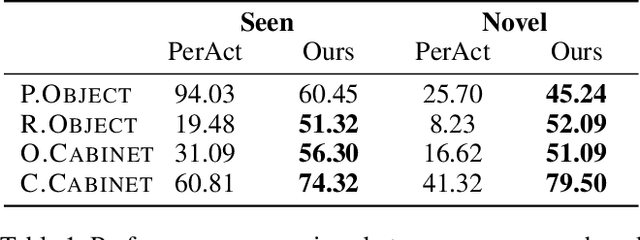
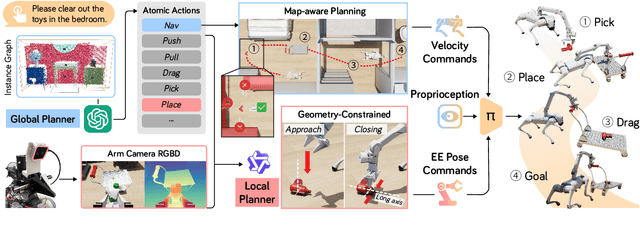

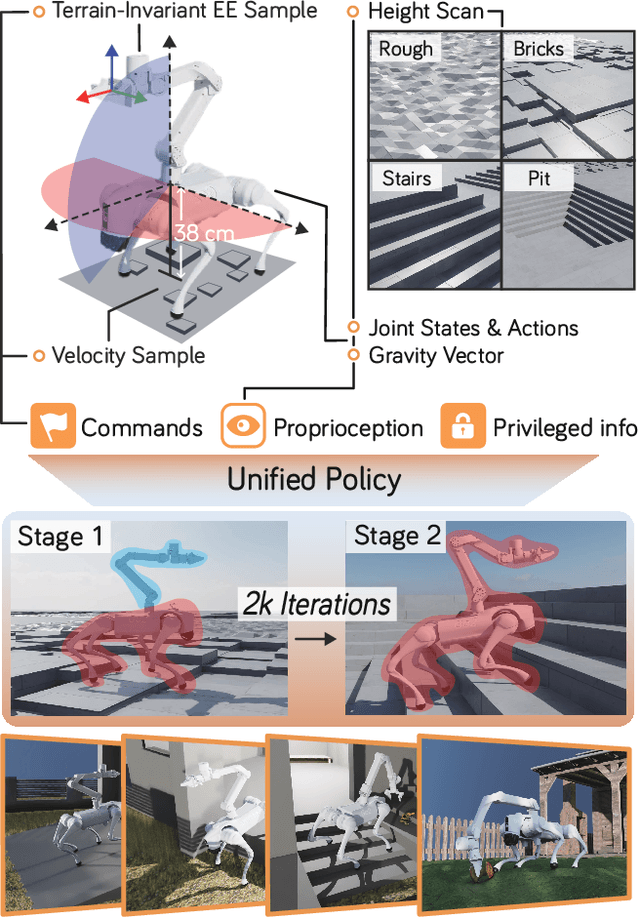
Language-guided long-horizon mobile manipulation has long been a grand challenge in embodied semantic reasoning, generalizable manipulation, and adaptive locomotion. Three fundamental limitations hinder progress: First, although large language models have improved spatial reasoning and task planning through semantic priors, existing implementations remain confined to tabletop scenarios, failing to address the constrained perception and limited actuation ranges of mobile platforms. Second, current manipulation strategies exhibit insufficient generalization when confronted with the diverse object configurations encountered in open-world environments. Third, while crucial for practical deployment, the dual requirement of maintaining high platform maneuverability alongside precise end-effector control in unstructured settings remains understudied. In this work, we present ODYSSEY, a unified mobile manipulation framework for agile quadruped robots equipped with manipulators, which seamlessly integrates high-level task planning with low-level whole-body control. To address the challenge of egocentric perception in language-conditioned tasks, we introduce a hierarchical planner powered by a vision-language model, enabling long-horizon instruction decomposition and precise action execution. At the control level, our novel whole-body policy achieves robust coordination across challenging terrains. We further present the first benchmark for long-horizon mobile manipulation, evaluating diverse indoor and outdoor scenarios. Through successful sim-to-real transfer, we demonstrate the system's generalization and robustness in real-world deployments, underscoring the practicality of legged manipulators in unstructured environments. Our work advances the feasibility of generalized robotic assistants capable of complex, dynamic tasks. Our project page: https://kaijwang.github.io/odyssey.github.io/
Generative Video Matting
Aug 11, 2025Video matting has traditionally been limited by the lack of high-quality ground-truth data. Most existing video matting datasets provide only human-annotated imperfect alpha and foreground annotations, which must be composited to background images or videos during the training stage. Thus, the generalization capability of previous methods in real-world scenarios is typically poor. In this work, we propose to solve the problem from two perspectives. First, we emphasize the importance of large-scale pre-training by pursuing diverse synthetic and pseudo-labeled segmentation datasets. We also develop a scalable synthetic data generation pipeline that can render diverse human bodies and fine-grained hairs, yielding around 200 video clips with a 3-second duration for fine-tuning. Second, we introduce a novel video matting approach that can effectively leverage the rich priors from pre-trained video diffusion models. This architecture offers two key advantages. First, strong priors play a critical role in bridging the domain gap between synthetic and real-world scenes. Second, unlike most existing methods that process video matting frame-by-frame and use an independent decoder to aggregate temporal information, our model is inherently designed for video, ensuring strong temporal consistency. We provide a comprehensive quantitative evaluation across three benchmark datasets, demonstrating our approach's superior performance, and present comprehensive qualitative results in diverse real-world scenes, illustrating the strong generalization capability of our method. The code is available at https://github.com/aim-uofa/GVM.
Large-scale Multi-sequence Pretraining for Generalizable MRI Analysis in Versatile Clinical Applications
Aug 10, 2025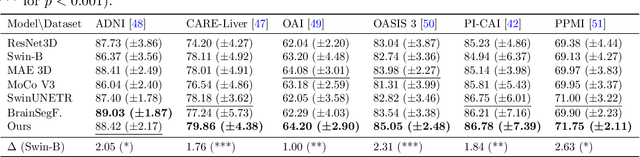
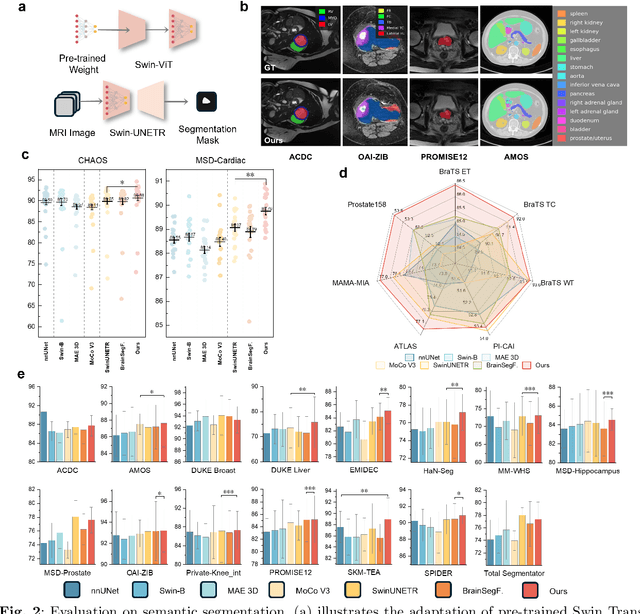
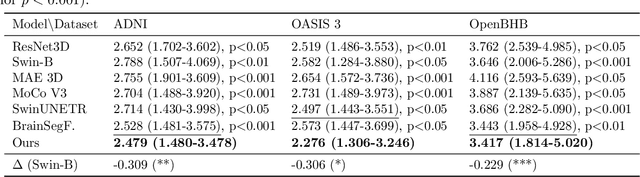
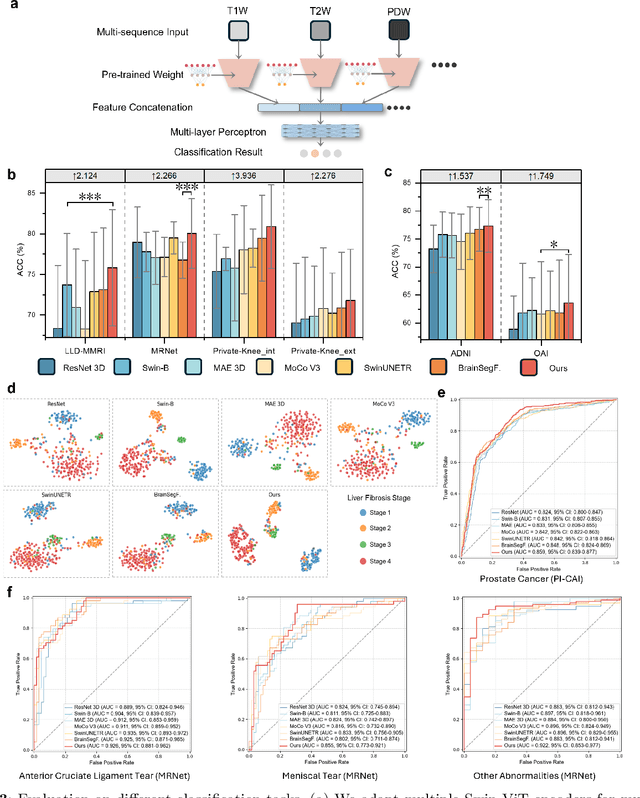
Multi-sequence Magnetic Resonance Imaging (MRI) offers remarkable versatility, enabling the distinct visualization of different tissue types. Nevertheless, the inherent heterogeneity among MRI sequences poses significant challenges to the generalization capability of deep learning models. These challenges undermine model performance when faced with varying acquisition parameters, thereby severely restricting their clinical utility. In this study, we present PRISM, a foundation model PRe-trained with large-scale multI-Sequence MRI. We collected a total of 64 datasets from both public and private sources, encompassing a wide range of whole-body anatomical structures, with scans spanning diverse MRI sequences. Among them, 336,476 volumetric MRI scans from 34 datasets (8 public and 26 private) were curated to construct the largest multi-organ multi-sequence MRI pretraining corpus to date. We propose a novel pretraining paradigm that disentangles anatomically invariant features from sequence-specific variations in MRI, while preserving high-level semantic representations. We established a benchmark comprising 44 downstream tasks, including disease diagnosis, image segmentation, registration, progression prediction, and report generation. These tasks were evaluated on 32 public datasets and 5 private cohorts. PRISM consistently outperformed both non-pretrained models and existing foundation models, achieving first-rank results in 39 out of 44 downstream benchmarks with statistical significance improvements. These results underscore its ability to learn robust and generalizable representations across unseen data acquired under diverse MRI protocols. PRISM provides a scalable framework for multi-sequence MRI analysis, thereby enhancing the translational potential of AI in radiology. It delivers consistent performance across diverse imaging protocols, reinforcing its clinical applicability.
You Don't Need Pre-built Graphs for RAG: Retrieval Augmented Generation with Adaptive Reasoning Structures
Aug 08, 2025Large language models (LLMs) often suffer from hallucination, generating factually incorrect statements when handling questions beyond their knowledge and perception. Retrieval-augmented generation (RAG) addresses this by retrieving query-relevant contexts from knowledge bases to support LLM reasoning. Recent advances leverage pre-constructed graphs to capture the relational connections among distributed documents, showing remarkable performance in complex tasks. However, existing Graph-based RAG (GraphRAG) methods rely on a costly process to transform the corpus into a graph, introducing overwhelming token cost and update latency. Moreover, real-world queries vary in type and complexity, requiring different logic structures for accurate reasoning. The pre-built graph may not align with these required structures, resulting in ineffective knowledge retrieval. To this end, we propose a \textbf{\underline{Logic}}-aware \textbf{\underline{R}}etrieval-\textbf{\underline{A}}ugmented \textbf{\underline{G}}eneration framework (\textbf{LogicRAG}) that dynamically extracts reasoning structures at inference time to guide adaptive retrieval without any pre-built graph. LogicRAG begins by decomposing the input query into a set of subproblems and constructing a directed acyclic graph (DAG) to model the logical dependencies among them. To support coherent multi-step reasoning, LogicRAG then linearizes the graph using topological sort, so that subproblems can be addressed in a logically consistent order. Besides, LogicRAG applies graph pruning to reduce redundant retrieval and uses context pruning to filter irrelevant context, significantly reducing the overall token cost. Extensive experiments demonstrate that LogicRAG achieves both superior performance and efficiency compared to state-of-the-art baselines.
Two-Way Garment Transfer: Unified Diffusion Framework for Dressing and Undressing Synthesis
Aug 06, 2025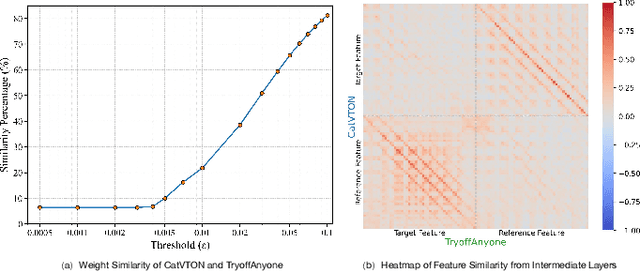
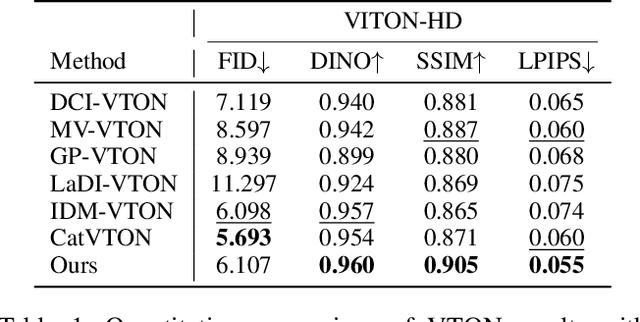
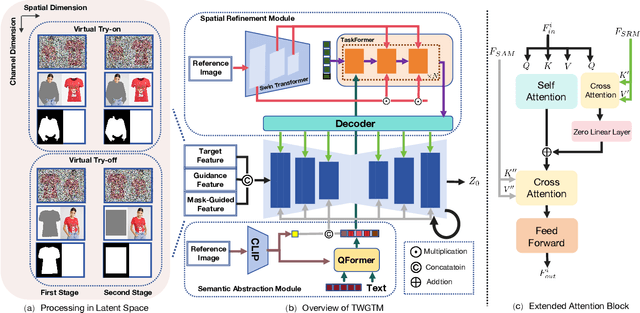

While recent advances in virtual try-on (VTON) have achieved realistic garment transfer to human subjects, its inverse task, virtual try-off (VTOFF), which aims to reconstruct canonical garment templates from dressed humans, remains critically underexplored and lacks systematic investigation. Existing works predominantly treat them as isolated tasks: VTON focuses on garment dressing while VTOFF addresses garment extraction, thereby neglecting their complementary symmetry. To bridge this fundamental gap, we propose the Two-Way Garment Transfer Model (TWGTM), to the best of our knowledge, the first unified framework for joint clothing-centric image synthesis that simultaneously resolves both mask-guided VTON and mask-free VTOFF through bidirectional feature disentanglement. Specifically, our framework employs dual-conditioned guidance from both latent and pixel spaces of reference images to seamlessly bridge the dual tasks. On the other hand, to resolve the inherent mask dependency asymmetry between mask-guided VTON and mask-free VTOFF, we devise a phased training paradigm that progressively bridges this modality gap. Extensive qualitative and quantitative experiments conducted across the DressCode and VITON-HD datasets validate the efficacy and competitive edge of our proposed approach.
MIHBench: Benchmarking and Mitigating Multi-Image Hallucinations in Multimodal Large Language Models
Aug 01, 2025Despite growing interest in hallucination in Multimodal Large Language Models, existing studies primarily focus on single-image settings, leaving hallucination in multi-image scenarios largely unexplored. To address this gap, we conduct the first systematic study of hallucinations in multi-image MLLMs and propose MIHBench, a benchmark specifically tailored for evaluating object-related hallucinations across multiple images. MIHBench comprises three core tasks: Multi-Image Object Existence Hallucination, Multi-Image Object Count Hallucination, and Object Identity Consistency Hallucination, targeting semantic understanding across object existence, quantity reasoning, and cross-view identity consistency. Through extensive evaluation, we identify key factors associated with the occurrence of multi-image hallucinations, including: a progressive relationship between the number of image inputs and the likelihood of hallucination occurrences; a strong correlation between single-image hallucination tendencies and those observed in multi-image contexts; and the influence of same-object image ratios and the positional placement of negative samples within image sequences on the occurrence of object identity consistency hallucination. To address these challenges, we propose a Dynamic Attention Balancing mechanism that adjusts inter-image attention distributions while preserving the overall visual attention proportion. Experiments across multiple state-of-the-art MLLMs demonstrate that our method effectively reduces hallucination occurrences and enhances semantic integration and reasoning stability in multi-image scenarios.
A Multi-Agent System for Information Extraction from the Chemical Literature
Jul 27, 2025To fully expedite AI-powered chemical research, high-quality chemical databases are the cornerstone. Automatic extraction of chemical information from the literature is essential for constructing reaction databases, but it is currently limited by the multimodality and style variability of chemical information. In this work, we developed a multimodal large language model (MLLM)-based multi-agent system for automatic chemical information extraction. We used the MLLM's strong reasoning capability to understand the structure of complex chemical graphics, decompose the extraction task into sub-tasks and coordinate a set of specialized agents to solve them. Our system achieved an F1 score of 80.8% on a benchmark dataset of complex chemical reaction graphics from the literature, surpassing the previous state-of-the-art model (F1 score: 35.6%) by a significant margin. Additionally, it demonstrated consistent improvements in key sub-tasks, including molecular image recognition, reaction image parsing, named entity recognition and text-based reaction extraction. This work is a critical step toward automated chemical information extraction into structured datasets, which will be a strong promoter of AI-driven chemical research.
A Versatile Pathology Co-pilot via Reasoning Enhanced Multimodal Large Language Model
Jul 23, 2025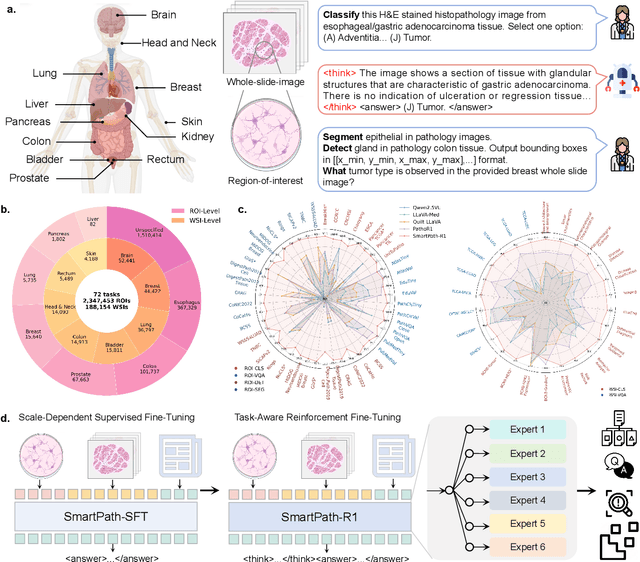
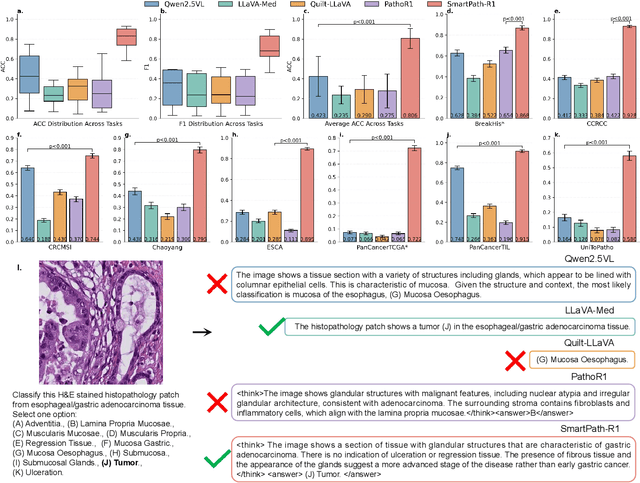
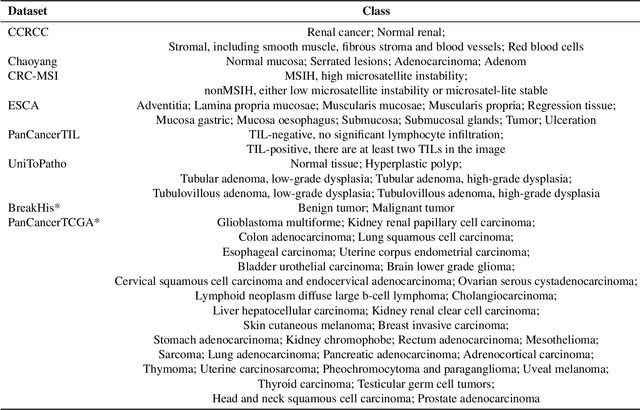
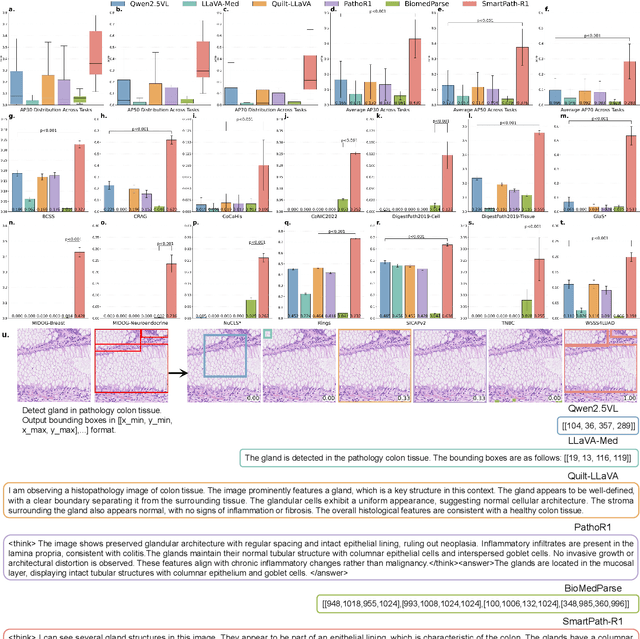
Multimodal large language models (MLLMs) have emerged as powerful tools for computational pathology, offering unprecedented opportunities to integrate pathological images with language context for comprehensive diagnostic analysis. These models hold particular promise for automating complex tasks that traditionally require expert interpretation of pathologists. However, current MLLM approaches in pathology demonstrate significantly constrained reasoning capabilities, primarily due to their reliance on expensive chain-of-thought annotations. Additionally, existing methods remain limited to simplex application of visual question answering (VQA) at region-of-interest (ROI) level, failing to address the full spectrum of diagnostic needs such as ROI classification, detection, segmentation, whole-slide-image (WSI) classification and VQA in clinical practice. In this study, we present SmartPath-R1, a versatile MLLM capable of simultaneously addressing both ROI-level and WSI-level tasks while demonstrating robust pathological reasoning capability. Our framework combines scale-dependent supervised fine-tuning and task-aware reinforcement fine-tuning, which circumvents the requirement for chain-of-thought supervision by leveraging the intrinsic knowledge within MLLM. Furthermore, SmartPath-R1 integrates multiscale and multitask analysis through a mixture-of-experts mechanism, enabling dynamic processing for diverse tasks. We curate a large-scale dataset comprising 2.3M ROI samples and 188K WSI samples for training and evaluation. Extensive experiments across 72 tasks validate the effectiveness and superiority of the proposed approach. This work represents a significant step toward developing versatile, reasoning-enhanced AI systems for precision pathology.