 Add to Chrome
 Add to Firefox
 Add to Edge
From Summary to Action: Enhancing Large Language Models for Complex Tasks with Open World APIs
Feb 28, 2024
The distinction between humans and animals lies in the unique ability of humans to use and create tools. Tools empower humans to overcome physiological limitations, fostering the creation of magnificent civilizations. Similarly, enabling foundational models like Large Language Models (LLMs) with the capacity to learn external tool usage may serve as a pivotal step toward realizing artificial general intelligence. Previous studies in this field have predominantly pursued two distinct approaches to augment the tool invocation capabilities of LLMs. The first approach emphasizes the construction of relevant datasets for model fine-tuning. The second approach, in contrast, aims to fully exploit the inherent reasoning abilities of LLMs through in-context learning strategies. In this work, we introduce a novel tool invocation pipeline designed to control massive real-world APIs. This pipeline mirrors the human task-solving process, addressing complicated real-life user queries. At each step, we guide LLMs to summarize the achieved results and determine the next course of action. We term this pipeline `from Summary to action', Sum2Act for short. Empirical evaluations of our Sum2Act pipeline on the ToolBench benchmark show significant performance improvements, outperforming established methods like ReAct and DFSDT. This highlights Sum2Act's effectiveness in enhancing LLMs for complex real-world tasks.

Optimal Parallelization Strategies for Active Flow Control in Deep Reinforcement Learning-Based Computational Fluid Dynamics
Feb 18, 2024Deep Reinforcement Learning (DRL) has emerged as a promising approach for handling highly dynamic and nonlinear Active Flow Control (AFC) problems. However, the computational cost associated with training DRL models presents a significant performance bottleneck. To address this challenge and enable efficient scaling on high-performance computing architectures, this study focuses on optimizing DRL-based algorithms in parallel settings. We validate an existing state-of-the-art DRL framework used for AFC problems and discuss its efficiency bottlenecks. Subsequently, by deconstructing the overall framework and conducting extensive scalability benchmarks for individual components, we investigate various hybrid parallelization configurations and propose efficient parallelization strategies. Moreover, we refine input/output (I/O) operations in multi-environment DRL training to tackle critical overhead associated with data movement. Finally, we demonstrate the optimized framework for a typical AFC problem where near-linear scaling can be obtained for the overall framework. We achieve a significant boost in parallel efficiency from around 49% to approximately 78%, and the training process is accelerated by approximately 47 times using 60 CPU cores. These findings are expected to provide valuable insights for further advancements in DRL-based AFC studies.
Translating Images to Road Network:A Non-Autoregressive Sequence-to-Sequence Approach
Feb 13, 2024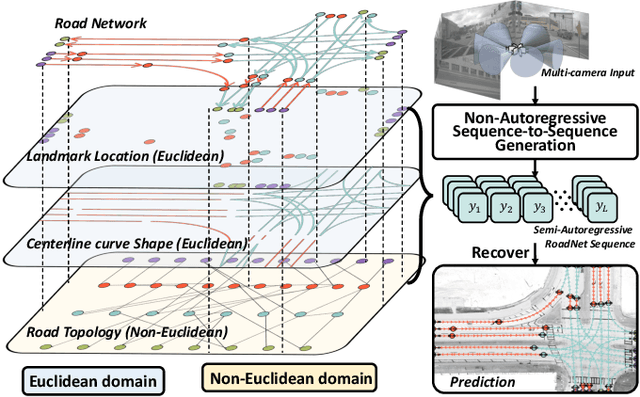
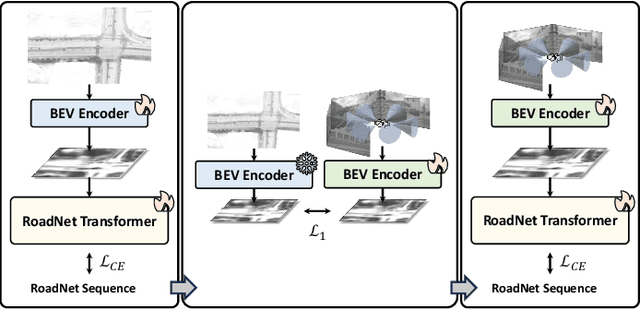
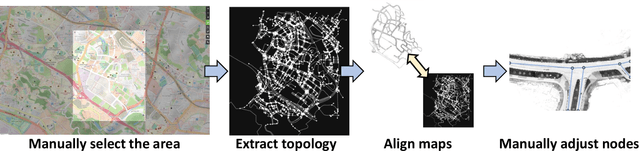
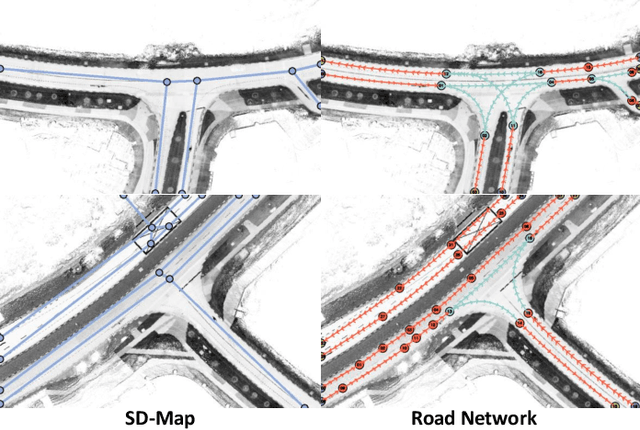
The extraction of road network is essential for the generation of high-definition maps since it enables the precise localization of road landmarks and their interconnections. However, generating road network poses a significant challenge due to the conflicting underlying combination of Euclidean (e.g., road landmarks location) and non-Euclidean (e.g., road topological connectivity) structures. Existing methods struggle to merge the two types of data domains effectively, but few of them address it properly. Instead, our work establishes a unified representation of both types of data domain by projecting both Euclidean and non-Euclidean data into an integer series called RoadNet Sequence. Further than modeling an auto-regressive sequence-to-sequence Transformer model to understand RoadNet Sequence, we decouple the dependency of RoadNet Sequence into a mixture of auto-regressive and non-autoregressive dependency. Building on this, our proposed non-autoregressive sequence-to-sequence approach leverages non-autoregressive dependencies while fixing the gap towards auto-regressive dependencies, resulting in success on both efficiency and accuracy. Extensive experiments on nuScenes dataset demonstrate the superiority of RoadNet Sequence representation and the non-autoregressive approach compared to existing state-of-the-art alternatives. The code is open-source on https://github.com/fudan-zvg/RoadNetworkTRansformer.
GS-CLIP: Gaussian Splatting for Contrastive Language-Image-3D Pretraining from Real-World Data
Feb 13, 2024


3D Shape represented as point cloud has achieve advancements in multimodal pre-training to align image and language descriptions, which is curial to object identification, classification, and retrieval. However, the discrete representations of point cloud lost the object's surface shape information and creates a gap between rendering results and 2D correspondences. To address this problem, we propose GS-CLIP for the first attempt to introduce 3DGS (3D Gaussian Splatting) into multimodal pre-training to enhance 3D representation. GS-CLIP leverages a pre-trained vision-language model for a learned common visual and textual space on massive real world image-text pairs and then learns a 3D Encoder for aligning 3DGS optimized per object. Additionally, a novel Gaussian-Aware Fusion is proposed to extract and fuse global explicit feature. As a general framework for language-image-3D pre-training, GS-CLIP is agnostic to 3D backbone networks. Experiments on challenging shows that GS-CLIP significantly improves the state-of-the-art, outperforming the previously best results.
Task-customized Masked AutoEncoder via Mixture of Cluster-conditional Experts
Feb 08, 2024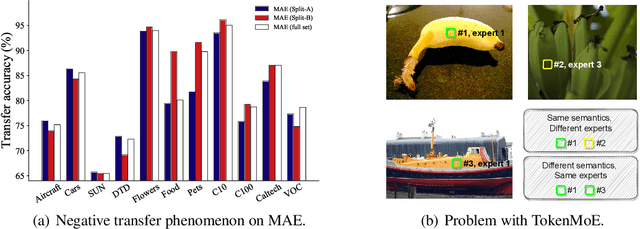
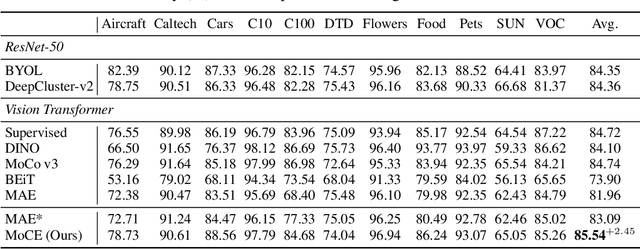
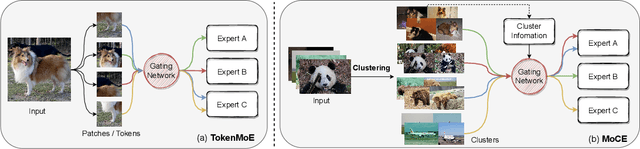
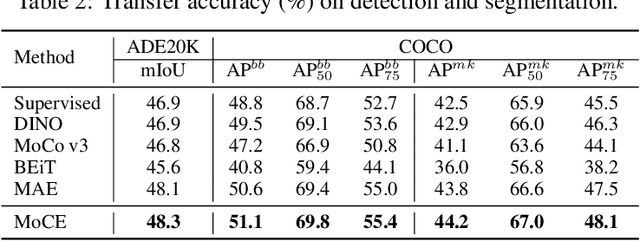
Masked Autoencoder~(MAE) is a prevailing self-supervised learning method that achieves promising results in model pre-training. However, when the various downstream tasks have data distributions different from the pre-training data, the semantically irrelevant pre-training information might result in negative transfer, impeding MAE's scalability. To address this issue, we propose a novel MAE-based pre-training paradigm, Mixture of Cluster-conditional Experts (MoCE), which can be trained once but provides customized pre-training models for diverse downstream tasks. Different from the mixture of experts (MoE), our MoCE trains each expert only with semantically relevant images by using cluster-conditional gates. Thus, each downstream task can be allocated to its customized model pre-trained with data most similar to the downstream data. Experiments on a collection of 11 downstream tasks show that MoCE outperforms the vanilla MAE by 2.45\% on average. It also obtains new state-of-the-art self-supervised learning results on detection and segmentation.
LaneGraph2Seq: Lane Topology Extraction with Language Model via Vertex-Edge Encoding and Connectivity Enhancement
Jan 31, 2024Understanding road structures is crucial for autonomous driving. Intricate road structures are often depicted using lane graphs, which include centerline curves and connections forming a Directed Acyclic Graph (DAG). Accurate extraction of lane graphs relies on precisely estimating vertex and edge information within the DAG. Recent research highlights Transformer-based language models' impressive sequence prediction abilities, making them effective for learning graph representations when graph data are encoded as sequences. However, existing studies focus mainly on modeling vertices explicitly, leaving edge information simply embedded in the network. Consequently, these approaches fall short in the task of lane graph extraction. To address this, we introduce LaneGraph2Seq, a novel approach for lane graph extraction. It leverages a language model with vertex-edge encoding and connectivity enhancement. Our serialization strategy includes a vertex-centric depth-first traversal and a concise edge-based partition sequence. Additionally, we use classifier-free guidance combined with nucleus sampling to improve lane connectivity. We validate our method on prominent datasets, nuScenes and Argoverse 2, showcasing consistent and compelling results. Our LaneGraph2Seq approach demonstrates superior performance compared to state-of-the-art techniques in lane graph extraction.
Holistic Autonomous Driving Understanding by Bird's-Eye-View Injected Multi-Modal Large Models
Jan 02, 2024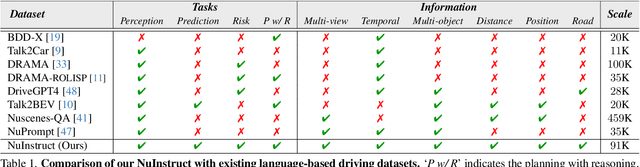
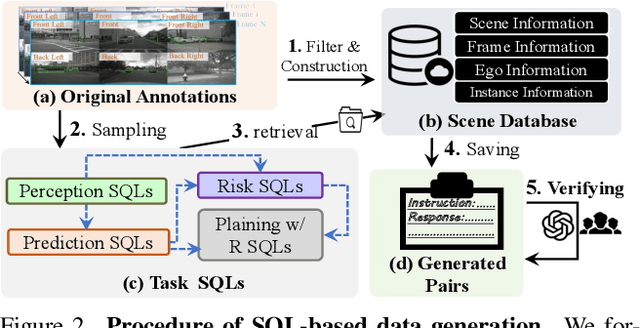
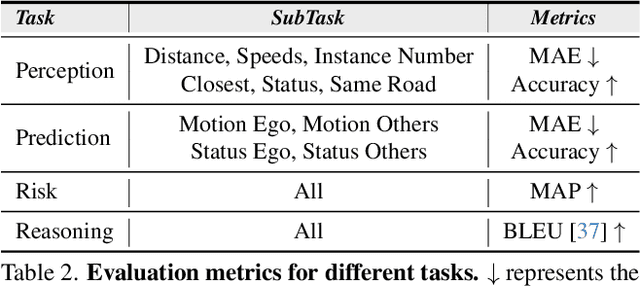
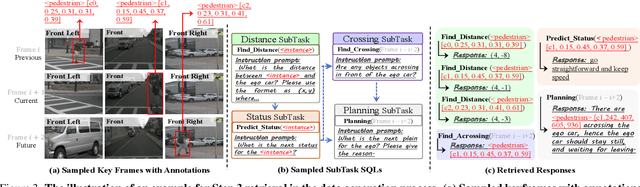
The rise of multimodal large language models (MLLMs) has spurred interest in language-based driving tasks. However, existing research typically focuses on limited tasks and often omits key multi-view and temporal information which is crucial for robust autonomous driving. To bridge these gaps, we introduce NuInstruct, a novel dataset with 91K multi-view video-QA pairs across 17 subtasks, where each task demands holistic information (e.g., temporal, multi-view, and spatial), significantly elevating the challenge level. To obtain NuInstruct, we propose a novel SQL-based method to generate instruction-response pairs automatically, which is inspired by the driving logical progression of humans. We further present BEV-InMLLM, an end-to-end method for efficiently deriving instruction-aware Bird's-Eye-View (BEV) features, language-aligned for large language models. BEV-InMLLM integrates multi-view, spatial awareness, and temporal semantics to enhance MLLMs' capabilities on NuInstruct tasks. Moreover, our proposed BEV injection module is a plug-and-play method for existing MLLMs. Our experiments on NuInstruct demonstrate that BEV-InMLLM significantly outperforms existing MLLMs, e.g. around 9% improvement on various tasks. We plan to release our NuInstruct for future research development.
PanGu-Draw: Advancing Resource-Efficient Text-to-Image Synthesis with Time-Decoupled Training and Reusable Coop-Diffusion
Dec 29, 2023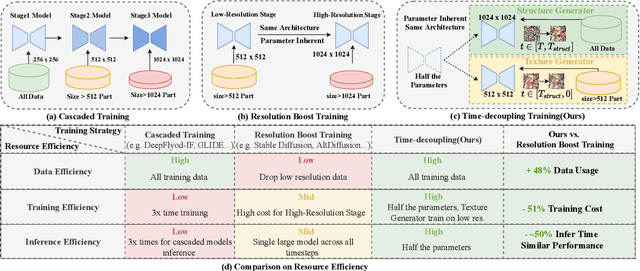
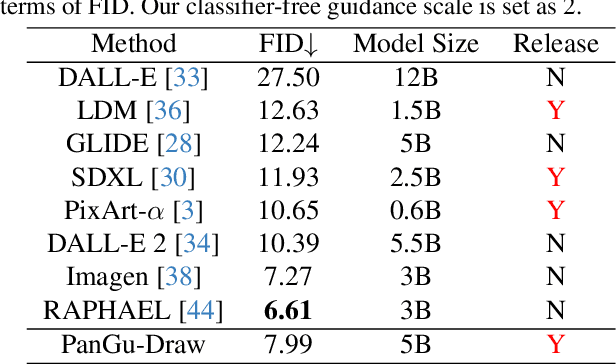
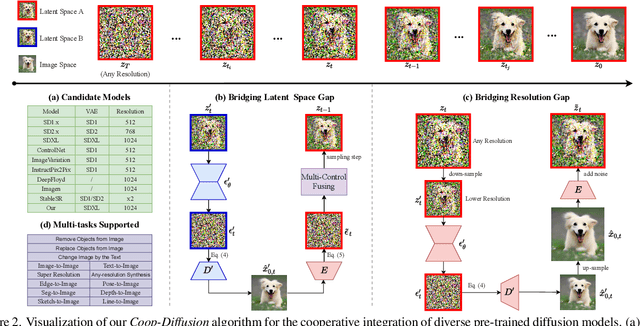
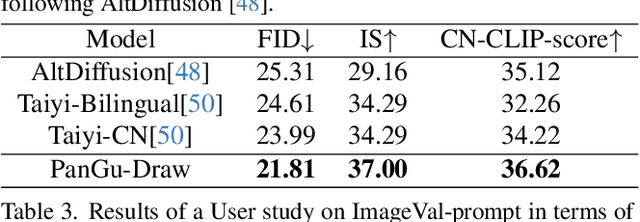
Current large-scale diffusion models represent a giant leap forward in conditional image synthesis, capable of interpreting diverse cues like text, human poses, and edges. However, their reliance on substantial computational resources and extensive data collection remains a bottleneck. On the other hand, the integration of existing diffusion models, each specialized for different controls and operating in unique latent spaces, poses a challenge due to incompatible image resolutions and latent space embedding structures, hindering their joint use. Addressing these constraints, we present "PanGu-Draw", a novel latent diffusion model designed for resource-efficient text-to-image synthesis that adeptly accommodates multiple control signals. We first propose a resource-efficient Time-Decoupling Training Strategy, which splits the monolithic text-to-image model into structure and texture generators. Each generator is trained using a regimen that maximizes data utilization and computational efficiency, cutting data preparation by 48% and reducing training resources by 51%. Secondly, we introduce "Coop-Diffusion", an algorithm that enables the cooperative use of various pre-trained diffusion models with different latent spaces and predefined resolutions within a unified denoising process. This allows for multi-control image synthesis at arbitrary resolutions without the necessity for additional data or retraining. Empirical validations of Pangu-Draw show its exceptional prowess in text-to-image and multi-control image generation, suggesting a promising direction for future model training efficiencies and generation versatility. The largest 5B T2I PanGu-Draw model is released on the Ascend platform. Project page: $\href{https://pangu-draw.github.io}{this~https~URL}$
Rotational Augmented Noise2Inverse for Low-dose Computed Tomography Reconstruction
Dec 19, 2023In this work, we present a novel self-supervised method for Low Dose Computed Tomography (LDCT) reconstruction. Reducing the radiation dose to patients during a CT scan is a crucial challenge since the quality of the reconstruction highly degrades because of low photons or limited measurements. Supervised deep learning methods have shown the ability to remove noise in images but require accurate ground truth which can be obtained only by performing additional high-radiation CT scans. Therefore, we propose a novel self-supervised framework for LDCT, in which ground truth is not required for training the convolutional neural network (CNN). Based on the Noise2Inverse (N2I) method, we enforce in the training loss the equivariant property of rotation transformation, which is induced by the CT imaging system, to improve the quality of the CT image in a lower dose. Numerical and experimental results show that the reconstruction accuracy of N2I with sparse views is degrading while the proposed rotational augmented Noise2Inverse (RAN2I) method keeps better image quality over a different range of sampling angles. Finally, the quantitative results demonstrate that RAN2I achieves higher image quality compared to N2I, and experimental results of RAN2I on real projection data show comparable performance to supervised learning.
Mixture of Cluster-conditional LoRA Experts for Vision-language Instruction Tuning
Dec 19, 2023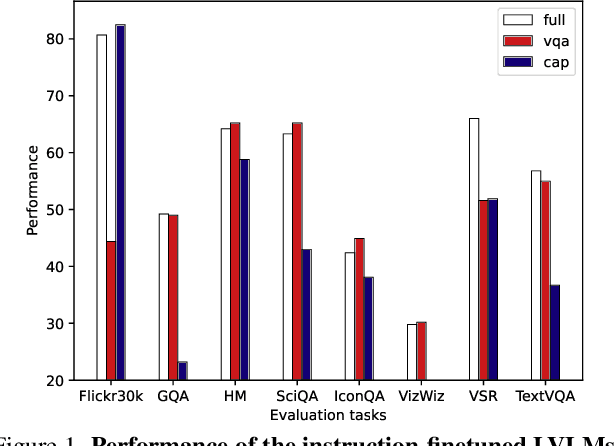
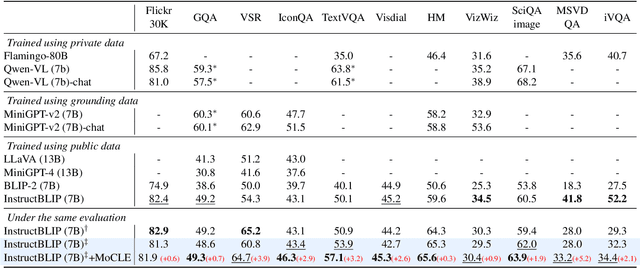

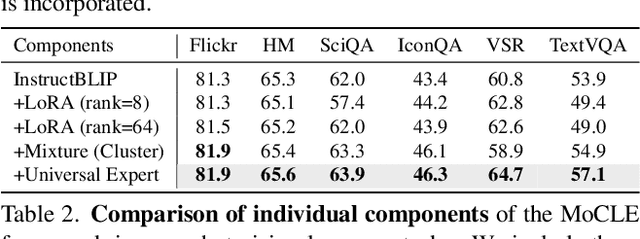
Instruction tuning of the Large Vision-language Models (LVLMs) has revolutionized the development of versatile models with zero-shot generalization across a wide range of downstream vision-language tasks. However, diversity of training tasks of different sources and formats would lead to inevitable task conflicts, where different tasks conflicts for the same set of model parameters, resulting in sub-optimal instruction-following abilities. To address that, we propose the Mixture of Cluster-conditional LoRA Experts (MoCLE), a novel Mixture of Experts (MoE) architecture designed to activate the task-customized model parameters based on the instruction clusters. A separate universal expert is further incorporated to improve the generalization capabilities of MoCLE for novel instructions. Extensive experiments on 10 zero-shot tasks demonstrate the effectiveness of MoCLE.