 Add to Chrome
 Add to Firefox
 Add to Edge
Progress Reward Modeling for Robotic Learning: A Comprehensive Survey
Jul 22, 2026
Robotic learning takes place in dynamic environments with large behavior spaces. A terminal success signal only tells the robot whether the task is completed. It does not explain whether the current behavior is making progress, remaining unchanged, or undoing earlier progress. For this reason, recent studies have increasingly explored progress rewards that provide feedback during task execution. However, the current literature lacks a shared framework. Existing methods use different observations, goal specifications, output signals, supervision sources, and evaluation protocols. This makes it difficult to compare them and understand what their results actually validate. In this survey, we provide a unified view of progress reward modeling for robotic learning. We organize the field in three connected steps. We first study the interface of a progress model. This defines the problem from the outside by asking what information the model receives and what form of progress signal it produces. We then move inside the model and study the methods used to construct this signal. This reveals the different assumptions and mechanisms behind progress estimation and reward generation. Finally, we examine the data and benchmarks that support these methods. This shows how progress supervision is obtained and what different evaluations actually measure. Together, these three perspectives connect what a progress model is, how it is built, and how its quality is validated. We further summarize the main limitations of current approaches and discuss future research directions.

AnnotateAnything: Automatic Annotation of 3D Assets for Robot Manipulation
Jun 16, 2026Simulation enables scalable robot data collection, but raw 3D assets provide only geometry, lacking the semantic, interactive, and physical knowledge needed to specify where and how robots should act. In this work, we present AnnotateAnything, a general automatic annotation framework that converts passive 3D assets into manipulation-ready assets with structured, diverse, and executable manipulation labels. AnnotateAnything is built around two complementary pipelines. First, a unified visual-language annotation pipeline using vision-language reasoning to infer object semantics, interaction constraints, and 3D-grounded cues, providing human-prior guidance for identifying meaningful interaction regions. Second, a fully automatic and massively parallel physics annotation pipeline grounds these priors in each asset's geometry and physical constraints through candidate generation, geometry optimization and trajectory generation. This pipeline produces diverse and executable action annotations, including grasp poses, dexterous contacts, articulation waypoints, insertion directions, hanging affordances, and navigation targets. Using the generated annotations, we further build an asynchronous parallel simulation data-collection system across diverse objects, tasks, and robot embodiments. Experiments demonstrate that AnnotateAnything achieves superior annotation efficiency, data-collection efficiency, and task success rates over existing annotation and data-generation pipelines, while also supporting downstream tasks such as affordance detection, robotic VQA, and visual instruction finetuning. We provide project materials on the project page and plan to release the full code, annotations, and benchmark to facilitate future research. Videos, code, demo assets, and annotations are provided in supplementary materials Project page: https://tourmaline-caramel-169490.netlify.app.
MagicSim: A Unified Infrastructure for Executable Embodied Interaction
Jun 16, 2026Robot learning and embodied agents now require simulation to serve as a shared execution substrate linking control, skills, and planning, not only as a renderer, controller testbed, or fixed task environment. Existing pipelines split these layers with "magic" actions, disconnected training environments, or forward-only renders that cannot reproduce, evaluate, and annotate the same episode. We present MagicSim, an embodied interaction infrastructure built around one deterministic batched runtime and a shared Markov decision process (MDP). From YAML-first specifications that decouple contents, placement, behavior, and agent exposure, MagicSim constructs diverse executable worlds spanning task families, interaction regimes, physics, layouts, sensors, avatars, and robot embodiments in one reset-and-step loop. A common execution interface grounds high-level commands through controllers, atomicskills, planner primitives, and asynchronous planning, realizing them as robot actions rather than simulator-side state edits. One task definition supports three capabilities: benchmark and RL evaluation, an autocollect interface that automatically turns commands into grounded trajectories, and agent/VLM-facing interaction. For automatic execution, commands flow through a Command->Skill->Planner->Robot->Record pipeline, while per-environment command, skill, planning, retry, annotation, and episode states advance independently above the shared physics tick. Successful rollouts are saved as structured multimodal trajectories aligning language supervision, action representations, visual/geometric representations, and task-level status with the executed episode. MagicSim thus unifies diverse world construction, embodied execution, task evaluation, automatic rollout generation, and interactive agent interfaces in one planner-in-the-loop runtime.
Phys4D: Fine-Grained Physics-Consistent 4D Modeling from Video Diffusion
Mar 03, 2026Recent video diffusion models have achieved impressive capabilities as large-scale generative world models. However, these models often struggle with fine-grained physical consistency, exhibiting physically implausible dynamics over time. In this work, we present \textbf{Phys4D}, a pipeline for learning physics-consistent 4D world representations from video diffusion models. Phys4D adopts \textbf{a three-stage training paradigm} that progressively lifts appearance-driven video diffusion models into physics-consistent 4D world representations. We first bootstrap robust geometry and motion representations through large-scale pseudo-supervised pretraining, establishing a foundation for 4D scene modeling. We then perform physics-grounded supervised fine-tuning using simulation-generated data, enforcing temporally consistent 4D dynamics. Finally, we apply simulation-grounded reinforcement learning to correct residual physical violations that are difficult to capture through explicit supervision. To evaluate fine-grained physical consistency beyond appearance-based metrics, we introduce a set of \textbf{4D world consistency evaluation} that probe geometric coherence, motion stability, and long-horizon physical plausibility. Experimental results demonstrate that Phys4D substantially improves fine-grained spatiotemporal and physical consistency compared to appearance-driven baselines, while maintaining strong generative performance. Our project page is available at https://sensational-brioche-7657e7.netlify.app/
Learning Structure-Semantic Evolution Trajectories for Graph Domain Adaptation
Feb 11, 2026Graph Domain Adaptation (GDA) aims to bridge distribution shifts between domains by transferring knowledge from well-labeled source graphs to given unlabeled target graphs. One promising recent approach addresses graph transfer by discretizing the adaptation process, typically through the construction of intermediate graphs or stepwise alignment procedures. However, such discrete strategies often fail in real-world scenarios, where graph structures evolve continuously and nonlinearly, making it difficult for fixed-step alignment to approximate the actual transformation process. To address these limitations, we propose \textbf{DiffGDA}, a \textbf{Diff}usion-based \textbf{GDA} method that models the domain adaptation process as a continuous-time generative process. We formulate the evolution from source to target graphs using stochastic differential equations (SDEs), enabling the joint modeling of structural and semantic transitions. To guide this evolution, a domain-aware network is introduced to steer the generative process toward the target domain, encouraging the diffusion trajectory to follow an optimal adaptation path. We theoretically show that the diffusion process converges to the optimal solution bridging the source and target domains in the latent space. Extensive experiments on 14 graph transfer tasks across 8 real-world datasets demonstrate DiffGDA consistently outperforms state-of-the-art baselines.
Learning to Feel the Future: DreamTacVLA for Contact-Rich Manipulation
Dec 29, 2025Vision-Language-Action (VLA) models have shown remarkable generalization by mapping web-scale knowledge to robotic control, yet they remain blind to physical contact. Consequently, they struggle with contact-rich manipulation tasks that require reasoning about force, texture, and slip. While some approaches incorporate low-dimensional tactile signals, they fail to capture the high-resolution dynamics essential for such interactions. To address this limitation, we introduce DreamTacVLA, a framework that grounds VLA models in contact physics by learning to feel the future. Our model adopts a hierarchical perception scheme in which high-resolution tactile images serve as micro-vision inputs coupled with wrist-camera local vision and third-person macro vision. To reconcile these multi-scale sensory streams, we first train a unified policy with a Hierarchical Spatial Alignment (HSA) loss that aligns tactile tokens with their spatial counterparts in the wrist and third-person views. To further deepen the model's understanding of fine-grained contact dynamics, we finetune the system with a tactile world model that predicts future tactile signals. To mitigate tactile data scarcity and the wear-prone nature of tactile sensors, we construct a hybrid large-scale dataset sourced from both high-fidelity digital twin and real-world experiments. By anticipating upcoming tactile states, DreamTacVLA acquires a rich model of contact physics and conditions its actions on both real observations and imagined consequences. Across contact-rich manipulation tasks, it outperforms state-of-the-art VLA baselines, achieving up to 95% success, highlighting the importance of understanding physical contact for robust, touch-aware robotic agents.
Fast and Low-Cost Genomic Foundation Models via Outlier Removal
May 01, 2025We propose the first unified adversarial attack benchmark for Genomic Foundation Models (GFMs), named GERM. Unlike existing GFM benchmarks, GERM offers the first comprehensive evaluation framework to systematically assess the vulnerability of GFMs to adversarial attacks. Methodologically, we evaluate the adversarial robustness of five state-of-the-art GFMs using four widely adopted attack algorithms and three defense strategies. Importantly, our benchmark provides an accessible and comprehensive framework to analyze GFM vulnerabilities with respect to model architecture, quantization schemes, and training datasets. Empirically, transformer-based models exhibit greater robustness to adversarial perturbations compared to HyenaDNA, highlighting the impact of architectural design on vulnerability. Moreover, adversarial attacks frequently target biologically significant genomic regions, suggesting that these models effectively capture meaningful sequence features.
Smoothness Really Matters: A Simple yet Effective Approach for Unsupervised Graph Domain Adaptation
Dec 16, 2024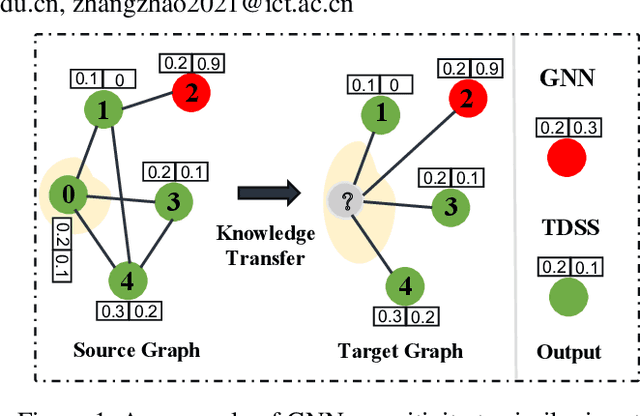
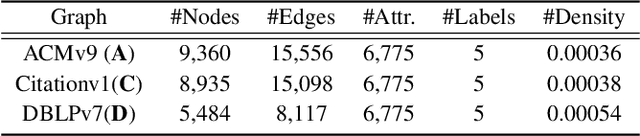
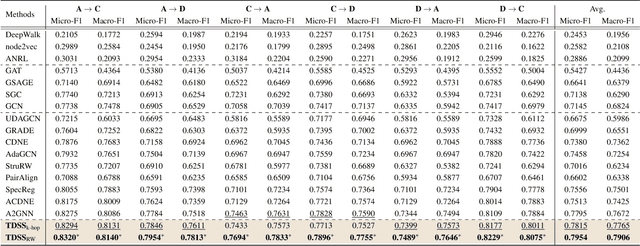
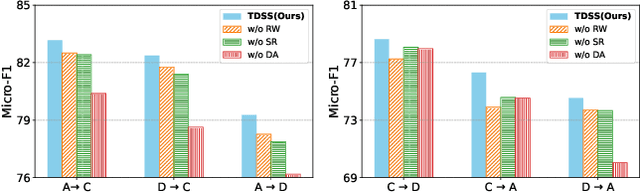
Unsupervised Graph Domain Adaptation (UGDA) seeks to bridge distribution shifts between domains by transferring knowledge from labeled source graphs to given unlabeled target graphs. Existing UGDA methods primarily focus on aligning features in the latent space learned by graph neural networks (GNNs) across domains, often overlooking structural shifts, resulting in limited effectiveness when addressing structurally complex transfer scenarios. Given the sensitivity of GNNs to local structural features, even slight discrepancies between source and target graphs could lead to significant shifts in node embeddings, thereby reducing the effectiveness of knowledge transfer. To address this issue, we introduce a novel approach for UGDA called Target-Domain Structural Smoothing (TDSS). TDSS is a simple and effective method designed to perform structural smoothing directly on the target graph, thereby mitigating structural distribution shifts and ensuring the consistency of node representations. Specifically, by integrating smoothing techniques with neighborhood sampling, TDSS maintains the structural coherence of the target graph while mitigating the risk of over-smoothing. Our theoretical analysis shows that TDSS effectively reduces target risk by improving model smoothness. Empirical results on three real-world datasets demonstrate that TDSS outperforms recent state-of-the-art baselines, achieving significant improvements across six transfer scenarios. The code is available in https://github.com/cwei01/TDSS.
POA: Pre-training Once for Models of All Sizes
Aug 02, 2024
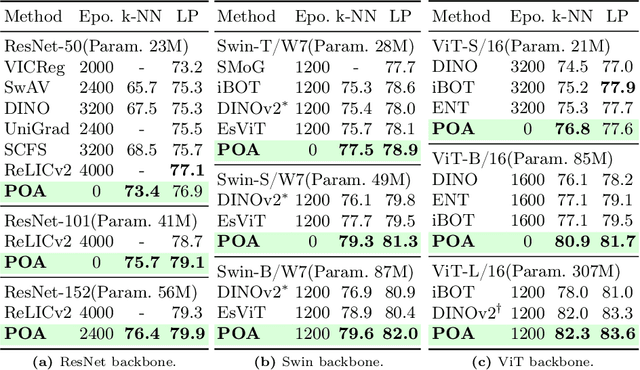
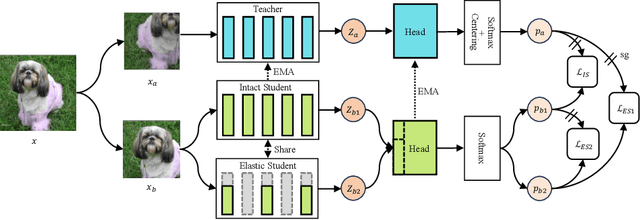
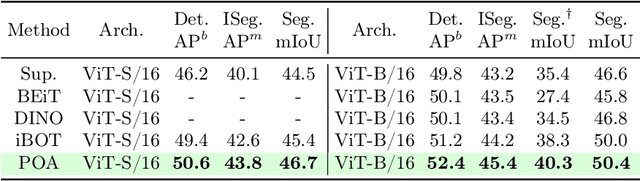
Large-scale self-supervised pre-training has paved the way for one foundation model to handle many different vision tasks. Most pre-training methodologies train a single model of a certain size at one time. Nevertheless, various computation or storage constraints in real-world scenarios require substantial efforts to develop a series of models with different sizes to deploy. Thus, in this study, we propose a novel tri-branch self-supervised training framework, termed as POA (Pre-training Once for All), to tackle this aforementioned issue. Our approach introduces an innovative elastic student branch into a modern self-distillation paradigm. At each pre-training step, we randomly sample a sub-network from the original student to form the elastic student and train all branches in a self-distilling fashion. Once pre-trained, POA allows the extraction of pre-trained models of diverse sizes for downstream tasks. Remarkably, the elastic student facilitates the simultaneous pre-training of multiple models with different sizes, which also acts as an additional ensemble of models of various sizes to enhance representation learning. Extensive experiments, including k-nearest neighbors, linear probing evaluation and assessments on multiple downstream tasks demonstrate the effectiveness and advantages of our POA. It achieves state-of-the-art performance using ViT, Swin Transformer and ResNet backbones, producing around a hundred models with different sizes through a single pre-training session. The code is available at: https://github.com/Qichuzyy/POA.
Not All Negatives Are Worth Attending to: Meta-Bootstrapping Negative Sampling Framework for Link Prediction
Dec 12, 2023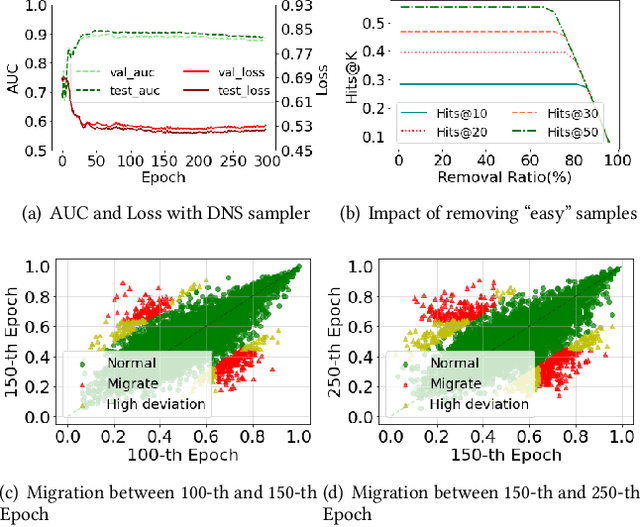
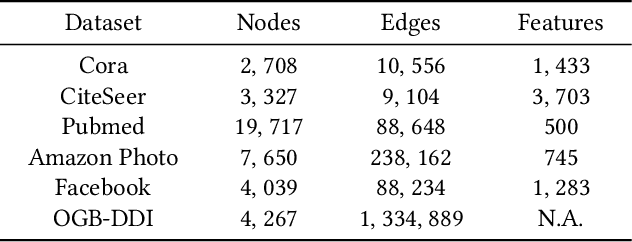
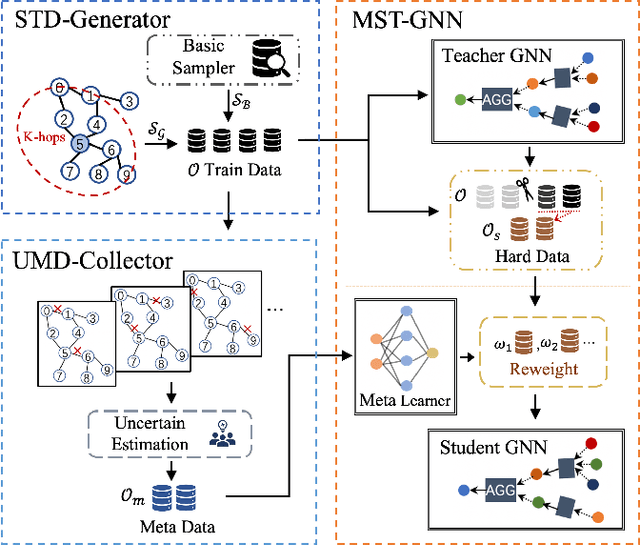
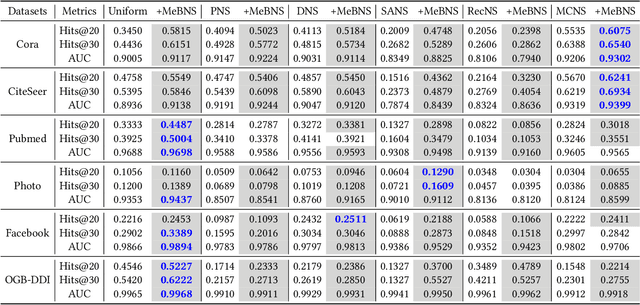
The rapid development of graph neural networks (GNNs) encourages the rising of link prediction, achieving promising performance with various applications. Unfortunately, through a comprehensive analysis, we surprisingly find that current link predictors with dynamic negative samplers (DNSs) suffer from the migration phenomenon between "easy" and "hard" samples, which goes against the preference of DNS of choosing "hard" negatives, thus severely hindering capability. Towards this end, we propose the MeBNS framework, serving as a general plugin that can potentially improve current negative sampling based link predictors. In particular, we elaborately devise a Meta-learning Supported Teacher-student GNN (MST-GNN) that is not only built upon teacher-student architecture for alleviating the migration between "easy" and "hard" samples but also equipped with a meta learning based sample re-weighting module for helping the student GNN distinguish "hard" samples in a fine-grained manner. To effectively guide the learning of MST-GNN, we prepare a Structure enhanced Training Data Generator (STD-Generator) and an Uncertainty based Meta Data Collector (UMD-Collector) for supporting the teacher and student GNN, respectively. Extensive experiments show that the MeBNS achieves remarkable performance across six link prediction benchmark datasets.